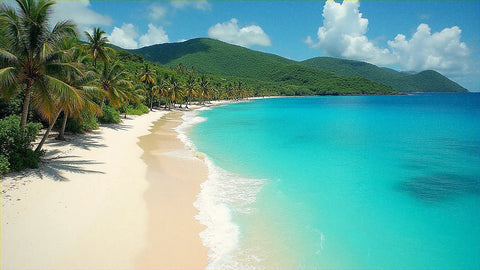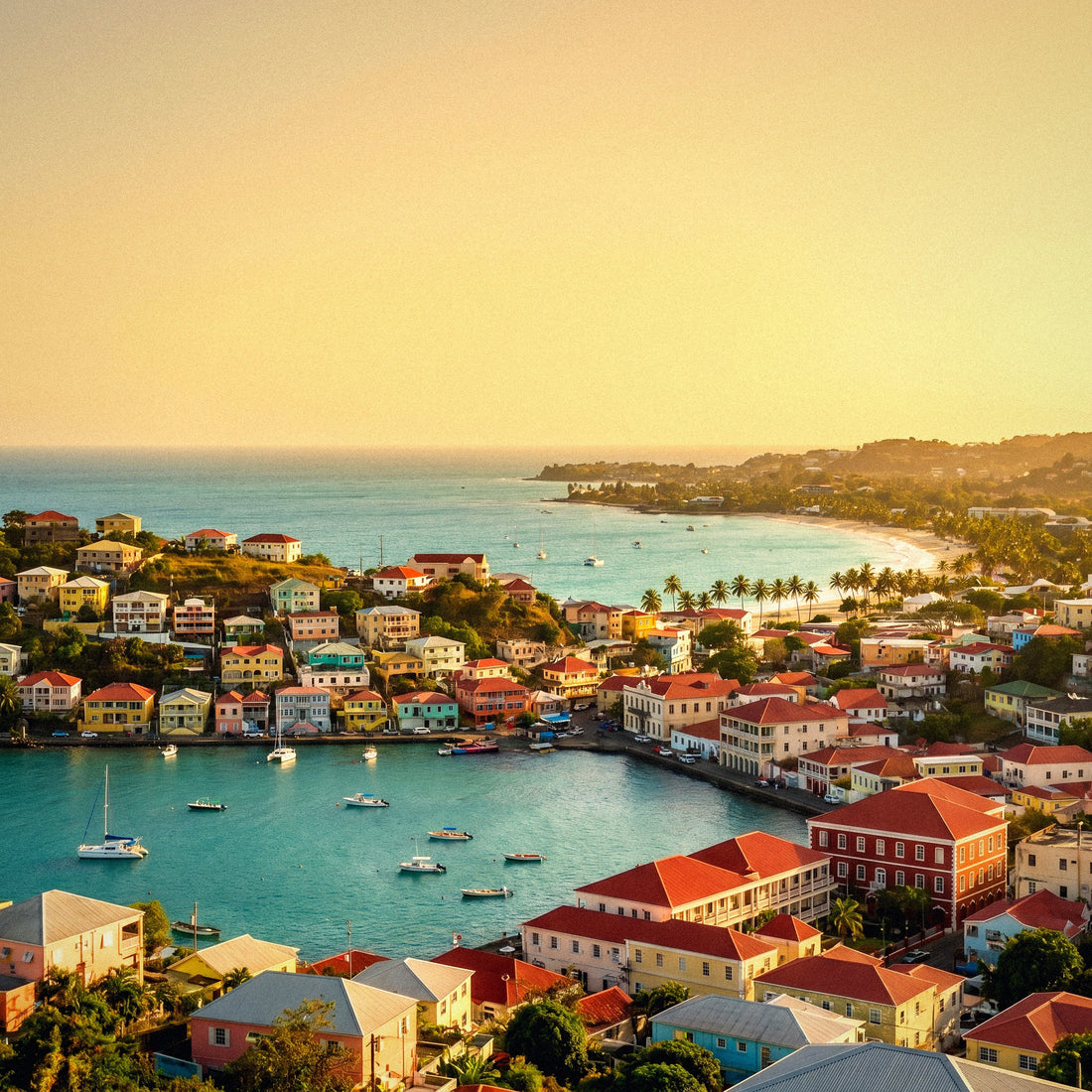
A heads-up before anything else, because everyone gets confused: this guide to internet in Grenada is about Grenada the island, the Caribbean country (in Spanish, Granada), with its capital in Saint George's, not the city of the Alhambra. If you were looking for coverage for a weekend in Andalusia, this is not your article. If, however, you're going to the Spice Island, to dive in Molinere and relax on Grand Anse, keep reading: I'll tell you how much it costs to get connected there, what operators are available, and what I would do.
Grenada the island, not Granada the city: let's clarify this now
In Grenada, the Caribbean island (not the Andalusian city), you have four options: Spanish roaming, which is very expensive here because the country is outside the EU; hotel Wi-Fi; a local Flow or Digicel SIM; or an eSIM activated before you fly. For one or two weeks, the eSIM wins.
The name confusion is constant. In Spanish, we call both the Andalusian city and the Caribbean country Granada, while in English the country is spelled Grenada and the city, Granada. That's why when you search for flights, insurance, or data cards, you end up finding mixed results from Andalusia and the Caribbean. If your ticket says GND (Maurice Bishop International Airport, in Point Salines) you are in the right place.
The country I am talking about is a sovereign state in the Lesser Antilles, a member of the Commonwealth of Nations, with King Charles III as head of state and English as the official language. It consists of the main island, Carriacou, and Petite Martinique. It is known as the Spice Island because it thrives on nutmeg and mace (the red membrane covering the nutmeg): it is the second largest producer in the world after Indonesia, and that nutmeg even appears on the national flag.
Why does this matter for connectivity? Because it changes everything. Granada city is in the European Union and your Spanish plan works just like at home. Grenada the country is more than 6,000 kilometers away, outside the EU, with its own operators and data prices that are completely different. If you mix the two, you'll get a shock on your bill. Now that's clear, let's get practical.
Real mobile coverage in Grenada: Flow and Digicel
On the island, there are only two companies: Flow (from the Cable & Wireless / Liberty Latin America group) and Digicel. No more. Both cover the populated coastal belt well, which is where you'll spend 95% of your trip: Saint George's, Grand Anse, Morne Rouge, Lance aux Épines, the airport, True Blue, Gouyave, Grenville, and Sauteurs.
The difference between them is in 4G. Generally, Digicel has better LTE coverage and faster data on the island, while Flow has weaker 4G but very widespread 3G, useful precisely in the corners where the other drops out. For a short trip, either one will do; if you're staying on the east coast or moving inland, Digicel usually performs better.
What you will not find is 5G. Grenada has not deployed a commercial 5G network, so forget about fiber-optic speeds over the air. With a good 4G signal, the experience is perfectly normal: maps, WhatsApp, Instagram, video calls to Spain without drama. With 3G, browsing works but uploading videos is slow.
Another honest detail: the island is mountainous and volcanic, with a jungle interior of enclosed ravines. There, the signal disappears at times, and it's not your phone's fault. The same happens in some northern coves and on boat trips between islands. Download offline maps before leaving the hotel and you'll save yourself the headache of losing GPS halfway down a dirt road.

Roaming with your Spanish operator: outside the EU
Here comes the important warning. Grenada does not belong to the European Union or the European Economic Area, and is not an outermost region like Guadeloupe or Martinique, which are right next door. It is an independent country of the British Commonwealth. Translation: the famous "Roam Like at Home", which allows you to use your gigabytes in France or Italy without paying extra, does not apply here.
This means that your Spanish plan falls into the most expensive category, "rest of the world" or "zone 3/4" depending on the operator. Without a contracted bundle, individual megabytes are billed at prices around several euros per megabyte, and it only takes for your phone to sync photos and email for a while to end up with a three-figure bill. With a daily world bundle, it's normal to pay between €6 and €15 per day for a very limited amount of data, sometimes 100 or 200 MB.
Golden rule for the Caribbean: if your operator does not confirm in writing that Grenada is included in your flat rate, assume it is not and disable data roaming before landing.
I'll explain it with numbers in how much international roaming costs, and if you want a direct comparison, you have it in eSIM vs roaming. My practical advice: activate airplane mode when you take off and don't turn it off until you have another data solution configured. Ten seconds of carelessness at the airport can cost you more than your entire trip's excursions.
Hotel and beach bar Wi-Fi
Wi-Fi is free and quite widespread, so it's part of the equation. Resorts in Grand Anse and Morne Rouge, hotels in Lance aux Épines, and a good number of tourist apartments offer included Wi-Fi. Beachfront restaurants, bars in the Carenage in Saint George's, and downtown cafes usually have a network for customers, typically with a password on the ticket.
Now for the uncomfortable part. The quality is very inconsistent: in many accommodations, the router is in reception and the signal barely reaches the room, and at night, when the whole hotel connects, the speed plummets. In small apartments and guesthouses, it's common for the connection to work well for WhatsApp and email, but struggle with video calls or Netflix. And on the east coast and inland, there's simply less infrastructure.
Wi-Fi also doesn't help you with what you really need outside the hotel: ordering a taxi, opening Google Maps on the way to Annandale, confirming the catamaran time, showing a QR code for a reservation, or calling your accommodation because the driver can't find the entrance. Precisely when you need it most, Wi-Fi isn't there.
And there's a security issue that shouldn't be ignored: open networks in bars and airports are shared. Avoid logging into your bank from a public network without a layer of encryption in between. My conclusion is simple: Wi-Fi is a great complement for downloading shows at night, but it's not a connection plan for your trip. You need your own data in your pocket.
Local SIM: prices, where to buy, and what you need
The traditional local SIM is still a valid option, especially if you're staying for weeks. You can buy it at the Flow and Digicel kiosks at Maurice Bishop Airport, which open to meet international flights, and at brand stores and convenience stores in Saint George's and Grand Anse. You'll need your passport or ID card to register the line; in Grenada, there's no biometric registration or fingerprinting, so the process is quick.
These are approximate prices circulating among travelers. They change by season and promotion, so confirm them at the counter:
| Operator | SIM | Data bundle examples | How to top up |
|---|---|---|---|
| Flow | From 10 XCD (~3.70 USD) | 60 MB for 2.70 XCD (1 day); around 46 XCD for 1 GB (30 days); 3-day packs with 1 GB + minutes | Dialing *777# or in stores and convenience stores |
| Digicel | Around 25 XCD (~9 USD) | Welcome bundles with lots of GB for a few dollars; tourist packages of 1 GB / 7 days and 5 GB / 30 days | MyDigicel App, *140# or top up in-store |
The currency is the Eastern Caribbean Dollar (XCD), shared with Saint Lucia, Dominica, and Antigua. It is pegged to the US dollar at 2.70 to 1 USD, a fixed exchange rate that doesn't fluctuate, which makes calculations much easier. Many businesses accept US dollars, but they will return change in XCD and not always in your favor.
The drawback of a local SIM is not the price: it's the time. Queuing at the kiosk, paperwork, swapping trays, losing your Spanish number, and finding out two days later that the contracted bundle wasn't what you thought. I break it down in eSIM vs local SIM.
eSIM: why it's what I recommend
An eSIM is a digital card that is downloaded to your mobile: no plastic, no ejecting trays with a paperclip, no queuing at the airport. You buy it from home, scan a QR, and when you land in Point Salines, you turn on your phone and you already have data. If you don't know what it's all about, start with what an eSIM is.
For Grenada, the advantage is twofold. First, you keep your Spanish number active: bank SMS, airline verification codes, and calls from home still come in, while data travels over the local network. Second, and this is a big one in the Caribbean: local operators do not offer eSIMs to prepaid customers, so a travel eSIM is the only way to get digital data without going through a physical store.
Our eSIM for Grenada relies on local networks, so the coverage is the same as you would get with a local SIM. Plans are sold by gigabytes and days, are activated when you decide, and can be extended from your mobile if you run short halfway through your trip.
Requirements: a compatible phone (iPhones from XR/XS, most Samsung Galaxy S20s onwards, Pixel 3 and later) and that it is unlocked. Check both before buying. And a tip I always give: install the profile with your home Wi-Fi, without activating it yet. Installation requires internet; activation does not.

Comparison of the four options
Putting everything on the table, here's how the landscape looks for a normal tourist trip to the island:
| Option | Estimated cost | Advantages | Disadvantages |
|---|---|---|---|
| Spanish roaming | €6-15/day with bundle; several €/MB without bundle | Zero setup | Grenada is outside the EU: it's by far the most expensive option and bundles come with little data |
| Hotel Wi-Fi | Free | Good for downloading at night | Inconsistent, slow at peak times, useless outside accommodation, and insecure open networks |
| Local SIM (Flow / Digicel) | 10-25 XCD for SIM + bundles from 2.70 XCD | Low price if you stay for weeks; local number for calling taxis | Passport, queuing at kiosk, lose your Spanish number, and need to understand bundle menu |
| Travel eSIM | Fixed plan by days and gigabytes | Ready before you fly, keep your number, extendable from mobile, no paperwork | Requires compatible and unlocked mobile |
What about pocket Wi-Fi? In Grenada, almost no one rents it, and it makes little sense: it's another gadget to carry, with a battery that runs out by mid-afternoon and has to be returned before your flight. If five people are traveling and want a single shared connection, it might be an option, but for a normal couple or family, it loses out. I compare it in depth in eSIM vs pocket Wi-Fi.
My order of preference for a one or two-week trip is clear: first the digital card, hotel Wi-Fi as backup for large downloads, local SIM only if you stay longer than a month, and Spanish roaming turned off from start to finish.
How many gigabytes you need according to your trip
The million-dollar question. Contracting too much is wasting money; running short in the middle of the island is a nuisance. These are the sizes that work in practice, assuming that much of the heavy consumption (streaming, photo backups) will be done over the accommodation's Wi-Fi.
| Trip profile | Duration | Recommended data | What it covers |
|---|---|---|---|
| Layover or day cruise in Saint George's | 1-2 days | 1 GB | Maps, WhatsApp, some photos, and finding a place to eat |
| Week at Grand Anse beach | 7 days | 3-5 GB | Daily browsing, social media, short video calls home |
| Two weeks island + Carriacou | 14 days | 8-10 GB | Normal use without watching the meter, uploading dive videos |
| Remote work or long stay | 20-30 days | 20 GB or more | Work video calls, screen sharing, tethering to laptop |
Quick references for calculating on your own: one hour of Google Maps with navigation uses about 5-10 MB, one hour of Instagram consumes between 300 and 800 MB, and a WhatsApp video call is around 300 MB per hour. As you can see, maps are not the problem; video is.
A useful note for the Caribbean: if you're going island hopping to Saint Lucia, Barbados, or Saint Vincent, look for regional plans that cover several islands instead of buying one per country. It's cheaper and you avoid configuring your mobile at each stop. And if in doubt, err on the side of caution: extending a plan from your mobile takes two minutes, but money from an oversized plan doesn't come back.
Area by area: beaches, waterfalls, jungle, and Carriacou
I'll break down the coverage for the places you'll actually be, honestly speaking:
- Saint George's: the capital, with its horseshoe-shaped harbor and red-roofed houses. Good 4G coverage in the Carenage, the spice market, and Fort George.
- Grand Anse Beach: the three kilometers of sand that appear in all the photos. Solid coverage across the entire beach and Wi-Fi in almost all beach bars and resorts.
- Molinere Underwater Sculpture Park: the world's first underwater museum, by Jason deCaires Taylor, within a protected marine area. You visit it by snorkeling or diving from boats departing from Grand Anse or Saint George's. Signal in the bay is acceptable, but there's no coverage underwater: keep your phone dry and in a bag, and don't expect to upload videos until you're back on land.
- Annandale Waterfalls: fifteen minutes from the center, amidst dense vegetation. There's signal in the parking lot and at the viewpoint, but it weakens at the bottom of the ravine.
- Grand Etang and the jungle interior: here I have to be honest. Between green monkeys, a volcanic lake, and mountain tracks, the signal comes and goes and in some sections disappears completely. Offline maps are essential, no doubt about it.
- Carriacou and Petite Martinique: the sister islands, an hour and a half ferry ride from Saint George's. There is coverage in population centers like Hillsborough and on the main beaches, but the infrastructure is more fragile, it suffered a lot with the passage of Hurricane Beryl in 2024, and in secluded coves you might lose data connection.
Honest summary: in the tourist strip of the southwest you will be perfectly connected, and in the interior and on the small islands, it's advisable to travel with everything downloaded.
Cruises in Saint George's: the ship's network trap
Grenada is a regular stop for cruises in the Southern Caribbean, and the terminal is right in Saint George's, a short walk from the Carenage. If you arrive this way, pay attention to this, because this is where frightening bills are generated.
At sea, the ship does not connect to any terrestrial network: it sets up its own satellite antenna, with names like "Cellular at Sea" or "MCP". This network is not included in any flat rate plan, neither in European plans nor in any international bundle, and it bills separately at prices that can exceed €5 per megabyte for data, in addition to several euros per minute for calls and per SMS. A mobile phone that only syncs photos for half an hour of nighttime sailing can leave you with a three-figure charge.
What I do on every cruise: airplane mode from the moment we set sail and mobile data disabled. On the ship, I only use its onboard Wi-Fi if I've contracted it; on land, the country's eSIM.
The plan that works best during a stopover: when you step onto the pier in Saint George's, you turn off airplane mode with the digital card already activated, enjoy the day with maps and messaging, and as soon as you re-board, you turn it back on. For an eight-hour stopover, 1 GB is more than enough.
And also pay attention to the detail of the floating stopover: if the cruise anchors far from the coast and you arrive by tender, it's possible that your mobile will connect to the ship's antenna even if you see land two hundred meters away. Check the operator's name in the top bar before opening anything.
Tips to use less data on the island
With these habits, a modest plan performs twice as well. Nothing complicated, everything is configured in five minutes before you leave:
- Download the offline map of Grenada in Google Maps before flying (search for the island, "Download offline map"). GPS works without data, so you'll be able to navigate inland even if there's no signal.
- Turn off automatic backups for photos and videos, or set them to "Wi-Fi only". This is, by far, the biggest data consumer on a beach trip.
- Disable app updates using mobile data on iOS and Android. A background system update can consume an entire plan.
- Save tickets, hotel reservations, insurance, and excursion QR codes to your phone. In PDF or as a screenshot, not as a link that requires a connection.
- Download music, podcasts, and series using the hotel's Wi-Fi for beach, ferry, or road travel hours.
- Use WhatsApp for calls instead of your voice line: it consumes very little and you avoid international rates.
- Check your data usage counter every two or three days from your phone's settings; this way you'll detect in time which app is overusing data.
An extra logistical tip: the power outlet in Grenada is British type G, with three flat pins, at 230 V, so bring a UK adapter or you'll run out of battery on the first day, and having data is useless if your phone is off. And if you rent a car, a phone holder and a car charger are worth their weight in gold: the island's roads are narrow and winding, and you'll be looking at the map many times.
Frequently Asked Questions
The most common questions I receive about getting connected on the island, including the eternal misunderstanding with Andalusia.
Is this guide for Granada (Andalusia) or the Caribbean island?
For the Caribbean island. We are talking about the independent country in the Lesser Antilles, Grenada in English, with its capital in Saint George's, airport GND, and currency XCD. If your trip is to the Andalusian city of the Alhambra, you don't need any of this: there you are in the European Union and your Spanish plan works just like at home, with no extra cost.
Does European roaming work in Grenada?
No. Grenada is a sovereign country of the British Commonwealth, outside the European Economic Area and without the status of an outermost region, so "Roam Like at Home" does not apply. Your Spanish operator will charge rest-of-world rates, which can be several euros per megabyte. Disable data roaming before landing.
Which operator has better coverage, Flow or Digicel?
Digicel usually offers better 4G and higher speeds; Flow has better 3G in remote areas. Both cover Saint George's, Grand Anse, and the tourist southwest well. There is no commercial 5G network deployed in Grenada, so 4G is the best available on the island.
Can I buy an eSIM directly from Flow or Digicel?
For prepaid, no. Local operators do not offer eSIMs to prepaid customers in Grenada, so if you want a digital card, you have to buy it from a travel provider before you leave. This eSIM will still connect to the local networks, so the coverage you will have is the same.
Is there coverage in Carriacou and Molinere Underwater Sculpture Park?
In Carriacou, yes, in inhabited areas; underwater in Molinere, obviously not. Hillsborough and the main beaches of the sister island have signal, although the network is more fragile since Hurricane Beryl in 2024. For Molinere, leave your phone on the boat and download the map before leaving port.
What do I need to buy a local SIM in Grenada?
Passport or ID, no biometric registration. The process is done at Flow and Digicel kiosks at Maurice Bishop Airport or in their stores in Saint George's and Grand Anse. The SIM costs from about 10 XCD with Flow and about 25 XCD with Digicel, and data bundles are activated by dialing *777# or *140#.
Why am I charged so much for data on the cruise?
Because the ship uses its own satellite network, excluded from all flat-rate plans. At sea, your mobile connects to antennas like "Cellular at Sea", which bill separately and can exceed €5 per megabyte. Navigate in airplane mode and only connect when you step ashore in Saint George's.
How many gigabytes do I need for a week on the island?
Between 3 and 5 GB for a normal beach trip. This is enough for maps, messaging, social media, and some video calls, assuming you'll use the hotel's Wi-Fi at night. If you're going for two weeks and include Carriacou, increase to 8-10 GB; for remote work, 20 GB or more.
Conclusion
To recap: Grenada is the Spice Island of the Caribbean, not the Andalusian city, and that difference changes your phone bill. It's outside the European Union, so Spanish roaming is the expensive option; hotel Wi-Fi is a backup but not a plan; a local SIM from Flow or Digicel is cheap if you stay for weeks, passport and queue included; and an eSIM lets you land in Point Salines with data working and your Spanish number intact.
If you're going diving among the statues of Molinere, hiking to Annandale, or taking a ferry to Carriacou, sort out your connection before you leave home: check out the eSIM for Grenada here and take your mobile ready from the first minute. Have a good trip, and save space in your suitcase for nutmeg.