If you're planning a trip to this microstate nestled between Switzerland and Austria, you're probably wondering how to get internet in Liechtenstein without getting a shock on your bill. And there's a nuance almost no one mentions that could cost you dearly: Liechtenstein is in the European Economic Area, so your Spanish plan works just like at home... unless your phone accidentally connects to a Swiss antenna. I'll explain it to you firsthand, with the trap clearly marked and the four ways to connect compared, so you can decide which network you connect to and not leave it to your phone by chance.
The quick answer: what do you need?
Your Spanish mobile works in Liechtenstein at no extra cost because the country is in the EEA and the EU's "Roam Like at Home" applies. The only real risk is that your phone jumps to a Swiss network, which is not in the EEA, and costs you a fortune.
That's the headline version, but it's worth clarifying because this destination has a peculiarity you won't find in France or Germany. Liechtenstein is tiny—about 160 km² and just over 40,000 inhabitants—and shares telecommunications space with Switzerland. This means that the signal your mobile picks up can come from either a Liechtenstein antenna or a Swiss one located a couple of kilometers away, without you noticing. And there's the whole story: the same coverage that's free with your plan becomes very expensive if the tower you connect to is on the wrong side of the border. That's why this article dedicates more space than usual to a topic I don't even mention in other countries: controlling which network you connect to. In the following sections, I'll break it down step by step.
Roaming with your Spanish plan: yes, it applies
Let's start with the good news, which is real and solid. Liechtenstein has been part of the European Economic Area since 1995, along with Norway and Iceland. Although it's not in the European Union, the roaming regulation was extended to the EEA, so for a Spaniard with a national plan, it behaves just like an EU country: you use your data, calls, and SMS as if you were at home, with no surcharges. You don't have to activate anything or pay a supplement for crossing the border.
The same fine print applies as in any European destination: the fair use policy. Your operator calculates how many gigabytes you can use while roaming with a formula tied to the price of your plan, so a very cheap or very old line might fall short if you use a lot of data. Check your contract for the GB limit in the EU before you leave. And be careful, because all this advantage has an implicit condition that many ignore: it only applies as long as you are connected to a Liechtenstein network, not a Swiss one. That's the trap we'll see now. If you want the full context, I'll leave you my comparison of eSIM vs. roaming.

The big nuance: the Swiss network trap
Here's why I wrote this guide. Switzerland does not belong to either the EU or the EEA, so it's not included in "Roam Like at Home." And since Liechtenstein doesn't have a fully independent mobile network, much of its coverage relies on infrastructure linked to Swiss operators. The result is that, near the border—and in such a small country, almost everything is "near the border"—your phone might automatically connect to a Swisscom antenna or another Swiss operator, thinking it provides a better signal. That silent jump is the expensive surprise of the trip.
Golden rule: In Liechtenstein, it's not just your plan that matters, but which antenna your phone connects to. If you see "Swisscom" or "Salt" on the bar without the Liechtenstein distinctive, it's very likely you're paying for expensive Swiss roaming.
The problem is that, technically, the connection works just as well: you browse, maps load, everything runs smoothly. There's no on-screen warning that you've switched to a non-EEA plan, and Swiss roaming prices can be several euros per megabyte. A day of watching videos carelessly can result in a three-figure bill. If you're curious about how much this can add up, read how much international roaming costs outside Europe.
How to avoid Swiss roaming: fix the local network
The solution is simple if you know where to look. Each network broadcasts a country code (MCC): Liechtenstein is 295 and Switzerland is 228. Your goal is to make sure you always stay on 295. The most reliable way is to take the wheel from your phone and manually select the network yourself.
- Go to Settings → Connections → Mobile networks → Network operators (name varies by phone).
- Disable "Automatic selection" of network.
- From the list, choose an operator from Liechtenstein (MCC 295), not its Swiss counterpart.
- When in doubt, prioritize FL1: it only exists in Liechtenstein, so it will never accidentally drag you to Switzerland.
| Name on your phone | Code (MCC) | Where does it broadcast? | Is it in the EEA? |
|---|---|---|---|
| FL1 / Telecom Liechtenstein | 295 | Liechtenstein only | Yes — free with your plan |
| Salt FL / 7acht | 295 | Liechtenstein | Yes — free with your plan |
| Swisscom FL | 295 | Liechtenstein | Yes — free with your plan |
| Swisscom / Sunrise / Salt | 228 | Switzerland | No — expensive Swiss roaming |
With the network manually set, you'll have to reactivate automatic selection when leaving the country, but that's a small price to pay for peace of mind. If your phone doesn't show the MCC, stick with the simplest clue: choose FL1 and you're good to go.
When an eSIM really pays off
I'm not going to sell you smoke and mirrors: if your Spanish plan is recent and you correctly fix the local network, the included roaming will work for you and you won't need to spend anything extra. That said, in this specific destination, there's an additional argument in favor of the digital chip that doesn't appear in other countries, and that is that it almost completely takes away the problem of the Swiss tower.
Here are the profiles for whom I would buy separate data for Liechtenstein:
- Travelers from outside the EU/EEA: If your line is from Latin America, the UK, or the USA, you don't have "Roam Like at Home" and your operator's roaming can be exorbitant.
- Those who don't want to mess with settings: If you're too lazy to manually fix the network and monitor the operator's name, a data plan with guaranteed network saves you the hassle.
- Old or very limited plans: Old contracts with 2-3 GB of fair use quickly fall short.
- Intensive use: If you're going to share a connection with family or work remotely, you'll exhaust your roaming allowance.
If you recognize yourself in any of these cases, keep reading. And if you've never used a digital chip, start with my article on what an eSIM is to understand what it's all about before buying anything.
eSIM for Liechtenstein: guaranteed network
For me, this is the sweet spot of the trip. An eSIM is a digital chip that you install by scanning a QR code, without plastic or queues, and it activates in minutes from home. The advantage that weighs more in Liechtenstein than anywhere else is that the plan is tied to a specific network: you don't depend on which antenna your mobile decides to jump to, because the provider already guarantees you local coverage and a flat rate. Goodbye to the Swiss tower lottery.
Plus, you don't lose your Spanish number. Your usual line remains active for receiving bank SMS or calls, and the digital chip only handles data; you can have both working at the same time on a dual-SIM phone. You buy the plan before flying, set it up, and upon crossing the border, you connect without touching settings or monitoring operator names. Almost all mid-to-high-end phones from recent years are compatible. To see plans, prices, and the step-by-step activation, check out my Liechtenstein eSIM guide, where I detail everything.

Local SIM: FL1 and Salt Liechtenstein
If you're coming from outside the EEA or simply prefer a physical prepaid card, you have two main local operators: FL1 (Telecom Liechtenstein) and Salt Liechtenstein. The big advantage of buying here, more than the price, is peace of mind: a local SIM defaults to the country's network (MCC 295), so you greatly reduce the risk of ending up on a Swiss antenna. Of the two, FL1 is the "safest" because it doesn't operate across the border.
| Operator | Network | Strong point | Note for travelers |
|---|---|---|---|
| FL1 (Telecom Liechtenstein) | Liechtenstein only (295) | Safest option: never jumps to Switzerland | Prepaid in shops in Vaduz and Schaan |
| Salt Liechtenstein (7acht) | Liechtenstein (295) | Good coverage and adjusted prices | Confirm it fixes you to the FL antenna |
The drawback is practical: there are few points of sale in such a small country, prices are in Swiss Francs (CHF), and, as in almost all of Europe, you'll need to register the card with your passport. For a short stay, it can be more hassle than it's worth. If you're torn between this and the digital route, my comparison of eSIM vs. local SIM will help you decide.
Hotel Wi-Fi and public Wi-Fi
Wi-Fi is a good complement, never your sole source of connection. In Liechtenstein, you'll find open networks in most hotels, in cafes and restaurants in Vaduz, at the visitor center, and in some museums. To check emails at night, make a video call from your room, or download maps before heading out, it's more than enough and doesn't use up your data.
But it has two clear limitations. The first is coverage: Wi-Fi only exists where you are stationary, so it won't help you with GPS as you ascend to Malbun, to check bus schedules at the stop, or to find a route halfway up a mountain. The second is security: open public networks are a sieve, so avoid logging into your bank or typing sensitive passwords without a VPN. My advice: use hotel Wi-Fi for "heavy" tasks (downloads, backups, series) and save mobile data for getting around. If you were thinking about a pocket router, first read my comparison of eSIM vs. pocket Wi-Fi: for a single traveler, it rarely pays to carry another device and its battery.
Coverage in Vaduz, Malbun, and on the trails
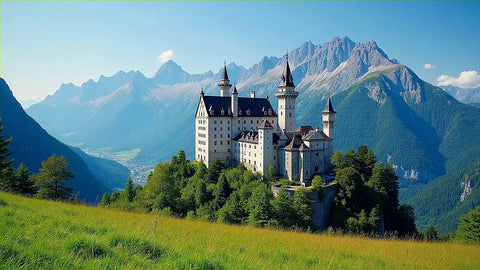
Let's talk about the beautiful part, because a trip here is pure scenery. In Vaduz, the capital, the connection is excellent: you'll walk under the castle (the prince's residence, not open for visits), queue for a stamp at the post office, and share photos instantly with no signal problems. The entire Rhine Valley floor, where Vaduz, Schaan, and Balzers are concentrated, has solid 4G and expanding 5G. Digital life there runs like silk.
Things change as you gain altitude. Climbing to Malbun, the country's small ski resort, you'll have coverage in the village and near the ski lifts, but on more remote slopes and at the summits, the signal becomes irregular, as in any alpine area. And if you're doing serious hiking—the legendary Fürstensteig or other ridge routes—assume there will be sections without data and download offline maps before starting. Curiously, it's precisely in these high areas where it's easiest for your phone to "see" a distant Swiss antenna, so check the operator name if you're going to use data in the mountains. In the villages, zero worries.
Comparison and how much data to take
To see everything at a glance, here are the four options compared. There isn't a single "best" one: it depends on where your line is from, how much you'll spend, and how much you want to deal with your phone's settings.
| Option | Ideal for | Advantage | Disadvantage |
|---|---|---|---|
| EEA Roaming | EU tourist with a recent plan | Free and with your number | Must watch out for jumping to Switzerland |
| Wi-Fi | Complement at the hotel | No cost | Only where stationary; not very secure |
| Local SIM | Long stays, outside the EEA | Anchors to the country's network | Few points of sale; change of number |
| eSIM | Convenience and guaranteed network | Ready before flying; keep your number | Requires compatible phone |
And how much data do you need? For a country that can be explored in two or three days, not much is needed. Maps, messaging, and social media consume little; video and long video calls are what eat up gigabytes. As a quick reference: a light traveler (maps, WhatsApp, and hotel Wi-Fi) will be fine with 1-3 GB; a medium one (daily GPS, photos, social media) with 3-5 GB; and an intensive one (streaming, sharing connection) with 5-10 GB. It's almost always better to overdo it a little than to run out halfway through your trip.
Frequently asked questions
Here I answer the most common questions I receive about connecting in Liechtenstein.
Will I be charged for Swiss roaming in Liechtenstein?
Only if your mobile connects to a Swiss antenna (code 228), which is not in the EEA. If you stay on a Liechtenstein network (code 295), your Spanish plan works without surcharges. Manually fix the network to avoid this.
Does my Spanish phone work without doing anything?
Yes, because Liechtenstein is in the EEA and "Roam Like at Home" applies. The only precaution is to ensure you are connected to a local network and not a Swiss one, which would generate high roaming charges.
How do I avoid connecting to the Swiss network?
Disable automatic network selection in settings and manually choose a Liechtenstein operator (MCC 295). The safest option is to choose FL1, which only operates in the country, so it will never connect you to a Swiss antenna.
What operators are there in Liechtenstein?
The two main ones are FL1 (Telecom Liechtenstein) and Salt Liechtenstein. FL1 is the most reliable for avoiding the Swiss network because it does not operate across the border. Both broadcast under country code 295.
Does an eSIM protect me from the Swiss trap?
To a great extent, yes. The plan is tied to a local network with a flat rate, so you don't depend on which tower your mobile jumps to or on monitoring the operator's name. It's the most convenient option to put your mind at ease.
Do I need a passport for a local SIM?
Yes. As in almost all of Europe, registering the card with an identity document is mandatory. Bring your passport or ID, and keep in mind that there are few points of sale and prices are in Swiss francs.
Is there good coverage for skiing in Malbun?
In the village and near the ski lifts, you will have a signal. On high slopes and remote peaks, it becomes irregular, as in any alpine area, and it is where it is easiest to pick up a Swiss antenna. Download offline maps.
Conclusion: my recommendation
To summarize the important points: connecting in Liechtenstein is easy and, in theory, free with your Spanish plan, because the country is in the EEA. The only enemy is that Swiss antenna that can sneak in without warning and drive up your bill. If you're comfortable with the settings, fix the local network (FL1 is best) and use your included roaming. And if you'd rather not think about towers or MCC codes, solve the problem before you take off with PuraSIM's Liechtenstein eSIM: install it in a minute, have data with guaranteed network as soon as you cross the border, and forget about the Swiss lottery. Enjoy the castle, the stamps, and Malbun. Have a good trip.