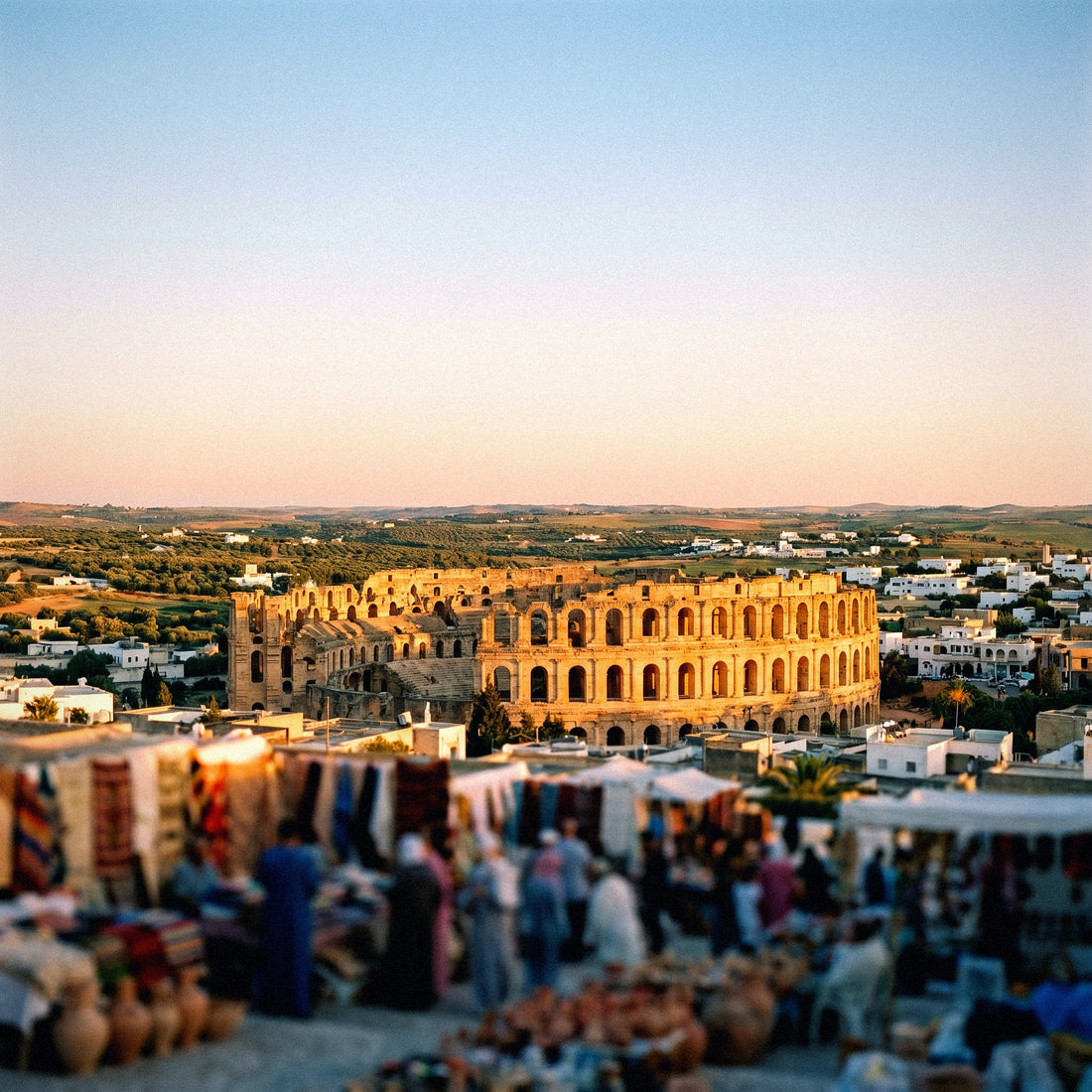
Every spring, I hear from people who land in Tunisia and discover, once they're already checked into their hotel, that their phone doesn't work or that their data bill is going to cost an arm and a leg. Solving your internet in Tunisia before you leave home will save you that sudden shock. In this guide, I compare the four real ways to get connected—from the most expensive to the one I recommend—so you can arrive in Hammamet, the Sahara, or Carthage with your data working and no surprises on your bill.
How mobile internet works in Tunisia
Tunisia has three operators—Ooredoo, Orange, and Tunisie Telecom—with 4G covering around 95% of the population and 5G in cities starting February 2025. Along the coast and in cities, you'll have excellent coverage; in the southern desert, the signal weakens. The most convenient way to connect is with an eSIM that you activate before you fly.
To understand what you'll find, it's helpful to know how the Tunisian mobile network is set up. The three operators share a very similar map: excellent coverage across the entire tourist coastal strip and in major cities, with the signal gradually weakening as you go further inland and south. Ooredoo is the market leader (around 43-47% share) and is usually the safest bet as the default network in cities and on the beach. Tunisie Telecom boasts the best coverage in remote populated areas, and Orange holds the signal slightly better on the outskirts of some desert towns.
In terms of speed, you won't feel like you're in the last century: the national median after the 5G rollout is around 50-60 Mbps, and in the center of Tunis, you'll easily see speeds of 20 to 60 Mbps. This is more than enough for maps, messaging, social media, and video calls. 5G, however, is concentrated in cities and is not always included in data plans for tourists, so it's wise to plan your trip expecting good 4G and treat 5G as a bonus when it appears.
The four options for connecting
When you land in Tunisia, you basically have four very different ways to get data on your mobile: stick with your Spanish roaming plan, use hotel Wi-Fi, buy a local prepaid Tunisian SIM, or install a travel eSIM. Each has its logic depending on how long you stay, how much you want to spend, and how much hassle you're willing to deal with. Before diving into the details of each, this table provides a quick mental map.
| Option | Approx. cost | Convenience | Ideal for |
|---|---|---|---|
| Roaming (Spanish plan) | Very high (up to €12.1/MB) | Zero hassle | Occasional emergencies |
| Hotel Wi-Fi | Free (included) | Only on premises | Quick checks at the resort |
| Local Tunisian SIM | Low (approx. €4-17) | Requires passport and store visit | Long stays with an unlocked phone |
| Travel eSIM | Low-medium | Everything from your phone | Most travelers |
The difference between them is not subtle: we're talking about going from spending the price of a coffee to risking a triple-digit bill for a few photos uploaded to Instagram. That's why it's worth taking five minutes to choose wisely before your trip, rather than improvising with your phone in hand in the Tunis-Carthage airport queue. Let's go through them one by one.
Roaming from Spain: the most expensive option
Here's the trap that causes the most distress: Tunisia is not in the European Union roaming zone, so the famous "roaming like at home" does not apply. Your Spanish plan shifts to the rest-of-the-world zone, where pay-as-you-go can reach up to €12 per megabyte consumed. With operators like Movistar or Orange, this à la carte rate is around €12.1/MB, a figure that turns a simple WhatsApp video into an absurd expense.
To give you an idea of the magnitude: at that price, downloading an offline map or watching a couple of Reels can cost you more than dinner. Many operators offer daily bundles for these zones, but they usually come with little data and at a price that isn't worth it if you're staying for a week. If you still want to use roaming, my advice is to keep it as an emergency network: data disabled by default and only turned on momentarily for critical tasks.
The conclusion is simple: as a primary option for your entire trip, roaming with your Spanish plan is by far the most expensive. If you're interested in the detailed "why," I explain it in my comparison of eSIM vs. roaming and in the guide on how much international roaming costs. For a country outside the EU like Tunisia, there is almost always a much cheaper alternative.
Hotel and beach resort Wi-Fi
Most hotels in Hammamet, Sousse, or Djerba include free Wi-Fi, and in large all-inclusive resorts, it usually works reasonably well in the lobby and common areas. For a relaxed beach trip, the resort's complimentary Wi-Fi covers most of your needs: sending photos at night, making a video call home, or planning the next day's excursion without using data.
The problem is that this Wi-Fi has very clear boundaries. As soon as you leave the premises—to the medina, to a public beach, to a downtown cafe, or on an excursion—you lose connectivity. And even within the hotel itself, the signal often drops in remote rooms or during peak hours, when hundreds of guests connect at once. It's also not the most secure network for sensitive operations: avoid accessing your bank from an open, shared Wi-Fi network.
My recommendation is to treat hotel Wi-Fi as a complement, not as your only connection. It's great for downloading heavy content at night and saving data, but to navigate the country with Google Maps, call a taxi, or translate a menu, you need something that travels with you. I compare the two logics in this guide on eSIM vs. portable Wi-Fi, which applies equally to fixed accommodation Wi-Fi.
Local Tunisian SIM (Ooredoo, Orange, Tunisie Telecom)
A local Tunisian SIM is cheap and works well if your phone is unlocked and you don't mind spending a bit of time on it. The three operators sell tourist plans at Tunis-Carthage airport and in official stores in cities, almost always requiring your passport in the store, as identity document registration is mandatory. Prices start from around 15 dinars (about €5) for 3 GB.
Ooredoo's "Holiday" packs are a good example of what you'll find. Here are the indicative data, with approximate Dinar to Euro exchange rates:
| Pack (Ooredoo Holiday) | Approx. price | Data | Validity |
|---|---|---|---|
| 15 dinars | ~€4-5 | 3.5 GB | 15 days |
| 30 dinars | ~€9 | 10 GB | 30 days |
| 40 dinars | ~€12 | 25 GB | 30 days |
| 60 dinars | ~€17 | 40 GB | 30 days |
The price per gigabyte is unbeatable, I won't deny it. The downside is the hassle: you need an unlocked phone, queue after a long flight, hand over your passport, wait for activation, and physically swap the card (with the risk of losing your Spanish one). If you're traveling for many days and don't mind the inconvenience, it's a solid option; if you want to land and be connected in five minutes, it might not be worth it. I break it down in detail in my comparison of eSIM vs. local SIM.
eSIM: my recommended option
For most travelers, the eSIM is the sweet spot between price and convenience, which is why I recommend it. It's a digital card you buy online that allows you to activate data before you take off: a QR code arrives in your email, you scan it, and as soon as your plane touches down in Tunisia, your phone automatically connects to the local network. No queues, no passport, no changing cards, and no losing your Spanish number.
I summarize it for my clients like this: the local SIM wins on price per gigabyte, but the eSIM wins on time, peace of mind, and not risking your bill. For a one or two-week getaway, that balance is usually worth it.
The Tunisian eSIM relies on the same networks you would use with a physical card—usually Ooredoo or Orange—so the coverage is the same as for a local: excellent on the coast and in cities. You can top up data from your phone if you run short and choose the plan according to how many days you'll be staying. If you've never used one, I explain the concept from scratch in what an eSIM is, and for the specific case of the country, you have my Tunisia eSIM guide. The only requirement is that your phone is eSIM compatible, which is common in recent mid-to-high-end models.
Coverage by zone: coast, cities, and desert
Here's where it's important to be honest: Tunisia has great connectivity where most tourists go, but it fades as soon as you stray from the main southern roads. The coast and cities have impeccable 4G; the heart of the Sahara is, quite simply, a land without coverage. This table will help you gauge what to expect depending on where you go.
| Zone | Coverage | What to expect |
|---|---|---|
| Tunis, Carthage, Sidi Bou Said | Excellent (4G/5G) | Full speed, everything works |
| Hammamet, Sousse, Monastir, Nabeul | Excellent (4G) | Ideal for data and video calls |
| Djerba, Mahdia, Sfax, Bizerte | Good (4G) | Reliable in tourist areas |
| Tozeur, Douz, Matmata (gateway to the desert) | patchy (3G/4G) | Only in village centers |
| Deep Sahara, salt flats, tracks | None | No signal off-road |
The practical takeaway is simple. If your trip is a beach vacation—Hammamet, Sousse, Djerba—or a cultural tour of the north—Tunis, Carthage, the medina—any decent data option will work more than sufficiently. But if you're going on a desert excursion, to the Chott el Jerid salt flats, or to sleep under the stars near Douz, assume you'll lose signal as soon as you leave the asphalt. Download offline maps before you go, let your family know you'll be unreachable for a few hours, and enjoy the disconnection, which in the Sahara is literal.
How much data you'll need for your trip
The million-dollar question. The answer depends on your usage, but for a week in Tunisia, almost no one needs as much as they think. If you rely on hotel Wi-Fi at night for heavy usage, you'll use much less data during the day than you imagine: uploading an entire camera roll of photos to the cloud consumes a lot, but maps, messaging, and social media use very little data.
Here are my guidelines for a typical 7 to 10-day stay:
- Light usage (1-3 GB): WhatsApp, Google Maps, some social media and email. Perfect if the hotel covers the rest.
- Medium usage (5-10 GB): the above plus daily social media scrolling, uploading photos, and some video calls. This is what most people choose.
- High usage (15-20 GB or more): video streaming, remote work, or tethering to a laptop and other devices.
My advice: if in doubt, go for the medium plan. A 10 GB pack is more than enough for a normal week-long trip with relaxed usage, and you can always top up in a couple of taps if you run short, without having to go back to any store. That's preferable to buying 40 GB that you won't use. And remember that pool and beach time are precisely times when your phone rests: in Tunisia, you travel more than you browse.
Tips for not running out of internet
A few simple actions make the difference between arriving connected or struggling with your phone at the airport. I learned the most important one from others' mishaps: prepare your connection at home, with your usual Wi-Fi, and don't leave anything until the moment you land in Tunis-Carthage, when you'll be tired and in a hurry.
- Disable data roaming before you take off if you're not going to use your Spanish plan, so your phone doesn't connect on its own at an exorbitant price.
- Install your eSIM at home and get it ready; it will activate automatically upon landing. Keep the QR and instructions just in case.
- Download offline maps for your destinations, especially if you're going south or to the desert, where coverage disappears.
- Check that your phone is eSIM compatible and unlocked; if not, consider a local SIM or a physical plan.
- Write down the local emergency number and keep the hotel Wi-Fi handy as a backup network.
With that routine, 99% of problems disappear. Most of the troubles I see don't come from poor Tunisian coverage—which is good—but from arriving unprepared and having to improvise. Five minutes at home will save you hours of stress at your destination, leaving you free for what's important: enjoying the country.
Frequently asked questions
Does my Spanish SIM card work in Tunisia without doing anything?
Technically yes, but as roaming outside the EU, with pay-as-you-go rates reaching €12.1/MB. Tunisia is not part of the European "roaming like at home" zone, so only use it for emergencies with data disabled by default.
Do I need a passport to buy a SIM card in Tunisia?
Yes. Identity document registration is mandatory for all three operators, so you'll need to present your passport at the store or airport kiosk. An eSIM, however, is purchased online without going to a physical store.
Is there coverage in the Sahara Desert?
Very limited. You'll only find 3G/4G signal in the center of towns like Tozeur or Douz, and on tracks and salt flats, coverage is nonexistent. Download offline maps before you go and expect to be disconnected for a few hours.
How many GB do I need for a week in Tunisia?
For average use, between 5 and 10 GB will cover a week with social media, maps, messaging, and some video calls. If the hotel has good Wi-Fi for heavy usage, 3-5 GB for light daily use will be more than enough.
Is there 5G in Tunisia?
Yes, all three operators launched 5G in February 2025, but it's concentrated in cities and not always included in tourist plans. Plan with good 4G, which covers 95% of the population.
Does the eSIM use the same network as a local SIM?
Yes. Travel eSIMs rely on Tunisian operators (usually Ooredoo or Orange), so you get the same coverage as with a physical card: excellent on the coast and in cities.
Can I use my phone as a Wi-Fi hotspot?
Yes, most data plans and eSIMs allow tethering to a laptop or tablet. Keep in mind that sharing uses data much faster, so choose a plan with extra capacity if you'll be doing it often.
Which Tunisian operator has the best coverage?
Ooredoo is the market leader and the safest bet for cities and the coast. Tunisie Telecom excels in remote populated areas, and Orange holds the signal slightly better near desert towns. On the coast, all three work well.
Conclusion
Connecting to the internet in Tunisia is easy if you choose wisely before traveling. Roaming with your Spanish plan is the most expensive option and only for emergencies; hotel Wi-Fi is a good complement but stays within the premises; a local SIM is very cheap if you don't mind the passport and the queue; and an eSIM is the perfect balance between price and convenience for most trips. On the coast and in cities, you'll have plenty of coverage; in the southern desert, be prepared to disconnect.
If you want to arrive in Hammamet, Djerba, or Carthage with your data already working, check out PuraSIM's Tunisia eSIM and leave home with your connection already sorted. You install it at home, it activates automatically upon landing, and you can forget about it to focus on what matters: the country. Have a good trip.