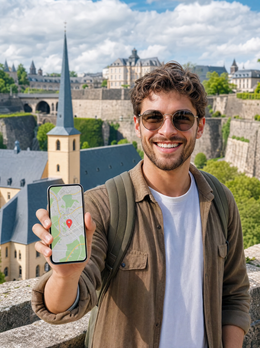
If you're planning a trip to Luxembourg, you're probably wondering how to get internet in Luxembourg without bill shock or having to hunt for Wi-Fi on every corner. I'll tell you straight and from personal experience: since Luxembourg is a European Union country, in most cases your home mobile plan will work for free with your Spanish tariff, but there are very specific situations where it's a good idea to plan your data before you leave. Here I compare all the options —your Spanish tariff, hotel Wi-Fi, a local Luxembourgish SIM, and eSIM— so you can choose the one that truly suits you, with real prices and coverage by area.
The quick answer: what do you need?
In Luxembourg, your Spanish mobile works for free with your home tariff thanks to EU roaming, with no extra cost. You only need a local SIM or an eSIM if you have an old tariff, use a lot of data, or are traveling from outside the European Union.
That's the headline version, but it deserves a bit of nuance because not all travelers are in the same situation. Luxembourg is one of Europe's most connected countries: there's 5G in the capital, stable 4G throughout the country, and good coverage even in villages and valleys. This means the problem is rarely the signal; the problem is how you pay for that data and if your contract gives you enough margin. If you come with a modern Spanish or any EU country tariff, the simplest option is to do nothing and use your own number. If you come from outside the EU (Latin America, UK, USA), that convenience doesn't apply, and you'll be interested in a local alternative. In the following sections, I break down each case with specific data, so you don't overpay or run out of connection.
Roaming with your Spanish tariff: free because it's the EU
Luxembourg belongs to the European Union, so it falls fully under "Roam Like At Home": you use your mobile as if you were in Spain, free and without surcharges for calls, SMS, or data. What you have contracted at home is what you spend there. Therefore, for a Spanish tourist with a normal tariff and a weekend or week-long trip, it is most common that you don't need to buy anything at all and can get around with your usual number.
Now, let's be honest, because there's fine print. Operators apply a fair use policy designed to prevent someone from using roaming permanently. As of 2026, the volume of data you can spend in the EU is calculated with a formula: (monthly price without VAT ÷ 1.10) × 2. In practice, a tariff of €9.99/month gives you about 15 GB to use for roaming; more expensive tariffs give considerably more. If you exceed that limit, they won't cut you off, but they may charge a small surcharge per extra GB. To delve deeper, I'll leave you with my comparison of eSIM vs. roaming and another on how much international roaming costs.
When an eSIM truly pays off
I'll be honest: if your Spanish tariff is recent and you use it reasonably, the included roaming is more than enough, and you don't need to buy extra data. That said, there are very specific profiles for whom an eSIM truly is worth it, and I prefer to warn you before you spend unnecessarily.
Simple rule: if your mobile is from the EU and you use little data, stick with your tariff; if you're coming from outside the EU or will use a lot of data, plan an alternative.
These are the cases where I would buy an eSIM for Luxembourg:
- Travelers from outside the EU: if your line is from Latin America, the UK, or the USA, you don't have "Roam Like At Home," and your operator's roaming can be very expensive.
- Old or very cheap tariffs: old contracts without included roaming or with a minuscule fair use limit (2-3 GB) quickly fall short.
- Intensive use or remote work: if you're going to share your connection, upload videos, or work remotely, you'll exhaust the margin quickly.
- Long stays or for those who want to keep their Spanish number free only for calls and banking.
If you're in one of these groups, keep reading: I compare eSIM with local SIM so you can choose wisely.
The border detail: don't connect to a neighboring network
Luxembourg is a tiny country bordering France, Germany, and Belgium, and at many points, you are just a few kilometers from the border. This means that near the border, your phone might sometimes connect to an antenna in a neighboring country instead of the Luxembourgish network. I'll tell you honestly: the risk here is smaller than it seems, because all three neighbors are also in the European Union, so with your Spanish tariff, you would still have free roaming anyway, without surcharge.
When does this detail matter? Especially if you are traveling from outside the EU, because then each country counts as a different destination, and connecting to a French or German network can activate a different, more expensive tariff. It can also happen if your plan counts countries separately. In these cases, my trick is to activate manual network selection and manually set the Luxembourgish operator from your phone's settings, so you don't accidentally jump to the neighboring antenna. With a local eSIM, the problem disappears completely, because it anchors to the network you have contracted and doesn't hop to the one across the border every time you approach a border town.
Hotel Wi-Fi and public Wi-Fi in Luxembourg
Wi-Fi is a good complement, never your only source of connection. In Luxembourg, you'll find open networks in most hotels, cafes, shopping centers, museums, and a good part of the city center, which also offers free municipal Wi-Fi in several areas. For checking emails at night, making a video call from your room, or downloading maps before heading out, it's more than sufficient and free.
The problem is twofold. First, coverage: Wi-Fi only exists where you're standing, so it's no good for GPS while walking through the old town, for calling a ride on the street, or for checking schedules at the tram stop. Second, security: open public networks are a sieve for anyone who wants to spy on your traffic, so avoid logging into banking or entering sensitive passwords without an activated VPN. My practical advice: use hotel Wi-Fi for "heavy" tasks (downloads, backups, streaming) and save your mobile data for getting around the city. If you were considering a pocket router, I recommend reading my comparison of eSIM vs. pocket Wi-Fi first, because for a single traveler, it's almost never worth carrying another device.
Local SIM: POST, Orange, and Tango
If you are coming from outside the EU or want a generous data plan with your own local number, a Luxembourgish prepaid physical card is a solid option. There are three main operators: POST Luxembourg (the historical one, with the best coverage in the country), Orange (good network and competitive data plans), and Tango (part of the Proximus group, offering good value for money). All three include EU roaming, useful if you continue your trip to France, Germany, or Belgium. The advantage over the fair use roaming of some tariffs is the volume: for what an old contract would give you a few GB, here you get dozens of gigabytes per month.
| Operator | Example of prepaid plan | Data | Approx. Price |
|---|---|---|---|
| POST | Prepaid Data | 20 GB / 30 days | ~20 € |
| Orange | Prepaid Go | 12 GB / 30 days | ~15 € |
| Tango | Prepaid | 10 GB / 30 days | ~12 € |
Be careful with one detail: in Luxembourg, it is mandatory to register the SIM with an identification document, so carry your passport or ID even if you buy it in a local store. You will find them at Findel Airport, operator stores, POST offices, and large supermarkets. If you are unsure between this and digital, check out my guide on eSIM vs. local SIM.
eSIM for Luxembourg: data without a physical card
For me, an eSIM is the sweet spot between convenience and price for those who need separate data. It's a digital chip installed on your mobile by scanning a QR code, without plastic or queues in a store, and it activates within minutes. You buy it from home, get it ready, and as soon as you land in Findel, it connects automatically to the local network without you having to do anything.
The big advantage over a physical SIM is that you don't lose your Spanish number: your usual line remains active for receiving bank SMS or calls, and the eSIM handles only the data. You can have both working simultaneously on a dual-SIM phone, which is impossible with a single SIM slot. It's ideal if you're coming from outside the EU, if your tariff is insufficient, or if you're traveling for business and don't want to look for a store upon arrival. Almost all mid-to-high-end phones from recent years are compatible. If this is the first time you're hearing about this, start with my article on what an eSIM is and then check out the Luxembourg eSIM guide, where I go into detail about plans and activation.
Coverage in the capital, Vianden, and Mullerthal
Luxembourg is one of Europe's best-connected countries: small, dense, and with a huge number of antennas per square kilometer. In the most touristy areas, the connection is excellent, and you won't have problems with any operator or any decent eSIM. There is widespread 5G in the capital and very stable 4G practically throughout the territory, including villages and the roads between them.
In Luxembourg City, you'll have plenty of coverage in the old town (a UNESCO World Heritage site), Place d'Armes, and the Kirchberg financial district, where the European institutions are located. An honest nuance: inside the Bock casemates, those tunnels carved into the rock, the signal drops because you're underground, so download it before going down. In Vianden, with its castle above the Our valley, coverage is good in the village, although in some secluded bends of the river, it might weaken. And in the Mullerthal region, also known as "Little Switzerland" of Luxembourg, you'll have signal in the villages and car parks, but among the rock formations and wooded gorges of the hiking trails, it's normal to lose data for a while: download offline maps before starting your walk.
How much data do you need for your trip?
The million-dollar question. The amount depends on your daily consumption and how much you use hotel Wi-Fi as a backup. To give you a realistic idea, maps, messaging, social media, and some searches use little data; streaming video and long video calls are what eat up gigabytes. This table gives you a reference according to your profile for a multi-day getaway:
| Traveler Profile | Typical Use | Recommended Data |
|---|---|---|
| Light | Maps, WhatsApp, some emails, and hotel Wi-Fi | 1-2 GB |
| Medium | Social media, photos, daily GPS, and browsing | 3-6 GB |
| Intense | Streaming, video calls, remote work, and tethering | 10 GB or more |
My practical recommendation: if you're using roaming from your Spanish tariff, check how many GB it allows you to use outside Spain and compare it with this table. If you contract a local SIM or an eSIM, a 5 GB plan is more than enough for a long weekend, and with 10 GB, you'll be comfortable uploading photos and videos or working remotely for a few days. Downloading series or music in advance via Wi-Fi will save you a lot of data, and it's almost always better to have a bit too much than to run out halfway through your trip.
Quick comparison of all options
To see everything at a glance, here are the four alternatives contrasted with their pros and cons. There is no universal "best": it depends on where you come from, how much you spend, and how much convenience you seek.
| Option | Ideal for | Advantage | Disadvantage |
|---|---|---|---|
| EU Roaming | EU tourist, normal use | Free and no management, your own number | Fair use limit; useless outside the EU |
| Wi-Fi | Hotel complement | Free | Only where you are stationary; not very secure |
| Local SIM | Long stays, lots of data | Very cheap per GB | Registration with passport; change of number |
| eSIM | Outside EU, convenience | Ready before flying; keep your number | Requires compatible phone |
For the average Spanish tourist with a recent tariff, roaming wins for convenience and because it's free in Luxembourg. For those coming from outside the EU or needing a large volume of data, the balance tips towards eSIM or a local SIM. The eSIM adds the advantage of having everything sorted from home before leaving. Decide calmly with the table in front of you: where your line is from, how many days you'll be there, and how many GB you use, and the correct option will choose itself.
Frequently asked questions
Here I answer the most common questions I receive about getting connected in Luxembourg.
Do I have free roaming in Luxembourg?
Yes. Luxembourg is in the European Union, so your Spanish tariff works with "Roam Like at Home" without surcharges for data, calls, or SMS. You just need to monitor the fair use limit, especially with very cheap or old tariffs.
Will my Spanish mobile work in Luxembourg without doing anything?
Yes. Upon landing, your phone will automatically connect to a local network, and you'll use your data and your usual number without touching any settings. It's only advisable to check your roaming limit if you use a lot of maps or video.
How much data does roaming allow me to use?
It depends on your tariff. As of 2026, it is calculated as (monthly price without VAT ÷ 1.10) × 2. A €9.99 tariff gives about 15 GB to use in the EU; more expensive tariffs give considerably more.
Do I need a document to buy a local SIM?
Yes. In Luxembourg, it is mandatory to register the SIM with an identification document. Carry your passport or ID even if you buy it in a supermarket; without registration, you won't be able to activate it.
Can my mobile connect to the French or German network?
Near the border, it can happen, because Luxembourg is tiny. With a Spanish tariff, it doesn't matter: all three neighbors are in the EU, and you would still have free roaming. If you are coming from outside the EU, manually set the Luxembourgish network to avoid paying more.
Can I use an eSIM and my Spanish number simultaneously?
Yes, if your mobile is dual SIM with eSIM. You keep your Spanish line active for calls and bank SMS, and the eSIM handles data in Luxembourg. This way, you don't lose your usual number.
Is there good coverage in Vianden and Mullerthal?
Yes, in the villages, car parks, and roads, where the signal is solid. In the wooded gorges of Mullerthal or in secluded river bends in Vianden, it may weaken, so download offline maps.
Is an eSIM worthwhile if I'm Spanish and going for a few days?
Usually not. With a recent tariff and reasonable use, the included roaming is more than enough for a short getaway and is also free. An eSIM pays off if you're coming from outside the EU, have an old tariff, or will use a lot of data.
Conclusion: my recommendation
To summarize the important points: connecting in Luxembourg is very easy because it is an EU country and coverage is excellent in the capital and very good throughout the territory. If you have a recent Spanish or EU plan, don't complicate things: use your included roaming, which is free here, and enjoy your trip. If you are coming from outside the EU, have an old plan, or will use a lot of data—or are teleworking from there—then an alternative is suitable, and an eSIM is the most convenient option because you can activate it before taking off and keep your usual number. If that's your case, take a look at the PuraSIM Luxembourg eSIM: you install it in a minute, have data as soon as you land in Findel, and forget about looking for stores or bill surprises. Have a good trip.