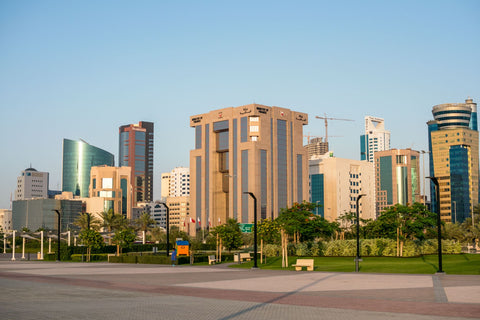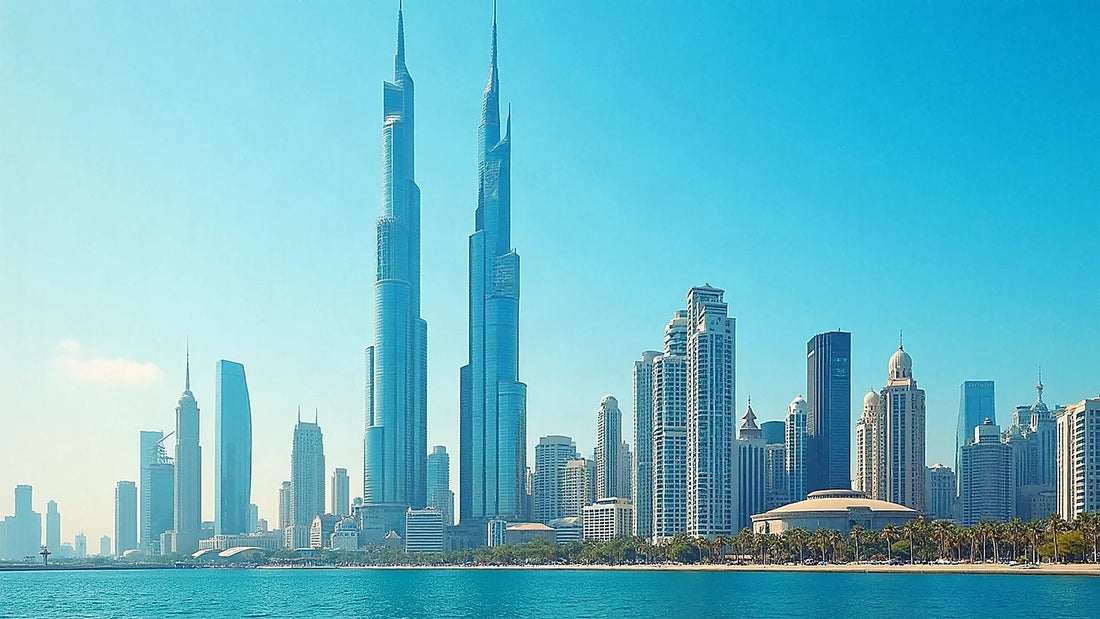
Bahrain is one of those surprising destinations: a tiny archipelago in the heart of the Gulf, with Manama boasting skyscrapers, ancient souks, and a Formula 1 weekend that fills hotels instantly. And the first logistical question is always the same: how to get internet in Bahrain without a shocking bill. Here I compare all the real ways to connect—roaming, hotel Wi-Fi, local SIM, and eSIM—so you can decide before boarding the plane, instead of wandering through the terminal looking for a counter.
How to connect to the internet in Bahrain
To connect in Bahrain, you have four options: roaming (expensive outside the EU), hotel and shopping mall Wi-Fi, a local Bahraini SIM (Batelco, stc, or Zain, with passport), or a travel eSIM. I recommend the eSIM: you arrive connected, keep your number, and browse on the best network in the country.
That's the quick version, but each path has its moment. In Bahrain, three mobile networks operate—Batelco, stc Bahrain, and Zain Bahrain—and all three are top-tier: the country is so small and urbanized that coverage is almost perfect in nearly every corner. The quality of your connection doesn't depend on whether your card is plastic or virtual, but on which of those three networks your line uses.
Here, there's also great news that sets Bahrain apart from its Gulf neighbors: internet calls are not blocked as they are in Qatar or the Emirates, so the debate focuses on price and convenience, not on whether you'll be able to call home. That's why it's worth settling this before you land. In the following sections, I break down the four options with prices, dedicate a section to calls, and conclude with coverage, the Grand Prix, and the causeway connecting the island to Saudi Arabia.
Roaming from Spain: convenient but expensive
I'll start with the most expensive mistake of all. Bahrain is not part of the European Union's "roam like home" zone, so your Spanish unlimited data plan is absolutely useless when you land. If you turn on your phone and use data without further thought, your operator will apply international roaming rates, which skyrocket outside the EU.
The numbers are alarming. Without a contracted bundle, many plans charge data per megabyte in the Gulf region, and just opening Google Maps a couple of times and uploading four photos of the Manama skyline is enough to get a serious shock on your bill. There are daily bundles for outside the EU, but they typically cost between 10 and 15 euros per day for very little data, and Bahrain almost always falls into the most expensive category.
When does it make sense? Only if you're there for a few hours layover, don't plan to touch your phone, and purchase a fixed bundle beforehand. For all other cases, it's a waste of money. I've detailed the costs in my guide on how much international roaming costs and the comparison of eSIM vs. roaming. My advice: before flying, check your customer area to see what they charge outside the EU, and if you can't find the fine print, assume the worst.

Hotel, mall, and airport Wi-Fi
Free Wi-Fi is widespread in Bahrain and is a good backup, but a poor main plan. Almost all hotels in Manama, major shopping malls—City Centre Bahrain, The Avenues, Seef Mall—and many cafes offer decent Wi-Fi. Bahrain International Airport itself, recently renovated, has free Wi-Fi, which is much appreciated if you have a layover or are waiting for a flight.
The problem is the usual one: Wi-Fi only exists where there's a router. As soon as you go for a walk in the Manama souk, cross to the Bahrain Fort, or take a taxi to the Sakhir circuit, you're without it precisely when you need a map, to translate a sign, or to order a car via an app. And relying on open networks for everything can leave you stranded more than once.
As a rule, use it for heavy tasks from your room—downloading maps at night, uploading the day's photo album, a long video call—and not for moving around outside. On open cafe networks, keep a VPN handy if you access your bank. That's why it's never wise to rely solely on Wi-Fi when you're away. If you're debating between pocket Wi-Fi and other options, I compare them in depth in eSIM vs. pocket Wi-Fi.
Local Bahraini SIM: Batelco, stc Bahrain, and Zain
The classic option is to buy a Bahraini SIM as soon as you land. In the airport arrivals hall, you'll find counters for Batelco, stc Bahrain, and Zain, and you can also find them in any shopping mall in Manama. They are readily available, but you will be asked for your original passport to register the line: it is mandatory by law, and they do not accept digital copies. Your phone must also be unlocked.
Tourist packs from the three operators are very similar. Keep in mind that the Bahraini Dinar (BHD) is one of the strongest currencies in the world: 1 BHD is around €2.40, so the figures can be misleading at first glance. These are typical plans in 2026:
| Operator | Data included | Approx. price | Validity |
|---|---|---|---|
| stc Bahrain (tourist) | 9 GB + 500 local min | BD 7.5 (~€18) | 28 days |
| Batelco (tourist) | Similar data + minutes bundle | BD 5-9 (~€12-22) | 28 days |
| Zain Bahrain (tourist) | 9 GB + 500 local min | BD 7.5 (~€18) | 28 days |
The downside? The friction. You have to queue after your flight, hand over your passport, wait for activation, and swap your physical SIM without losing your Spanish one, with the risk of misplacing the tiny chip. The data plan is cheap for what it offers, but you lose the convenience of arriving already connected. I detail this thoroughly in eSIM vs. local SIM.
The eSIM: my recommendation for travelers
The eSIM is a virtual card you buy online before traveling and activate by scanning a QR code. You don't visit any stores, you don't change your physical card—you keep your Spanish number for banking and messages—and as soon as your phone connects to the network in Manama, you have data. For the average tourist, it is by far the most convenient option, which is why I recommend it almost always.
The advantages over a local card are specific. You don't need a passport or to queue, because registration is handled by the provider before you leave home. Most operate on the Batelco, stc, or Zain network, so you arrive with the best signal in the country without having to choose an operator or compare counters with luggage in hand. And since Bahrain is a destination with free VoIP, you don't carry the problem of calls that its neighbors do have.
All you need is a compatible phone—almost all iPhones from XR onwards and recent mid-to-high-end Androids—and to have it installed before landing. If you've never used one, I explain how it works in what an eSIM is, and for this destination, you can find my Bahrain eSIM guide with detailed activation steps.
WhatsApp and FaceTime: good news in Bahrain
This is where Bahrain offers a pleasant surprise compared to half the Gulf. Unlike Qatar or the Emirates, which block voice and video calls via WhatsApp, FaceTime, or Skype on their networks, Bahrain maintains a much more open policy regarding internet voice calls. In practice, video calls and WhatsApp calls usually work normally on both local networks and Wi-Fi, without needing any tricks.
This is a huge difference for travelers. It means you can buy any option—local SIM or eSIM—thinking only about price and data, without the headache of "will I be able to call home?" which you would have on the other side of the bridge, in Saudi Arabia, or in Doha. That's why the debate is greatly simplified here compared to other destinations in the region.
That said, in the Gulf, telecommunications regulations can change, so it's wise not to be complacent: check the current status on the web before flying, because what works today might be adjusted. As a cheap safety net, have a reliable VPN installed before you leave; you'll almost certainly not need it, but it covers you if a specific service fails you one day.
My rule for the Gulf: I trust what official sources say in the month of travel, not what I remember from a year ago. In Bahrain, I'm confident about video calls, but I always have a VPN installed just in case.

Comparison: the four options head-to-head
To give you an overview, here are the four alternatives compared by what really matters in Bahrain: cost, where they work, and how much friction they involve. Since there are no call blocks, the balance tips towards convenience and price. Reference prices for a one-week trip.
| Option | Estimated cost | Coverage | Convenience | Drawback |
|---|---|---|---|---|
| Spanish Roaming | Very high (per MB without bundle) | Your associated network's | Plug and play | Exorbitant bill |
| Free Wi-Fi | €0 | Only where there's a router | None outside the hotel | Useless on the street |
| Local SIM | Low (BD 5-9) | Excellent (3 networks) | Queue + passport | Changing physical SIM |
| eSIM | Low-medium | Excellent (3 networks) | Maximum (arrive connected) | Requires compatible phone |
The takeaway is clear: for the average traveler, the real struggle is between a local SIM and an eSIM, because roaming is too expensive and Wi-Fi isn't enough. Both use the same Bahraini networks and provide almost identical coverage; what changes is the convenience of obtaining them. If you value your time upon landing and don't want to hassle with counters or tiny chips, the virtual card wins by offering the best comfort-to-price ratio for this destination.
Coverage in Manama and the rest of the country
Here, Bahrain is literally one of the best in the world. It's such a compact and urbanized country that 5G reaches virtually the entire island, and 4G is fast and stable everywhere. In Manama, you'll find ample signal at the Bahrain World Trade Center, the souk, the Seef financial district, and the Corniche, with speeds that are more than sufficient for maps, ride-sharing apps, streaming, and video calls.
Outside the capital, the story repeats because distances are minuscule. The Bahrain Fort (Qal'at al-Bahrain), a World Heritage site, the Sakhir circuit, Muharraq with its historic center, and the Tree of Life in the middle of the desert all have plenty of coverage. As a small, well-connected archipelago, almost any journey can be made with continuous map usage without interruptions, which cannot be said for much larger destinations.
Weak points? Very few. Perhaps some stretches of the interior desert or the inside of old buildings with thick walls, where the signal might drop a notch. But with any of the three base networks, you'll have stable connection almost everywhere. My usual trick, more out of habit than necessity: downloading offline maps of the area the night before any excursion.
Grand Prix, layovers, and the King Fahd Causeway
Bahrain has three distinct visitor profiles worth noting. The first is for the Formula 1 Grand Prix, which takes place at the Sakhir circuit and dramatically increases hotel occupancy during its weekend: if you're traveling for the race, the venue fills with tens of thousands of people using data simultaneously, so arriving with your own activated connection avoids network saturation and queues at counters.
The second is the layover traveler. Bahrain is a hub for Gulf Air, and many routes to Asia stop here; if you leave the airport to stretch your legs or stay overnight in Manama, a virtual card activated from the plane allows you to order a taxi and open your map without searching for kiosks with your luggage in tow.
And the third is crucial due to geography: the King Fahd Causeway, a bridge about 25 km long that connects the island with Saudi Arabia. Many people cross by car on the same trip. Be careful here: a Bahrain-only plan does not cover the Saudi side. If you plan to cross the border, look for a regional Gulf eSIM or a plan that includes both countries, or you'll lose data right after crossing the bridge.
How much data you need for your trip
The million-dollar question: how many gigabytes should I get? It depends on your usage, but for a typical week-long trip to Bahrain—Manama, the fort, Muharraq, maybe the Grand Prix—between 3 and 5 GB is more than enough for most people who use data for maps, messaging, social media, and looking up places. This figure assumes that heavy photo uploads and streaming are done via hotel Wi-Fi at night.
| Traveler Profile | Typical Usage | Data for 7 Days |
|---|---|---|
| Light | Maps, WhatsApp, some email | 2-3 GB |
| Medium | Above + social media and browsing | 3-5 GB |
| Intensive | Streaming and video calls with data | 8-10 GB or more |
| Layover / Weekend | Maps and taxi for a couple of days | 1-2 GB |
A couple of tricks to stretch your data: rely on hotel Wi-Fi for heavy tasks, download music, maps, and shows before you leave, and disable automatic app updates in the background. With these, even a modest plan will be plenty for the whole week. And if you run short, almost all eSIMs allow you to top up in two minutes from the app. For a first trip to the country, opt for a 5 GB plan: the sweet spot between price and peace of mind.
Frequently asked questions
Do WhatsApp and FaceTime calls work in Bahrain?
Yes. Unlike Qatar or the Emirates, Bahrain does not block VoIP voice and video calls, so WhatsApp and FaceTime usually work normally on local networks and Wi-Fi. As Gulf regulations can change, verify before flying and have a VPN installed just in case.
Where can I buy a SIM at Bahrain Airport?
In the arrivals hall, there are counters for Batelco, stc Bahrain, and Zain, and you can also find them in Manama's shopping malls. You need your original passport and an unlocked phone. If you prefer to avoid queuing after your flight, have an eSIM already installed.
Can I use my Spanish plan without extra charges?
No. Bahrain is outside the EU zone, so your unlimited plan does not apply, and you would pay roaming per megabyte or a daily bundle of €10-15. For a week, a local SIM or travel eSIM is much cheaper.
Is there good coverage in Manama and on the island?
Excellent. Bahrain has 5G virtually across the entire island and fast 4G everywhere, among the best in the Gulf. Being such a small and urbanized country, you'll hardly notice any dropouts except in some stretches of the interior desert or very old buildings.
Does my Bahrain plan work if I cross into Saudi Arabia?
No. The King Fahd Causeway connects the two countries, but a Bahrain-only plan does not cover the Saudi side. If you plan to cross, purchase a regional Gulf eSIM or a plan that includes both countries so you don't lose data when you cross the bridge.
How many GB do I need for a week?
For a 7-day trip involving maps, messaging, and social media, 3 to 5 GB is sufficient for most. If you do a lot of streaming or upload videos using data, increase to 8-10 GB. For a layover or a weekend, 1-2 GB is plenty.
Is my phone compatible with eSIM?
Most recent phones are: iPhones from XR onwards, Pixels, and many mid-to-high-end Samsung and Android devices. Check your Settings for "eSIM" or "digital SIM." If the option appears, you are compatible and can install it before flying.
Conclusion
Getting connected in Bahrain is one of the easiest things in the Gulf. Roaming can ruin your bill, Wi-Fi is only good for the hotel, and a local SIM is cheap but requires queuing, a passport, and a card change. And the best news is that here you don't have to deal with your neighbors' call blocking: WhatsApp and FaceTime usually come as standard. For those who want to move freely around Manama, enjoy the Grand Prix, or have a peaceful layover, the virtual card wins: you arrive connected from the moment you land, you keep your number, and you'll be on the best network in the country. Estimate 3-5 GB for a week, and if you cross into Saudi Arabia, choose a plan that covers both sides. If you want to sort it out in two minutes, check out my Bahrain eSIM and land without thinking about anything else.