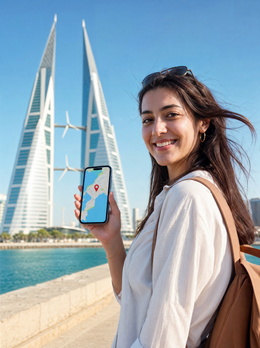
If you've already decided that you're going to use data and you just need to decide on the size, this guide is about that: how many GB you need for Bahrain, and not a single one more. It's a tiny country, very connected, and with Wi-Fi everywhere, so the answer is usually much less than what people buy. I'll give you the figure by profile and by day, and then I'll explain the two things that can really drive it up: the Grand Prix weekend and crossing the causeway to Saudi Arabia.
The short answer, no beating around the bush
For a typical 4-7 day trip to Bahrain, most people will be fine with 3 GB. If you're only using maps, WhatsApp, and an occasional video, 1 or 2 GB will suffice. If you work remotely or upload a lot of video, you'll need 10-15 GB.
I know it sounds like a small amount compared to what's advertised, but Bahrain is a specific case: the entire country is just over 50 kilometers from end to end, distances are very short, hotels almost always have decent Wi-Fi, and shopping malls—which in Bahrain are half a tourist attraction—have open and fast Wi-Fi. This eliminates precisely what consumes the most data: large downloads and long videos, which you end up doing at the hotel.
What does consume data on such a trip is the small, constant usage: maps while wandering through Manama souq, WhatsApp with family, checking schedules, ordering a taxi via an app, uploading four photos of Bahrain Fort. All of that, combined, rarely exceeds 300-400 MB per day per person. Multiply that by the number of travel days and you have your figure, without drama. If you want the general method for any destination, you'll find it in my guide on how much data you need for travel; here I'll focus on the specifics of Bahrain, which is where the real nuance lies.
Why you'll spend less in Bahrain than you think
There are destinations where your phone becomes your permanent lifeline: a camera translator to read every sign, maps all day because transportation is chaotic, a mandatory VPN that also consumes extra data. Bahrain is none of those, and that's why the number goes down.
First, the language: English is used everywhere—hotels, restaurants, taxis, museums, airport—so you won't be pulling out the camera translator every two minutes. That, which in Japan or Egypt can add hundreds of MBs to your trip, is practically zero here.
Second, the network: Bahrain has one of the best coverages in the region. The three local operators (Batelco, stc, and Zain) have 5G in practically all inhabited areas, and being such a small archipelago, there are no coverage gaps that force you to download things "just in case." Be careful, a fast network is a double-edged sword: with 5G, your phone will try to download everything in maximum quality, and that's where your data package can disappear without you realizing it. I'll tell you how to curb that later.
And third, Wi-Fi: hotels, shopping malls, cafes, and many museums have Wi-Fi that actually works. On such a compact city trip, you end up spending several hours a day under a decent Wi-Fi connection, and those hours don't count against your data package.
How much each activity you do there consumes
These are the figures I use for calculation. They are average real consumptions; your phone may vary depending on the connection quality and each app's settings, but they work well as a reference.
| Activity | Approximate consumption | What it means for a trip to Bahrain |
|---|---|---|
| Maps with navigation (Google Maps) | 3-5 MB per hour | Almost nothing. With satellite view, it goes up to 15-20 MB/h |
| WhatsApp text and audio only | 1-3 MB per hour | Irrelevant, even if you text all day |
| WhatsApp voice call | 15-25 MB per hour | They do work in Bahrain (see VoIP section) |
| Video call | 250-350 MB per hour | The most expensive daily activity. Do it at the hotel |
| Social media (Instagram, TikTok scroll) | 600-800 MB per hour | The big drain. 20 minutes a day is already ~250 MB |
| Upload 20 phone photos | 60-100 MB | An afternoon in the souq or at the fort |
| Upload 1 minute of 1080p video | 60-100 MB | Reels are what throw off calculations |
| Music streaming (normal quality) | 40-70 MB per hour | Little, unless you stream at very high quality |
| Video streaming (SD / HD) | 0.7 GB / 3 GB per hour | Only over Wi-Fi. In 4K it goes up to 7 GB/h |
| Order a taxi via app | 5-10 MB per ride | Nothing, even if you use it six times a day |
The takeaway is always the same: what's going to cost you money is not maps or WhatsApp, it's video, in any of its forms—watching it, uploading it, or making video calls. I have a detailed breakdown by app in my mobile data usage statistics by activity, if you want to fine-tune your specific case.
How many GB by profile and duration
This is the table that really matters. Find the row that best matches you and the column with your number of days. The figures are per person and already include a reasonable margin, assuming you'll be sleeping in a place with Wi-Fi.
| Profile | 5 days | 10 days | 15 days | 30 days |
|---|---|---|---|---|
| Tourist (maps and WhatsApp only, little mobile use) | 1 GB | 2 GB | 3 GB | 5 GB |
| Traveler (photos and social media, daily stories) | 3 GB | 5 GB | 8 GB | 15 GB |
| Digital nomad / remote worker (video calls) | 10 GB | 20 GB | 30 GB | 50 GB |
| Family sharing a single mobile | 5 GB | 10 GB | 15 GB | 25 GB |
Three honest caveats about this table. First: most people traveling to Bahrain fall into the first two rows, and most trips to Bahrain are less than a week, often as a stopover within a longer trip through the Gulf. In those cases, 1-3 GB is the realistic range, and anyone who buys 20 GB ends up having 17 left over.
Second: if you're sharing the connection with another phone, add up both profiles, don't just stick to yours. A second phone on a hotspot with activated backups can consume a small package in two days.
Third: if you're seriously working remotely, don't just look at GB, look at where you'll be working. With solid hotel or cafe Wi-Fi, a digital nomad can easily cut those figures in half and only use data for travel and emergencies.
The Sakhir Grand Prix: the annual peak
If your trip coincides with the Grand Prix at the Bahrain International Circuit in Sakhir, throw the previous table out the window for those three days. It's the only week of the year when the island suddenly fills up: hotels are fully booked, prices skyrocket, and tens of thousands of people are concentrated at a circuit in the middle of the desert, all recording video and uploading it at the same time.
Two things happen. One, you consume much more: photos, videos, stories, team radios, live timing apps. And two, the network is slow even if you see 5G on your screen, because thousands of phones are connected to the same antennas. This isn't fixed with more gigabytes; it's fixed with patience and not relying on your phone for critical things.
| One day at the circuit | Estimated consumption |
|---|---|
| Photos and videos uploaded to social media (30-40 files) | 500-900 MB |
| Live timing app (6 hours) | 150-300 MB |
| Social media scrolling during waits (1.5 h) | 900 MB - 1.2 GB |
| Maps, digital tickets, and messaging | 50-100 MB |
| Total for one race day | 1.5-2.5 GB |
Translated: a Grand Prix weekend alone will eat up between 4 and 7 GB. If you're going for F1, calculate 8-10 GB for a week instead of the 3 GB for a normal trip. And save your digital pass and tickets as screenshots, because with a saturated network, opening your email at the access gate is a bad time to discover it won't load.
King Fahd Causeway: crossing is changing countries
This is the most expensive mistake in Bahrain, and it has nothing to do with gigabytes. The King Fahd Causeway is 25 kilometers of bridges connecting Bahrain with the Eastern Province of Saudi Arabia, and many people cross it to spend the day in Al Khobar or Dammam.
A Bahrain data plan covers Bahrain. As soon as you pass the halfway point of the causeway, you're in Saudi Arabia, your phone connects to a Saudi network, and that plan stops providing you with data. It's not a malfunction: it's another country and another rate.
In fact, your phone usually warns you before you realize it: halfway across the bridge, at the shared border post, your phone starts jumping between operators on both sides, and you might see the Saudi welcome message even before you've passed customs. If at that moment you only have a Bahrain plan, you'll be without maps precisely when you need them most.
What to do, depending on your situation:
- Not crossing: a Bahrain plan is sufficient, it's the cheapest option.
- Crossing for a single day: download the map of the Al Khobar area and notify via WhatsApp that you'll be disconnected for a few hours. You'll manage with Saudi shopping mall Wi-Fi.
- Crossing multiple times or staying overnight: you'll need coverage for both countries. Either a regional Gulf plan, or two different plans and switch data lines when you cross.
The same applies to the King Hamad Causeway when it comes into service. The rule doesn't change: the plan covers the country stated in the plan, not "the area." If you're going to travel through several Gulf countries, choose your plan from the start to avoid a nasty surprise.
Gulf Air layovers and Manama Airport
Many people set foot in Bahrain for the first time during a Gulf Air layover, as it uses Manama as its base airport. If that's your case, calculating gigabytes is even simpler, but there are a couple of details to keep in mind.
On a short layover without leaving the airport, honestly, you hardly need data: Bahrain International Airport has free Wi-Fi, and the new terminal works well. Data is mainly useful for the ten minutes of landing and takeoff, when you haven't connected to Wi-Fi yet and want to announce your arrival or check your boarding gate.
The important detail is when you activate your plan. If you have a long layover and want to go out and see Manama—which is possible, the city is 15 minutes away and visas on arrival are available for many passports—then you definitely want data from minute one: taxi, maps, schedules, and getting back on time. For that, 500 MB or 1 GB is plenty for an 8-12 hour layover.
And a practical tip: during layovers, it's easy for your phone to start syncing everything it couldn't during the flight. Photos, updates, emails with attachments. Connect to the airport Wi-Fi first and let it sync there, not using your data plan. If you're debating between roaming, a local SIM, or an eSIM for a layover, I compare them in detail in my guide to internet in Bahrain.
How to check your own data usage (in 2 minutes)
All the tables in the world are worth less than your own data. And you have it on your phone, for free, right now.
On Android: Settings → Network & internet → SIM / Data usage, and check your consumption for the last full monthly cycle. On iPhone: Settings → Mobile Data, scroll down to "Current Period" (it's a good idea to reset statistics on the 1st of the month for a clean measurement). What you're looking for is how many GB you use per month outside your home, without Wi-Fi.
The calculation is this: divide that monthly total by 30 to get your actual daily consumption. Multiply it by the number of travel days. Now, adjust with two corrections:
- Subtract if you use a lot of data at home during your commute or for podcasts in the car: you won't replicate that in Bahrain.
- Add 30-50% if you're someone who documents their travels: you upload much more content on vacation than on a typical Tuesday.
- Subtract 20-30% for hotel and shopping mall Wi-Fi, which in Bahrain actually works.
Real-world example for an average Spanish user, who uses around 15-20 GB per month: that's about 500-650 MB per day, but a good portion of that is with Wi-Fi off on the way to work. On a 5-day trip to Bahrain, with hotel and shopping mall Wi-Fi in between, that same profile would use about 300-400 MB daily, meaning less than 2 GB. Almost always, the number from your own settings is lower than what fear tells you.
Tips for making your data last longer in Bahrain
With these adjustments, made before leaving home, a small package will last twice as long. These aren't guru tricks: they're just four simple checkboxes.
| What to download before you leave (over Wi-Fi) | Approximate size |
|---|---|
| Offline map of all Bahrain in Google Maps | 100-200 MB |
| Arabic language pack for translator | 40-60 MB |
| Series or movies for the flight and hotel | 0.5-2 GB |
| Offline music playlists | 300-800 MB |
| Boarding passes, tickets, and reservations | less than 10 MB |
And once at your destination, four adjustments that are worth more than an extra gigabyte:
- Backups only over Wi-Fi. Google Photos and iCloud are the number one culprits: if you don't disable it, every photo from the souq is uploaded to the cloud as soon as you take it.
- Disable auto-play video on Instagram, TikTok, X, and Facebook. This alone will cut your social media consumption by half.
- Activate data saver mode in your system and browser. It's a checkbox and it works.
- Video in automatic or low quality, never HD with data. Watching something in SD instead of HD divides the cost by four.
Bahrain, moreover, plays in your favor: the country is so compact that with the map downloaded, you'll hardly need online maps. I have the complete list of settings, with screenshots, in my tips for saving data while traveling.
What happens if you run out
Nothing dramatic, and here's the key to this whole article. When you run out of data on a travel plan, you're not charged extra or sent a surprise bill: you simply stop having data until you top up. And topping up takes just a couple of minutes from a Wi-Fi connection, without touching anything on your phone.
Compare the two scenarios. If you buy 3 GB and run out on the second-to-last day, you lose ten minutes topping up from the hotel's Wi-Fi and continue. If you buy 20 GB "just in case" and use 3, you've wasted 85% of what you paid, and there are no refunds. The asymmetry is evident: running short costs ten minutes; overspending costs money.
That's why my advice is always the same, and it goes against selling large packages: start with the smallest plan and top up if needed. In a destination like Bahrain, with accessible Wi-Fi in any hotel or mall, running out of data doesn't even leave you stranded; it leaves you waiting for the next coffee shop.
Two caveats, though. If you're going to be in areas where your phone is essential for getting back — a day trip, or if you're crossing into Saudi Arabia — allow for a margin, because that's when it really matters. And if your trip includes the Grand Prix, don't cut it close: the network is strained on those days, and you won't want to be struggling with a top-up in the middle of the grid. Before deciding, take a look at how an eSIM works if it's your first time; it will clear up half your doubts.
Frequently asked questions
The most common questions I get about data in Bahrain, answered straight to the point and without fuss.
How many GB do I need for 7 days in Bahrain?
3 GB is more than enough for a week if you are a normal tourist. If you barely use your phone beyond maps and WhatsApp, 1-2 GB will suffice. If you upload daily stories or work from there, go up to 5-8 GB. And if it coincides with the Grand Prix, count 8-10 GB.
Do WhatsApp calls work in Bahrain?
Yes, VoIP calls work normally in Bahrain. Unlike the Emirates, where WhatsApp and FaceTime calls are blocked, the Bahraini regulator (TRA) has allowed VoIP for years, and WhatsApp, Telegram, or FaceTime voice and video calls work on local networks without needing a VPN. Verify upon arrival before relying on it for anything important.
Does my Bahrain plan work if I cross into Saudi Arabia?
No. A Bahrain plan stops providing data as soon as you cross the King Fahd Causeway. Saudi Arabia is another country and another rate, and your phone connects to a Saudi network halfway across the bridge. If you plan to cross more than once, you need coverage for both countries or a regional Gulf plan.
Is there good coverage throughout the country?
Yes, Bahrain is one of the best-covered countries in the Middle East. The three operators (Batelco, stc, and Zain) have 5G in practically all inhabited areas, and being a very small and urban archipelago, there are no significant gaps. The exception is saturation peaks, such as the Formula 1 weekend in Sakhir.
Do I need a VPN in Bahrain?
Not for the basics: messaging apps and calls work without a VPN. There is some filtered content, but nothing that affects the average traveler. If you still use a VPN out of habit, keep in mind that it adds between 5% and 15% extra consumption to everything you do.
Is an unlimited plan for Bahrain worth it?
For a short trip, almost never. For stays of less than a week and Wi-Fi available in hotels and shopping centers, an unlimited plan is more expensive than what you will actually use. It only makes sense if you work remotely with daily video calls or if you are staying for a long month.
How much data do I use on a Gulf Air layover in Manama?
Almost none if you don't leave the airport: 500 MB is more than enough. Bahrain International Airport has free Wi-Fi. If you take advantage of a long layover to explore Manama, 1 GB covers taxis, maps, and messaging all day without issues.
Can I top up if I run out of data while I'm there?
Yes, and it takes a couple of minutes from any Wi-Fi. When your package runs out, you simply stop having data, with no extra charges or surprise bills. That's why it's worth starting with the smallest plan: topping up takes ten minutes, and overspending on data isn't refundable.
Conclusion
Bahrain is one of those destinations where I can be emphatic: buy little. For a typical trip of three to seven days, 3 GB is more than enough for maps, WhatsApp, taxis, and a few photos of the souk and Bahrain Fort. If your trip involves discreet mobile use, 1-2 GB will suffice. The country is small, the network is fast, and hotel and mall Wi-Fi does half the work for you.
Only increase the amount for two specific reasons: if you're attending the Sakhir Grand Prix — in that case, estimate 8-10 GB for the week, because a single day at the circuit consumes 1.5-2.5 GB — or if you're going to be teleworking with video calls, which is the only thing that breaks any data budget. And if you plan to cross the causeway to Saudi Arabia, resolve that before considering gigabytes: it's a country coverage issue, not a package size issue.
The rest is common sense. Download the map of Bahrain before you leave, save backups for the hotel Wi-Fi, turn off video autoplay, and relax. If you run short, you can top up in two minutes; if you overspend, that money won't come back. I prefer to sell you the small package and have you return rather than giving you twenty gigabytes you won't use. Once you're clear, here's the eSIM for Bahrain, and if you want to see all the options and prices for the destination first, they are in my Bahrain eSIM guide.