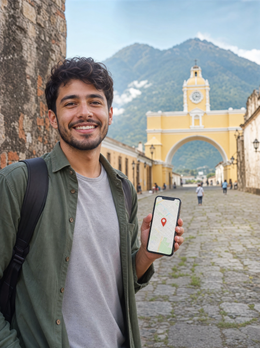
You're wrapping up your trip to Guatemala —Antigua, Lake Atitlán, the Tikal temples— and it's time to sort out a detail that can make or break half your experience: how to get internet in Guatemala without overpaying or getting stranded in the middle of Petén. In this guide, I compare the four ways to connect —your regular provider's roaming, hotel Wi-Fi, a local SIM with passport, and an eSIM— with real prices and coverage area by area, so you can leave the airport already connected and without any surprises.
The four options to get connected
To get internet in Guatemala, you have four ways: roaming with your Spanish provider, hotel and cafe Wi-Fi, a local Tigo or Claro SIM purchased with your passport, and an eSIM that you activate before flying. The eSIM is usually the most convenient and practical; the local SIM is the cheapest for long stays.
The difference between these four isn't just price: it's convenience, speed, and when you stay connected. Roaming works instantly but can hit you with a hefty bill; a local SIM is very cheap but requires queuing and registration; Wi-Fi is free but ties you to the hotel; and an eSIM gets you online as soon as you land. My advice is to make a single decision before flying and not leave it for La Aurora airport, where flight fatigue often leads people to overpay.
| Option | Approximate Cost | Convenience | Ideal for |
|---|---|---|---|
| Spanish Roaming | High (per MB or daily bundle) | Zero hassle | 2-3 day getaways |
| Hotel Wi-Fi | Free | Only at accommodation | Occasional checks |
| Local SIM (Tigo/Claro) | Low (SIM from ~$1.30) | Passport and store | Long stays |
| Travel eSIM | Medium-low | Activates automatically | Most travelers |
No option is "the best" in abstract: it depends on how many days you stay and how much coverage you need off the tourist trail. In the following sections, I break down all four with numbers and their fine print.
How the Guatemalan mobile network works
In Guatemala, mobile telephony is currently divided between two operators that truly matter: Tigo and Claro. The historical third, Movistar, exited the market years ago (América Móvil, Claro's parent company, acquired its operations in 2019), so when you compare plans or coverage, you'll almost always be choosing between these two names. Tigo is the leader, with slightly over 50% of the market and the most extensive network, and Claro is close behind with about 47%.
The second idea I want you to take away is that it's worth separating the "how" from the "where". One thing is how you connect (roaming, Wi-Fi, SIM, or eSIM), which affects price and convenience; a very different thing is where you will be moving each day, which determines whether you'll have a signal or not. In cities and tourist destinations, there's very decent 4G —speeds of 20 to 40 Mbps in Guatemala City and Antigua— and some 5G is starting to appear in the capital. Outside of that, geography rules: the currency is the Quetzal (about 7.7 Q per dollar), but neither money nor the operator can fix a mountain valley without an antenna.
Roaming with your Spanish provider
First important warning: Guatemala is not part of the European Union, so the "roam like home" rate you use in France or Italy does not apply here. As soon as your mobile connects to a Guatemalan network, you'll be charged international roaming rates, which for many Spanish providers are counted in individual megabytes at prices ranging, depending on the company, from several euros per MB to daily bundles that can quickly eat up your budget in a couple of days.
The only major advantage is that you don't have to do anything: you arrive, turn on your phone, and it works. But that convenience comes at a cost, and often it's the surprise bill upon returning that prompts people to look for alternatives. Before relying on it, call your provider and ask for the exact price outside the EU, because brochures often hide it.
If you're still considering it, check the temporary travel bundles some companies sell for "Zone 2" or "rest of the world": for a two or three-day getaway, they can sometimes be worthwhile. To understand how all this is calculated, I recommend my guide on how much international roaming costs, and if you want a direct comparison, I have an eSIM vs. roaming comparison with clear figures.
Hotel, hostel, and cafe Wi-Fi
Free Wi-Fi is your ally for anything that isn't urgent. Almost all hotels and hostels in Antigua, Guatemala City, Panajachel, and Flores offer decent Wi-Fi in common areas, and in Antigua, you'll also find dozens of cafes and co-working spaces with connections designed for digital nomads. For uploading photos, making video calls at night, or planning the next day, using the lobby Wi-Fi at nine is more than enough and doesn't cost a cent.
The problem arises as soon as you leave your accommodation. Wi-Fi doesn't accompany you on the boat ride across the lake, or on the road to Tikal, or when you need a map to find an unmarked dirt turn-off with no signal. And in hostels in small Atitlán towns or jungle lodges, the connection is often slow, shared among many guests, and sometimes limited to the reception area for a few hours a day.
Another downside is security: on open networks, it's advisable not to enter bank details without a VPN. My advice is to treat Wi-Fi as a complement, never as your sole network. If you want to see why portable Wi-Fi doesn't completely solve the problem either, take a look at my comparison of eSIM vs. pocket Wi-Fi, where I explain the issues with batteries and deposits.
Local SIM: Tigo and Claro with passport
A local SIM is the most economical option if you're staying for many days or consume a lot of data. The two operators with stores everywhere are Tigo, with the best rural coverage in the country, and Claro, which is very strong in cities. A physical SIM card costs between 10 and 25 quetzales (about $1.30-3.30), an initial data package is around 25-50 Q ($3-6.50), and prepaid data starts at 10 Q for 1 GB; a generous monthly plan of 25-60 GB costs 100-150 Q (about $13-20).
The catch is the management. By law, buying a prepaid SIM requires registering it with your passport, so you'll have to queue with your passport in hand at an official store or at the Tigo and Claro kiosks in the arrivals terminal at La Aurora airport. Be warned: at the airport, prices are inflated —150 Q ($19) for 2 GB and 7 days— considerably more expensive than at a downtown store.
If you're traveling for a month or need a Guatemalan number for administrative tasks, it's worth it. For a one or two-week trip, many travelers prefer to avoid the hassle. I compare it in detail in my article on eSIM vs. local SIM so you can see when each is worthwhile.
The eSIM, my recommended option
For the vast majority of trips to Guatemala, my recommendation is a data eSIM. It's a digital SIM that you buy online, receive by email, and install by scanning a QR code: you can activate it from your sofa at home days before you fly and land at La Aurora already connected, without searching for stores or registering with your passport. If you've never used one, in my guide on what an eSIM is, I explain it step-by-step.
The advantages are clear. You keep your Spanish number active in the physical slot of your phone (to receive bank SMS or calls), while data travels via the eSIM, relying on the local network with the best coverage, usually Tigo or Claro. There's no plastic to lose, no deposit, and you don't depend on an open store. The only requirement is that your phone is compatible, which almost all recent models are.
The honest drawback: for very long stays and huge data consumption, a refillable local SIM might be slightly cheaper per GB. But when you factor in convenience, lack of paperwork, and not wasting time upon arrival, the eSIM wins for the average traveler. You can find all the fine print in my eSIM guide for Guatemala.
Real coverage: city and lake yes, Tikal no
This is the section most people skip and then regret. In Guatemala City, Antigua, Panajachel, and the larger towns around Lake Atitlán, and in Flores, 4G coverage is good and you'll have plenty. The problem arises when you delve into the Petén jungle or the deep highlands: there are places where going deep into the jungle without coverage is normal, and no operator or eSIM can change that.
Inside Tikal Park, there is no signal with any company: it is forbidden to install antennas in the archaeological site, so you will only get some data at the top of certain pyramids. Download your maps and notify your loved ones before entering.
This table summarizes what to expect in the most popular destinations. Tigo holds up best off the main roads, but even it doesn't perform miracles north of Flores.
| Area | Mobile Coverage | What to expect |
|---|---|---|
| Guatemala City | Very good (4G, some 5G) | Smooth connection, 20-40 Mbps |
| Antigua | Good (4G) | More than enough for the whole day |
| Panajachel and Lake Atitlán | Good in larger towns | Weak in villages on the other side |
| Flores (Tikal base) | Good (4G) | Ideal for downloading everything |
| Tikal Park | Almost none | Only at the top of pyramids |
| Deep Petén and Highlands | Scarce | Only Tigo off-road |
Moral of the story: where there's a network, you'll connect, and where there isn't, no magic is possible. Plan your days in Tikal and remote villages expecting to be without signal.
How much data you really need
The million-dollar question. The good news is that calculating gigabytes wisely is easier than it seems if you categorize by usage type. As a general rule, an average traveler uses around 1 GB per day: light use (maps, messaging, some web browsing) is about 0.4 GB, while intense use with social media, video, and photo uploads can go up to 2.5 GB daily or more.
For a typical week or ten-day trip to Guatemala, this translates to a range between 8 and 25 GB. If you use hotel Wi-Fi a lot at night, you'll be at the lower end; if you do live streams and video calls every day, aim for the higher end or a plan with top-ups. Here it is in a table for a quick overview.
| Profile | Daily consumption | 7-10 days |
|---|---|---|
| Light (maps and chat) | ~0.4 GB | 3-5 GB |
| Medium (social media and browsing) | ~1 GB | 8-12 GB |
| Intense (video and live streams) | ~2.5 GB | 18-25 GB |
My trick: since you'll be without data in Tikal and remote villages anyway, don't inflate your calculation thinking you'll consume data every day. And if in doubt, go for a plan with top-ups; running out on the penultimate day is a common, avoidable hassle.
How to choose and activate your connection
Choosing well means cross-referencing three pieces of information: days of travel, estimated gigabytes, and the coverage you need outside the city. If your route involves a lot of jungle and villages (Petén, Ixil, remote highlands), prioritize an option backed by the network with the best rural reach. If you're moving between Antigua, the lake, and Flores, almost any option will work, and convenience will be more important. The best thing is to get everything ready before you take off and not improvise at the airport.
With an eSIM, the process is quick. These are the steps I follow:
- Check that your mobile is eSIM compatible (phone settings or manufacturer's website).
- Buy the plan with the right GB and days for you, a few days before flying.
- Install the profile by scanning the QR code you receive by email, using Wi-Fi at home.
- Set up the eSIM for "data" and your Spanish SIM for calls and SMS.
- Upon landing, activate data roaming for the eSIM, and you're good to go.
A practical note: install the profile at home, but don't activate it until you arrive, to avoid using up plan days prematurely. And keep a screenshot of the QR handy just in case. With that, you'll leave La Aurora with Google Maps working, without losing a minute searching for where to buy a signal.
Tips to avoid losing signal
Even with the best connection, in Guatemala, you will inevitably spend time without coverage, and a couple of habits can make all the difference. Most importantly: download offline maps from Google Maps for all areas of your route before leaving the hotel. Having offline maps downloaded will save you from getting lost on the nameless mountain roads that lead to highland villages, of which there are plenty.
Other habits that have helped me out of more than one tight spot:
- Inform your family which days you will be unreachable (Tikal, boat trips on the lake).
- Download tickets, reservations, and boarding passes to your phone in case there's no network upon arrival.
- Save music playlists or podcasts offline for long road trips.
- Carry a power bank: searching for a signal in fringe areas drains your phone battery quickly.
A surprising fact: more and more lodges and hostels in the interior are installing Starlink, so you might find satellite Wi-Fi in the middle of the jungle where there's no data signal. Don't count on it, but it's a pleasant extra. By combining a good digital SIM for daily use and Wi-Fi for heavy tasks, your trip will be well-covered.
Frequently asked questions
Does my Spanish provider's roaming work in Guatemala?
Yes, but at international roaming rates, not European rates. Guatemala is not in the EU, so "roam like home" doesn't apply. Check the cost per MB or the travel bundle before you go, because it's almost always expensive.
Do I need my passport to get a connection?
Only if you buy a local SIM: the law requires you to register it with your passport at a Tigo or Claro store, or at the airport kiosks. With a travel eSIM or roaming, no in-person process or document is needed.
Will I have coverage in Tikal and Petén?
Little to none inside Tikal Park, where it's forbidden to install antennas: you'll only get some at the top of the pyramids. In deep Petén, the signal is scarce, and only Tigo holds up off the main roads. Download maps before entering.
Which operator has better coverage, Tigo or Claro?
Tigo, with slightly over 50% of the market and the most extensive network, reaches further in rural and mountainous areas. Claro is very similar and performs wonderfully in cities. For the deep interior, Tigo is the sure bet.
How many gigabytes should I contract for ten days?
For average use, between 8 and 12 GB is usually enough; if you take many photos, videos, or live streams, aim for 18-25 GB. Remember that in Tikal and remote villages, you won't consume data, so don't inflate your estimate.
Can I still use WhatsApp with my usual number?
Yes. With a data eSIM, you keep your Spanish number active in the physical SIM for SMS and calls, and WhatsApp continues to work with that number using the eSIM's data. You won't lose your account or your chats.
Is hotel and hostel Wi-Fi sufficient?
For nocturnal and non-urgent tasks (uploading photos, video calls, planning), yes, especially in Antigua and the capital. But it won't be with you on the boat or on the road, and in small towns, it's often slow. Treat it as a supplement, not your only network.
Conclusion
To summarize the map: roaming is convenient but expensive, Wi-Fi is free but stays at the hotel, a local SIM card is worthwhile if you stay a long time but requires a passport and a process, and eSIM is the sweet spot for most travelers. And above all, the Guatemalan lesson: in the city, Antigua, and the lake, you'll have plenty of signal, but in Tikal and Petén, assume you'll be without a signal and have your maps downloaded.
If you want to forget about it and arrive connected from the first minute, check out the PuraSIM eSIM for Guatemala: buy it, install it at home, and land in La Aurora with Google Maps working. Have a good trip and see you among volcanoes and pyramids.