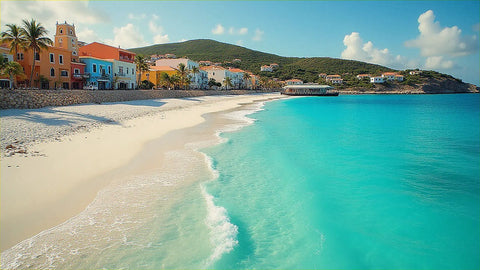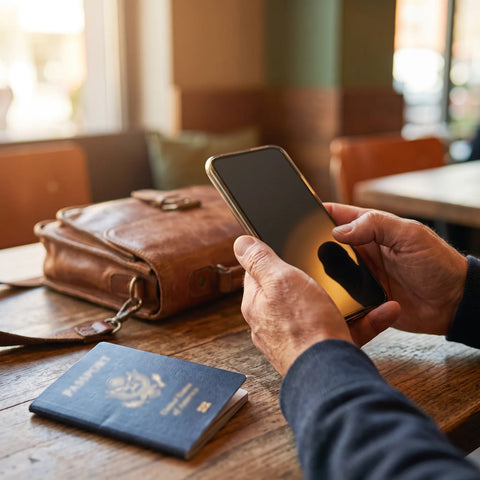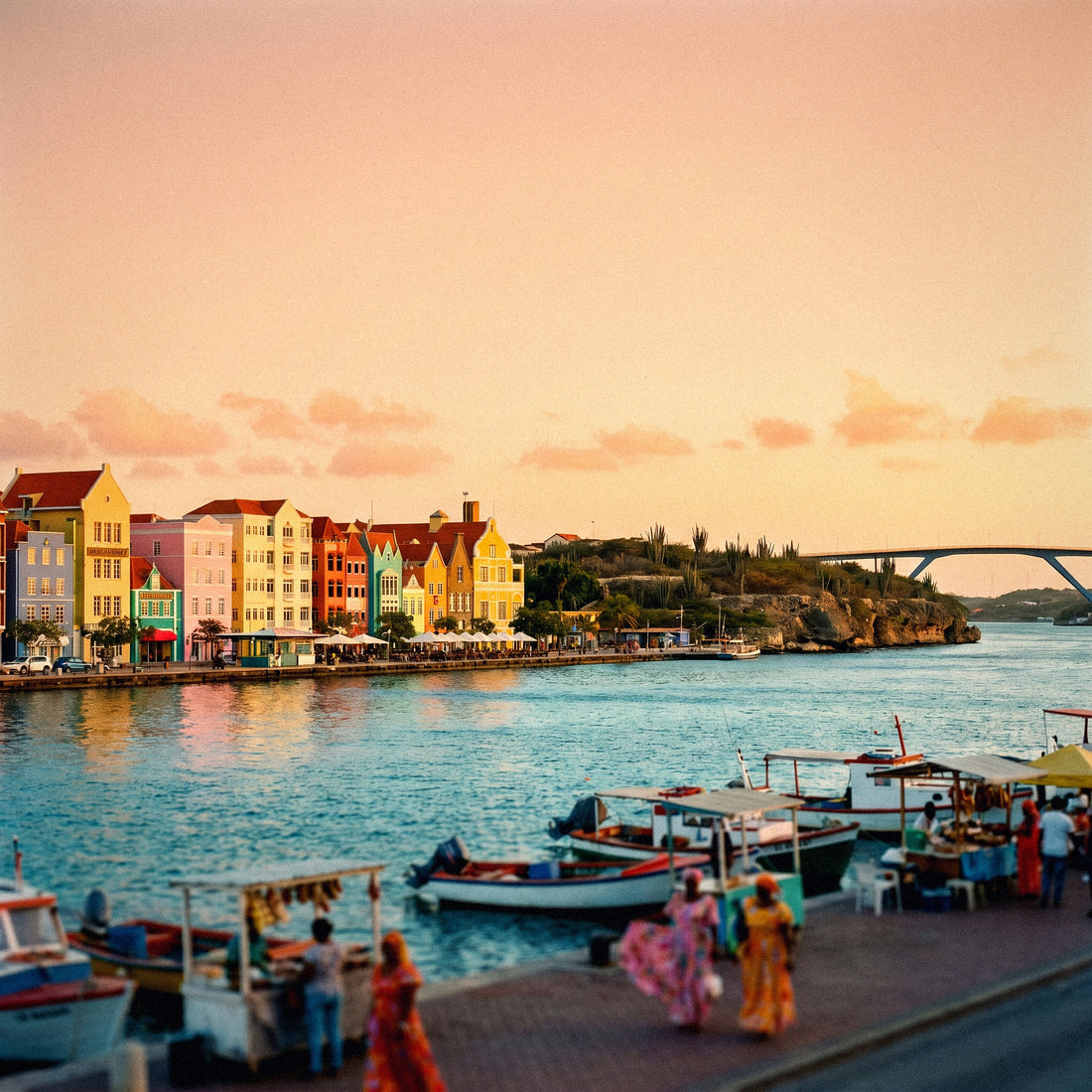
If you're planning your trip to Curaçao —colorful Willemstad, beach-side reefs, and maybe a cruise stop— there's one detail you shouldn't leave until the last minute: how to get internet in Curaçao without a nasty surprise on your bill or getting lost without Google Maps on your way to a hidden cove. In this guide, I'll compare, straightforwardly, all the ways to connect —from your usual operator's roaming to a local SIM with a passport— so you land (or disembark) ready and can stay connected with your phone always at hand from the very first minute.
How to connect to the internet in Curaçao
To get internet in Curaçao, you have four options: your operator's roaming, hotel and cruise Wi-Fi, a local Digicel or Flow SIM card purchased with your passport, and an eSIM that you activate before flying. For most tourists, the eSIM is the most practical and economical.
Curaçao is the "C" of the ABC islands —along with Aruba and Bonaire— a piece of the Caribbean off the coast of Venezuela that is part of the Kingdom of the Netherlands. This confuses many people when it comes to connectivity, and I'll clarify that later. The island has two mobile operators, Digicel and Flow (heir to the former UTS), and both offer very decent 4G LTE in Willemstad and tourist areas. There is still no 5G: the fastest you'll find is 4G, which is more than enough for travel.
The good news is that Curaçao is outside the hurricane belt, so its travel season is long and stable. That's why it's advisable to make two decisions before flying. One is how you connect (roaming, Wi-Fi, local SIM, or eSIM), which affects your wallet and convenience. The other is where you will be each day, which determines whether you will have coverage: Willemstad's historic center, with antennas everywhere, is not the same as an excursion to Klein Curaçao in the middle of the sea.
The four options for connecting
To get connected on the island, you basically have four options, and it's worth knowing all of them before deciding. There's no single answer: what works great for someone spending a week at a Jan Thiel resort might be a mistake for someone exploring the western coves by rental car or disembarking from a cruise for a few hours at the mega-pier.
That's why I present them as four very different approaches instead of just selling you one. Before going into detail about each, here's a quick overview of where each option fits depending on your trip, your budget, and how much hassle you want when you land.
| Option | Estimated Cost | Convenience | Ideal for |
|---|---|---|---|
| Spanish Roaming | High (per MB or bundles) | Zero hassle | Very short trips |
| Hotel/cruise Wi-Fi | Free or paid ($25-40/day) | Only on-site | Occasional checks |
| Local SIM Digicel/Flow | Low (SIM from ~$14) | Passport and store | Long stays |
| Travel eSIM | Medium-low | Activates automatically | Most tourists |
None is "the best" in the abstract: it depends on how many days you stay, whether you're traveling with family, and how much coverage you need outside the capital. And there's a nuance that weighs more heavily in Curaçao than it seems: although the island is Dutch, that doesn't mean what almost everyone thinks it does for your bill. Let's get to it.

Roaming with your Spanish operator
Roaming means turning on your mobile and it just works: you land, it connects to a Curaçao network, and you browse. That's its only big advantage, and for a two-day getaway, it might be worth it out of sheer laziness. The problem is the price, because the European rate you use in Amsterdam or Lisbon doesn't apply here. As soon as your phone connects to a Curaçao network, you pay an international roaming rate, which for many Spanish operators is calculated in single megabytes at several euros per MB or daily bundles that drain your budget in two days.
Often, it's the surprise bill upon returning home that drives people to seek alternatives. Before relying on it, call your operator and ask for the exact price for Curaçao, because it's usually in the most expensive category, "rest of the world."
If you're still considering it, check the temporary travel bundles for that area, which can sometimes be worthwhile for three or four days. To understand how all this is calculated, I recommend my guide on how much international roaming costs, and if you want a direct comparison, I have a comparison of eSIM vs. roaming with the numbers laid out.
Dutch but not EU? European roaming doesn't apply here
This is the big misunderstanding about Curaçao, and I want to be very clear so you don't get an unpleasant surprise. Yes, Curaçao is part of the Kingdom of the Netherlands, but it is an autonomous country within the Kingdom and, for European purposes, an "overseas country and territory": it is not part of the European Union. This is an exception that misleads many travelers, because in the continental Netherlands —Amsterdam, Rotterdam— your Spanish rate works "like at home," without surcharges.
Just because your passport bears a Dutch stamp doesn't grant you European roaming in Curaçao. The EU regulation that lowered roaming costs applies to continental Europe of the Netherlands, not to its Caribbean islands. Here you pay international rates, as in any destination outside the EU.
Why does it matter so much? Because some people assume that, being "Holland," they can use their European data without thinking, and then face expensive surcharges. The same applies to Aruba and Bonaire, the other two ABC islands. The practical conclusion is simple: to connect in Curaçao, treat it for what it is —a Caribbean destination outside the EU— and choose an option designed for travel, don't rely on your European bundle. Below, you'll see why a digital SIM is often the cleanest solution.
Hotel, resort, and cruise ship Wi-Fi
Free Wi-Fi is your ally for anything that isn't urgent. Almost all hotels and resorts in Willemstad, Jan Thiel, and Pietermaai offer decent Wi-Fi in rooms and common areas. For uploading photos of the colorful houses in Handelskade, making video calls at night, or planning the next day, using the lobby Wi-Fi at night is more than enough and doesn't cost a cent.
The problem arises when you leave the hotel, and especially if you arrive by cruise. Onboard Wi-Fi is satellite-based, slow, and costs extra: depending on the cruise line, it's around $25-40 per day. Multiply that by the number of days and people, and you'll understand why many people look for another option for their time ashore. The good news is that as soon as you step onto Willemstad's pier, you're on the island and there's regular mobile network.
Another drawback of open Wi-Fi is security: on public networks, it's not advisable to enter banking details without a VPN. My advice is to treat Wi-Fi as a complement, never as your sole network. If a portable Wi-Fi tempts you as an alternative, check out my comparison of eSIM versus pocket Wi-Fi, where I explain the hassle of batteries, deposits, and why it's rarely worth it for a short trip.
Local SIM: Digicel and Flow with passport
A local SIM is the cheapest option if you're staying for many days or use a lot of data. The two operators are Digicel (very strong in Willemstad and tourist areas) and Flow, heir to UTS, which usually has the most consistent coverage across the rest of the island. A SIM costs around 25 guilders (about $14), and tourist packages are straightforward: Flow offers 10 GB for $20 or 20 GB for $40, and Digicel, 5 GB for $20 or 20 GB for $50. For long stays, the price per gigabyte is hard to beat.
The downside is the management. Curaçao law requires you to register your prepaid SIM with your passport, so you'll have to queue with your passport in hand at a kiosk at Hato International Airport or an official store. Digicel and Flow counters are in the arrivals area, but if you land at night, they might be closed, leaving you without data for the first few hours.
If you're traveling for several weeks or need a Curaçaoan number for administrative tasks, the hassle is worth it. For a week at a resort or a cruise stop, most people prefer to avoid the queue. I compare it calmly in my article on eSIM versus local SIM so you can see when each one truly pays off.

The eSIM, my recommended option
For the vast majority of trips to Curaçao, my recommendation is a data eSIM. It's a digital SIM that you buy online, receive by email, and install by scanning a QR code: you can activate it from your couch at home days before flying and arrive in Willemstad already connected, without looking for kiosks or registering anything with your passport. If you've never used one, my guide on what an eSIM is explains it step by step.
The advantages are clear. You keep your Spanish number active in the physical slot of your phone (to receive bank SMS or some calls), while data travels via the eSIM, relying on the local network with the best coverage. There's no plastic to lose, no deposit, and you don't depend on any store's opening hours when you disembark. The only requirement is that your phone is eSIM-compatible, which is true for almost all models from recent years.
The honest downside: for very long stays and huge data consumption, a rechargeable local SIM might be slightly cheaper per gigabyte. But when you add up the convenience, the absence of queues, and not relying on a store, the eSIM wins for the average tourist. You can find all the fine print in my eSIM guide for Curaçao.
Real coverage: the island yes, remote coves so-so
This is the section that most people skip and later regret. In Willemstad, Jan Thiel, Mambo Beach, and Pietermaai, 4G LTE coverage is very good with both operators: fluid browsing, instant maps, and uninterrupted video calls. The situation changes when you move towards the west of the island —Westpunt, Christoffel Park, Shete Boka— and some northern coves, where Flow usually holds up better than Digicel, but the signal can be intermittent.
The real black spot is Klein Curaçao, the uninhabited islet to the southeast that you visit by boat: there are no antennas there, and you'll lose data. Take photos of that white sand and upload them later, once you're back on solid ground.
Knowing in advance where you're going to lose a bar of coverage saves you stress. In the water, diving at the Tugboat in Caracasbaai or snorkeling at Playa Kenepa, don't expect miracles either: the beach usually has a signal, but underwater, obviously not. Here's what to expect in the most common places.
| Area | Mobile Coverage | What to Expect |
|---|---|---|
| Willemstad and Pietermaai | Very good (4G LTE) | Fluid connection at all times |
| Jan Thiel and Mambo Beach | Very good | No problems in the resort area |
| Playa Kenepa / west of the island | Acceptable | Good on the beach, intermittent on the way |
| Christoffel / Shete Boka | Irregular | Flow is better; expect some gaps |
| Klein Curaçao | None | Uninhabited island: no data |
Moral of the story: where there's a town or resort, you'll connect wonderfully, and where there isn't, no magic is possible. Plan excursions to Klein Curaçao and the far west assuming you'll be without signal for a while.
How much data you actually need
The million-dollar question. The good news is that calculating gigabytes wisely is easier than it seems if you separate by type of use. As a general rule, an average traveler uses about 1 GB per day: light use (maps, messaging, some web browsing) is around 0.4 GB, while intense use with social media, video, and photo uploads can go up to 2.5 GB daily or more.
For a typical one or two-week trip, this translates to a range of between 7 and 30 GB. If you use hotel Wi-Fi a lot at night, you'll stay on the lower end; if you do live streams from the beach and video calls every day, aim for the higher end or a generous plan. Here it is in a table.
| Profile | Daily Consumption | 7-14 Days |
|---|---|---|
| Light (maps and chat) | ~0.4 GB | 3-6 GB |
| Medium (social media and browsing) | ~1 GB | 7-15 GB |
| Intense (video and live streams) | ~2.5 GB | 18-35 GB |
My trick: since you'll be without data in Klein Curaçao and some western coves anyway, don't inflate your estimate thinking you'll consume the same amount every day. And if in doubt, go for a plan with some margin or a top-up option; running out on the second to last day is a typical hassle that can be avoided with a little foresight.
How to choose, activate, and avoid losing signal
Choosing wisely is a matter of cross-referencing three pieces of information: travel days, estimated gigabytes, and how far you'll be from Willemstad. If you're exploring the west or going to Klein Curaçao, prioritize range and accept some gaps; if you're moving between the capital, the southern beaches, and classic excursions, convenience is key. The best approach is to get everything ready before takeoff and not improvise upon arrival. With an eSIM, the process is quick; these are the steps I follow:
- Check if your phone is eSIM compatible (phone settings or manufacturer's website).
- Purchase the plan with the GBs and days that suit you, a few days before flying.
- Install the profile by scanning the QR code you receive by email, using Wi-Fi at home.
- Set the eSIM for "data" and your Spanish SIM for calls and SMS.
- Upon landing at Hato, activate eSIM data roaming, and you're all set.
And a couple of habits that have saved me from more than one tight spot: download offline Google Maps of the island, save tickets and reservations on your phone in case there's no network when you disembark, and carry an external battery. By combining the digital SIM for daily use, Wi-Fi for heavy tasks, and these little tricks for gaps, your trip through Curaçao will be covered from end to end.
Frequently asked questions
Do I have EU roaming in Curaçao because it's Dutch?
No. Curaçao is part of the Kingdom of the Netherlands, but it is an autonomous country and an overseas territory outside the European Union. Your European "like at home" rate does not apply: you will pay international roaming, just like in any destination outside the EU.
Does my Spanish operator's roaming work in Curaçao?
Yes, but at international roaming rates, not European rates. Curaçao is not in the EU, so check the cost per MB or the travel bundle before you go, because the island is usually in the most expensive category, "rest of the world."
Do I need a passport to get connected?
Only if you buy a local Digicel or Flow SIM: the law requires you to register it with your passport at Hato Airport or an official store. With a travel eSIM or roaming, no in-person process or document is needed.
Is there 5G in Curaçao?
Not yet. Both operators, Digicel and Flow, operate on 4G LTE, which provides ample speed for maps, video, and video calls. Don't count on 5G, but you won't miss it for normal travel use.
Will I have coverage in Klein Curaçao and the western coves?
Not in Klein Curaçao: it's an uninhabited islet without an antenna, so assume you'll be without data during the excursion. In the west (Westpunt, Christoffel) the signal is intermittent and Flow usually holds up better. In the southern beaches and Willemstad, you'll have plenty of coverage.
I'm arriving on a cruise for a few hours, would an eSIM work for me?
Yes. As soon as the ship docks at Willemstad's mega-pier, you're on the island, with normal mobile network coverage, and your eSIM will work immediately. It saves you from expensive and slow onboard Wi-Fi for those hours of shore leave. At sea, however, there's no antenna.
How many gigabytes should I get for a week?
For average use, 7 to 15 GB is usually enough; if you take a lot of photos, videos, or do live streaming, aim for 18-35 GB. Remember that in Klein Curaçao and some remote coves, you won't be using data, so don't inflate your calculation thinking you'll spend the same amount every day.
Can I pay for the connection in dollars?
Yes. The official currency is the florin (formerly the Antillean guilder, now the Caribbean florin), pegged to the dollar at 1.79, but the US dollar is accepted almost everywhere. Travel SIMs and eSIMs are usually charged directly in dollars, so you won't have any exchange rate issues.
Conclusion
To sum up the map: roaming is convenient but expensive, Wi-Fi is free at the hotel but costs money and is slow on the cruise, a local SIM card is worthwhile if you stay a long time but requires a passport and queuing, and an eSIM is the sweet spot for most tourists. And the Curaçaoan lesson you shouldn't forget: although the island is Dutch, it is not in the EU, so your European plan is not valid and it's a good idea to arrive with a travel plan in mind.
If you want to forget about it and arrive connected from the first minute, take a look at the PuraSIM eSIM for Curaçao: you buy it, install it at home, and land in Willemstad with Google Maps working. Have a good trip and see you among the reefs.