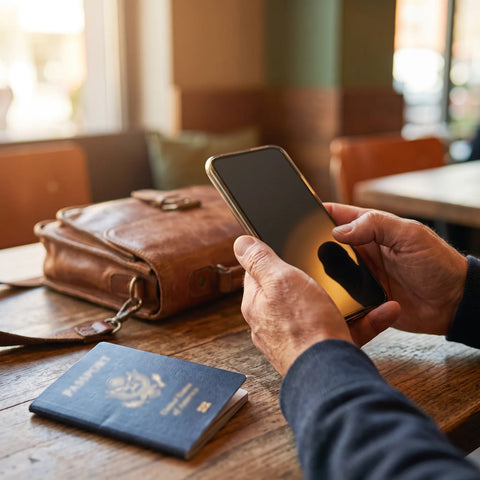
Bolivia is one of those destinations where your phone goes from having full bars to zero signal in a matter of miles. You'll climb over 3,600 meters in La Paz, cross an endless salt flat, and head into the Amazon rainforest, and each of those landscapes treats reception differently. That's why planning your internet in Bolivia before you leave isn't some geeky whim: it's what separates a smooth trip from spending half the morning hunting for signal just to request a transfer. Here I compare, honestly, all the real options and tell you where you'll have data and where you won't.
What connectivity is like in Bolivia in 2026
Quick answer: you have four options to get online in Bolivia: roaming with your carrier (convenient but expensive), hotel Wi-Fi (free but ties you to the building), a local Bolivian SIM (cheap, bought with your passport), or a travel eSIM that you activate before you leave and works as soon as you land.
It helps to understand the terrain. Bolivia has less investment in mobile infrastructure than its neighbors — Peru, Chile, or Argentina — so the rule is simple: cities are well covered with 4G (around 15 to 25 Mbps, plenty for tourist use), but as soon as you leave urban centers, it drops to 3G or disappears entirely.
There are three carriers, and you need to remember this order because it matters a lot later on:
- Entel: state-owned and the one that reaches farthest. It has the best national coverage, especially on the high plateau and along tourist routes. For a traveler, the obvious choice.
- Tigo: works very well in the big cities (Santa Cruz, La Paz, Cochabamba), but its rural reach is clearly weaker.
- Viva: the smallest, focused on the capitals. Outside them, better not to rely on it.
Translated into travel decisions: in Bolivia, whoever has the tower rules, and that tower is almost always Entel's.
Roaming with your carrier: convenient and very expensive
The do-nothing option: you turn on your phone and let your usual carrier connect to the Bolivian network. It works, but it's the most expensive of all and the one that gives you the biggest shock when you get home.
Bolivia is outside the European Union, so your "roaming included" plan doesn't apply here. You're in the most expensive international zone for almost every company, and that's where three-figure bills come from. Browsing without a data package can cost you several euros per megabyte — some carriers advertise rates around 6 € per MB outside a package — so watching two minutes of video at El Alto airport could cost you the price of dinner.
That's why they sell international data packages: a few gigs for between 5 and 15 € per day. The problem isn't just the price, it's the fine print: they expire, auto-renew, and throttle your speed once you run out. If you want the numbers, I break it down in how much international roaming costs and in the eSIM vs roaming comparison.
When does it make sense? Only in two cases: if your company is paying the bill, or if you're on a 24-hour layover and don't want the hassle.

Hotel Wi-Fi: Useful, but Limited
Wi-Fi is free and in Bolivian cities it usually works. Almost all hotels, hostels, and cafés in La Paz, Sucre, or Santa Cruz offer a decent connection, and as a backup network it’s perfect: upload the day’s photos, make a long video call, or download offline maps before heading out on a tour.
The problem is that Wi-Fi only exists where there are walls, and traveling through Bolivia means being almost always outside them: on a cable car over La Paz, on a night bus to Uyuni, or in line for a boat on Titicaca. That’s exactly when you need Google Maps, the guide’s number, or the QR code for your ticket.
Plus, there are three reasons not to rely on it:
- Security: open networks in airports and bus terminals are a comfortable ground for credential theft.
- Actual speed: the Wi-Fi in a full hostel at nine at night is a lottery that rarely pays off.
- Zero coverage outside the premises: it won't help you call a taxi or let someone know you’re running late.
If you’re considering a portable router as an alternative, I compare it thoroughly in eSIM vs pocket Wi-Fi: quick summary, it’s one more gadget to carry, keep an eye on, and return.
Local Bolivian SIM: Entel, Tigo, and Viva
The classic backpacker option. It’s cheap, works well in the city, and gives you a Bolivian number, useful if you’re booking tours by phone. The chip costs very little —between free and 10 bolivianos with a normal activation— and the data packages are laughable: about 3 GB for 30 BOB (around 4 €) or 10 GB for 70-100 BOB (about 10-14 €).
Now, the fine print almost no one tells you: in Bolivia it’s mandatory to register the SIM with your passport and link your phone’s IMEI. If you don’t, the carrier will block the line exactly after 7 days and you’ll be stranded. That’s why it’s best to buy it at an official shop —Entel has counters at El Alto and Viru Viru airports— and not from a street vendor.
The process with your passport in hand takes between 15 and 30 minutes. What to expect from each carrier:
- Entel: the best coverage outside the cities. If you leave the pavement, it’s the safe bet.
- Tigo: good prices and solid signal in big cities, weak in rural areas.
- Viva: the cheapest on some plans, but with significant gaps outside the capitals.
The real cost isn’t the money, it’s the time and paperwork. I compare it calmly in eSIM vs local SIM.
eSIM: My Recommendation for Most People
It’s a digital card that you download onto your phone and it coexists with your regular line without removing anything. You buy it from home, install it with your Wi-Fi, and when you land in La Paz or Santa Cruz, it automatically connects to the Bolivian network. No queues, no passport at the counter, and no IMEI registration.
If you’ve never used one, start with what is an eSIM. The only requirement is a compatible phone (iPhone XS or later, Samsung Galaxy S20 onwards, Pixel 3 and above) and unlocked from a carrier.
The concrete advantages for Bolivia are three:
- Connection on landing: you get off the plane with Google Maps and the translator working, which is exactly when you need them most.
- Fixed price: you pay before you travel and forget about surprise bills when you get back.
- Your number stays active: you receive the bank SMS —that verification code that always arrives at the worst moment— without using data or skipping local registration.
The honest downside: it doesn’t give you a Bolivian number for local calls, and if you go over on data, you’ll have to top up. For a normal tourist trip, neither is a problem. You have the plans and the step-by-step in the eSIM guide for Bolivia.
Comparison: which option works for you
Here's a table summarizing what we've covered so you can decide in thirty seconds. Prices are approximate for a ten-day trip and depend heavily on your home carrier and the data plan you choose:
| Option | Approximate cost (10 days) | Ready when you land | Best for |
|---|---|---|---|
| Roaming from your carrier | 50-150 € (or much more without a bundle) | Yes | Business trips and short layovers |
| Hotel Wi-Fi | 0 € | No | Backup, never a sole solution |
| Local Bolivian SIM | 10-20 € | No (requires passport and IMEI registration) | Long stays and a local number |
| Travel eSIM | 10-25 € | Yes | Most tourists |
My take, after many trips: if you're going for less than a month and want zero friction, the digital card wins hands down. If you're staying for weeks working from Sucre or La Paz, it's worth the paperwork to get a Bolivian line with your own number. And hotel Wi-Fi is always there, but as a supplement.
The right question isn't "which option is cheapest?" but "what happens if I lose internet at the worst moment?" In Bolivia, that moment usually comes in the middle of the Salar, hours from the nearest town.

Coverage in La Paz, El Alto, and the cities
Here's the good news, and let's bust a myth while we're at it: altitude doesn't ruin coverage. La Paz sits at 3,640 meters and El Alto airport at 4,061 meters, yet you get stable 4G throughout the city. Even the cable car —the public transport that flies over La Paz— has coverage end to end, so you can upload photos while crossing the city by air.
The rest of the major urban centers work just as well:
- Santa Cruz de la Sierra: the country's most modern city, with the best 4G network, especially from Tigo.
- Cochabamba and Oruro: solid urban coverage in the center and tourist neighborhoods.
- Sucre: the constitutional capital has good 4G throughout the historic quarter, ideal if you're staying a few days.
- El Alto: despite its size and altitude, decent signal in market and transport areas.
In the cities, any option from this guide works: maps, messaging, translator, and social media run smoothly. The antenna density is high where people live, and that's the comfortable scenario. The problem starts as soon as the road empties out. And in Bolivia, it empties out very fast.
Salar de Uyuni: the big warning of this trip
If you take away just one thing from this guide, let it be this: there is no coverage inside the Salar de Uyuni. In the town of Uyuni you have signal (Entel works best), you can book your tour, upload photos, and let people know you've arrived. But as soon as the 4x4 drives into the salt desert, the signal disappears and doesn't come back.
And this matters, because the tours aren't short: the classic route through the Salar and the highland lagoons lasts 3 days and 2 nights, and a good chunk of that time you'll be completely offline. It's not a problem with your card: there are no antennas in the middle of 10,000 km² of salt, and nothing can invent coverage where it doesn't exist.
How to prepare so it's not a problem:
- Download offline maps of the area before leaving Uyuni.
- Let your people know you'll be unreachable those days; no need to panic if you don't reply.
- Save the tour details (driver's name, agency, schedules) on your phone or on paper.
- Embrace the disconnection: it's part of the trip. The sunrise over the salt mirror is best enjoyed without looking for bars.
You'll have quality connection before and after, in town. During the Salar, your phone is a spectacular camera and little else.
Titicaca, Sucre and the Amazon
Outside the big cities, Bolivian coverage is a patchwork, and it pays to know what to expect in each key tourist area so you don't get caught off guard:
| Area | Actual coverage | What to expect |
|---|---|---|
| Copacabana (Lake Titicaca) | Decent in town | Reasonable 4G on Entel; enough for bookings and messaging |
| Isla del Sol and lake islands | Patchy or none | Signal comes and goes; on boat crossings, almost nothing |
| Sucre and Potosí | Good in the city | Solid 4G in the urban core; drops off at the mines and on the roads |
| Rurrenabaque (Amazon) | Basic in town | Barely-there 3G/4G on Entel; in the jungle and the pampas, nothing |
The Amazon deserves the same warning as the Salar: Rurrenabaque has basic connectivity, but jungle and pampa tours last 3 or 4 days with no coverage from any carrier. Prepare the same way: download everything and switch off with a clear conscience.
The Titicaca is kinder —Copacabana works— but on Isla del Sol the signal comes and goes, so don't count on livestreaming the sunset. The rule that never fails in Bolivia: sort out everything important while you have 4G in town, because out on the water or in the jungle there'll be no way to do it.
How much data you actually need
The million-dollar question. The short answer: less than you think, and in Bolivia even less, precisely because you'll spend whole days in the Salar, the Titicaca or the jungle with no signal, where you won't use a single megabyte.
My practical rule is to budget between 500 MB and 1 GB per day for normal tourist use: maps, WhatsApp, finding somewhere to eat, uploading a few photos and some time on social media at night. That leaves you comfortable. Only if you make long video calls daily or work from your phone should you go up to 2 GB a day.
| Trip type | Duration | Recommended data |
|---|---|---|
| Stopover or city break in La Paz | 3-4 days | 3 GB |
| Classic route (La Paz + Uyuni + Sucre) | 10 days | 5-8 GB |
| Grand route with Titicaca and the Amazon | 3 weeks | 10-15 GB |
| Digital nomad or remote work | 1 month | 20 GB or more |
One tip that saves a lot of gigs: download Google Maps offline for each region before you head out. It's the biggest data hog and, on top of that, it's the only thing that will save you when you lose signal on the endless stretch of the highlands. Days on excursions without coverage are, in practice, gigs you don't spend.
Tricks to avoid being cut off
After traveling through countries with impossible geography, these are the habits that really make a difference in Bolivia:
- Download everything critical offline: maps by region, tickets, bus and flight passes, and your accommodation bookings as PDFs.
- Share your itinerary: if you're doing the Salar tour or a jungle trip, let people know which days you'll be without coverage.
- Always carry a power bank: hunting for signal drains battery the fastest, and at 4,000 meters the cold wears it down even quicker.
- Check your data when you land: if you're using a digital SIM, test it on the airport Wi-Fi before leaving the terminal.
- Save the key numbers in your contacts: emergencies (110 Police, 118 medical emergencies), your accommodation and your tour agency.
- Don't trust the signal bar: in rural areas you can see 3G and still have no usable data. The ghost signal is common.
And one mindset tip: the days without coverage in the Salar or the Amazon are not a flaw in your trip, they are the trip. Prepare well and enjoy them instead of fighting with your phone looking for a bar that is not going to come.
Frequently asked questions
Is there coverage in the Salar de Uyuni?
In the town of Uyuni, yes, with good Entel signal. But inside the Salar, coverage is practically nonexistent: most of the 3-day tours happen without data from any carrier. Download the maps before you leave and accept the disconnection.
Do I need my passport to buy a SIM in Bolivia?
Yes. You are required to register the SIM with your passport and link the IMEI at an official store. Without that registration, the carrier blocks the line after 7 days, so avoid street vendors.
Which Bolivian carrier has the best coverage?
Entel, no question, especially outside the cities and in the highlands. Tigo works very well in the big cities, particularly in Santa Cruz, and Viva is the most limited outside the capitals.
Does the altitude in La Paz affect mobile signal?
No. Even though La Paz sits at 3,640 meters and El Alto at over 4,000, there is stable 4G across the city and even on the cable car. Altitude does not degrade coverage; what reduces it is moving away from urban centers.
How many GB do I need for 10 days in Bolivia?
Between 5 and 8 GB easily covers a 10-day tourist trip with maps, messaging, social media, and the occasional video call. You use less than you think because you will spend many hours in the Salar or the jungle with no signal, using no data.
Will my phone work in Bolivia?
Yes. Bolivia uses 4G bands compatible with European phones, so any recent, carrier-unlocked device will work. If you use a digital card, you just need a phone that supports eSIM.
Is there internet in the Amazon and Lake Titicaca?
In the base towns (Rurrenabaque, Copacabana) there is basic connectivity, but on jungle and pampa tours you'll be 3-4 days without signal, and on Isla del Sol coverage is intermittent. Get everything sorted before you head out.
How much does a local data card cost in Bolivia?
Very little: the SIM card ranges from free to 10 bolivianos, a 3 GB package costs around 30 BOB (about 4 €) and 10 GB costs between 70 and 100 BOB (10-14 €). The real cost is the registration process with your passport, not the money.
Conclusion
Bolivia will give you two opposite experiences: well-connected cities at over 3,600 meters and corners —the Salar, the jungle, the Titicaca islands— where your phone turns into a very expensive camera. Accepting that duality is the key to traveling stress-free.
My recommendation is simple: get your connection sorted from home for everything that does have coverage (La Paz, Sucre, Santa Cruz, the airports, the base towns) and prepare offline mode for what doesn't.
If you want the simplest option, activate the PuraSIM eSIM for Bolivia before you board the plane: it installs in two minutes, connects automatically on landing, and gives you a fixed price with no surprises when you get back. The rest —the salt flat, the llamas, and the coca tea— is on you.