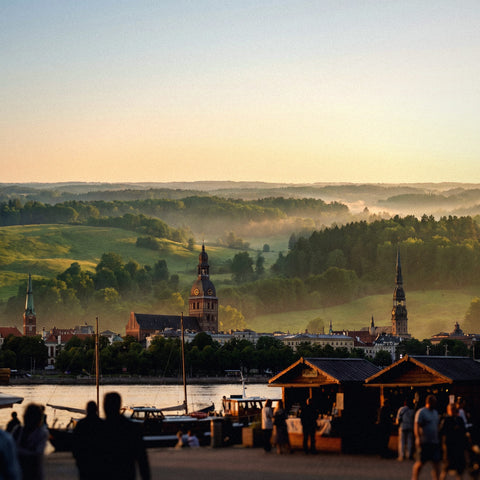
If you're planning a trip to Riga, a beach day in Jūrmala, or a hike in the forests of Sigulda, and you're wondering how internet in Latvia works, I'll tell you clearly and directly. The good news is twofold: Latvia has one of the best mobile networks in Europe, and often you won't even need to buy anything, because your Spanish plan might work just as it is. Here, I compare the four real options you have for getting connected and tell you which one is best for each case, so you can decide before you pack your bags and not in the airport queue.
What are your options for getting internet in Latvia?
To get internet in Latvia, you have four paths: use your Spanish plan with EU roaming (included and at no extra cost), rely on free Wi-Fi in hotels and cafes, buy a local SIM from LMT, Tele2, or Bite, or activate an eSIM before you leave. For most Europeans, your existing plan will suffice.
Latvia makes it very easy because it's a small country with well-connected cities and a top-tier mobile network: 4G reaches over 98% of the population, and speeds are more than enough for any tourist use. That's why the question is rarely "will I have coverage?" but rather "what's the most convenient and cheapest way to stay online?" And the answer largely depends on what plan you have and how many days you're staying. Here's a quick summary to give you an overview before we go into detail:
| Option | Estimated Cost | Ideal for | Things to consider |
|---|---|---|---|
| EU Roaming | Included in your plan | EU travelers with plenty of data | Fair usage cap on cheap plans |
| Hotel/Public Wi-Fi | Free | Saving data at your accommodation | Doesn't cover streets and isn't always secure |
| Local SIM | €4-5 (7 days) | Long stays or high data consumption | Need to swap cards and buy it there |
| eSIM | Starting from a few euros | Convenience and data upon landing | Requires a compatible phone |
Roaming with your Spanish plan: Latvia is in the EU
This is the point almost no one explains well, and it's the most important: Latvia is a member of the European Union and the Schengen area. This means your Spanish plan works there thanks to the "Roam Like At Home" rule: calls, SMS, and data are deducted from your usual allowance without any surcharge. In practice, your mobile behaves as if you were still in Madrid or Seville. This regulation has been in effect since 2017 and is guaranteed, at least, until 2032.
The fine print is called "fair usage policy." Operators can apply a data cap abroad, especially on very economical and prepaid plans, calculated with a regulated formula (in 2026, the wholesale cost dropped to €1.10/GB excluding VAT). That's why a cheap plan might give you fewer gigabytes outside Spain than within. My advice: check your EU data limit in your operator's app before you leave.
When does it really pay off not to rely solely on your plan? If you have few gigabytes, an old plan without EU data, or if you're traveling from outside the European Union. In these cases, having an alternative prepared saves you the disappointment of running out of internet halfway through your trip.
If you want to be precise, here's my comparison of eSIM versus roaming and a guide on how much international roaming costs when you leave the EU.

Hotel and public Wi-Fi: how far does it reach?
Latvia has a strong digital culture, and you'll find free Wi-Fi almost anywhere useful: hotels, apartments, cafes, restaurants, shopping centers, Riga Airport (RIX), and many public spaces in the city center. Riga was one of the first Baltic capitals to embrace open connectivity, so for tourists, it's a convenient and very real resource.
For a trip, this is gold: you can download maps, make video calls, upload photos, and watch series from your accommodation without touching your mobile data. If your data plan is tight on gigabytes, relying on hotel Wi-Fi significantly changes the equation and reduces what you consume on the street to almost nothing.
Now, let's be honest: public Wi-Fi doesn't cover everything. You won't have it while strolling through the old town, waiting for a Bolt, looking for an address, or taking a train to Sigulda. And it's not always secure for sensitive operations like online banking, because open networks are easy to eavesdrop on. That's why I see it as an excellent complement, not a substitute for having mobile data. If you were considering a portable router, in Latvia it rarely pays off; I explain it in eSIM versus pocket Wi-Fi.
Latvian local SIM: LMT, Tele2 and Bite
The Latvian mobile market is divided among three networks: LMT (Latvijas Mobilais Telefons), Tele2, and Bite. LMT is the historical operator and has the best rural coverage, ideal if you're going to be moving around Sigulda, Cēsis, or the Latgale lakes. Tele2 is very competitive in cities and is usually the cheapest for prepaid, with its brand Zelta Zivtiņa ("ZZ"). Bite is the smallest, but it performs perfectly well in Riga and along the coast.
Buying one is simple: there are tourist SIMs at the Narvesen in Riga airport arrivals (they sell Tele2 and LMT) and in kiosks and shops throughout the city. These are the packages designed for travelers:
| Operator / plan | What it includes | Price |
|---|---|---|
| LMT (Tourist SIM) | Unlimited data + calls + SMS, 7 days | €4.50 |
| Zelta Zivtiņa (Tele2) | Unlimited data + calls + SMS, 7 days | €4.49 |
| Bite (Basic package) | 100 MB + calls and SMS, 30 days | Check in-store |
The downsides: you need an unlocked phone, you have to swap out your physical card (and lose your Spanish number if you don't have dual SIM), and sometimes register it with your passport. For long stays or high data usage, it's still very cheap. If you're in doubt, check out my comparison of eSIM versus local SIM.
eSIM for Latvia: data from the moment you land
An eSIM is a digital card that's installed on your mobile phone without plastic: you scan a QR code, and that's it. If you're not sure how it works, I explain it step-by-step in what an eSIM is. The big advantage for travel is that you buy and activate it from your couch at home, before you take off, and when you land in Riga, you already have internet without having to look for shops, queues, or change anything.
In Latvia, these digital cards rely on the local LMT or Tele2 networks (including 5G where available), so the quality is the same as for a Latvian customer. Plus, you keep your Spanish number active in the other slot, ideal for continuing to receive WhatsApp messages or bank SMS without giving up anything.
Who is this the best option for? Especially if you are traveling from outside the EU, if your plan does not include enough European data, or if you simply value the convenience of controlling costs beforehand and arriving with everything sorted. You install it in five minutes, choose the gigabytes you need, and forget about it. This is the method I recommend most when someone wants zero surprises and maximum peace of mind during their trip.
Coverage in Latvia: Riga, Jūrmala, Sigulda, and the Baltic countryside
Here, Latvia surprises: it has one of the best networks in Europe. 4G reaches around 99% of the population, and 5G is already widespread in cities. In Riga, you have excellent 4G and 5G throughout the center, the old town, and the airport, with download speeds reaching 200-400 Mbps where 5G is available. You will have more than enough for maps, video, and work.
In Jūrmala, the trendy beach half an hour from Riga, the signal is stable with 5G in much of the promenade. For Sigulda and the Gauja National Park, LMT is the strongest network: there is solid 4G even on the cable car above the valley, in Cēsis, and along the Vidzeme coast. Only in very isolated farms or deep forest sections might coverage be a bit weak.
The honest summary: Tele2 is already nearing 90% 5G coverage and LMT has deployed more than 1,500 5G antennas, but the workhorse outside the cities is still 4G, which is very fast here. If your plan involves the Baltic countryside and nature, opt for LMT; if you're staying in Riga and Jūrmala, any of the three will do.

How much data do I need for my trip?
The million-dollar question. The short answer: less than you think, especially because free hotel and café Wi-Fi saves you a good chunk of heavy consumption (series, downloads, cloud backups). Mobile data will cover maps, messaging, social media, the occasional Bolt ride, and sporadic video, which consume very little over the course of the day.
As a rule, 5 GB is more than enough for a weekend getaway, and 8-10 GB will give you a comfortable week. Here's a breakdown by profile:
| Travel Profile | Recommended Data |
|---|---|
| Weekend Getaway | 3-5 GB |
| One week of normal tourism | 8-10 GB |
| Two weeks or intense usage | 15-20 GB |
| Remote work or digital nomad | 20 GB or unlimited |
To give you an idea of actual consumption: an hour of maps uses around 5-10 MB, an hour of Instagram or TikTok goes up to 300-500 MB, and a long video call can consume 1 GB. That's why video and social media really move the needle; the rest (WhatsApp, email, searching things) barely counts. If you limit streaming to hotel Wi-Fi, your mobile data will stretch much further than you imagine.
My practical advice: err slightly on the high side. The price difference between a small plan and the next one up is usually minimal, and running out of data halfway through your trip is much more annoying than having a couple of gigabytes left over. And if you're combining Latvia with its Baltic neighbors, calculate the total for the entire trip, not just your days in Latvia.
Baltic route: Latvia with Estonia and Lithuania
Many people don't visit Latvia alone: they combine it with Estonia and Lithuania on the classic Baltic route, going up or down through Tallinn, Riga, and Vilnius. It's a very comfortable trip by bus or car, with short distances and three beautiful capitals in just a week or ten days. And there's great news for connectivity.
All three countries are members of the European Union. This means that with your Spanish plan, roaming is included in all three equally: you cross from Latvia to Estonia or Lithuania, and your mobile phone continues to work the same way, without surcharges or changes. You don't need a different card at each border or to buy local SIMs in each country, which used to be the biggest hassle for this type of trip.
If you're coming from outside the EU or your plan falls short, a digital card truly shines here: you can choose a plan that covers the entire Baltic region or even all of Europe, and you only need one installation for all three countries. This way, you avoid juggling at each stop and maintain the same connection from Tallinn to Vilnius. It's the cleanest way to travel the Baltics without thinking about coverage for a second.
So, which option is best for you?
Let's break it down by your specific situation, which is what truly matters. If you're traveling from Spain with a modern plan and plenty of gigabytes, don't buy anything: use your EU roaming and rely on free Wi-Fi. It's the most convenient option and won't cost you an extra euro. Just check your data cap abroad in case you have an old or very basic plan.
If you're traveling from outside the EU, your plan doesn't include European data, or you simply want to be worry-free and have everything sorted from home, the digital card is your best ally, especially if you're doing the full Baltic route. And if you're staying for many weeks, use a lot of data, or are looking for the lowest cost per gigabyte, a local SIM from LMT or Tele2 bought at the airport will be very worthwhile.
And if you're torn between two options and can't decide, think about the worst moment of your trip: looking for your hotel at night in the rain in Riga, or ordering transportation in a Latgale village without Wi-Fi coverage. That's when having your own reliable data, activated beforehand, without depending on finding an open network or your plan holding up to fair usage limits, really makes a difference.
In summary: choose without overspending and tailored to your trip. You'll find all the details, prices, and activation steps in my complete guide to Latvia eSIM. Happy travels.
Frequently Asked Questions
These are the most common questions I get about connecting in Latvia, answered in a couple of lines each.
Will my Spanish mobile work in Latvia without doing anything?
Yes. Latvia is in the European Union, so your Spanish plan works with "Roam Like At Home": calls, SMS, and data come from your usual allowance without surcharge. It's only advisable to check your data cap abroad if you have a very basic plan.
How much does roaming cost in Latvia with a Spanish plan?
Zero extra euros: as an EU country, your national tariff applies without surcharge, and this will continue until at least 2032. The only limit is the fair use policy for economical plans. If you were traveling from outside the EU, then there would be a cost that you should calculate beforehand.
Is there free Wi-Fi in Riga and Latvia?
Plenty. There's free Wi-Fi in hotels, cafes, restaurants, shopping centers, Riga airport, and many public spaces in the city center. It's perfect for saving data, though it doesn't cover the streets and isn't advisable for sensitive banking operations.
Is an eSIM worth it for Latvia?
It depends on your plan. If you're traveling from the EU with plenty of data, you probably don't need it. It's worth it if you're coming from outside the EU, if your plan is short on gigabytes, or if you value having everything activated from home and doing the Baltic route with a single installation.
Where can I buy a local SIM in Latvia?
The most convenient place is the Narvesen at Riga Airport arrivals, which sells Tele2 and LMT. There are also tourist SIMs in kiosks and shops throughout the city. You need an unlocked phone and, sometimes, your passport to register it.
How many GB do I need for a week in Latvia?
With 8-10 GB, you'll be fine for a week of normal tourism, as free hotel Wi-Fi absorbs most heavy usage. For a weekend, 3-5 GB is enough, and if you're working remotely, 20 GB or an unlimited plan is advisable.
Is there 5G in Latvia?
Yes, and it's very good. Tele2 is close to 90% 5G coverage, and LMT has over 1,500 antennas, with 5G in Riga, Jūrmala, and other cities at 200-400 Mbps. Outside urban areas, 4G is very fast and reaches 99% of the population.
Can I use the same connection in Estonia and Lithuania?
Yes. All three Baltic countries are in the EU, so your Spanish plan works the same in Latvia, Estonia, and Lithuania without surcharge. And if you use a digital card, you can choose a regional plan that covers all three with a single installation.
Conclusion
Getting internet in Latvia is one of the easiest things you'll encounter while traveling: a very fast mobile network, excellent coverage even in Sigulda, and free Wi-Fi everywhere. If you're coming from the EU, your plan will work as is; if not, or if you're doing the Baltic route and want to be completely worry-free, a digital card will solve it in two minutes. Choose according to your trip and arrive already connected from landing with the PuraSIM Latvia eSIM. Happy travels.