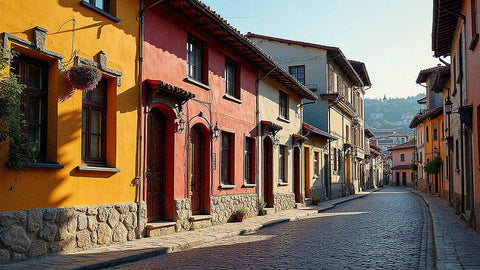
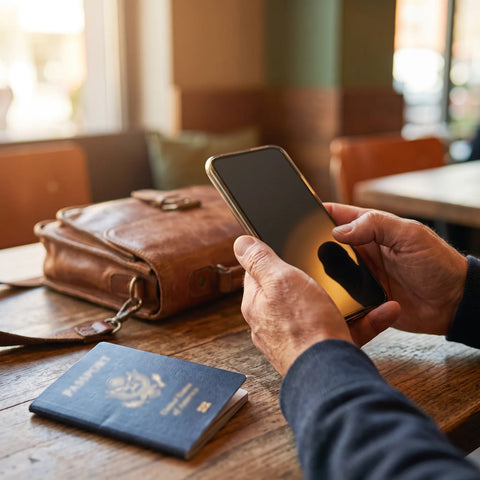
If you're planning a trip to Sofia, the Black Sea beaches, or skiing in Bansko, you're probably wondering about internet in Bulgaria and which option is best for staying connected without bill shock. The good news is that Bulgaria is an easy country: it's part of the European Union, has good coverage, and offers several ways to connect. The bad news is that "many options" doesn't mean "all of them are suitable." In this guide, I'll honestly compare roaming with your Spanish plan, hotel Wi-Fi, a local Bulgarian SIM, and an eSIM, so you can choose the best option for your specific needs.
How the internet works for tourists in Bulgaria
When it comes to connectivity, Bulgaria is one of the most convenient Eastern European destinations for Spanish travelers. Being within the European Union, your home plan works there just as it does in Spain, thanks to EU regulations, and the country's infrastructure is solid: all three operators provide 4G coverage to over 99% of the population and are rapidly deploying 5G in cities and along the coast.
As a tourist, you essentially have four ways to connect, and it's advisable to choose wisely instead of just going with the first option you're offered: use your Spanish company's roaming, buy a local prepaid SIM, purchase a data eSIM before you leave, or rely on hotel and cafe Wi-Fi. Each option has its strengths and weaknesses. There's no single answer: it depends on how many days you're traveling, how much data you use, whether your plan is old or new, and, most importantly, whether you're traveling from inside or outside the EU. In the following sections, I'll break down each option with real data and prices, so you can make a decision based on calculations, not marketing.
Quick summary: In Bulgaria, an EU country, your Spanish plan works with roaming included at no extra cost, up to your data limit. If you have limited data, an older plan, or are coming from outside the EU, an eSIM or a local Bulgarian SIM (A1, Yettel, Vivacom) is usually more cost-effective.
Roaming with your Spanish plan: what's included and what's not
Here's the truth many guides hide: since Bulgaria belongs to the EU, your Spanish plan includes usage there without surcharge, thanks to the "Roam Like At Home" principle. This means your calls, SMS, and data are consumed from your usual allowance, at the same price as in Barcelona or Madrid. For most travelers with a modern plan and sufficient data, this is simply the most convenient and straightforward option: no setup, you keep your number, and you don't spend an extra euro.
The nuance lies in the "fair use policy." If your plan has a very low price per gigabyte, your operator may apply a lower data limit abroad than your national allowance. Once that cap is exceeded, a regulated EU surcharge of €1.30/GB in 2025 will apply, decreasing to around €1/GB from 2027. This is why "unlimited" plans don't offer unlimited data outside Spain: they have a roaming allowance that might be insufficient for a long trip.
When is roaming NOT enough for you? If you have limited monthly data, if you're on an old plan without roaming included, or if you're a heavy user who would quickly exhaust the allowance. I explain this in detail in my guide on how much international roaming costs and in the eSIM vs. roaming comparison.

When an eSIM is truly worth it
I'll be clear so as not to oversell it: if you're traveling from Spain with a standard plan and sufficient data, roaming already covers you, and you don't need anything else. That said, there are several scenarios where a data eSIM does win out, and it's worth doing the math before you travel rather than assuming one way or the other.
An eSIM is particularly worthwhile in these cases:
- Travelers from outside the EU: If you're coming from the UK, Latin America, the United States, or any country without a European agreement, roaming in Bulgaria can be very expensive. Here, an eSIM is almost mandatory.
- Spanish plans with limited data: If you have 5-10 GB per month and your trip is long, you'd burn through your allowance in two days. An eSIM with abundant data frees you up.
- Old or business plans without roaming included, where every MB is billed separately.
- Heavy usage: remote work, video calls, uploading content. You would exceed the "fair use" allowance.
- You want to separate lines: keep your Spanish number for banks and notifications, and use the eSIM only for data.
If you don't know exactly what this technology is, I explain it step-by-step in what an eSIM is. The important thing is that it's activated before you leave home and works as soon as you land.
Local Bulgarian SIM: A1, Yettel, and Vivacom
The physical local SIM is the classic option and remains valid, especially if you're staying for many days or want a Bulgarian number for various needs. The three operators in the country are A1 (leader in speed and with the fastest 5G), Vivacom (the best coverage, around 97% of the population), and Yettel (formerly Telenor). All of them sell prepaid SIMs for tourists and have stores in central Sofia, at the airport, and in tourist areas like Burgas or Varna.
Since 2026, Bulgaria uses the euro, so prices are easy to understand. These are typical prepaid plans:
| Operator | Tourist plan | Data | Approx. price |
|---|---|---|---|
| A1 | Traveler 14 days | 10 GB | ~€8 |
| A1 | Traveler Plus 30 days | 20 GB | ~€13 |
| Yettel | Prepaid 30 days | 15 GB | ~€8 |
| Vivacom | Prepaid 30 days | 25 GB | ~€10 |
The drawback is the process: in Bulgaria, you have to register the SIM with your passport, spend time at the store, and swap out your phone's physical card. If you're interested in this route versus the digital one, I compare them in depth in eSIM vs. local SIM.
Hotel Wi-Fi and public Wi-Fi: useful but limited
Wi-Fi is your ally in Bulgaria, but never as your sole connection. Free Wi-Fi coverage is extensive: virtually all hotels, hostels, cafes, restaurants, and shopping centers in Sofia, Plovdiv, and along the coast offer free access. For downloading offline maps at night, making video calls from your accommodation, or uploading photos from the day, it's more than sufficient and doesn't use up your data.
The problem is relying solely on it. As soon as you leave the hotel, you lose connectivity for GPS, ordering a taxi, translating a menu, or checking bus schedules, precisely when you need it most. Furthermore, open public networks have two serious drawbacks: speed is inconsistent (and in summer, saturated in tourist areas) and security is low, so it's advisable to avoid banking operations or entering sensitive passwords on open Wi-Fi without protection.
My practical advice: use Wi-Fi as a complement for heavy tasks from your accommodation, and always have your own data connection—roaming, SIM, or eSIM—for moving around outside. If you were considering a pocket Wi-Fi router, in eSIM vs. pocket Wi-Fi, I explain why for a single traveler, it's usually just another device to carry and recharge.
Comparison of all options
Putting everything together in a single table helps you see at a glance what fits your trip. There is no "best" option in abstract: there is only the best for your profile. A Spanish tourist with plenty of data shouldn't complicate things; a traveler from outside the EU or a digital nomad does need their own data solution. Here's the complete picture:
| Option | Ideal for | Advantage | Disadvantage |
|---|---|---|---|
| EU Roaming | Spanish tourist with sufficient data | Zero setup, same number | Fair use allowance; useless outside the EU |
| Data eSIM | Low data, long trips, non-EU | Activates before departure; plenty of data | Requires compatible phone |
| Local SIM | Long stays, Bulgarian number | Plenty of cheap data | Passport registration and store visit required |
| Wi-Fi | Heavy tasks from the hotel | Free and doesn't use data | Doesn't cover outside; less secure |
Simple rule: If you're traveling from Spain with a modern plan, start with roaming. If you're coming from outside the EU, have limited data, or will use a lot, go straight for an eSIM. A local SIM only pays off for very long stays.
With this table in mind, the rest is a matter of checking your contract and calculating your data needs, which will become very clear in the following sections on coverage and consumption.

Coverage by area: Sofia, Plovdiv, Black Sea, and Bansko
Coverage in Bulgaria is generally good, but it's worth knowing the nuances by area, especially if you're traveling during peak season or venturing away from cities. These are the most common scenarios for tourists:
- Sofia and Plovdiv: European-level urban coverage, with 5G in many neighborhoods and speeds of 50-100 Mbps. No issues whatsoever.
- Black Sea Coast (Varna, Burgas, Sunny Beach, Golden Sands): excellent 4G and 5G. The only caveat is that in July and August, resort networks can become saturated, and speeds may drop in the evenings due to tourist crowds.
- Ski resorts (Bansko, Borovets): reliable 4G signal throughout the village and main slopes, with a strong presence of digital nomads. It only weakens if you venture into long routes through the forest or mountains.
- Rural and mountainous areas (Rila, Pirin): decent but more variable coverage, with speeds of 20-50 Mbps and some dead spots in remote valleys.
In practice, for 95% of trips—cities, beaches, and ski resorts—the connection will be fast and stable with any of the three operators. If your plan includes serious hiking in the Rila mountains, download offline maps before leaving your accommodation and don't rely on real-time GPS.
How much data you need for your trip
Calculating your data needs prevents overpaying or running out. Most travelers overestimate their consumption: for navigation with maps, messaging, and some social media, a modest amount is more than enough for a normal trip. Here are the approximate real consumption figures for the most used apps at a destination:
| Usage | Approximate consumption |
|---|---|
| Google Maps (navigation) | ~5-10 MB per day |
| WhatsApp (text and some audio) | ~5-20 MB per day |
| Instagram / social media (moderate use) | ~20-30 MB per day |
| Instagram / video (heavy use) | ~60-80 MB per hour |
| Light profile (maps + messaging) | 100-200 MB per day |
| Moderate profile (with social media and music) | 500 MB - 1 GB per day |
Translated to a full trip: a moderate user consumes between 2 and 5 GB in a week, and about 5-10 GB in two weeks. That's why an eSIM or a local SIM with 10-15 GB largely covers most getaways, and only those who work remotely, stream, or share their connection need larger plans. If you plan to rely on hotel Wi-Fi for heavy tasks, estimate even lower. Reserving an extra 20% margin over your calculation is the most sensible way to travel stress-free.
How to choose and activate your connection
With all the above information, choosing is quick if you follow a small decision tree that you can resolve in five minutes from your couch before packing your suitcase:
- Are you traveling from Spain with a modern plan and plenty of data? Use roaming. Do nothing, your phone will connect automatically upon arrival.
- Do you have limited data, an old plan, or are you coming from outside the EU? Purchase a data eSIM before you leave.
- Are you staying for many weeks and want a local number? Consider a Bulgarian SIM from an official store.
If you opt for the digital route, the process is simple: you buy the plan online, receive a QR code by email, scan it in your phone's settings, and the eSIM is ready to activate upon landing in Sofia. You don't change your physical card, so you keep your Spanish number for calls and bank verifications, and use the data from the new plan to browse. Just check two things: that your phone is compatible (almost all recent models are) and that the plan covers the days of your trip with a margin.
If you want the specific step-by-step for this destination, with screenshots and setup tips, you can find it in my eSIM guide for Bulgaria. There you'll find the recommended option based on the number of days and gigabytes you need.
Frequently asked questions
Does my Spanish phone work in Bulgaria without doing anything?
Yes. Bulgaria is in the EU, so your Spanish plan automatically connects upon arrival and uses your usual allowance without surcharge. Just make sure you have enough data and that roaming is enabled in your settings.
Does roaming in Bulgaria incur extra cost for a Spaniard?
No, as long as you use your contracted allowance. "Roam Like At Home" applies: same prices as in Spain up to your limit. Once the fair use allowance is exceeded, a regulated surcharge of €1.30/GB applies in 2025.
How many gigabytes do I need for a week in Bulgaria?
For moderate use (maps, messaging, and some social media), 3-5 GB per week is sufficient. If you use a lot of video or share your connection, estimate 8-10 GB and add a 20% margin to avoid running out.
Which operator has the best coverage in Bulgaria?
Vivacom leads in coverage, covering nearly 97% of the population, and A1 excels in 5G speed. Yettel is a solid third option. For a tourist in cities and on the coast, all three work perfectly well.
Is there good signal on the Black Sea coast and in Bansko?
Yes. Varna, Burgas, Sunny Beach, and resorts like Bansko or Borovets have reliable 4G and 5G. The only caveat is summer saturation at beach resorts in the evenings.
Should I get a local Bulgarian SIM or an eSIM?
A local SIM is worthwhile for long stays or if you want a Bulgarian number, but it requires passport registration and time at a store. For most short trips, an eSIM is faster because it activates before you leave.
Can I just use hotel Wi-Fi and save on data?
As your sole connection, I don't recommend it. Wi-Fi is ideal for heavy tasks from your accommodation, but it leaves you without GPS or a translator when you're out and about. Always carry your own data connection as a backup.
Do I need a special phone to use an eSIM?
Only that it be compatible, which is true for almost all recent iPhone, Samsung, Google Pixel, and high-end Android models. It's installed by scanning a QR code and coexists with your Spanish SIM without removing it.
Conclusion
Getting connected in Bulgaria is easy if you choose wisely and not out of fear: as an EU country, your Spanish plan is usually sufficient, and you only need an eSIM or a local SIM if you have limited data, an old plan, or are traveling from outside Europe. Check your contract, calculate your gigabytes, and make a decision based on that information. If your situation requires a dedicated data solution, you can set it up in two minutes from your phone with PuraSIM's eSIM for Bulgaria and land in Sofia already connected, without queues or surprises on your bill.