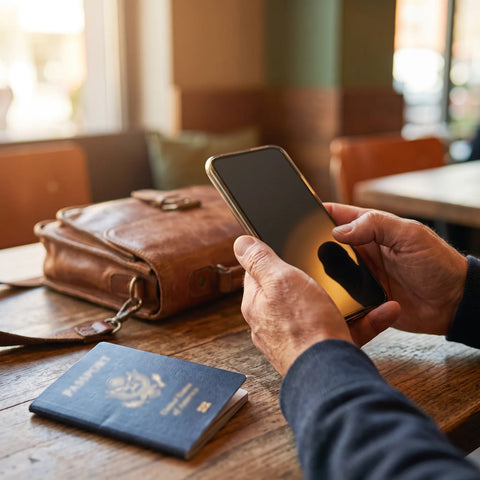
I prepared for my first trip to Jordan as I prepare for all trips: by looking at desert maps and thinking about how I would stay connected. And there’s the detail that almost no one resolves before leaving. Getting internet in Jordan is not difficult, but it is advisable to choose the right option before leaving home, because between Amman airport, the Wadi Rum desert, and the Petra gorges, coverage changes a lot. In this guide, I compare all the alternatives with real data so you land knowing what you're going to use.
How to connect to the internet in Jordan
To connect in Jordan, you have four options: roaming from your Spanish provider, hotel Wi-Fi, a local Jordanian SIM, or an eSIM purchased before traveling. The best for most tourists is the eSIM: it activates automatically, works on the Zain network, and you don't spend a single minute in queues.
That's the short answer, but each option has its moment. The country has three mobile operators—Zain, Orange, and Umniah—and the quality of the connection depends mainly on which of these three networks your line uses, not so much on whether you have a physical or virtual card. Zain is the operator with the widest national coverage: it works well in Amman, Petra, Wadi Rum, Aqaba, and the Dead Sea, which is why it's the network almost all travel eSIMs choose. Orange is very similar in cities. Umniah is the cheapest, but its signal weakens as soon as you leave the capital.
My advice is to decide this at home and not improvise at the baggage claim. There are four possible paths, and only one allows you to leave the airport already browsing, with the map open to hail a taxi at a good price. In the following sections, I break down each one with prices and fine print, and conclude with coverage by area, which is what makes the difference on a trip that mixes city and desert.
Roaming from Spain: convenient but expensive
I'll start with the most common trap. Jordan is not in the European Union's "roaming at home" zone, so your Spanish unlimited data plan is not valid here. If you arrive and use data without further thought, your operator will apply the standard international roaming rate, which is very expensive outside the EU.
The numbers are alarming: without a contracted package, operators like O2 or Movistar charge around €30 to €36 per MB of data. Translated: opening a map and sending four photos of the Petra Treasury can cost you tens of euros in an afternoon. There are daily packages for outside the EU, but they usually cost several euros a day for very little data, with the fine print that Jordan falls into the most expensive zone.
When does it make sense? Only if you're staying for very few days, don't want to touch anything on your mobile, and contract a fixed package before leaving to avoid a surprise on your bill. If you choose this route, activate the package from your operator's app and limit background data. If you want to see the numbers in detail, I explain it in my guide on how much international roaming costs and in the comparison of eSIM vs. roaming. For almost everyone, this is the option to avoid.

Hotel, restaurant, and tourist site Wi-Fi
Free Wi-Fi is quite widespread in Jordan and is a good supplement, but a bad plan A. Most hotels in Amman, Petra, and the Dead Sea area offer Wi-Fi in rooms and common areas, and many tourist cafes and restaurants do too. For video calls at night, uploading photos, or planning the next day, it's more than sufficient.
The problem is that Wi-Fi only exists where there's a router, and in Jordan, you'll spend your day outdoors: driving along the King's Highway, walking through the Siq, in a 4x4 in the desert, or floating in the Dead Sea. During all those moments—exactly when you need Google Maps, to translate a sign, or call a driver—there's no Wi-Fi to be found. That's why you should never rely solely on Wi-Fi to get around the country.
There are two more nuances. The first is security: open café networks are not the place to access your bank; if you use them, have a VPN handy. The second is speed, which in desert camps and small hotels can be very slow and shared among dozens of guests. My recommendation: use Wi-Fi for heavy tasks at night, but carry your own data for daily use. If you were debating between pocket Wi-Fi and other options, I compare it in eSIM vs. pocket Wi-Fi.
The local Jordanian SIM: Zain, Orange, and Umniah
The classic option is to buy a local SIM as soon as you land. At Queen Alia Airport in Amman, there are operator stores right after baggage claim; Zain has a store in the arrivals hall open 24 hours, and Umniah usually opens first thing in the morning. They are sold to tourists without issue, but they will ask for your passport to register the line in your name, a mandatory legal procedure in Jordan.
Prices are good, and the data volume is generous. These are typical options for visitors in 2026:
| Operator | Typical Tourist Plan | Approx. Price | Coverage Notes |
|---|---|---|---|
| Zain | 20 GB, 30 days (or 12 GB weekly) | ~15 JOD (€19-21) | Best national coverage; 5G in Amman |
| Orange | 20 GB, 30 days | ~15 JOD (€19-21) | Very reliable in cities |
| Umniah | 10-15 GB, 7-10 days | from ~6 JOD (€8) | Weak outside Amman; avoid if leaving the capital |
The drawback? The process. You have to queue after a long flight, hand over your passport, wait for the line to activate, and swap cards, keeping your Spanish one safe. For many, it's worth it for the price; for others, it's unnecessary hassle when you could arrive already connected. If you're interested in this path in depth, I detail it in eSIM vs. local SIM.
The eSIM: my recommendation for travelers
The eSIM is a virtual card that you buy online before traveling and activate by scanning a QR code. You don't go to any store, you don't change your physical card—you keep your Spanish number for WhatsApp and banks—and as soon as you land in Amman, you have data. For the average tourist, it is by far the most convenient option, which is why I almost always recommend it.
The advantages over a local SIM are concrete. You don't need a passport or to queue, because the provider manages the registration. Most travel eSIMs operate on the Zain network, which is precisely the one with the best national coverage, so you arrive with the best possible signal without having to choose an operator. And compared to roaming, the savings are massive: a 3-5 GB plan for a week costs significantly less than what your Spanish operator would charge you for a single day of roaming.
All you need is a mobile phone compatible with eSIM—almost all iPhones since the XR and recent mid-to-high-end Androids—and to have the virtual card ready before landing. If you've never used one, I explain how it works in what an eSIM is, and for the specific destination, you have my Jordan eSIM guide with activation steps. Once you understand it, installing and readying it takes only two minutes.
Comparison: the four options face to face
For a quick overview, here are the four alternatives compared by what matters: cost, functionality, and hassle, with reference prices for one week.
| Option | Estimated Cost | Coverage | Advantage | Disadvantage |
|---|---|---|---|---|
| Spanish Roaming | Very high (up to €30-36/MB without package) | That of your associated network | Zero management | Exorbitant bill |
| Free Wi-Fi | €0 | Only where there's a router | Free and unlimited | Useless outside the hotel |
| Local SIM | Low (~15 JOD / €19-21) | Excellent (Zain/Orange) | Plenty of data, cheap | Queue + passport + card swap |
| eSIM | Low-medium | Excellent (Zain network) | No queues; keep your number | Requires compatible phone |
My golden rule: if you're staying more than two days and want to move around freely, the virtual card wins for the best comfort-price ratio. I would only choose a local SIM if I want to squeeze every euro and don't mind queuing; and roaming, only for a few hours' stopover.
In practice, the real choice for most is between a local SIM and an eSIM: roaming is expensive, and Wi-Fi is not enough. Both use the same Jordanian networks and provide similar coverage; what changes is the convenience of obtaining them. If you value your time upon arrival, the balance tips itself.

Coverage in Amman, Petra, and the north
This is where Jordan surprises, for better or worse. Let's start with the easy part. Amman has the best connection in the country: solid 4G throughout the city and 5G increasingly present with Zain, with speeds ranging from 200 Mbps to 1 Gbps where fiber optic is available. For maps, translations, app-based taxis, and messaging, you won't have any problems in the capital or in northern cities like Irbid, Jerash, or Madaba.
Petra is another story and needs to be understood. You will have good signal at the entrance, along the Siq, and at the Treasury, which is where everyone gathers. But coverage becomes spotty as you walk towards the Monastery (Ad-Deir), and within the complex, the signal fluctuates due to the rock walls, narrow passages, and the number of people saturating the antennas. It's normal to notice irregular signal within the Siq during peak hours.
My advice for Petra is simple: download the offline Google Maps for the area the night before from your hotel Wi-Fi, and save your accommodation's address in Arabic and English. That way, even if you lose data for a while among the rocks, you can still orient yourself and have your photos saved to upload as soon as you regain coverage. With a good base network—I insist, Zain—outages are occasional and brief, not a total blackout.
Coverage in Wadi Rum and the desert
Wadi Rum is the point that generates the most questions, and rightly so: it's a protected, enormous desert with very little infrastructure. The good news is that there's decent 4G/LTE coverage in most of the tourist Bedouin camps, which is where you'll sleep and spend your evenings. In the camp, in general, you'll be able to send messages and even some photos.
The bad news is that as soon as you venture into the deep valleys and more remote areas of the desert—precisely the 4x4 excursions that make Wadi Rum magical—the signal disappears completely. Here the rule is simple: in the camp, yes; in the dunes, no. And it's not a problem with your card: there simply aren't any antennas in the middle of nowhere.
This changes how you should prepare. For the Wadi Rum desert, I recommend:
- Downloading an offline map of the area and routes before entering.
- Notifying your family that you'll be disconnected for a few hours; it's part of the experience.
- Trusting your Bedouin guide, who knows the terrain better than any GPS.
- Taking advantage of the camp's signal at night to upload photos and check in.
Going with the best possible network helps ensure the camp has usable signal, but accept that excursion hours will be completely disconnected. Honestly, looking at that starry sky, it's appreciated.
Coverage in the Dead Sea and Aqaba
After the uncertainty of the desert, the Dead Sea is a relief. Coverage is excellent in hotels and on the beaches along the Dead Sea coast, so you can instantly share that photo of yourself floating on the salty water reading the newspaper. The large resorts in the area (Sweimeh and surroundings) have good 4G signal in addition to Wi-Fi, and the road from Amman is well-covered almost the entire way.
Aqaba, on the Red Sea, is the other major base in the south and is also very well connected: it's a city, port, and tourist area, with solid 4G in hotels, beaches, and the city center. Between Aqaba and Wadi Rum is little more than an hour's drive, so many travelers combine morning diving with an afternoon in the desert; keep in mind that you'll go from excellent coverage by the water to intermittent desert signal on the same day.
The conclusion of this tour is clear: in the areas where you sleep, eat, and swim—Amman, Petra hotels, Dead Sea, and Aqaba—you'll be perfectly connected with any decent network. The only real gaps are the deep corners of Petra during peak hours and excursions into the interior of Wadi Rum. Knowing this, and with downloaded maps, there will be no surprises throughout your trip.
How much data do you need for your trip?
The million-dollar question: how many gigabytes should I contract? The answer depends on how much you use your mobile, but for a typical week-long trip to Jordan—Amman, Petra, Wadi Rum, and the Dead Sea—between 3 and 5 GB is more than enough for most who use data for maps, messaging, social media, and searching for places. This figure assumes you upload photos and make video calls from the hotel Wi-Fi at night.
| Traveler Profile | Typical Use | Data for 7-10 days |
|---|---|---|
| Light User | Maps, WhatsApp, some emails | 2-3 GB |
| Medium User | Above + social media and browsing | 3-5 GB |
| Heavy User | Streaming, many photos/videos with data | 8-10 GB or more |
A couple of tricks to stretch your data: rely on hotel Wi-Fi for heavy tasks, download music, shows, and offline maps before you leave, and disable automatic app updates in the background. With that, even a modest plan will easily last you the whole week. And if you run short, almost all eSIMs allow you to top up in two minutes from the app. My recommendation: go for a 5 GB plan if it's your first trip to the country; it's the sweet spot between price and peace of mind.
Frequently asked questions
Is there coverage in Petra and Wadi Rum?
Yes, but with nuances. In Petra, you have a good signal at the entrance, the Siq, and the Treasury, and it's more irregular when climbing to the Monastery. In Wadi Rum, there's 4G coverage in the camps, but you lose it in the deep valleys during 4x4 excursions. Download offline maps just in case.
Do I need a passport to connect?
Only if you buy a local SIM: by law in Jordan, the operator must register the line with your passport. With an eSIM purchased online, no paperwork is needed: the provider handles the registration, and you just scan a QR code.
Which mobile network provides the best coverage in Jordan?
Zain is the operator with the widest national coverage, including Amman, Petra, Wadi Rum, Aqaba, and the Dead Sea, which is why it's the network almost all travel eSIMs use. Orange is similar in cities; Umniah is weak outside the capital.
Can I use my Spanish plan without paying extra?
No. Jordan is outside the EU zone, so your unlimited data plan does not apply. Without a contracted package, you would pay up to €30-36 per MB. To avoid this, use an eSIM or a local SIM.
How many GB do I need for a week?
For a typical 7-day trip with maps, messaging, and social media, between 3 and 5 GB is enough for most. If you do a lot of streaming or upload videos using data, go for 8-10 GB. Rely on hotel Wi-Fi for heavy usage.
Will the eSIM work as soon as I land in Amman?
Yes. You install it at home with Wi-Fi and activate it upon arrival; as soon as your mobile connects to the Jordanian network at Queen Alia Airport, you already have data. Ideal for ordering a taxi with the app without having to go to any store.
Is my phone eSIM compatible?
Most recent phones are: iPhones since the XR, the Pixel range, and many mid-to-high-end Samsung and Android phones. Check in Settings by searching for "eSIM" or "digital SIM." If the option appears, your phone is compatible.
Is there free Wi-Fi in hotels and restaurants?
Yes, it's quite widespread in hotels in Amman, Petra, and the Dead Sea, and in many tourist cafes. It's a good supplement for the evening, but don't rely solely on it: outside the building, there's no Wi-Fi available.
Conclusion
Getting connected in Jordan is easy if you decide before you leave. Roaming is convenient but can ruin your bill, Wi-Fi is only useful for the evening, and a local SIM is cheap in exchange for a queue and passport. For tourists who want to move freely between Amman, Petra, the desert, and the Dead Sea, the virtual card wins: you arrive connected as soon as you land, keep your number, and travel on the best network in the country. Prepare offline maps for the gaps in Wadi Rum and Petra, estimate 3-5 GB for a week, and you're good to go. If you want to get it sorted in two minutes, check out my Jordan eSIM and land without worrying about anything else.