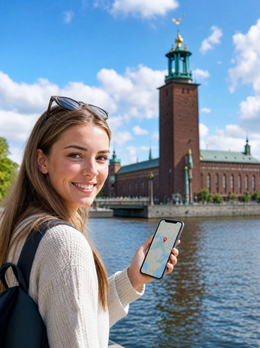
If you're planning your trip and wondering how to get internet in Sweden without a nasty surprise on your bill, let me tell you clearly and from personal experience. The good news is that Sweden is part of the European Union, so often your Spanish rate already covers you without paying extra. But there are nuances, rates where it doesn't pay off, and areas in the north where coverage is spotty, and it's good to have all the information before deciding which one really suits you.
Internet in Sweden: all options at a glance
In Sweden, you have four ways to connect: roaming with your Spanish plan (included because it's an EU country), a data eSIM, a local Swedish SIM, or hotel and train Wi-Fi. For most Europeans, roaming is usually enough; those traveling from outside the EU benefit from an eSIM.
That's the short answer. The long answer depends on your plan, how much data you use, and whether you're staying in large cities or heading up to Swedish Lapland, where the network changes quite a bit. Before diving into each option, I'll give you a comparison table so you can see at a glance what suits you best according to your profile. Sweden has one of the best mobile infrastructures in Europe: 4G reaching 99% of the population and 5G that, after its 2025 expansion, will reach 99.9% of the population and 90% of the territory. Network quality won't be your problem in the south; the decision is about not paying too much and knowing where the signal might fail.
| Option | Estimated Cost | When to choose it |
|---|---|---|
| Roaming (Spanish plan) | €0 extra within your limit | You live in the EU and have plenty of data |
| Data eSIM | From €3-5 for several GB | You're from outside the EU or use a lot of data |
| Local Swedish SIM | From ~45 SEK for the SIM + data | Long stays or need a Swedish number |
| Hotel Wi-Fi | Almost always free | Support, never your only network |
Roaming: Sweden is in the EU (and what that means)
Sweden is part of the European Union, so the roaming regulation known as Roam Like At Home applies. In plain English: you use your mobile just like in Spain, with the same included gigabytes in your plan and no extra charges for calling, texting, or browsing. If you have 20 GB per month contracted in Spain, those same 20 GB can be used in Stockholm without paying a single extra cent. It is, by far, the most convenient way for most Europeans.
There's an important nuance: the fair use policy. Your operator can set a data cap for roaming based on what you pay monthly. The European formula is approximately (monthly price without VAT ÷ maximum surcharge) × 2 gigabytes, and that maximum excess surcharge is regulated: it's around €1.30/GB in 2025 and will drop to €1/GB from 2027. For a one-week getaway with normal use, you'll rarely reach that limit.
It works with all national operators: Movistar, Vodafone, Orange, Yoigo, Simyo, Pepephone, Lowi, and others. If you want to delve deeper into the differences compared to buying data separately, I compare them in eSIM vs roaming, and if you're traveling from outside the EU and are concerned about costs, here I explain how much international roaming costs.
When an eSIM really pays off
I'm going to be honest with you, because not everything works for everyone. If you're a resident in Spain or any EU country, have a modern plan with plenty of gigabytes, and will make reasonable use in Swedish cities, roaming already covers you and you don't need anything else. Buying data separately would be paying twice for the same thing, and I don't like to sell snake oil.
That said, there are clear profiles for whom it does pay off to have separate data:
- Travelers from outside the EU (Latin America, UK, USA): they don't have Roam Like At Home, and classic roaming can cost them a fortune.
- Old plans or low data plans: if your plan includes 2-3 GB or less, it runs out quickly with maps, photos, and translations.
- Heavy data users: remote work, video, or tethering can easily exceed the fair use cap.
- Those who want to separate: keep the Spanish number active for WhatsApp and calls, and use data on another line without touching their main plan.
If you're torn between a physical and digital card, I break it down in eSIM vs local SIM. And if you still don't know exactly what this technology is or how to install it, start with what an eSIM is: in two minutes, you'll understand and can make an informed decision.
Swedish local SIM: Telia, Tele2, Telenor and Tre
The Swedish market relies on four operators: Telia, Tele2, Telenor, and Tre (3, part of the Hi3G group). Physically, there are three networks: Telia's, the one shared by Tele2 and Telenor through their joint venture Net4Mobility, and Tre's. In independent coverage rankings, Telia usually wins, especially in rural areas and in the north of the country, while in cities the differences between them are minimal.
Buying a prepaid SIM is cheap: the card costs from about 45 SEK at Comviq (Tele2's prepaid brand), 49 SEK at Telenor, and 59 SEK at Telia. Then you load a data package, with European roaming included in many of them. It's a reasonable option if you're staying for weeks or months or need a Swedish number. For a short trip, however, it's usually more hassle than benefit: queues, registration with ID, and less flexibility than activating data from home.
| Operator | Physical Network | Estimated Prepaid |
|---|---|---|
| Telia | Own network | SIM ~59 SEK; plan from 149 SEK / 5 GB |
| Tele2 / Comviq | Net4Mobility | SIM ~45 SEK; ~175 SEK / 8 GB, EU included |
| Telenor | Net4Mobility | SIM ~49 SEK; packages from ~199 SEK |
| Tre (3) | Own network | Aggressive urban data prices |
eSIM: the convenient option for data
An eSIM is a digital card that you install on your phone by scanning a QR code, without going to any store or changing your physical card. You activate it from home before flying, and as soon as you land in Stockholm, you have data working. For me, it's the most practical way to connect when roaming doesn't cover me or when I want to control spending down to the penny.
The good thing is that you can keep your Spanish number active for calls and WhatsApp while the data runs on the digital line, without changing cards. You choose a plan with the gigabytes you expect to use, install it, and you're done; no need to look for a store in a language you don't master or wrestle with vending machines. You only need a compatible mobile, which is common in models from recent years. If you've never used one, the guide to what an eSIM is explains it step by step.
For Sweden, you have all the coverage, pricing, and installation information in the eSIM guide for Sweden. And if you want to get straight to the point, you can buy your Sweden eSIM in a couple of clicks: it activates upon arrival and you forget about bill surprises.
Hotel Wi-Fi and public Wi-Fi: useful, but limited
Sweden is one of the most digitized countries in the world, and you'll find free Wi-Fi practically everywhere: hotels, cafes, libraries, shopping centers, airports, and even many trains. Hotel Wi-Fi is perfect for downloading offline maps at night, making long video calls, or uploading photos from the day without touching your data. It's a great ally, but with a couple of caveats worth remembering.
The first: don't make it your only network. You won't always have an open signal handy on the street, and public networks have their security risks. Avoid accessing your bank or entering sensitive passwords on an open Wi-Fi without a VPN. The second: the speed of shared Wi-Fi in a crowded hostel can be frustrating exactly when you need to orient yourself or buy a ticket.
My practical recommendation: use Wi-Fi as support for heavy tasks and always have your own mobile data (roaming or eSIM) for what happens outside your accommodation, which is where you really need it: maps, transport, translations, and reservations. If you're weighing portable Wi-Fi against other options, I compare them in depth in eSIM vs pocket Wi-Fi.
Coverage in Stockholm, Gothenburg and the south
In southern and central Sweden, where most travel is concentrated, coverage is simply excellent. In Stockholm, you'll have strong 5G almost on every corner, just like in Gothenburg and Malmö, the other two major cities. 4G is practically universal, and 5G is already the standard in urban corridors, with plenty of speed for maps, streaming, video calls, or remote work.
The capital is an archipelago of islands connected by bridges, and the signal holds up well both in the historic center of Gamla Stan and in modern neighborhoods. If you take a boat trip through the Stockholm archipelago, you'll maintain coverage near the most populated islands; only on some remote islet or in the open sea will you see the bars drop. University cities like Uppsala, Lund, or Linköping and the major road and rail arteries in the south are covered with hardly any blind spots.
In summary: for a city trip through southern Sweden, the connection will be fast and stable almost all the time, and it doesn't matter which operator you have, because urban differences are minimal. Things change, and a lot, when you head north. You can find detailed operator information in the eSIM guide for Sweden.
Lapland and the north: auroras and irregular coverage
Here's where I need to be honest, because northern Sweden is not like the south. In the towns and cities of Swedish Lapland—Kiruna, Abisko (the great aurora borealis viewpoint), Luleå, or Jokkmokk—you do have decent coverage, especially with Telia and the shared network of Tele2 and Telenor. You'll be able to share your aurora photos from the village without a problem. The warning comes as soon as you move away from populated areas.
In the most remote Arctic areas, the signal is irregular or directly non-existent. Hiking trails like the Kungsleden (the King's Trail, between Abisko and Kvikkjokk), snowmobile routes, and isolated mountain stations can be without any bars for hours. It's a matter of geography: these are huge territories with very sparse population and few antennas.
In Swedish Lapland, coverage depends on where you are. In Kiruna or Abisko it will work; in the middle of Kungsleden or on a night snowmobile safari, assume you'll be out of communication. Always download offline maps before heading out.
If your plan includes aurora hunting far from the village, mountain trekking, or sled dog excursions, no type of SIM will save you where there's no antenna. Precaution is key: downloaded maps, charged battery, and, if you're doing serious routes, an emergency satellite device. For moving between villages, Telia is the safest bet for its rural coverage.
Internet on trains and public transport
A good part of a trip through Sweden takes place on rails, and the connection there is better than many expect. The high-speed trains of SJ, the national operator (the X2000 and SJ3000, as well as the double-deckers), offer free Wi-Fi on board and, recently, 5G connectivity that greatly improves the experience compared to old Wi-Fi. It's a much-appreciated extra on long journeys between Stockholm, Gothenburg, and Malmö.
Even so, train Wi-Fi depends on the mobile coverage in each section of the track, so in rural areas or in the north it can slow down or cut out. My advice is not to rely solely on it: with your own data (roaming or eSIM), you maintain the connection even if the wagon's system is saturated. On the Stockholm subway, the Tunnelbana, there is mobile coverage in most stations and tunnels, and long-distance buses usually also have Wi-Fi.
For urban daily life—buying tickets on the transport app, checking real-time schedules, or paying for the archipelago ferry—you will need data for sure, because in Sweden almost everything is managed from a mobile phone and cash has practically disappeared. Having a reliable connection is not a luxury; it's part of the ticket.
How much data do I need for my trip?
The million-dollar question. The short answer: less than you think if you take advantage of your accommodation's Wi-Fi for heavy tasks. For an average traveler who checks maps, messaging, social media, and some browsing, a couple of gigabytes a day is more than enough. If you also use hotel Wi-Fi at night, 1 GB daily will be plenty for getting around.
What most increases consumption is streaming video and long video calls. If you plan to watch series with mobile data, live stream the auroras, or tether your laptop, adjust your calculations upwards. Here's a realistic reference based on your usage type for a one-week getaway:
| Usage Type | Daily Data | Total 7 Days |
|---|---|---|
| Light (maps, chat) | ~0.5 GB | 3-4 GB |
| Medium (social media, some video) | ~1 GB | 7-8 GB |
| Intense (streaming, tethering) | ~2-3 GB | 15-20 GB |
With these numbers, deciding is easy: if your Spanish plan includes more gigabytes than you'll use, go with roaming; if you're cutting it close or coming from outside the EU, calculate your total and choose a data plan accordingly. I always prefer to have a bit extra rather than being stranded looking for Wi-Fi with my suitcase in tow and minus eight degrees outside.
Frequently asked questions
Is roaming in Sweden free with my Spanish plan?
Yes. Sweden is an EU country, so Roam Like At Home applies: you use your included gigabytes without surcharges, with the same limit as in Spain. You would only pay extra if you exceed your plan's fair use limit.
Do I need an eSIM if I am a resident in Spain?
Normally not, if you have a plan with enough data and are traveling in the south and cities. An eSIM is especially beneficial for those coming from outside the EU, who have an old plan with few gigabytes, or who use a lot of data for remote work or video.
Is there coverage in Swedish Lapland to see the auroras?
In towns like Kiruna or Abisko, yes, especially with Telia. But when you move away to remote routes like the Kungsleden or snowmobile safaris, the signal is irregular or non-existent. Download offline maps before heading out.
How many gigabytes do I need for a week in Sweden?
For average use of maps, messaging, and social media, 7-8 GB is more than enough for seven days, especially if you take advantage of hotel Wi-Fi at night. If you watch a lot of video or tether, estimate 15 GB or more.
Is a local Swedish SIM or an eSIM better?
It depends on the length of your stay. For short trips, an eSIM is more convenient: it activates from home without queues or registration. A local SIM (Telia, Tele2, Telenor, or Tre) makes sense for long stays or if you need a Swedish number.
Does Wi-Fi work on Swedish trains?
Yes. SJ's high-speed trains have free Wi-Fi and 5G on board, although its speed depends on the coverage of the section. In rural areas, it can cut out, so it's good to also have your own data as a backup.
Can I pay in Sweden without mobile data?
It's very difficult. Sweden is almost a cashless society, and almost everything is managed from a mobile phone: transport tickets, parking, entry tickets. Having reliable data is not a luxury; it is practically essential for daily life.
Conclusion
Staying connected in Sweden is straightforward if you're clear about your situation. If you reside in the EU and your plan includes plenty of data, roaming already covers you without paying extra for the south and cities. If you're coming from outside the EU, use a lot of data, or your plan is limited, an eSIM gives you affordable data and total control. And don't forget the nuance of the north: in deep Lapland, no SIM card works miracles where there's no signal, so plan for offline maps. It all comes down to planning ahead before you go. If you want the easiest way, check out the eSIM guide for Sweden and travel connected from minute one.