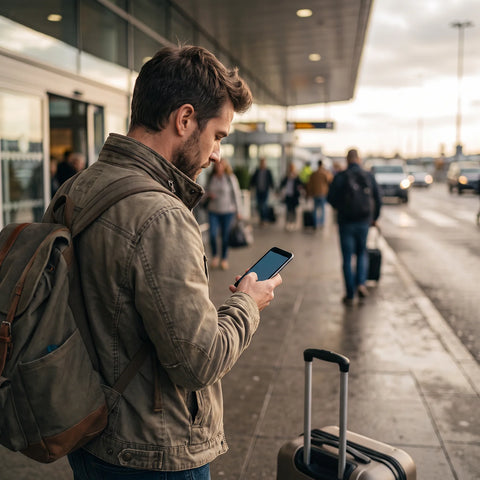
How international roaming works with Movistar Venezuela
International roaming allows you to use your Movistar Venezuela line outside the country by connecting to the network of a local operator with whom Movistar has a commercial agreement. Your number remains the same, but the calls, messages, and data you consume abroad are billed separately, according to your plan.
This sounds simple, but in practice, it constantly raises questions: Does the phone automatically connect to another network as soon as you cross the border? Do you need to activate anything before leaving? What happens if the country you're going to doesn't have an agreement with Movistar? The short answer is that roaming is not a "universal" service: it depends on which local operator has an agreement with Movistar in that specific country, on your plan, and on whether roaming is enabled by default or needs to be requested.
This reliance on third parties—the local operator you connect to when you're abroad—is the root of almost all complaints about roaming worldwide: you are not a direct customer of that network, so you have less visibility into prices, coverage, and signal quality than when you use your regular operator.
Which countries Movistar international roaming covers
Here's where it's important to be honest: the roaming coverage of any operator—Movistar included—is not a fixed list you can memorize. It changes according to the agreements in force between Movistar and the operators in each country, and these agreements are renegotiated over time. That's why the most reliable source will always be the official information for your own plan, not a blog article or what an acquaintance who traveled last year told you.
What you can anticipate is the general pattern: Latin American operators usually have stronger agreements with high-traffic tourist and business destinations—the United States, Spain, some Western European countries, and large cities in the region itself—and more limited or non-existent agreements with less frequented destinations. If your trip is to a "unusual" destination in your itinerary, it's reasonable that roaming coverage will be poorer or more expensive than if you're going to a popular destination.
This uncertainty is, in fact, why alternatives designed specifically for travelers exist: a travel data eSIM does not depend on your home operator having an agreement with the country you're visiting, because you contract a data line directly for that destination, and this same mechanism is repeated in over 200 different destinations.
How to check if your Movistar plan has international roaming active
Before assuming "I definitely already have it activated" or, on the contrary, panicking and thinking you need to sign up for something super expensive, there are a few concrete details worth confirming directly with Movistar before packing your bags. These aren't complicated procedures, but they are the difference between traveling worry-free and being hit with surprises upon your return.
| What to check | Where to confirm it | Why it matters |
|---|---|---|
| If roaming is included or a separate service | Official app or Movistar customer service channel | Some plans include it by default; others require signing up before traveling |
| If you need to activate it manually | Account or app settings | "Available" roaming isn't always turned on: it might require an extra step |
| Which countries your specific plan covers | Official terms and conditions of your current plan | Coverage varies depending on the plan you have, it's not the same for everyone |
| How it's billed (per MB, per day, or per package) | Roaming service terms and conditions | Completely changes how much it might cost you depending on how much you use your phone |
| If there's a cap or automatic cutoff for consumption | Account settings | This is what prevents an oversight from turning into an out-of-control bill |
If, after reviewing this, you still have doubts about how this model compares to other ways of getting data abroad, the guide on roaming with Movistar explains in more detail how that particular service works.

How much Movistar charges for international roaming
This is probably the question that brought you here, and also the one that can least be answered with a fixed figure. Roaming rates change depending on the destination country, the plan you have contracted, and the time you travel, and only Movistar can give you the exact current number for your case through its official channels. Any figure you see without a date or source should be taken with a grain of salt: roaming is one of the services whose prices change the fastest.
What is a consistent pattern in the telecommunications industry, not just with Movistar, is the billing logic: most operators bill roaming per megabyte consumed, per daily package, or per specific bundle for the destination country. This variety of models is precisely what makes it difficult to calculate in advance how much you will spend, because your actual consumption depends on how many apps you open, how much you use the map, and how many photos or videos you send.
International roaming is not activated just by buying a plane ticket: with most operators, you have to confirm, contract, or activate it manually before leaving the country.
Therefore, if what you are looking for is predictability—knowing in advance exactly how much you will pay for your travel data, without relying on a per-MB calculation that you only see reflected in the following month's bill—the fixed-price model offered by a travel data eSIM solves that specific problem, as explained below.
Why roaming bills skyrocket without warning
The "surprise bill" phenomenon after a trip isn't exclusive to any single operator: it happens anywhere in the world when someone uses their regular line outside their home country without changing their habits. The phone continues to update apps in the background, sync photos, load maps, and receive notifications exactly as it does at home, only now every megabyte of this "invisible" activity is also being billed as roaming.
Added to this is a visibility problem: at home, almost no one checks how much data they consume per day because the plan is fixed, and there's no difference between using a little or a lot within the monthly limit. When roaming, that logic changes completely, but the habit of not monitoring consumption persists, because no one is used to checking their phone that frequently during a trip.
The result is that the expense accumulates silently throughout the trip and only becomes visible when the bill arrives, with no possibility of correcting anything. This is exactly the kind of risk that a fixed-price data plan, contracted before leaving, eliminates completely: you know how much you paid from day one, with no surprises upon your return.
The data eSIM: the alternative almost no one knows about
If you've never heard of this before, it's not because it's new or experimental: it's because most travelers still assume that the only two options for internet abroad are their operator's roaming or buying a physical SIM card upon arrival. There's a third, intermediate option that solves several of the problems of both: the eSIM.
An eSIM is, in essence, a digital phone line. Instead of inserting a physical card, your phone downloads a line profile—similar to installing an app—that activates a data line independent of your Movistar line. You don't have to remove your current SIM or risk losing it; the eSIM works in parallel, specifically for the data you'll use in your travel destination. If you want to understand the concept in more technical detail, the guide what is an eSIM explains it from scratch.
The practical difference with traditional roaming is simple: instead of relying on your home operator having an agreement with the operator in the country you're visiting, you directly contract a data line designed for that destination, with a price you know before you travel. And unlike buying a physical SIM at the airport, you don't have to wait in line, you don't need to change cards, and you don't risk being without your Movistar number in the meantime: you can see the full comparison between both formats in eSIM vs. physical SIM.
How a travel eSIM works, step-by-step
To make it concrete and not just an abstract explanation, let's look at a real example: imagine you live in Caracas and have a five-day business trip to Bogotá. Here's how using a data eSIM would look on that trip, from start to finish.
- Before traveling: You choose and purchase the data plan for Colombia from your phone or computer, without needing to go to any physical store.
- You receive the eSIM profile by email, usually in the form of a QR code that your phone can read directly.
- You install the profile by scanning that code with your phone's camera. This step only needs an internet connection to download, so you can do it calmly at home, connected to Wi-Fi, even days before your trip.
- Upon landing in Bogotá, you activate the eSIM data line from your phone settings and leave your physical Movistar line on only to receive calls or text messages if needed.
- You use data normally for the rest of your trip: maps, messaging, social media, everything runs on the data line you specifically contracted for Colombia.
Step 3 has a detail that almost no one takes advantage of: since installing the profile only requires internet for downloading—not for starting data consumption—you can get it ready at home calmly, without relying on airport Wi-Fi or finding a signal as soon as you get off the plane. The data plan doesn't start until you activate it manually, so you arrive at your destination with the connection already ready to use from the first minute. The complete process, with screenshots, is detailed in how to install an eSIM.
Before buying, it's a good idea to confirm that your phone is compatible: most mid-range and high-end models from recent years are, and you can check the complete list in eSIM-compatible phones.

Operator roaming vs. data eSIM: direct comparison
Placed side by side, these are the criteria that matter most when deciding between keeping Movistar roaming or contracting a specific data eSIM for your destination.
| Criterion | Traditional roaming | Travel data eSIM |
|---|---|---|
| Price known before traveling | Not always; depends on billing model | Yes, it's a fixed price from purchase |
| Requires new physical SIM | No | No |
| Keep your Movistar number active | Yes | Yes, in parallel, for calls and messages |
| Depends on agreements between operators | Yes, on the agreement with the local operator | No; the data line is contracted directly for the destination |
| Activation | Varies by plan and country | In approximately 1 minute, when you decide |
| Window to activate from purchase | Not applicable | 180 days |
Neither option is "bad" in the abstract: roaming makes sense if you only need to receive an occasional call and will use very little data. But if your priority is reliable internet throughout your trip without depending on agreements between operators or per-MB rates you don't control, the eSIM solves exactly that problem. You can delve deeper into this comparison in eSIM vs. roaming.
Real example: deciding between roaming and eSIM for a trip from Caracas to Mexico City
Let's return to a concrete case to finalize the idea. Suppose the trip is no longer to Bogotá but to Mexico City, for a week, and you need to be available for your family in Venezuela as well as work normally from your phone.
The most practical combination in this scenario is to keep your physical Movistar line on—so your number remains reachable by call or SMS if someone needs you—and use a data eSIM specifically contracted for Mexico as your primary internet line. This way, you don't depend on whether Movistar has a favorable agreement with any Mexican operator at that moment, and you know before boarding the plane how much you will pay for your data.
If any questions arise during the trip about the installation or operation of the eSIM, 24/7 support is available in all languages via email and WhatsApp, which is particularly useful when a problem appears at an hour when no one in your home country would answer the phone.
Frequently asked questions
Do I need Wi-Fi to use the eSIM throughout the trip?
You only need Wi-Fi or data to install the eSIM profile the first time. Once installed and activated, the data line works just like any normal data plan, without depending on a Wi-Fi network.
Can I use my Movistar line and a data eSIM at the same time?
Yes. The eSIM acts as a second line in parallel, so you can keep your physical Movistar line active for calls and messages while using the eSIM for your travel data.
What if my phone isn't eSIM compatible?
If your phone doesn't support eSIM, that specific option wouldn't apply to you, and you would have to consider traditional roaming or a local physical SIM. You can check the list of compatible models before deciding.
How long do I have to activate the eSIM after purchasing it?
You have 180 days from purchase to activate it, so you can buy it in advance and activate it exactly when you need it, without rushing.
Will I lose my Movistar number if I install an eSIM?
No. The eSIM does not replace your physical line; it is installed as an additional line. Your Movistar number continues to function normally on the same physical line.
What do I do if I have a problem with the eSIM during my trip?
24/7 support is available in all languages via email and WhatsApp, so you can resolve installation or activation questions no matter the time or country you are in.
Do I need to change my phone's physical SIM card to use an eSIM?
No. That's precisely one of the advantages: you don't have to remove or change your physical Movistar SIM; the eSIM is installed digitally in parallel.
How do I know if the problem I'm having with my eSIM is common or something specific to my phone?
Most issues with installing or activating an eSIM have known causes and quick solutions; you can check them in the common eSIM problems guide before assuming it's an isolated case.
In short
Movistar's international roaming can work well for short trips with low data usage, but its coverage and cost depend on agreements between operators that change over time and that only Movistar can accurately confirm for your plan. If what you are looking for is predictability—knowing in advance how much you will pay for your data, without depending on those agreements or on MB rates that you do not control—a data eSIM specifically contracted for your destination solves that problem from the root, without you having to give up your Movistar line for calls and messages.
If you want to start from scratch before your next trip, the definitive eSIM guide for travel brings together the entire process in one place. And when you want to see what plans are available for your specific destination, you can check the international eSIM collection, which covers more than 200 destinations with activation in approximately 1 minute.