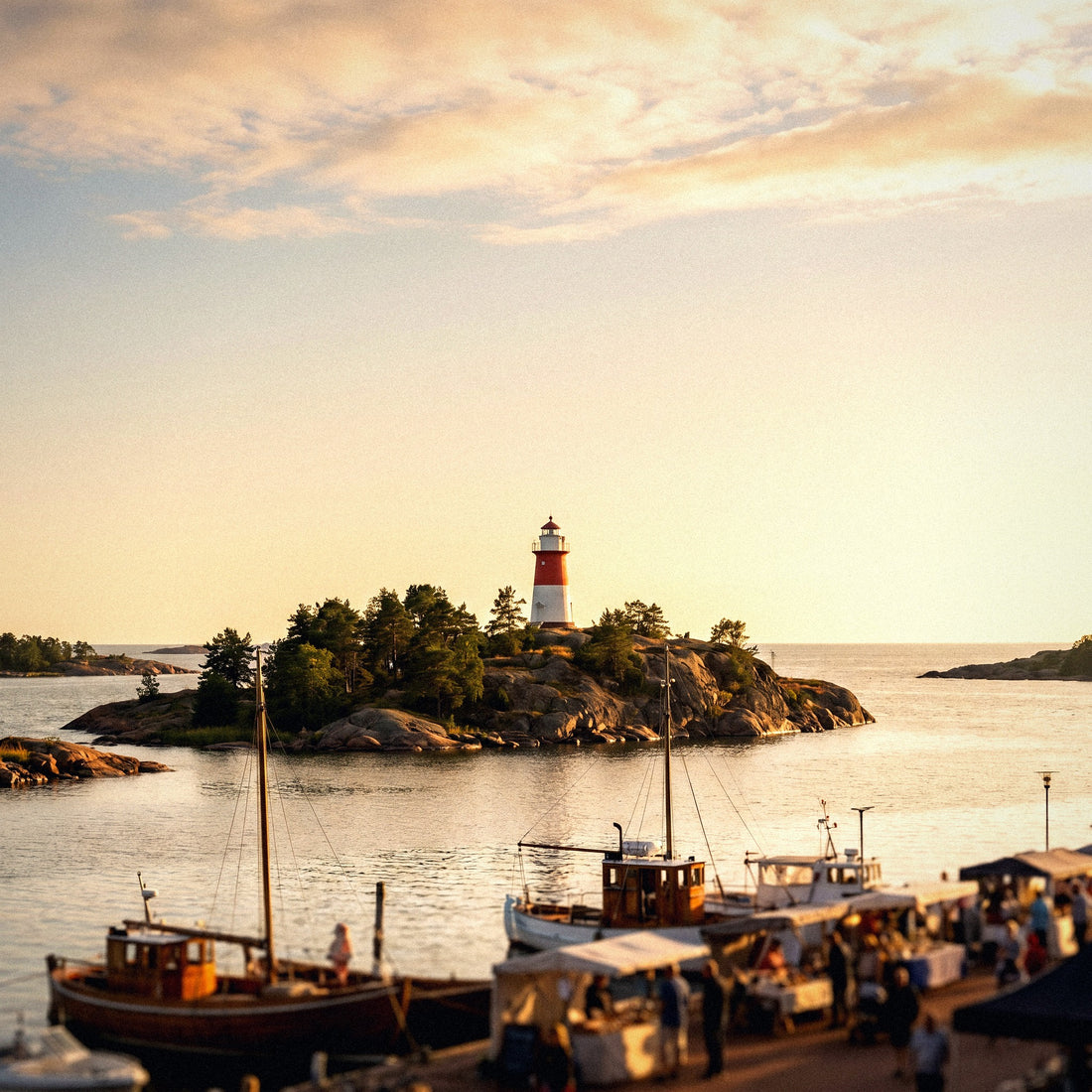
If you've already decided to get data and the only thing left is to decide how many GB to buy for the Åland Islands, this guide is all about that and nothing else. I won't repeat the comparison of connection options; here we'll go straight to the exact number you need, taking into account the big peculiarity of this destination, which isn't on the islands themselves but on the ferry that takes you there.
The number, straight to the point
For a typical 4 or 5-day trip to Åland, most people will be fine with 3 GB. If you're someone who uploads photos and stories every day, aim for 5 GB. And if you only use maps and WhatsApp, 1 GB will leave you with plenty of data left over at the end of your trip.
I'll tell you where that number comes from, because I haven't made it up or inflated it to sell you more. A trip to Åland is almost always a short, quiet trip: two, three, five days of cycling, ferries, ports, and forests. It's not Tokyo or New York, where you spend the day with your translator and subway apps open. Here, your phone does three things: maps, WhatsApp, and photos. Little else.
And there are two destination-specific factors that push consumption down. The first is that much of the day you spend cycling or waiting for a ferry, with your phone in your pocket. The second is that accommodations, cafes, and Mariehamn itself usually have Wi-Fi, so backups, downloads, and long video calls won't eat into your data.
If you've been reading about how much data you need for travel in general, the rule of having more than enough falls short here: the European average of 500 MB per day is designed for cities. In Åland, a normal tourist uses between 100 and 200 MB per day. Multiply that by your number of days, add a 30% buffer, and you have your number.
How much data each app actually uses
Most people buy too much because they have no idea how much data an hour of mobile use consumes. And it's not their fault: the figures circulating mix Wi-Fi with data and extremely high qualities that you won't be using. These are the figures I use, rounded up to ensure a conservative calculation, not the other way around.
| Activity | Approximate Consumption | Comment |
|---|---|---|
| Navigating maps (Google Maps, Organic Maps) | ~5 MB per hour | Initial loading of the area does consume data: 50-100 MB |
| WhatsApp (text only and some photos) | 10-20 MB per day | Negligible. This won't deplete your data |
| WhatsApp voice call | ~1 MB per minute | About 60 MB per hour of conversation |
| Video call | 300-450 MB per hour | The hidden large expense of travel |
| Instagram or TikTok scrolling | 500-750 MB per hour | Autoplaying videos are the enemy |
| Uploading a photo to chat | 3-5 MB | Twenty photos a day is 100 MB |
| Uploading a short video | 20-50 MB | Better at night and via Wi-Fi |
| Music streaming, normal quality | ~150 MB per hour | Download playlists before leaving |
| Video at 480p | 300-500 MB per hour | More than sufficient quality on mobile |
| Video at 1080p | 1.5-2 GB per hour | One movie and your data package is gone |
| Email and web browsing | 10-20 MB per hour | Minimal |
| Automatic camera roll backup | Hundreds of MB or several GB | Seriously, disable it for mobile data |
Notice the pattern: what really consumes your mobile data is video, in any form. Maps and messaging are negligible. If you control video and backups, you control 90% of your consumption. You can find a complete breakdown in the mobile data usage statistics by activity.
The ferry on the high seas: where surprise bills are born
This is the important warning in the article, and it has nothing to do with how many gigabytes you buy. You get to Åland by ferry from Sweden (Stockholm, Kapellskär, Grisslehamn) or from Finland (Turku, Naantali), and these crossings last between two and six hours. When the ship moves away from the coast and loses land signal, your mobile doesn't lose coverage: it connects to the maritime network that the ship itself carries on board, connected by satellite.
And this network is not a network of any country. It is not included in European rates, not in any travel data package, and not in any virtual SIM card, no matter how good it is. It is billed separately and at satellite prices: we are talking about several euros per megabyte, depending on the operator. With those numbers, half an hour of scrolling on the ship can cost you more than the ticket.
| Where you are | Which network your mobile connects to | Is it included in your data package? |
|---|---|---|
| Mariehamn and any inhabited island | Normal Finnish network | Yes, included |
| Ferry in port or close to the coast | Swedish or Finnish terrestrial network | Yes, included |
| Ferry in the middle of the Baltic Sea | Ship's maritime satellite network | No. Billed separately and very expensive |
| Onboard Wi-Fi | Does not use your data plan | Free or paid depending on the shipping company |
Before the ship sets sail: airplane mode. And if you want to connect, activate only Wi-Fi. It's the two-second action that separates a calm crossing from an absurd bill.
Another way to protect yourself: disable data roaming while sailing, or revoke background data permission for heavy apps. And if at any point you see a strange maritime-looking network name in the status bar instead of your usual operator, you know what has happened. Avoiding the surprise ferry bill doesn't cost money, it costs remembering.
Åland is in the EU for mobile (its exception is fiscal)
There's a good deal of confusion surrounding Åland's status, so let's clarify it because it directly impacts your purchasing decision. Åland is an autonomous region of Finland, demilitarized and Swedish-speaking, and is part of the European Union. However, it does have an exception: it falls outside the EU's VAT and excise tax territory.
This exception is fiscal, not telecommunications-related. That's why large ferries between Stockholm and Helsinki stop in Mariehamn or Långnäs: this stop allows them to sell duty-free on board. But for your mobile phone, Åland is Finland, period: European rates apply just as they do in Helsinki, and any data package covering Finland or Europe will work here without tricks or asterisks.
In terms of coverage, the archipelago is well-served. The local operator, Ålcom, provides 4G and 5G, and the major Finnish operators also operate there. In Mariehamn and on the main island, you'll have plenty of coverage; in the outer archipelago —Kökar, Brändö, Kumlinge, Sottunga— and on the ferry routes between islands, the signal drops and there are dead zones. This isn't a problem if you have your maps downloaded.
Translated into gigabytes: you don't need to buy more "just in case the coverage is bad." You'll be connected to the usual Finnish networks almost the entire trip. If you want details on how all of this works on the ground, you can find it in the guide to internet in the Åland Islands.
Why you'll use less data in Åland than you think
Åland consists of over 6,000 islands and islets, of which only a few dozen are inhabited. The standard trip involves Mariehamn as a base, cycling, ferries, and nature. And this plan, by its very nature, consumes very little data: cycling doesn't use megabytes, and short inter-island crossings don't either, because you're either looking at the scenery or you have no coverage.
There are two very local details that help. First, the short ferries that cross the straits between islands are free and run frequently, so you don't spend your time checking schedules or buying tickets on your phone (for the longer archipelago routes, it's advisable to book a spot in advance, especially with a bike). And second, over a thousand kilometers of marked cycling routes mean you only check the map at junctions, not while riding.
Here's what a real day looks like, including a visit to the Pommern sailing ship museum:
| Time of day | What you do | Mobile data |
|---|---|---|
| Morning | Bike route with map open occasionally, 10 photos | ~30 MB |
| Midday | Waiting for ferry, messages, a couple of audio clips | ~10 MB |
| Lunch | Finding a place in Mariehamn, reviews, map | ~25 MB |
| Afternoon | Maritime museum and Pommern, photos to family group | ~20 MB |
| Evening | Accommodation with Wi-Fi: uploads, videos, calls | 0 MB |
| Total for the day | 85-120 MB | |
That's why I confidently say that you'll spend less than you think. If I sold you 20 GB for five days of cycling in the Baltic, I'd be selling you smoke. Buy what you'll use and top up if you need to.
How many GB according to your profile and duration of stay
This is the table you've been looking for. Find the profile that best matches yours, cross-reference it with your trip duration, and that's your number. The figures already include a safety margin, so there's no need to round up again.
| Traveler Profile | 5 days | 10 days | 15 days | 30 days |
|---|---|---|---|---|
| Tourist using maps and WhatsApp (no social media) | 1 GB | 2 GB | 3 GB | 5 GB |
| Normal traveler: maps, messages, photos, and some social media | 3 GB | 5 GB | 8 GB | 15 GB |
| Photos and stories: uploads content daily | 5 GB | 10 GB | 15 GB | 25 GB |
| Digital nomad or remote worker (video calls, cloud) | 10 GB | 20 GB | 30 GB | 50 GB |
| Family sharing phone as a hotspot | 5 GB | 10 GB | 15 GB | 25 GB |
Two nuances about this table, because not all profiles behave the same way in this particular destination:
- Digital nomad: This is the only profile I recommend being generous with. Åland has decent Wi-Fi in accommodations and cafes in Mariehamn, but if you go to Kökar or Brändö, you might end up relying on your phone as your only connection, and a work video call eats up 400 MB per hour.
- Family: Sharing the connection doesn't multiply consumption by the number of people if the plan is shared. What does skyrocket it is a child watching videos on the ferry. Download cartoons before boarding and you'll save half the data package.
If you're hesitating between two rows, only choose the bottom one if the profile that most resembles you includes work. For pure tourism, the "normal traveler" row is accurate in nine out of ten cases. The specific sizes sold for this destination and how to activate them can be found in the guide to eSIM for the Åland Islands.
How to check your actual consumption before leaving home
Everything above is an average. You are not an average, so there's a way to find out your exact number, and it takes two minutes. Your phone keeps track of what you use, and checking it is much more reliable than any table, including mine.
On Android: Settings > Network & Internet > SIM > App data usage. On iPhone: Settings > Mobile Data, and scroll down to the app list. On iPhone, it's a good idea to reset the counter at the beginning of a month to get a clean reference, because otherwise it accumulates since you bought the phone.
Take your consumption from the last full month, divide it by 30, and you'll have your average daily usage at home. Now adjust it for your trip:
- Subtract what you do at home over Wi-Fi and will also do in Åland over Wi-Fi (Netflix, updates, backups).
- Subtract desktop hours: you won't be sitting in front of your phone during your trip.
- Add maps: this is the only thing that increases during a trip, and it's 5 MB per hour, so it adds little.
- Add a 20-30% buffer for unforeseen circumstances, changes of plan, and waiting times.
With this calculation, most people are pleasantly surprised: they discover that their data usage without Wi-Fi is much lower than they thought. Knowing your own actual consumption is the best antidote to buying giant packages that you won't exhaust. And if the number comes out very high, it's almost always a specific app running wild, not you.
Tips to make your data last in the archipelago
With these five things done before leaving home, your data consumption for a trip to Åland will be cut in half. None of them require you to give up anything.
- Offline maps of the entire archipelago. In Google Maps, search for Åland and use "Download offline map." This is doubly useful here: it saves you in the dead zones of the outer archipelago and on inter-island ferries. Also download the Swedish and Finnish coasts if you're doing the long crossing.
- Backups only over Wi-Fi. Google Photos, iCloud, and OneDrive upload your entire camera roll as soon as they detect data. With a day's worth of cycling photos in the Baltic, that's hundreds of megabytes evaporating without you noticing.
- Autoplay video disabled on Instagram, TikTok, X, and Facebook, and "data saver" quality on YouTube. This is the most effective setting on the entire list.
- System data saver activated (Android: Data Saver; iPhone: Low Data Mode). This cuts background activity for apps you're not actively using.
- Playlists and episodes downloaded before you leave. Long journeys and bike routes call for music, and downloading it at home is free.
An extra tip specific to Åland: also download ferry schedules in PDF or as screenshots. That way, you won't depend on having a signal right at the pier, which is often where it fails. You can find more ideas in the guide on how to save data while traveling, but with these five, you'll be more than well-equipped to make your data last without hassle.
What if you run out of data
Let's talk about what nobody likes to think about: running out of data halfway through your trip. And the honest answer is that not much happens. When the data package runs out, the connection simply stops working; no counter starts ticking, and you don't get any surprise bills. You still have Wi-Fi at your accommodation and at any cafe in Mariehamn, and from there you can top up in a couple of minutes.
I much prefer you to run short and top up than to buy 20 GB for five days of cycling and waste fifteen. The former takes two minutes; the latter is wasted money.
That's why my general recommendation is to start with the data package that's on the table and not the next one up. If you use it up early, you'll know that your consumption is higher than you thought and you can buy more data wisely for the rest of your trip. And if you don't use it all, you've made the right choice.
There are only two situations in which it makes sense to go a step up from the beginning:
- You're going to work remotely from the outer archipelago, where Wi-Fi is a lottery and a video meeting can cost you half a gigabyte.
- You're traveling off-season, when many businesses on the small islands are closed and you won't have anywhere to connect to an open network.
For everything else, running out of data is a two-minute problem, and topping up on the go solves it. What can't be solved is the money you've overspent.
Frequently asked questions
How many GB do I need for 3 days in Åland?
1 GB is fine, and 2 GB is more than enough. Three days is the most common duration for a trip to Åland, and with maps, WhatsApp, and photos, you'll hardly exceed 400 MB in total. Save the extra margin in case you end up making video calls from the ferry back.
Are Åland included in European rates?
Yes, because for telecommunications they are considered part of Finland. Their famous exception is fiscal (they are outside the scope of EU VAT and excise duties), not telecommunications. Your European rate works in Mariehamn exactly the same as in Helsinki, without surcharges.
And on the ferry from Stockholm or Turku, does it work the same way?
No, and this is the exception that really matters. On the high seas, your mobile connects to the ship's satellite network, which does not belong to any country and is billed separately at several euros per megabyte. Airplane mode during the crossing and on-board Wi-Fi if you need a connection. It's worth checking the network name in the status bar before doing anything.
Is there good coverage on the small islands?
Yes, on inhabited islands, with 4G and 5G in much of the archipelago. The local operator is Ålcom, and major Finnish operators also operate there. In the outer archipelago municipalities and on some ferry routes between islands, there are dead spots, but with downloaded maps, you won't notice it.
Do I need more gigabytes if I'm going to be cycling all day?
No, quite the opposite: you'll spend less. On-route navigation consumes about 5 MB per hour, which is negligible. What does consume data is the initial loading of a new area's map (50-100 MB), and that can be avoided by downloading the entire Åland map via Wi-Fi before you leave.
Can I share data with my partner or children?
Yes, by activating your mobile hotspot, and 5 GB is more than enough for a couple for a week. Shared consumption doesn't multiply per person if everyone uses maps and messaging. What really increases data usage are videos: download them before boarding.
What do I do if I run out of data there?
You top up from any Wi-Fi in two minutes and continue. There are no excess charges: when the package runs out, the connection stops working, and that's it. That's why it's better to start with the right package rather than buying too much "just in case." If this sounds strange to you, here I explain what an eSIM is and how top-ups work.
Conclusion
Summarizing what really matters. For a short, relaxed trip to Åland — which is the trip almost everyone takes — 3 GB will easily cover 4 or 5 days of maps, WhatsApp, photos, and some social media. If you only use your mobile for navigation and to check in at home, 1 GB is enough. If you upload content daily, 5 GB. And if you're going to work from the archipelago, aim for 10 GB and don't worry about it.
But the expensive mistake in this destination isn't getting the size wrong: it's having your data active while the ferry crosses the Baltic. That maritime satellite network is outside any European rate and outside any data package, and that's where all the surprise bills from Åland originate. Airplane mode when departing, and there's no problem.
Download the map of the islands before you leave, leave backups on Wi-Fi, start with the right package, and top up if necessary. With that, you can forget about it and dedicate yourself to what you came to do: cycle between islands, climb aboard the Pommern, and get lost in an archipelago of over six thousand islands.
Once you've decided, choose your package for Åland here: eSIM for the Åland Islands. Activation in minutes, no paperwork, and no surprise bills.