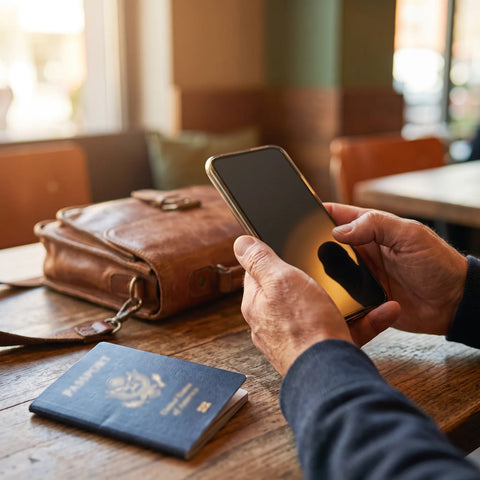
In short: With an eSIM Naples and Amalfi Coast, you have active data as soon as you land in Capodichino, without roaming or queues. Coverage is solid in Positano, Amalfi, Sorrento, and the historic center of Naples, and only falters in the tunnels of the SS163, at sea, and inside the ruins of Pompeii. For a week, estimate between 5 and 8 GB.
Naples is not explored calmly: it's noise, traffic, and alleys that cross without warning. And the Amalfi Coast, right next door, is the opposite — a winding road suspended over the sea, tiny villages, and coverage that goes up and down with each cliff. If you've never used an eSIM, think of it as a SIM card installed via software: you scan a QR code before leaving home and, upon arrival, you activate it and immediately have data, without having to search for a store or queue at the airport.
Is an eSIM worth it in Naples?
It depends on your plan, and here it's important to be honest: if you have a Spanish line with roaming included in the EU, you technically don't need anything else to browse in Italy — data roaming within the European Union has been free of charge for years. So if you're going to Naples for a weekend with your usual plan and plenty of GB, don't buy anything: save the money for pizza.
A local eSIM makes sense in three specific cases: if your Spanish plan has limited data and you don't want to run out of GB halfway through your trip; if you're coming from outside the EU (UK, Latin America, United States) and roaming charges skyrocket as soon as you land; or if you simply prefer to have a separate data line, without touching your own, while sharing your real-time location in Rione Sanità or buying your Circumvesuviana ticket from your phone without queuing at the machine.
The difference from traditional roaming is well explained in our eSIM vs. roaming comparison: an eSIM gives you dedicated and controlled data from your phone, without depending on what your home operator decides to charge you outside the EU.
Local tip: In Naples, your mobile is your best ally against traffic. Use live data maps, not offline, because streets change direction and offline GPS doesn't always reflect this in time.

Coverage on the Amalfi Coast
The Amalfi Coast boasts breathtaking beauty, yet it's a challenging terrain for any antenna: villages clinging to cliffs, tunnels carved into rock, and the SS163 road winding in sharp curves above the sea. In tourist hubs like Positano, Amalfi, Ravello, and Sorrento, 4G and 5G coverage is good and stable, due to the concentration of antennas and tourism. The problem arises between villages: on the sharpest bends, inside the short tunnels that pierce the road, and on some hillside stretches, the signal disappears for a minute or two and then returns on its own.
A detail almost no one mentions: if you're traveling by SITA bus on the SS163 (the cheapest way to get between villages), there are sections of the journey with no coverage precisely where you'll most want to take photos — so if you're going to upload something to Stories, do it when you arrive at the next village, not halfway through a bend. And if you're traveling by ferry between Amalfi, Positano, and Capri, coverage is good in the ports but can drop in the middle of the crossing, especially if the sea is rough and the boat moves away from the coast.
To avoid relying on luck, download an offline map of the area before leaving your hotel and write down (not just on the map) the addresses of your accommodations and the name of the nearest village. A quality eSIM automatically searches for the best available Italian network at each point, so you'll have plenty of signal in the villages; the challenge isn't the eSIM, it's the topography.
Italian operators and which network the eSIM uses
Italy has four major operators: TIM, Vodafone, WindTre, and Iliad. TIM and Vodafone historically offer the best coverage in southern Italy and in rural or coastal areas like the Amalfi Coast, because they have been investing in antennas outside major cities for more years. Iliad, on the other hand, is stronger in large urban areas and somewhat weaker on mountain or coastal road sections.
A travel eSIM doesn't force you to choose an operator: it automatically connects to the available network with the best signal in each area, within the agreements it has with local operators. This means you won't be comparing Italian rates or filling out forms in Italian: you'll simply have data, and in Positano or Sorrento, you'll experience the same coverage as a local with TIM or Vodafone.
| Italian Operator | Strong point | Typical coverage on the Amalfi Coast |
|---|---|---|
| TIM | National and rural coverage | Very good in towns and on the road |
| Vodafone | Cities and coastal areas | Good, stable in tourist hubs |
| WindTre | Urban areas | Average, more erratic outside towns |
| Iliad | Large cities | Average, loses strength in curves and tunnels |

How many GB for your trip to Campania
For a typical one-week trip through Naples and the Amalfi Coast, with maps almost all day, many photos, and some video for Stories, estimate between 5 and 8 GB. If you make daily video calls or upload long video reels, go up to 10-12 GB. What consumes the most, by far, is GPS on the road with the screen on for hours — more than the photos themselves.
| Type of trip | Duration | Estimated GB |
|---|---|---|
| Short getaway | 2-3 days | 2-3 GB |
| Classic trip | One week | 5-8 GB |
| Content creator | One week | 10-12 GB or more |
Since the eSIM can be topped up directly from your phone, there's no need to overbuy GB just in case. Start with a modest plan and only extend it if you find yourself quickly using data uploading photos of buffalo mozzarella and the views of Positano. If you want to refine your calculation before purchasing, check our guide on how to save data with an eSIM on a trip, with tricks that are especially noticeable on long road trips like the SS163.
Naples, Pompeii, Capri: connectivity at each stop
The Campania region is explored through excursions, and each has its own coverage behavior. In the historic center of Naples, the signal is complete, which is logical in such a dense city: ideal for navigating the alleys of Spaccanapoli or locating the recommended pizzeria without relying on the accommodation's Wi-Fi.
In Pompeii and Herculaneum, you'll have coverage at the entrance and in a good part of the site, but in the lower areas of the excavations — where the ruins are sunken compared to the current street level — the signal may weaken. This isn't a real problem because you won't need data between Roman columns, but if you're meeting someone outside the site, let them know before entering that it might take a while to respond.
In Capri, the town and Marina Grande have good coverage, but inside the Blue Grotto or sailing around the island by boat, the signal easily drops due to the rock of the coastal caves. Vesuvius has reasonable signal in the car park and a good part of the ascent trail, although it becomes erratic near the crater, where the open terrain and altitude work against it. The general rule that works throughout the region: live data within cities, offline map downloaded for excursions and coastal stretches.
Myths and what almost no one tells you
There are preconceived notions about traveling with data in Italy that should be debunked before leaving home.
"In the EU, I don't need anything, so it doesn't matter which eSIM I buy." It's true that you don't pay extra roaming within the Union, but that doesn't mean all eSIMs are the same: it's important that it relies on operators with good actual coverage in southern Italy (TIM and Vodafone, not just Iliad), and that you can top it up from your mobile if you run short halfway through your trip.
"With the traditional physical chip, I have more guarantees." Not necessarily. A physical local operator chip means looking for a store, sometimes with queues and paperwork, and ending up with an Italian number that you then have to deactivate. If you want to compare both options in depth, we have a detailed analysis of international chip vs. eSIM that summarizes when each is worth it.
"Free Wi-Fi at restaurants and on the ferry is enough." This is a real hidden gem: public Wi-Fi networks in tourist areas like Positano or the port of Amalfi are saturated during high season and, moreover, are among the least secure for entering passwords or making payments. If you're going to use public Wi-Fi on your trip, check our guide on privacy and VPN while traveling — with your own mobile data, you simply avoid the problem.
"The more signal bars, the faster the internet." Not always. In Amalfi, it's common to see 4 bars and slow loading because the nearest tower is saturated with tourists connected simultaneously during high season (July-August and Easter). If your trip coincides with these dates, be patient with the speed during peak midday hours, when everyone in the town goes out to eat with their phone in hand.
How to install the eSIM before flying
Ideally, you should install the eSIM at home, using Wi-Fi, and only activate it when you land in Naples. The entire installation process takes about a minute once you have the QR code, so you'll have data available without relying on the saturated Wi-Fi at Capodichino Airport.
- Check that your mobile supports eSIM (most recent iPhones and Androids do).
- Purchase the data plan for Italy and receive the QR code by email.
- Scan it from your mobile's settings, connected to Wi-Fi, to add the eSIM to your list of lines.
- Upon landing in Naples, activate that line and also activate data roaming specifically for it, not your main line.
If it's your first time installing one, follow our step-by-step guide on how to install an eSIM. A common mistake is activating the eSIM too early, before flying: only do it when you arrive in Campania, to avoid wasting days of validity while you're still on the plane or at your departure airport.
Frequently asked questions
Do I need an eSIM in Italy if my Spanish plan includes roaming in the EU?
It's not mandatory: within the EU, you don't pay extra roaming with your Spanish plan. However, a local eSIM gives you dedicated data without using up your plan's GB, which is useful if your plan is limited or you share your phone with a partner. If you're coming from outside the EU, however, your home operator's roaming usually skyrockets as soon as you land, so an eSIM is advisable there.
Is there good coverage on the Amalfi Coast road?
In the towns — Positano, Amalfi, Ravello, Sorrento — 4G/5G coverage is good. Between towns, on the sharp bends of the SS163 and in the short tunnels on the road, it's normal to lose signal for a minute or two. Download an offline map of the route before driving or getting on the SITA bus.
Does the eSIM work in Capri and on the ferries?
In the town of Capri and Marina Grande, you'll have coverage without issue. In the Blue Grotto, while sailing around the island, or in the middle of a ferry crossing, the signal can drop due to the coastal geography. In the departure and arrival ports (Amalfi, Positano, Sorrento), there is coverage to check schedules before boarding.
How many GB should I take for a week in Naples and Amalfi?
With normal use of maps, photos, and social media, between 5 and 8 GB is sufficient for a week. If you upload reels or make daily video calls, go up to 10-12 GB. Since the eSIM can be topped up directly from your mobile, you can start with a modest plan and extend it if you find yourself using data faster than expected.
Can I use the same eSIM in Rome or Florence after Naples?
Yes, a data eSIM for Italy (or for Europe, if your route continues through other countries) covers the entire journey without needing to buy anything new when changing cities. You just need to ensure you have enough GB and validity days left for the rest of your route.
Which operator is better for the Amalfi Coast, TIM or Iliad?
For this specific area, TIM and Vodafone perform better than Iliad because they have historically better coverage in Southern Italy and on coastal roads. A travel eSIM doesn't force you to choose: it automatically searches for the best available network at each point of your route.
Is roaming expensive in Italy if I don't have an eSIM and I'm from outside the EU?
Costs skyrocket outside of EU agreements and vary depending on your home operator, so it's advisable to check the current price directly with your company before traveling. This is precisely why travel eSIMs exist: you pay for a fixed and known data plan in advance.
Conclusion
Naples and the Amalfi Coast are much more enjoyable with a connected mobile: you navigate Neapolitan traffic without getting lost, follow the cliffside road with a live map, and share every view of Positano without rationing data. With an eSIM Naples and Amalfi Coast, you save yourself the uncertainty of roaming and arrive with active internet from Capodichino Airport. At PuraSIM, you'll find a catalog of over 200 destinations and 24/7 support in all languages via email and WhatsApp if you need help with installation. Prepare your eSIM before you fly and get it from our Europe eSIM.