In short: an eSIM for festivals acts as a backup network when the venue's network gets saturated: thousands of cell phones share the same antennas, and even with full coverage, the internet won't load. If the festival is abroad, the eSIM goes from being a plan B to the main connection, without roaming. Combine it with shared location and battery saver mode, and your weekend won't depend on luck anymore.
You've experienced it if you've been to Primavera Sound, Mad Cool, or any festival with over thirty thousand people: you have four bars of signal, but WhatsApp keeps showing the loading circle, and the group photo won't upload for anything. It's not that there's no signal. It's that the antenna serving you is attending to tens of thousands of phones at once and simply can't handle any more. Here's how that saturation works, what role an eSIM plays, and how to set up a battery and location plan so you don't lose your group between stages.
Why the network gets saturated at a festival
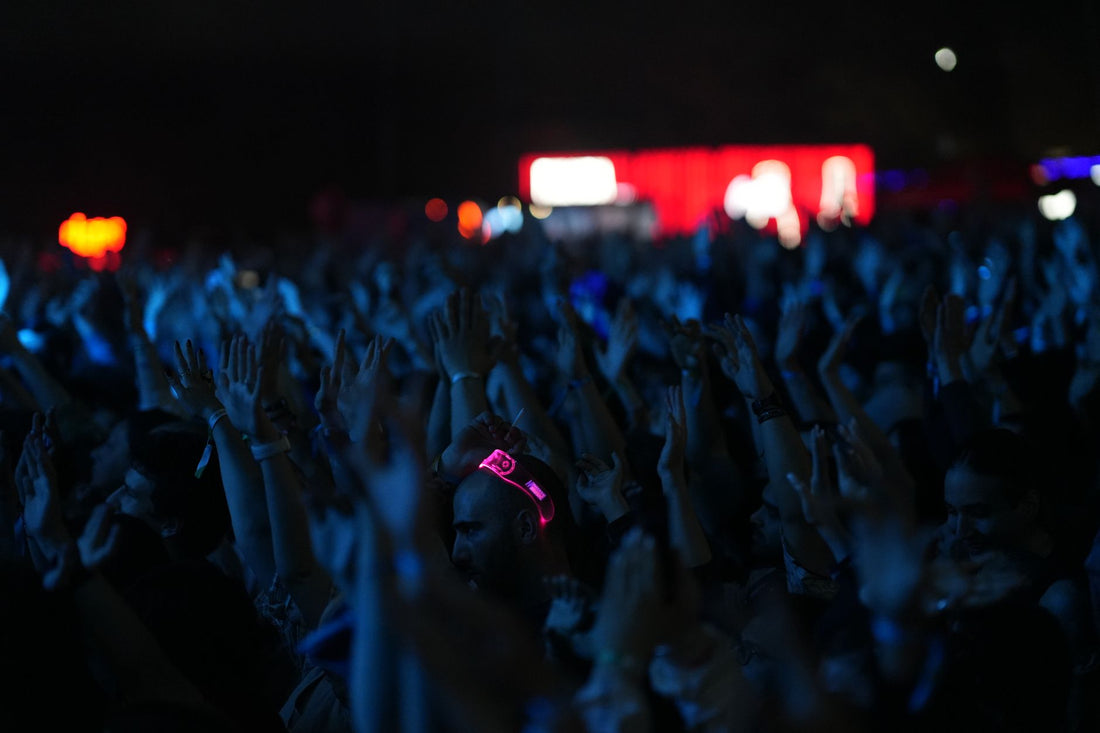
A cell phone antenna is designed to handle a normal volume of users in its coverage area: a neighborhood, an industrial park, a town. At a festival, that same space goes from having a few hundred connected phones to tens of thousands within a radius of a few hundred meters. The bandwidth doesn't increase, so it's distributed among many more people. The result is the same even if the icon above shows full coverage: the network moves at a snail's pace because it's serving too many people at once.
Large festivals (Primavera Sound at Parc del Fòrum, Mad Cool at Valdebebas airfield, Bilbao BBK Live in Kobetamendi, Arenal Sound in Burriana) often negotiate with operators to deploy temporary mobile antennas (COWs, "cell on wheels") for the weekend. They help, but they are rarely enough when the headliner takes the stage and everyone in the venue records and uploads video at the same time. It's peak hour within peak hour.
Here's the detail almost no one considers: not all operators get saturated equally at the same point in the venue. Your company might be overwhelmed near the main stage while another network holds up better near the food trucks, simply because it has fewer connected customers in that area at that moment. That's why having access to a second network gives you a real escape route when yours goes down; it's not just about having "more data."

Mobile network saturation at Spanish festivals: what to expect depending on the venue
If you're specifically looking for how mobile network saturation behaves at Spanish festivals, the short answer is: it depends on the size of the venue and whether it's in a city or an open field. Urban festivals like Primavera Sound or Sónar (both in Barcelona) have more basic infrastructure because they are surrounded by urban areas with plenty of fixed antennas, although they still get saturated during peak times in front of the main stage.
Camping festivals in open fields are the toughest scenario for the network: Arenal Sound, FIB in Benicàssim, Viña Rock in Villarrobledo, or Dreambeach in Almería set up the venue in rural areas where basic coverage was already limited before anyone arrived. There, temporary antennas are almost the only available infrastructure, and when they fail, they fail for everyone at once, not just for one operator.
The time slot matters as much as the venue: between 10:00 PM and 1:00 AM, with headliners performing live and thousands of stories being uploaded simultaneously, is when the network performs worst at almost any Spanish festival. If you need to send a location or confirm an important plan, do it before that time slot or after the last encore, when people start leaving and the pressure on the network suddenly drops.
How an eSIM helps you at a festival
A data eSIM adds a second line to your mobile, independent of your usual physical SIM, which can connect to a different network. If your operator is overwhelmed in the stage area, you switch mobile data to the eSIM, and if that network holds up better at that point in the venue, you regain internet without moving. It's a connection plan B within the same phone, without needing to carry a second mobile or a second physical card that you could lose in the crowd.
Installation should be done at home, with stable Wi-Fi, one or two days before entering the venue. This is the most common mistake: trying to install the eSIM already in the queue, with the festival network saturated from minute one. If you want exact step-by-step instructions, you have the guide on how to install an eSIM to get it ready and activate it only when you need it.
The eSIM also allows you to share internet with anyone in your group who has run out of data. By activating the hotspot from the eSIM line, anyone can connect for a moment to send the classic "where are you?". There's a cost: the hotspot significantly increases battery and data consumption for the sharer, so reserve it for short messages, not for someone to watch videos using your connection.
Share location with your group without getting lost
Losing your group at a festival with thirty thousand people is completely normal, and trying to find each other by calling when the network is saturated is the worst possible strategy. What works even when the network is crawling is sharing live location via WhatsApp, Telegram, or the mobile's "Find My iPhone"/"Find My Device." Location data is very light and updates as soon as the phone finds a network slot, so it usually gets through even if a text message takes several minutes to send.
- WhatsApp real-time location: Share it with your group as soon as you enter the venue; it lasts up to 8 hours, enough for the entire night session.
- Fixed meeting point: Agree on a large, visible spot from afar (a Ferris wheel, the food truck area, the main entrance) in case someone runs out of battery and can't share their location.
- Short messages, no photos or audio: Plain text gets through faster than any file when the network is tight; save photos and long audio messages for when you leave the venue.
A detail that's appreciated at three in the morning: take a screenshot of the venue map (stages, restrooms, water points, exits) and save it to your photo gallery. If the network completely goes down, you still have the map handy without relying on anything loading.
Sharing location uses very little data. What really devours data are stories and live videos of the concert, so if you're on a tight data plan, control that consumption with these data saving tips before you run out by Sunday.

Battery: how to make it to the encore alive
There's no point in having backup internet if your phone dies at nine in the evening. Battery is the scarcest resource at a multi-day festival, and network saturation itself drains it faster than normal: when the phone can't find a good signal, it boosts the internal antenna's power, searching non-stop, and you'll notice it in the percentage much sooner than you think.
| Situation | What to do | Why it works |
|---|---|---|
| You'll be hours without using your phone (concert, sleeping) | Airplane mode | The phone stops actively searching for signal, which consumes the most battery in a saturated area |
| You need your phone but want to save power | Power saving mode + low brightness | Reduces screen consumption, which is usually the biggest drain after signal search |
| You're going to share a hotspot with your group | Do it in short bursts, not all day | Hotspot keeps the antenna at maximum power constantly |
| You've been camping for several days | Fully charged power bank from home | Charging points at the venue, if they exist, usually have queues |
Regarding power banks: check the festival regulations before putting it in your backpack. Many large venues limit the capacity of external batteries that can be brought in for security reasons, so don't buy the largest one without checking first. And when you know you'll be without your phone for a while (sleeping in the tent, in the middle of a concert without needing a photo), airplane mode is your best ally: you recharge, and when you reconnect, everything syncs at once. You can see exactly how the eSIM behaves in airplane mode and what happens with the main line in our guide on data roaming, also useful if the festival is outside Spain.
Festival abroad: the eSIM becomes your main connection
If the festival is outside Spain (Tomorrowland in Boom, Belgium; Glastonbury in the UK; Sziget in Budapest; Coachella in California), the eSIM stops being just a backup and becomes your main internet connection for the trip. You avoid depending on your Spanish operator's roaming, whose cost outside the European Union can skyrocket depending on your contracted plan, and you also don't rely on the official camping's Wi-Fi, which, with thousands of tents connected, tends to be as saturated as the mobile network.
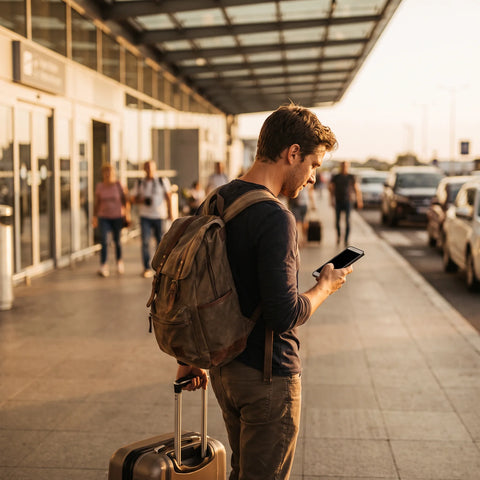
The best strategy: install the eSIM for the destination country before leaving home (or a European coverage eSIM if you'll be moving between several countries), and land with active data. You'll have maps to get from the airport to the venue, internet for accommodation check-in, and a connection for your group from the very first minute, without having to search for a Wi-Fi spot in the terminal. For festivals within the European Union, check out the Europe eSIM; if the destination is the United States (Coachella, Lollapalooza), you have the United States eSIM ready to install before your flight. If you're unsure between a physical chip and a digital one for your trip, this comparison of international chip vs eSIM clarifies which one is best depending on how long you'll be away.
And vice versa: if you're coming from abroad to a Spanish festival (Primavera Sound or Sónar receive many international attendees every year), the same applies in reverse. Install a Spain eSIM before landing and arrive with internet working from the airport, without depending on your home operator's roaming or having to look for a phone store as soon as you get off the plane.
Now, be honest with yourself about when you DON'T need any of this: if the festival is in your own city or an hour's drive away, with your usual Spanish plan, there's no point in buying a backup eSIM unless you already know that particular venue gets badly saturated every year. Save the expense for when you'll truly be outside your usual coverage area.
Common mistakes: what almost no one tells you before you go
There are a series of recurring failures festival after festival that usually don't appear in "what to pack" lists:
- Installing the eSIM in the access queue. This is the moment with the worst network in the entire venue because thousands of people are entering at once, all looking at their phones. Install it at home, not at the gate.
- Trusting that the festival's hotspot "will be fine" because Wi-Fi is advertised. The free Wi-Fi at many venues and campsites is designed for light browsing, not for hundreds of people to make video calls at once. Don't use it as your only plan.
- Not checking which data line is active. If you have both a physical SIM and an eSIM, it's easy for the phone to keep trying to use the saturated line by default even if you've activated the eSIM. Check your mobile network settings to see which data line is selected before assuming you've already switched.
- Bringing a power bank without checking the venue's regulations. Some large festivals restrict the capacity of external batteries for security; they might confiscate it at the access control if you exceed the permitted limit.
- Using open Wi-Fi networks at the venue for payments or banking. With so many people connected to the same access point, it's a bad place to enter sensitive data. If you need to do something like that, it's better with your own mobile data and, if you're concerned about privacy on shared networks, with an active VPN.
Quick checklist before entering the venue
Before you walk through the gate and lose your room to maneuver, get these things sorted. This is the thirty-second check that prevents most of the stress inside:
- eSIM installed at home, with data ready to activate if your main line gets saturated.
- Checked in settings which data line is active at all times.
- Live location shared with the entire group, with a duration of several hours.
- Power saving mode activated and screen brightness low.
- Power bank charged to one hundred percent (and checked that its capacity is permitted at the venue).
- Screenshot of the festival map saved in the photo gallery.
- Fixed meeting point agreed upon in case someone runs out of battery or network.
With this checklist and a backup eSIM ready, network saturation stops being the drama that ruins the weekend.
Frequently Asked Questions
Why doesn't the internet work at festivals if I have full coverage?
Because four bars indicate that there's a signal, not that there's free bandwidth. Thousands of phones share the same antenna in a small space, so the data per person drops dramatically. It's worse during headliner performances, when everyone in the venue records and uploads video at the same time.
Does an eSIM solve network saturation at a festival?
It doesn't eliminate it, but it gives you an alternative network to switch to. If your operator is overwhelmed in your area of the venue, you activate the eSIM data, which can depend on another network, and it's possible that one holds up better at that specific point. It's a real plan B, not a magical solution that guarantees speed.
How do I share my location at a festival when the network is slow?
With real-time location on WhatsApp or Telegram: it uses very little data and updates as soon as the phone finds a network slot, even if normal text messages take a while. Share it as soon as you enter and also agree on a physical meeting point in case someone runs out of battery.
How do I save battery at a multi-day festival?
Activate power-saving mode, lower the brightness to a comfortable minimum, close background apps, and put it in airplane mode during times when you don't need your phone, such as when sleeping. A saturated network drains more battery because the phone constantly searches for a signal, so the less you insist on using it during peak hours, the longer your battery will last.
Do I need an eSIM if the festival is in Spain?
It's not essential, and if it's near home with your usual plan, you probably don't need it. It helps as a backup in large venues that are known to get saturated (festivals with over twenty thousand people, especially at night). If the festival is abroad, then it's much more advisable, as it also helps you avoid roaming charges.
Can I use the eSIM and my physical SIM at the same time at the festival?
Yes, most compatible phones allow you to have both lines active: one for calls and SMS, the other for data, or to alternate which one uses data as needed. This way, you can remain reachable by call on your usual number while using the eSIM only for browsing when your main network is saturated.
Does the network saturate equally at an urban festival as at a camping festival in an open field?
Not exactly. City festivals, like Primavera Sound or Sónar in Barcelona, have more fixed infrastructure around them, although they also get saturated during peak times. Camping festivals in rural areas, like Arenal Sound or Viña Rock, rely almost entirely on temporary antennas set up by the festival, so when they fail, they fail for everyone at once.
Conclusion
At a festival, the combination that works is having an alternative network handy, sharing your location with your group, and managing your battery wisely—not a single magic solution. With an eSIM installed beforehand, you no longer completely depend on your operator withstanding the headliner's onslaught. And if your next festival is outside Spain, that same eSIM stops being a plan B and becomes your primary connection from the moment you land, without roaming and without depending on the campsite's Wi-Fi.