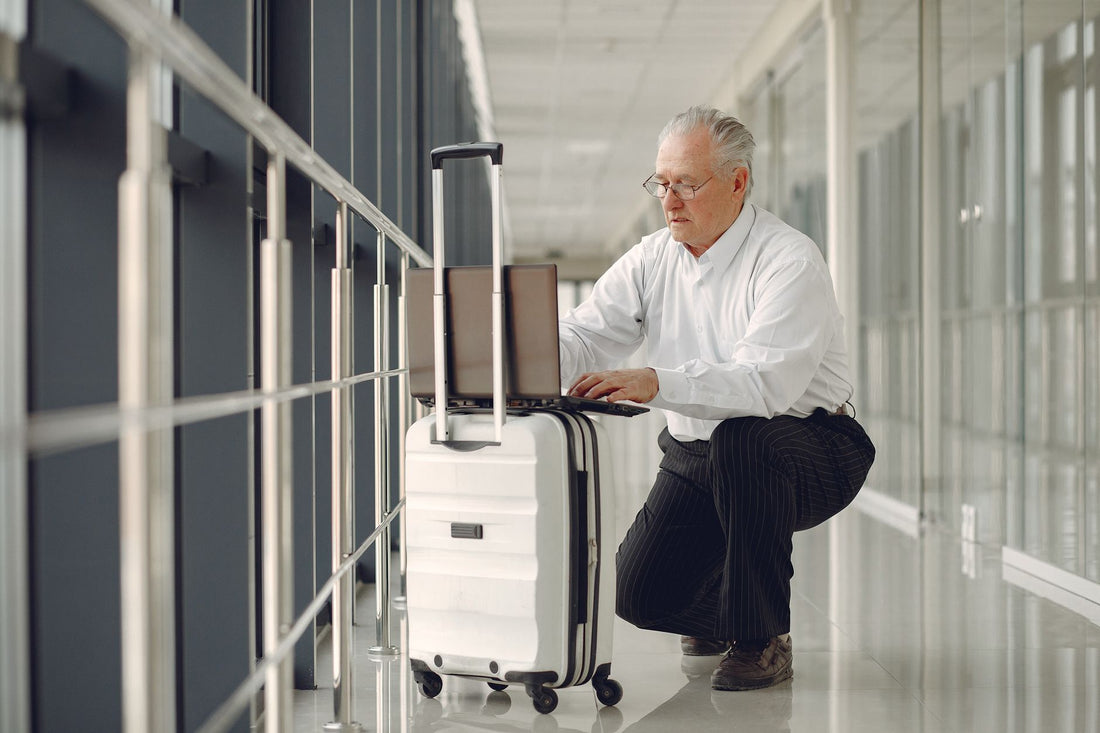
In short: an eSIM for business travel gives you reliable internet as soon as you land, a clear invoice to justify the expense to your company, stable coverage for video calls, and multi-country plans that avoid changing cards at each border, almost always cheaper than corporate roaming outside the European Union.
A business trip doesn't forgive a bad connection. A video call that cuts out halfway through a presentation, an email that doesn't send before the meeting ends, or a ticket you can't show on your phone because it didn't load in time: all of this translates into lost money and unnecessary stress. For those who fly for work, connectivity is not a luxury, it's another production tool, just like a laptop or a company credit card. That's why an eSIM for business travel solves three common headaches in one go: connection from minute one, invoicing for reimbursement, and multi-country coverage, without relying on hotel Wi-Fi or the surprises of corporate roaming.
What is an eSIM for business travel and why is it useful to you
An eSIM is a digital SIM card installed on your mobile phone using a QR code, without needing to visit a store or handle the physical phone tray. If you've never used one, you can find a complete explanation of how this technology works internally in what is a virtual eSIM. For the professional traveler, what matters is the practical aspect: you install it before leaving home, get it ready, and activate it when you land, without losing a minute of your schedule searching for a phone store in an unfamiliar country.
The advantage goes beyond convenience. Public Wi-Fi in hotels, airports, and waiting rooms is convenient, but it's also an open door to prying eyes when handling confidential documents, accessing corporate email, or logging into the company's VPN. With your own mobile data connection, you reduce this exposure and maintain control of your traffic. And since the eSIM coexists with your regular physical SIM, you continue to receive calls and SMS on your usual number while browsing with data from the destination country: no one loses contact with you by changing cards.

How to install it before boarding (and why it's a good idea to do it at home)
Installation takes a couple of minutes and is done from the phone's mobile network settings, by scanning the QR code you receive by email after purchase. We detail it step by step in how to install an eSIM, but the advice that truly makes a difference on a business trip is this: install it calmly, at home or in the office, with good Wi-Fi, and don't leave it until the last minute at the airport. Many plans allow you to install the profile in advance and activate the data days only when you arrive at your destination, so there's no reason to risk the airport Wi-Fi failing just when you need it most. If you're traveling with a corporate mobile managed by IT, check beforehand that eSIM profile installation isn't blocked by administrator policies.
Invoice and deductible expense: how to justify it to your company
This is one of the most important points for the professional traveler and one that hardly anyone explains well. When you buy an eSIM, you receive a receipt with the purchase details, which you can present as a travel expense or pass on to the company for reimbursement, exactly as you do with hotels or flights.
Compared to your personal operator's roaming, which gets mixed into your monthly line bill and is a hassle to separate when it's time to file an expense report, an eSIM is a clean, contained expense: you know exactly how much it cost and for what trip it was. This simplifies accounting whether you're self-employed or submitting expense reports to a company with a finance department. Save the confirmation email as soon as you receive it and you'll always have the proof handy.
Practical tip: create a folder in your email called "travel expenses" and file the confirmation of each eSIM there along with tickets and reservations for the same trip. When it's time to justify the trip to accounting, you'll have everything grouped in one place, without having to dig through three months of purchase history.
Security and privacy of corporate data outside the office
When you travel for work, you usually carry something more valuable than the phone itself: access to company email, documents with confidentiality clauses, and access credentials to internal systems. Connecting to the hotel or convention center's Wi-Fi network to check all of this is a common practice, but also one of the riskiest: these are shared networks, often without robust encryption, where you don't know who else is connected.
Using your own eSIM data instead of public Wi-Fi significantly reduces this risk, because your traffic no longer passes through a network you don't control. If your company also requires a VPN to access internal systems, it's worth understanding how both layers of protection combine; we explain it in eSIM, VPN, and privacy when traveling.
Reliable coverage for video calls: what you really need
A video call requires a stable connection, not just a fast one. Your image freezing in the middle of a meeting with a client leaves a bad impression and makes you lose the thread of the conversation, in addition to the feeling of not being in control. Therefore, for a business trip, it is advisable to choose a plan with good coverage over the main networks at the destination and with plenty of data to endure long meetings without checking the meter every ten minutes.
Video call consumption is around 0.5 to 1.5 GB per hour depending on video quality and the number of participants, so if your schedule includes several daily meetings, don't skimp on gigabytes to save a few euros. If you also need to work with your laptop from a waiting room or a cafe, most mobile phones allow you to share the eSIM connection via Wi-Fi as a hotspot; it's the most practical way to have internet on your computer without depending on an external network. A good trick is to reserve heavy downloads for when you have reliable Wi-Fi at the hotel, and save eSIM data for what truly can't wait. To better calculate how many gigabytes you need according to your schedule, review the tips on how to save data on your travel eSIM.

Multi-country plans for tight schedules
Business trips rarely go to just one destination. A sales tour through three European capitals, a trade fair in Germany followed by meetings in France, or an itinerary that jumps between countries in a few days, are the daily bread of those who live off international accounts. Changing eSIMs at each border would be absurd and, above all, a waste of time that no one has between flights.
A multi-country plan covers an entire region with a single profile and a single balance, so your phone stays connected as you cross borders without you having to do anything. If your work route is within the continent, the eSIM for Europe plan covers a good part of those itineraries with a single active profile; if you frequently fly to the United States for work, the eSIM for the United States plan solves the destination without needing to contract anything upon arrival.
| Type of business trip | Recommended plan | Key advantage |
|---|---|---|
| Specific meeting in a single country | Specific country plan | Best price per GB adjustment |
| Sales tour in a region | Regional multi-country plan | No need to change eSIM when crossing borders |
| Frequent intercontinental travel | Global or multi-country plan | Broad coverage without managing multiple cards |
| Schedule with lots of video (meetings, training) | Plan with more GB or rechargeable | Data margin without watching the meter |
| Fair or conference with intensive connection | High-consumption rechargeable plan | You can extend data without losing the assigned number |
eSIM vs. corporate roaming: when each one pays off
Many companies have tariffs with roaming included, but it's worth checking the fine print before assuming everything is covered. If you want to understand what roaming is exactly first, we explain it from the ground up in what is data roaming. Corporate roaming usually works well within the European Union, where the "roam like at home" regulation applies and the additional cost is minimal or non-existent. Outside the EU, however, rates can skyrocket considerably depending on the operator and destination, a cost that quickly multiplies on a long trip with several employees.
eSIM offers something that traditional roaming rarely does: a fixed and predictable cost. You know in advance how much you'll pay for travel data, with no surprises when the company mobile bill arrives at the end of the month. For destinations outside Europe, it almost always works out cheaper than operator roaming, and the expense is also perfectly identified and separated by trip. If you are considering other connectivity alternatives, the comparison of eSIM vs. roaming helps you decide with better judgment. The most common combination among professionals who travel a lot is to use the included roaming within the EU and rely on eSIM where that roaming suddenly becomes expensive.
What almost no one tells you about eSIM for business trips
Beyond the obvious, there are a number of details that are only learned through extensive business travel and rarely appear in generic guides. These are the ones that truly make a difference:
- Deactivate data roaming on your physical SIM before installing the eSIM. If you don't, your phone may still try to use your usual operator's network in the background and incur roaming charges without you realizing it.
- Not all "unlimited data" is truly unlimited. Some plans reduce speed after a certain daily consumption. For a schedule with back-to-back video calls, check the actual volume of data included before relying solely on the word "unlimited."
- Save a screenshot of the installation QR code separately from the email. If your corporate inbox has aggressive security filters, the activation code sometimes ends up in spam. Having an offline copy avoids wasting time right upon landing.
- The phone must be unlocked. If you are using a company phone with a contract to a specific operator, check that it supports third-party eSIMs; some managed models come locked to a single operator.
- Compare the price per GB, not just the total plan price. A more expensive plan with much more data can be cheaper per gigabyte than an economical one with just enough, especially with full days of video calls.
Practical tips for the business traveler
A few habits make the difference between a smooth business trip and one full of digital frictions. These are the ones that work best, according to the experience of those who travel for work regularly:
- Install the eSIM at home with good Wi-Fi and get it ready; activate it upon arrival if your plan counts days from the first use at the destination.
- Download documents and tickets offline before flying, in case coverage fails just when you need them most.
- Choose a plan with data margin: meetings often run longer than expected, and video calls consume more data than one calculates on paper.
- Configure the hotspot before the trip to connect your laptop without relying on hotel Wi-Fi or asking for the password at reception.
- Save the purchase receipt as soon as you receive it, in the same folder as the rest of your travel expenses.
With these steps, connectivity ceases to be a concern: you arrive at each meeting connected, with your documents at hand, and without the surprise roaming bill at the end of the month.
Frequently asked questions
Can I ask for an eSIM invoice to deduct it as a business expense?
Yes. When you buy an eSIM, you receive a receipt with the purchase details that serves as proof of travel expense, whether you are self-employed or submit expense reports to a company with a finance department. Keep the confirmation email handy when it's time to justify the trip.
Can an eSIM handle work video calls without interruptions?
Yes, provided you choose a plan with good coverage at the destination and enough data for your schedule. A video call consumes between 0.5 and 1.5 GB per hour, so if you have several daily meetings, a generous or rechargeable plan is advisable so you don't run out halfway through the trip.
Are there eSIMs that cover several countries on the same trip?
Yes. Regional plans cover an entire area, such as Europe, with a single profile and a single balance, so you don't have to change eSIMs when crossing borders. They are ideal for sales tours and schedules that jump between capitals in a few days without time to reconfigure anything.
Is an eSIM cheaper than my company's roaming?
It depends on the destination. Within the EU, the roaming included in the corporate rate is usually sufficient with no significant additional cost. Outside Europe, where roaming rates often skyrocket significantly, eSIM almost always wins with a fixed and known cost in advance. Many professionals combine both options depending on the country they are traveling to.
Can I share my eSIM connection with my laptop?
Yes. Most mobile phones allow you to activate the hotspot to share eSIM data with your laptop or other devices via Wi-Fi. It is the most convenient way to work on your computer without relying on hotel Wi-Fi, although it should be noted that it consumes more data than usual.
Is an eSIM secure for working with confidential documents?
Using your own mobile data instead of public Wi-Fi in hotels or waiting rooms reduces the risk compared to shared networks that you don't control. If your company requires a VPN to access internal systems, combining your own data with a corporate VPN is one of the most reasonable options for working outside the office with sensitive information.
What happens to my usual phone number if I use an eSIM?
You don't lose it. The eSIM coexists with your regular physical SIM, so you continue to receive calls and SMS on your usual number while browsing with the eSIM data in the destination country. This is precisely the advantage of having two active profiles on the same mobile at the same time.
Conclusion
For the business traveler, an eSIM solves three fronts at once: reliable connection for video calls, a clean invoice for reimbursement, and multi-country plans for busy schedules. Outside the European Union, it also generally beats corporate roaming in terms of cost and predictability. With connectivity sorted from the moment you step off the plane, the business trip runs smoothly: you land with internet, no roaming, no stress, and with all your attention focused on the meeting that brought you there.