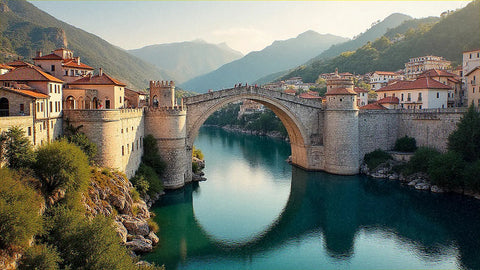
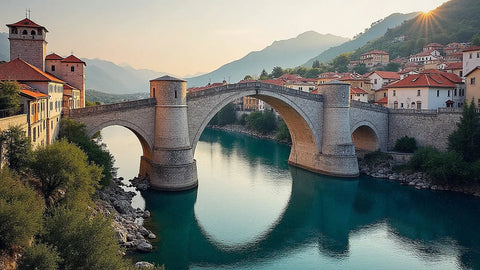
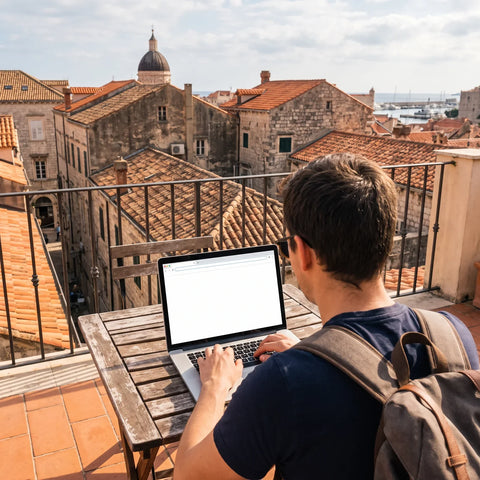
Are you planning a trip to Sarajevo and Mostar, with a stop at the Stari Most bridge at sunset, and assume that having internet in Bosnia and Herzegovina will be as easy as in Croatia or Italy? Well, here comes the first Balkan surprise, and it's good to know before packing your bags: Bosnia is not part of the European Union, so your usual mobile plan won't work the same way and could be very expensive. In this guide, I compare all the real options for connecting —from hotel Wi-Fi to a local Bosnian SIM card— and I tell you which one I choose and why.
Why connecting in Bosnia and Herzegovina is not like in the rest of Europe
Bosnia and Herzegovina is not in the European Union, so the European "roam like at home" policy does not apply here. With your Spanish plan, you will pay high "rest of the world" zone prices. To connect without unpleasant surprises, you need a local Bosnian SIM card or a travel eSIM ready before you leave.
It's a deceptive destination precisely because of how close and European it seems. You fly three hours from Spain, land in Sarajevo, and find a country with both Central European and Ottoman flair: minarets and bell towers, Turkish coffee shops, and green mountains everywhere. But Bosnia is a candidate country to join the EU, still outside the bloc, and that has a direct consequence for your mobile phone. All European regulations that eliminated surcharges for browsing abroad apply only between member countries. As soon as your phone connects to a Bosnian network, your Spanish operator treats you as if you were in a remote destination, with out-of-this-world rates. It's the typical Balkan trap, the same one you find in Serbia, Montenegro, or North Macedonia. The good news: connecting well is easy and cheap if you sort it out before you fly, instead of improvising at the airport with your mobile already searching for a network on its own.
The big misunderstanding: you don't have free roaming in Bosnia
Here's the mistake that costs many people money. You arrive in Mostar, turn on your phone without touching anything, and use it as you would at home. The problem is that, outside the EU zone, your usual plan does not include Bosnia, and "rest of the world" prices kick in. How much are we talking about? It depends on the operator, but the numbers are frightening:
- Movistar: around €12 per MB if you don't activate a bonus; calls are around €1.80/min.
- Vodafone: about €25 per GB in its non-European zone.
- Orange: bonuses of about €9 per day that activate automatically as soon as you browse.
- DIGI: the cheap exception, about €2/GB.
A couple of Instagram videos from Stari Most and you've already spent what a data plan for the entire trip would cost. That's why the first thing I do is read the fine print of my operator's "non-EU" zone before I leave.
The surprising Balkan roaming bill is almost a meme among travelers. Don't let it happen to you: check your plan before you leave, not when you return and open the bill.
You can find the detailed information in my guide on how much international roaming costs, and I compare the two options in eSIM vs. roaming. With those numbers in front of you, the decision almost makes itself.

The Balkan agreement and negotiations with the EU: why it doesn't cover you
Here's a nuance that confuses many people, and it's worth explaining honestly. You may have read that the Western Balkan countries have their own "Roam Like at Home" agreement among themselves: since July 2021, a Bosnian traveling to Serbia, or a Montenegrin going to Macedonia, browses at local prices without surcharges within the region. Sounds great… until you read the fine print. This agreement only covers SIM cards issued within the region itself and their residents. You, with a Spanish SIM in your pocket, are completely out of luck: for your operator, Bosnia is still an expensive "rest of the world" zone, and that Balkan pact does not apply to you at all.
And what about that good news that is so often announced? The European Union has just taken the first steps: the Commission proposed in February 2026 to open negotiations to integrate the six Balkan countries —including Bosnia— into its roaming zone, and the Council authorized those talks in June 2026. The goal is to completely eliminate surcharges by 2028. But as of today, nothing is signed or in force, so you cannot count on it for your trip. My advice is simple: plan as if cheap roaming did not exist in Bosnia, because right now, for an average Spaniard, it doesn't. When the change comes, it will be a joy; in the meantime, a local SIM card or an eSIM is still the sensible answer.
All your options for internet, compared
For a tourist, there are basically four paths, and each has its moment. Hotel Wi-Fi is free but ties you to the building; roaming is convenient but very expensive; a local Bosnian SIM card is very cheap for data but requires on-site management; and the eSIM seeks a balance between price and convenience. This is how I see it at a glance:
| Option | Estimated Cost | Coverage | Ideal for |
|---|---|---|---|
| Spanish Roaming | Very high (up to €12/MB) | Your operator's | Occasional emergencies |
| Hotel Wi-Fi | Free | Only within the premises | Video calls in the room |
| Local Bosnian SIM card | €16-57 depending on data | Excellent in cities and valleys | Long stays and groups |
| Travel eSIM | Adjusted, depending on GB | Local network, without changing SIM | Most tourists |
There's no single answer: if you're staying for two weeks and sharing a car with friends, a local SIM card might be worth it for the data volume. If you're traveling for four days and want zero hassle, the eSIM almost always wins. The key is to cross three variables: how many days you're staying, how much you'll consume, and how much on-site management you're willing to do. With those three answers, the right option usually becomes clear. In the following sections, I break down each one so you can choose wisely.
Hotel Wi-Fi: useful, but not your Plan A
Almost all hotels, hostels, and apartments in Bosnia —in Sarajevo, Mostar, Blagaj, Trebinje, or Jajce— offer free Wi-Fi, and it usually works well for the basics: uploading daily photos, making a video call at night, or downloading a series before bed. Many cafes in the old town, with their tradition of long after-dinner talks, also provide it without a problem, and taking advantage of it helps you stretch your mobile data. It's a good complement. But as a main plan, it falls very short for an obvious reason: it only works where there's a network, and you'll be out all day, crossing the Stari Most, going up to the Buna spring in Blagaj, or driving through the Neretva valley. Without a connection, you have no maps, no translator, and no way to call a taxi.
And there's a security issue that I can't stress enough: open public networks are not trustworthy. Never enter your banking details on such a network without a VPN, and disable automatic connection to unknown Wi-Fi networks. If you're interested in the details of why having your own plan almost always beats relying on someone else's Wi-Fi or a portable router, I compare them in depth in eSIM vs. pocket Wi-Fi. My summary: use hotel Wi-Fi as a backup, never as your only way to stay connected during your trip.
The local SIM card: BH Telecom, m:tel, and HT Eronet
Bosnia has a peculiarity you won't see in other countries: its three operators are spread across regions, a legacy of the country's organization. BH Telecom is the leader and dominates the Federation, especially Sarajevo, where it performs best. m:tel, based in Banja Luka, covers the entire Republika Srpska and is often rated as having the best overall network quality. And HT Eronet, based in Mostar, is strong in Herzegovina and the Croat-majority areas, and is known for being cheap and simple for tourists. All three provide national coverage, so you won't be stranded by choosing one over the other; the difference is where each performs a little better. All sell tourist SIM cards in their stores and at Sarajevo airport. These are the prices for 2026 (the convertible mark, KM, is pegged to the euro: €1 ≈ 1.96 KM):
| Package | Data | Duration | Price |
|---|---|---|---|
| BH Telecom Tourist 1 | 40 GB | 10 days | 31.70 KM (≈€16) |
| BH Telecom Tourist 2 | 100 GB | 30 days | 51.70 KM (≈€26) |
| BH Telecom Unlimited | 500 GB | 30 days | 111.70 KM (≈€57) |
| m:tel prepaid tourist | 20 GB (+4 GB Balkans) | 30 days | ~20 KM (≈€10) |
In terms of data volume, the local SIM card is unbeatable, and there are basic options from 5-20 KM (€3-10). The downside? The hassle: you have to go to a store or an airport counter, and by law, you'll be asked for your passport to register it in your name. Plus, you change your number to a Bosnian one, which is a nuisance if you're expecting bank verification SMS. If you're torn between this option and a digital SIM, I help you decide in eSIM vs. local SIM. For long stays and groups, it makes perfect sense.

The eSIM: my recommendation for most travelers
For the average traveler who spends one or two weeks exploring Sarajevo and Herzegovina, my clear choice is the eSIM. It's a digital SIM card installed on your mobile with a QR code, without having to insert or remove anything physical. It connects to the same Bosnian networks as a local SIM card (BH Telecom, m:tel, or HT Eronet, depending on the area), so the coverage is practically the same, but with two huge advantages: you get it ready from your sofa at home and keep your Spanish number active for calls and bank SMS. You land in Sarajevo, activate the data, and you're already browsing, with no queues, no counters, and no passport on the table.
If you've never used one and it sounds like Greek to you, in what is an eSIM I explain it step-by-step; and if you want specific details for this destination—plans, GB, and activation—you have it all in the Bosnia and Herzegovina eSIM guide. The only thing you should check beforehand is that your mobile is compatible: almost all iPhones from the XS and recent mid-to-high-end Android phones are. For price, convenience, and zero risk of surprise bills, it's the option I recommend to nine out of ten people who ask me how to connect in Bosnia.
Coverage by area: Sarajevo, Mostar, and the mountains
Coverage in Bosnia is better than many people expect. In cities and along the classic tourist route, you'll be more than fine; the problem is only in the high mountains, and the country has many of them. Here's a breakdown of the key areas:
- Sarajevo, Banja Luka, and cities (Mostar, Tuzla, Zenica): solid 4G and 4G+ everywhere, with seamless streaming, maps, and video calls. 5G is just starting —the license will be tendered in 2026— so don't count on it yet.
- Tourist Herzegovina (Mostar, Blagaj, Počitelj, Trebinje): very well covered with 4G along the Neretva valley and the M17 road. At the Stari Most bridge, you'll have plenty of signal for your photos.
- Jajce and the center: good coverage in the town and its famous urban waterfall; on secondary roads, it drops a bit, but remains consistent.
- Mountains and parks (Sutjeska, Bjelašnica, Prenj, Čvrsnica): here the story changes. In the narrow valleys and hiking trails, the signal is weak or non-existent. No SIM card works miracles between rock walls.
My advice for the mountains is simple: download offline maps from Google Maps or Maps.me before you go and treat the route as offline territory. For everything else—90% of a typical trip through Bosnia, between cities and Ottoman villages—you'll be connected without a problem. If your plan is mainly Sarajevo, Mostar, and Herzegovina, don't worry about the signal.
How much data do I really need?
This is the question I get most often, and almost always the answer is the same: you don't need as much data as you think. Unless you're going to telework or do a lot of high-quality streaming from your mobile, a moderate plan will be more than enough. What really consumes data are videos and long video calls; maps, messaging, and social media consume very little. This is the table I use to calculate:
| Trip Type | Recommended Data |
|---|---|
| Weekend in Sarajevo | 2 GB |
| One week: Sarajevo + Mostar | 3-5 GB |
| Two weeks across the country | 8-10 GB |
| Digital nomad or intensive use | Large plan or local SIM card |
A trick: rely on hotel Wi-Fi for heavy downloads (uploading photo albums, updating apps) and save mobile data for when you're out and about. With that, a 3 to 5 GB plan is more than enough for a normal week of tourism between Sarajevo and Herzegovina. And if you run short, you can always top up. Another useful reference: an hour of maps in the car uses barely a few megabytes, while half an hour of high-quality video can eat up more than 1 GB.
How to get everything ready before you fly
So you don't forget anything, this is the little ritual I follow before any trip to a non-EU country like Bosnia. It takes ten minutes and saves you 100% of the scares:
- Deactivate data roaming in your phone settings, so that expensive roaming doesn't kick in by accident as soon as you land in Sarajevo.
- Check that your phone supports eSIM (Settings > About phone, or search for your model online).
- Choose and buy your data plan in advance, calculating the GB with the table above.
- Install the digital card at home, with Wi-Fi, by scanning the QR code. Do not activate it until you arrive if your plan counts days from the first use.
- Download offline maps of the mountain areas you plan to visit, from Sutjeska to Bjelašnica.
I check it the night before I fly, with my suitcase already packed, so I arrive at the airport knowing that as soon as I turn on my phone, I'll be connected. No searching for stores, no queues, and no crossing my fingers about the bill when I get back. Preparing your connection is as important as booking your hotel: it's what you'll use every day of your trip, from maps to translators.
Frequently asked questions
Do I have free roaming in Bosnia?
No. Bosnia and Herzegovina is not part of the European Union, so "roam like at home" does not apply. With your Spanish plan, you will pay "rest of the world" zone prices, which can be as high as €12 per MB. To connect cheaply, you need a local SIM card or an eSIM.
Do I need a passport to buy a local Bosnian SIM?
Yes. By law, all SIM cards in Bosnia are registered in the buyer's name: at the store or airport, they will ask for your passport. With a travel eSIM, you save yourself the hassle because you activate it online before leaving.
Which operator is best: BH Telecom, m:tel, or HT Eronet?
It depends on the area. BH Telecom works very well in Sarajevo and the Federation; m:tel dominates Republika Srpska and often scores high in quality; HT Eronet is strong and cheap in Herzegovina. All three provide national coverage, so you won't go wrong with any of them.
Is there 5G in Bosnia?
Hardly any yet. The country will tender the 5G license in 2026, so what you'll have is fast 4G and 4G+, more than enough for everything: maps, streaming, and video calls in cities and on the tourist route.
How many GB do I need for a week between Sarajevo and Mostar?
3 to 5 GB is more than enough if you use hotel Wi-Fi for heavy downloads. Maps and messaging use very little; high-quality video is what really drives up consumption.
Does the Western Balkans roaming agreement work for me?
No. That "Roam Like at Home" pact only covers cards issued within the region and to its residents. With a Spanish SIM, you're out: for your operator, Bosnia is still a high-rate zone.
Does my phone work in the mountains and parks like Sutjeska?
Partially. In narrow valleys and hiking trails, the signal is weak or non-existent. In cities and on main roads, you'll have no problem, but download offline maps before venturing into the mountains.
When will European roaming be free in Bosnia?
The EU opened negotiations in 2026 to integrate the Balkans into its roaming zone, with an eye on 2028. But nothing is in effect yet, so as of today, you should expect high rates or use an eSIM.
Conclusion
Getting connected in Bosnia and Herzegovina is easy once you understand the essentials: you are not in the EU, so your usual roaming won't work and can be very expensive, and the Balkan agreement doesn't cover you because you have a Spanish card. From there, choose wisely. Hotel Wi-Fi is good support, a local card is unbeatable for data for long stays, and an eSIM is the most convenient and balanced option for most. Calculate your GB, prepare everything at home, and forget about the problem. My advice, after comparing everything: get your phone ready before you leave with a Bosnia eSIM and don't worry about it. You can activate yours here and land already connected, without queues or counters in Sarajevo. Have a good trip across the Stari Most.