In short: Bosnia and Herzegovina is outside the European roaming zone, so your Spanish tariff doesn't cover data here. An eSIM for Bosnia and Herzegovina connects you as soon as you land, with solid 4G in Sarajevo and Mostar, without having to find a shop or pay roaming charges per megabyte.
The reason is simple: the European "roam like at home" agreement that covers you at no extra cost in Croatia or Slovenia does not apply in Bosnia and Herzegovina, because the country is outside the European Union. Just cross the border—for example, on the way from Split to Mostar, or when entering through Neum—for your phone to connect to a Bosnian network and, if you don't have your own plan, start racking up expensive roaming minutes without you even realizing it. In this guide, you'll see the actual coverage, how many GB you'll need, and how it compares to alternatives. If you want to first understand the fundamental difference between paying for roaming and using your own data plan, we have a complete comparison: eSIM vs. roaming.
Does an eSIM work well in Bosnia?
Yes. A travel eSIM in Bosnia connects to local operator networks and works just like a physical SIM, with 4G data in populated areas. It's the most convenient way to have internet because it installs in 1 minute, doesn't require going to any store, and avoids roaming, which is not included in your Spanish tariff here.
The key is to understand the context: Bosnia and Herzegovina is not part of the EU's "Roam like at home" area, unlike Croatia or Slovenia. This means that, unless your operator has a specific (rare and expensive) tariff for the Balkans, browsing with your usual SIM will cost you a per-megabyte roaming rate that will eat into your travel budget. The eSIM solves this problem from the root: you pay a fixed plan in advance and know exactly how much you're going to spend. If you come from an EU country with included data, don't trust it: as soon as your phone connects to a Bosnian operator, you are no longer covered.

Coverage by area: Sarajevo, Mostar, and route
Coverage in Bosnia is good in cities and tourist hubs, and weaker in mountain areas, which is logical in a country with such marked relief. Here's what you can expect depending on where you go.
- Sarajevo: solid 4G coverage throughout the historic center, Baščaršija, and the new area. No problems for maps, translation, and reservations.
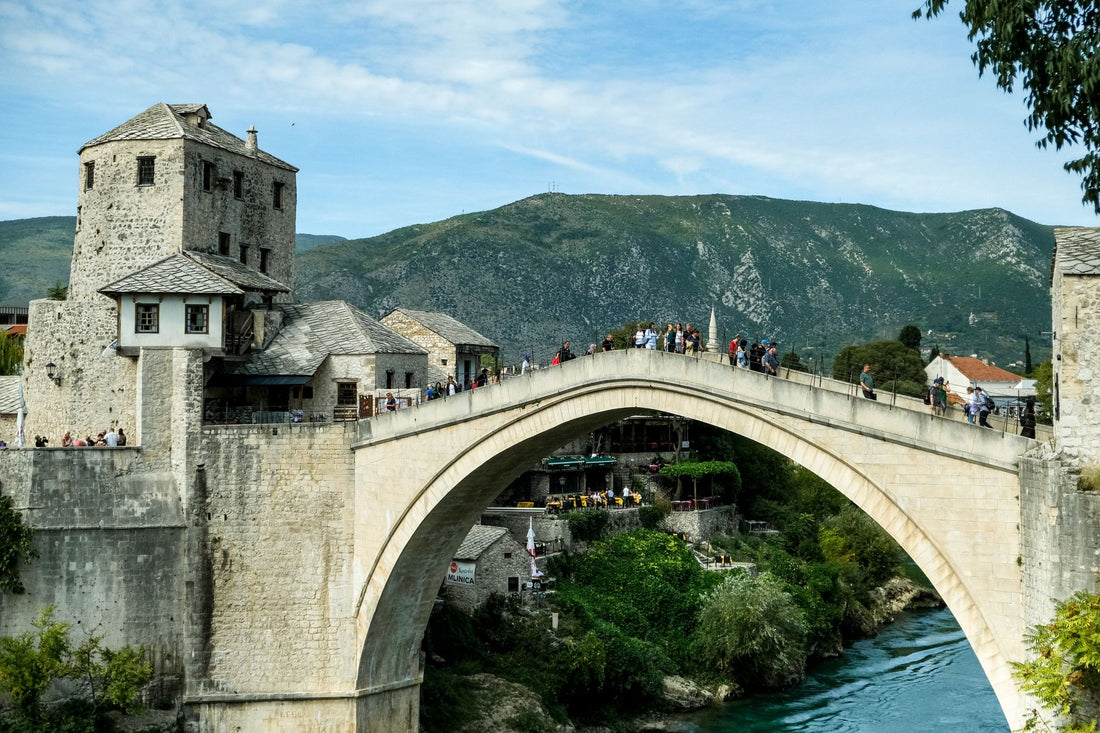
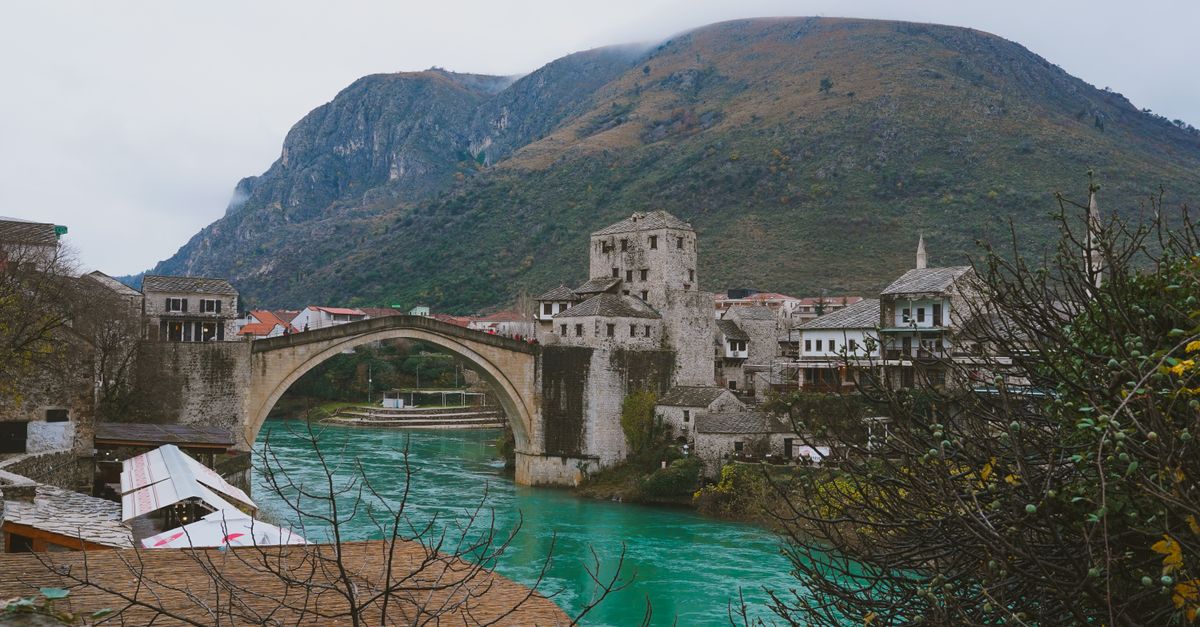
- Mostar and the Old Bridge: good signal in the old town, heavily frequented by tourists. Ideal for uploading photos of the Stari Most instantly.
- Travnik, Jajce, Blagaj: towns and tourist enclaves with decent coverage in the urban core.
- Mountain roads and natural parks: the signal can drop in stretches between valleys. Download offline maps before leaving the city.
Route tip: If you drive from Sarajevo to Mostar along the Neretva Canyon road, download the route to Google Maps offline. The scenery is spectacular, but there are sections without coverage between tunnels and gorges.
The case of Neum: you cross Bosnia without realizing it
There's a detail that almost everyone traveling from Split to Dubrovnik along the coast misses: at some point on that journey, you cross Bosnia. Neum is the country's only access to the sea, a corridor of just a few kilometers between the two halves of the Croatian coast, and the highway passes right through it. If you're traveling with European roaming activated and don't have your own eSIM, your phone will connect to a Bosnian network for a while without you realizing it, and that twenty-minute stretch will no longer be covered by your Spanish tariff. It doesn't usually incur a huge expense due to the brevity of the passage, but if you have an eSIM for Bosnia activated beforehand, that stretch is also resolved without surprises or having to check your phone to see which network you've connected to.
Local operators vs. travel eSIM
The usual question is whether to buy a SIM from a Bosnian operator upon arrival or rely on a travel eSIM. Both work, but for a tourist trip, the balance clearly tips towards the eSIM.
Three main networks operate in Bosnia—BH Telecom, m:tel, and HT Eronet—which provide good coverage. Buying their prepaid SIM can be cheap for data, but it involves finding the store, sometimes registering your passport, understanding the language, and wasting a bit of travel time setting it up. The travel eSIM relies on these same networks, but you buy it before leaving home, install it with a QR code, and activate it upon arrival in 1 minute. Let's compare:
| Option | Data price | Convenience | Paperwork |
|---|---|---|---|
| Travel eSIM | Fixed plan, no surprises | High: install at home | None |
| Local SIM (BH Telecom, m:tel...) | Very cheap for data | Low: must go to a store | Possible passport registration |
| Spanish roaming | Expensive (not included in the EU) | High, but surprise bill | None, but pay per MB |
For stays of one or two weeks, the eSIM wins in convenience and predictability; the local SIM only pays off if you stay for a long time and prioritize maximum savings over time. If you also want to understand the difference between an international physical chip and an eSIM in general terms (beyond this destination), we explain it in detail in international chip vs. eSIM.
How many GB do you need for Bosnia?
Bosnia is a destination for leisurely tourism: historic centers, nature, and gastronomy. You won't use the data you would working remotely, so don't overdo it with the plan.
For typical use—maps to navigate, WhatsApp, translating menus, uploading photos, and making some reservations—estimate between 0.5 and 1 GB per day. With that reference:
- 3-4 day getaway: 1-2 GB is more than enough.
- Full week: 3-5 GB with margin for social media and some streaming.
- Two weeks or long trip: 5-10 GB, especially if sharing internet with your partner or group.
If you run short, almost all eSIMs allow you to top up without reinstalling anything. And if you want to stretch every GB (for example, by deactivating automatic updates or lowering streaming quality on Google Maps), we have some tricks to save data on your travels. If your route is broader and you're moving through several European Union countries, check out our Europe eSIM to have coverage in several destinations without changing plans.
Myths and what almost no one tells you
Before buying, it's worth dispelling some ideas circulating about eSIMs and Bosnia in particular. None of them are obvious nonsense: they are the kind of detail you only discover halfway through your trip, when it's too late.
- "Bosnia has two entities, so coverage will be spotty depending on where I go." False. The country is administratively divided into the Federation of Bosnia and Herzegovina and the Republika Srpska, but that's politics, not telecommunications: the three operators (BH Telecom, m:tel, and HT Eronet) provide service throughout the territory and your eSIM won't notice the change of entity when crossing from one area to another.
- "If my eSIM covers 'Europe,' it surely includes Bosnia." Don't take anything for granted. Many regional European plans are designed for the EU roaming area and exclude Balkan countries that are not part of it, precisely because it is not technically "roaming" but a different network. Before buying, review the list of covered countries in the plan's description and confirm that Bosnia and Herzegovina is explicitly listed.
- "If I use an eSIM for data, I lose my Spanish number and people can't call me." That's not true: the vast majority of phones in recent years are dual SIM, meaning they support your Spanish physical SIM (or eSIM) for calls and SMS at the same time that the Bosnian data eSIM handles internet. If you're not sure what an eSIM is or how it coexists with your usual line, we explain it from scratch in what is a virtual eSIM.
- "Free Wi-Fi at my accommodation is more secure than mobile data." Quite the opposite. Open Wi-Fi networks in hostels and cafes in Sarajevo or Mostar are an easy target for sniffing traffic; browsing with data from your own eSIM is more private than connecting to a shared network with strangers. If you're going to handle online banking or reservations during your trip, it's worth reading this guide on eSIM, VPN, and privacy on a trip.
Bosnia as part of a Balkans itinerary
Few travelers go only to Bosnia: it's common to combine it with Croatia, Montenegro, or Serbia on the same route. Here, the choice of eSIM changes and should be considered before purchasing.
If your trip combines several Balkan countries, you have two paths. One: one eSIM per country (one for Bosnia, another for Croatia, etc.), which is cheap but involves changing plans when crossing borders. Two: a regional eSIM that covers the entire area, which is more convenient because you don't have to do anything when moving from one country to another. Pay attention to an important detail: Croatia is in the EU (with roaming included for Spaniards), while Bosnia, Montenegro, and Serbia are not. That's why a travel eSIM makes special sense precisely in the sections outside the EU. If your route is mainly within the Union, compare it first with our guide on how data roaming works in the EU and decide based on how many days you spend inside and outside European roaming.
How to install and activate your eSIM
This is the part that deters those who have never done it before, and it's the simplest of all. It's done at home, calmly and with Wi-Fi, in just 1 minute.
The general process is the same on iPhone and Android: you buy the plan, receive a QR code by email, scan it from your phone settings, and that's it. The eSIM is installed but doesn't use data until you activate it upon arrival in Bosnia. Our advice: install it before leaving Spain, with Wi-Fi, and leave the activation (or data line change) for when you land. If you want the complete step-by-step with screenshots, see the guide on how to install an eSIM. And if you doubt whether your phone supports it, the vast majority of smartphones in recent years do: check your phone settings (look for "Add eSIM" or "Mobile Data") before buying, so you don't get a surprise at the airport.
Frequently asked questions
Do I need an eSIM in Bosnia if I'm coming from the EU?
Yes. Bosnia and Herzegovina is not part of the European "Roam like at home" roaming area, so your Spanish tariff does not include data here. Without an eSIM, browsing with your usual SIM will be charged as expensive roaming. A travel eSIM gives you data at a fixed price from the moment you arrive.
What is the coverage like in Sarajevo and Mostar?
Very good. Travel eSIMs rely on local operators such as BH Telecom or m:tel, with solid 4G in the center of Sarajevo, the new area, and the old town of Mostar. In mountain roads, the signal may be weaker, so download offline maps before routes inland.
Is a local SIM or a travel eSIM better?
For tourism of one or two weeks, the eSIM: you buy it before traveling, activate it in 1 minute, and don't waste time looking for a store or registering your passport. The local SIM only pays off if you stay for a long time and are looking for the lowest possible price per GB.
How many GB do I need for a week in Bosnia?
Between 3 and 5 GB will cover a week of tourism with maps, WhatsApp, social media, and photos. If you share internet with more people or watch videos, it goes up to 5-10 GB. Almost all eSIMs allow you to top up on the go if you run short, without reinstalling anything.
Does the same eSIM work for Bosnia and Montenegro?
It depends on the plan. A Bosnia-specific eSIM only covers Bosnia; for a route that includes Montenegro or Serbia, choose a regional Balkan eSIM or combine several plans. Check the list of covered countries in the description before buying to avoid running out of data when crossing borders.
Do I still receive calls and WhatsApp on my Spanish number if I use an eSIM in Bosnia?
Yes, on most phones. Being dual SIM, your Spanish line (physical or eSIM) remains active for calls and SMS while the Bosnia eSIM handles only data. WhatsApp works as always because it uses data, not your operator number to transmit messages.
Do I need a passport or any paperwork to activate the eSIM in Bosnia?
No. Unlike a local prepaid SIM, which sometimes requires passport registration at the store, the travel eSIM is purchased and activated online with the confirmation email and QR code. There is no paperwork to do upon arrival.
Conclusion
Bosnia is outside the European roaming zone, so arriving without a data plan is a recipe for an unpleasant bill. A travel eSIM gives you reliable coverage in Sarajevo, Mostar, and on the road, at a fixed price and without paperwork. Install your eSIM for Bosnia before you fly and land already connected, with just enough GB for your trip.