If you've made it this far, it's because you've already decided to take data with you and all you want to know is how many GB you need for Bosnia and Herzegovina, without overdoing it or running out of data in the middle of the Neretva Valley. I'll tell you quickly and with figures: people here spend much less than they end up buying, especially if your plan is a classic day trip from the Croatian coast. Let's get straight to the point.
The quick answer, in one paragraph
For 10 days in Bosnia and Herzegovina, most people will be fine with 2 GB. If you're just taking a day trip from Dubrovnik or Split, 1 GB will be more than enough. If you upload photos and videos to social media every night, count on 5 GB for those same 10 days.
That's the honest recommendation, and I stand by it even though we sell larger packages. Bosnia is a low-data destination for three reasons that come together: travel distances are short (Mostar and Sarajevo are just over two hours apart), hotel, cafe, and restaurant Wi-Fi works reasonably well in cities, and you spend much of the day walking through old towns or on a bus with your phone in your pocket.
What does change the number compared to other European destinations is the point that almost no one considers: your usual European plan won't cover you here, so every megabyte you spend outside of a specifically contracted plan will be charged separately. That doesn't mean buying more gigabytes; it means buying just enough and activating them before crossing the border.
If you want the general criteria I apply to any country before delving into the details of this one, you can find it in the main guide on how much data I need for travel. Here I'll focus only on Bosnia and why the number is smaller than you might expect.
Bosnia is not the EU: that's why the number changes
This is the most important warning in the article, and it's worth stating plainly: Bosnia and Herzegovina is not part of the European Union. Your "use your data like at home" plan does not apply when crossing the border. Croatia is in the EU; Bosnia is not. And between Dubrovnik and Mostar, there's a border that you cross by bus, often without anyone saying anything beyond a passport stamp.
The result is classic: you enter Neum or Metković, your phone connects to a Bosnian network, and your operator starts billing at non-EU rates. You don't even need to open anything; an automatic backup or a couple of WhatsApp videos are enough. That's why the annoyance usually doesn't come from spending a lot, but from spending a little at an absurd price.
There is political movement, however. In June 2026, the EU Council authorized opening negotiations to extend the "Roam Like at Home" system to the six Western Balkan countries, including Bosnia. Authorizing negotiations doesn't mean it's already in force: meanwhile, what your contract says still applies. European and Balkan operators signed a voluntary commitment in 2023 to gradually lower the price of roaming data in the area, but it's voluntary and not all companies apply it equally.
The practical consequence for you: don't rely on your home line, have data specifically contracted, and use it wisely. If you want a complete comparison of options for connecting there, you can find it in internet in Bosnia and Herzegovina. If you don't yet know how this technology works, I explain it in what an eSIM is.
Day trip from Dubrovnik or Split
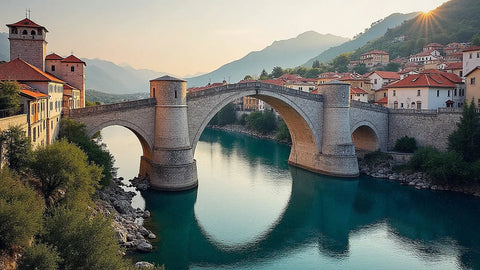
This is the dominant profile in Bosnia and deserves a separate chapter, because the figures plummet. Most visitors don't sleep in the country: they leave Dubrovnik or Split early in the morning, visit Mostar, Blagaj, Počitelj, or the Kravice waterfalls, and return to Croatia for dinner. That's between 8 and 12 hours, of which four or five are spent sitting on a bus or in a car.
For that, you don't need gigabytes, you need crumbs. Here's a breakdown of a normal day:
| Time of day | What you do with your phone | Estimated consumption |
|---|---|---|
| Outbound journey (2-3 h) | Messages, some music, checking the map | 60-120 MB |
| Mostar (3-4 h) | Map occasionally, finding a restaurant, WhatsApp | 40-80 MB |
| Blagaj or Kravice (2 h) | Photos, some social media stories | 30-100 MB |
| Return journey (2-3 h) | Messages, uploading 15-20 photos | 60-150 MB |
| Total for the day | 200-450 MB |
In other words: the smallest package you can find will be more than enough. A 1 GB plan covers the excursion with plenty of margin, even if you decide to make a ten-minute video call from Stari Most. Buying 5 or 10 GB for eight hours is a waste of money. The only thing you must do is have it active before crossing, not when you're already inside and without a connection to install anything. If you travel this way, look at the short plans for eSIM for Bosnia and Herzegovina and choose the smallest one.
How much data each app really uses
Before deciding, it's important to know what each thing consumes. These are the reference figures I use, rounded and conservative (I always prefer to overestimate rather than underestimate):
| Activity | Approximate consumption | On a typical travel day |
|---|---|---|
| Maps with turn-by-turn navigation | 5-10 MB per hour | 20-50 MB |
| Downloaded offline maps | Virtually 0 | 0 MB |
| WhatsApp: text, audio, and individual photos | 10-20 MB per day | 15 MB |
| Voice call on WhatsApp | 25-35 MB per hour | 15 MB |
| Video call | 250-350 MB per hour | 0-150 MB |
| Social media with video (Instagram, TikTok) | 500-900 MB per hour | 150-500 MB |
| Upload 30 photos from phone to cloud | 100-150 MB | 100 MB |
| Streaming music, normal quality | 50-70 MB per hour | 50-150 MB |
| Video in standard quality | 0.3-0.7 GB per hour | Avoid with data |
| Video in high definition | 1.5-3 GB per hour | Avoid with data |
| Browsing and reading news | 30-60 MB per hour | 60 MB |
It's clear where the money goes: video. Everything else is background noise. Maps, which people fear the most, consume very little; you can navigate for a whole week in Bosnia and not even reach 300 MB. A single afternoon lying down watching series with data costs more than the entire trip combined. That's why the right question isn't how much you travel, but how much video you consume. If you want more detailed information by application, I break it down in the mobile data usage statistics by activity.
A real day in Mostar, Blagaj, Kravice, and Sarajevo
Let's get down to earth with the itinerary almost everyone follows. Imagine you're sleeping in Mostar and have three days ahead. The first day you dedicate to the old town: bridge, Kujundžiluk bazaar, Koski Mehmed Pasha mosque. You walk a lot, photograph a lot, and use your phone little, because the center is walkable and there's no way to get lost. Actual consumption: 80-150 MB if you upload photos at night from the hotel using data.
On the second day, you rent a car or book a tour for Blagaj, Počitelj, and the Kravice waterfalls. Here you do use the map continuously, between 90 minutes and two hours of total driving. Add 30-60 MB for navigation, plus photos. In Kravice, additionally, there are stretches where coverage is weak and you simply don't spend data.
On the third day, you go to Sarajevo: two and a half hours of road through the Neretva canyon, one of the most beautiful routes in the country. There, your phone loses signal at times between tunnels and gorges, and then you arrive in a city with decent Wi-Fi in almost any cafe in Baščaršija. Another 150-250 MB, assuming you look up schedules, restaurants, and some history about the war tunnel.
Total for three fairly intense days: around 500 MB. With 1 GB, you would have been comfortable, with 2 GB, you'd have half left over. That's the order of magnitude I want you to remember, because Bosnia is traversed slowly and with your head up, which is exactly the opposite of a data-devouring destination.
Master table: GB by profile and duration
This is the table you've been looking for. Find your profile, cross-reference it with the number of days you'll be there, and that's your number. These are calculated with a margin: if you find yourself somewhere between two rows, take the lower one and use data saving strategies.
| Travel Profile | 5 days | 10 days | 15 days | 30 days |
|---|---|---|---|---|
| Day trip from Croatia | 1 GB covers the whole trip | — | — | — |
| Map and WhatsApp tourist | 1 GB | 2 GB | 3 GB | 5 GB |
| Photos and social media user | 3 GB | 5 GB | 8 GB | 15 GB |
| Family sharing a hotspot | 5 GB | 10 GB | 15 GB | 25 GB |
| Digital nomad or remote work | 10 GB | 20 GB | 30 GB | 50 GB or unlimited |
Three nuances about the table. First: the "family sharing" profile assumes one phone acts as a router for two or three other devices, with children watching cartoons in the car; if the kids watch video, go up a step. Second: a digital nomad who makes daily hour-long video calls already uses 300 MB just for that, so always round up. Third, and most useful: most people who buy 10 GB for a week come home with 8 GB untouched.
A rule I apply to Bosnia without exception: buy for the usage you normally have, not for the usage you fear you might have. If you're torn between 2 and 5 GB, take 2 and recharge if necessary. Recharging takes minutes; no one refunds gigabytes.
Three operators and mountains: where you won't spend data
Bosnia has a particularity you won't see in almost any country of its size: three mobile operators distributed by territorial criterion. BH Telecom dominates the Federation and Sarajevo, m:tel (Telekom Srpske) is strong in the Republika Srpska and Banja Luka, and HT Eronet is in charge in Herzegovina and the Mostar area. All three have 4G coverage throughout the country, but each is denser in its own area.
Why does this matter for calculating gigabytes? Because if your plan only connects to one of those networks, in certain valleys you will be relying on a weaker signal, and a weak signal consumes the same but performs worse: retries, stuck videos, maps that reload. The ideal is a plan that can switch between networks.
| Area | Predominant network | What to expect |
|---|---|---|
| Sarajevo and Federation | BH Telecom | Solid 4G, comfortable speeds in the city center |
| Mostar, Blagaj, Herzegovina | HT Eronet | Good urban coverage and on the tourist route |
| Banja Luka, Republika Srpska | m:tel | Extensive coverage in cities and main routes |
| Neretva and Drina Canyons | Variable | Sections with no signal; the phone doesn't use data |
| Inland mountain roads | Irregular | Definitely download the map |
The other side of the coin is good news for your wallet: hours without coverage are hours without consumption. On mountain routes between Mostar and Sarajevo, or on the way to Jajce and the Pliva lakes, there are long stretches where your phone transmits nothing. Count that as a reduction in your estimate, and compensate by downloading the map of the entire country before you leave.
City Wi-Fi and how much it saves you
Bosnian Wi-Fi is better than people assume. In Sarajevo and Mostar, practically every hotel, hostel, apartment, cafe in Baščaršija, or old town restaurant has an open network or a password in the menu. Add to that many accommodations are family-run and the host gives you the key as soon as you arrive. In terms of mobile data, that means you can offload between 60% and 80% of your total consumption to Wi-Fi if you organize yourself minimally.
How does that translate into gigabytes: the two most data-intensive activities (uploading photos and videos to the cloud or social media, and watching videos) are also the two easiest to postpone. You don't need to post your camera roll at three in the afternoon from the bridge; upload it at night from your accommodation. With just that, a 10-day trip that would have cost 5 GB now costs 2 GB.
That said, don't build your plan around Wi-Fi. Outside cities, things change: in small towns, at the Kravice waterfalls, or at roadside gas stations, there's either no Wi-Fi or it's very slow. And open bar networks have the usual problems, so avoid banking and shopping on them. My criterion is simple: Wi-Fi is for heavy and postponable tasks, data is for urgent and sensitive ones. With that division, the small package is more than enough.
How to calculate your own consumption before you leave
All the tables in the world are worth less than your own history. You have the data on your phone right now, and it takes a minute to check, so do it before buying anything.
- On Android: Settings → Network & internet → SIM or Data usage. You'll see the current cycle's usage and the breakdown by app.
- On iPhone: Settings → Mobile Data. Below, you have the breakdown by app; remember to tap "Reset Statistics" on the 1st of the month if you want a clean measurement.
Take the total from the last full month and divide it by 30. That's your daily consumption at home. Now apply two corrections for Bosnia: subtract between 40% and 60%, because at home you have Wi-Fi all day at work and on the couch, and when traveling, you're walking and sleeping less with your phone in hand; and add 10% for the extra use of maps, translator, and restaurant searches.
A real example: if you use 12 GB per month at home, that's 400 MB per day. Applying the correction, you're left with about 200 MB per day of travel. For 10 days: 2 GB. There you have it, it matches the general recommendation. If you get more than 500 MB daily, it's because you watch video every day, and then your profile is social media user, not map tourist. This thirty-second calculation is more accurate than any online calculator, because it's based on what you actually do.
Stretching your data and what happens if you run out
Assuming you've already bought the small package, here's how to make it last. None of this is about sacrificing your trip; it's about stopping giving away megabytes to processes that don't add anything to your experience.
- Download the map before you leave. In Google Maps, your profile → Offline maps. The entire country takes up a few hundred MB over Wi-Fi, and then you can navigate for free.
- Download the translator's language pack. Bosnian offers an offline package, and the camera mode for reading letters and signs works the same.
- Backups only over Wi-Fi. Google Photos and iCloud are the biggest silent data hogs during a trip.
- Disable autoplay for videos on Instagram, TikTok, Facebook, and X.
- Activate system data saver and lower video and music quality to standard.
- Download music and series the night before, especially for the Dubrovnik-Mostar journey.
And what if you still run short? Just top up. That's exactly why I prefer to err on the side of having less: a top-up can be done from your phone in two minutes, and you only pay for what extra you need. On the other hand, the gigabytes you bought extra and didn't use don't come back. Running short costs two minutes; having too much definitely costs money. And if you run out of data right on the road, with the map downloaded, you'll still reach your destination without drama. You have more ideas in my guide on how to save data while traveling.
Frequently Asked Questions
How many GB do I need for a day trip to Mostar?
1 GB is more than enough. A day of eight to twelve hours with maps, WhatsApp, photos, and some social media usually stays between 200 and 450 MB. Buying 5 GB for a single day is a waste of money, even if the price seems low.
Is Bosnia and Herzegovina included in my European roaming plan?
No, and this is the most expensive mistake of the trip. The country does not belong to the EU, so the "use your gigabytes like at home" rules do not apply. In June 2026, the EU authorized negotiations for its inclusion in the system, but until that is finalized, every megabyte is billed outside the standard rate.
Can I use the same plan for Croatia and Bosnia?
Only if the plan explicitly covers both countries. A European Union package does not include Bosnia by default. If you're doing Dubrovnik or Split with a jump to Mostar, look for a regional Balkans plan or two separate plans, and check it before you cross, not after.
Do I need data to drive on mountain roads?
No, if you have the map downloaded. This is the number one recommendation for Bosnia: in the Neretva canyon, on the route to Jajce or towards the Drina, there are sections without signal where online maps simply won't load. Download it via Wi-Fi the night before and forget about the problem.
Is there good Wi-Fi in Sarajevo and Mostar?
Yes, better than expected. Accommodations, cafes, and restaurants in the old towns usually have a network available, so you can save your data for the street and the road. Outside the cities, in villages and natural areas, don't count on it.
What happens if I run out of gigabytes halfway through my trip?
You top up from your phone in a couple of minutes. Nothing is irreversibly cut off, nor do you lose your number. That's why I always recommend starting with the small package: the cost of being short is minimal, and the cost of having too much is money you don't get back.
Is it worth buying 20 GB just in case?
For a normal tourist trip, no. It only makes sense if you telework with daily video calls, share a connection with multiple devices, or watch videos daily outside your accommodation. In any other case, you will come home with more than half unused.
Conclusion
To summarize, so you have just one number in mind. Day trip from Croatia: 1 GB. Five-day getaway: 1 or 2 GB. Ten days of normal travel through Mostar, Sarajevo, and surroundings: 2 GB, and 5 GB if you're someone who uploads photos and videos every night. Only if you telework or share your connection with family does it make sense to go into double digits.
What you cannot do is cross the border relying on your European tariff, because Bosnia is not in the EU, and that's where bill shocks come from. Have your data contracted and active before leaving Dubrovnik or Split, with the map downloaded and backups in Wi-Fi mode, and the trip will cost you less than you thought.
Once you're clear, choose the right size on our eSIM for Bosnia and Herzegovina and install it from home. If you're debating between two sizes, you know which one I'll tell you: the small one, and top up if necessary.