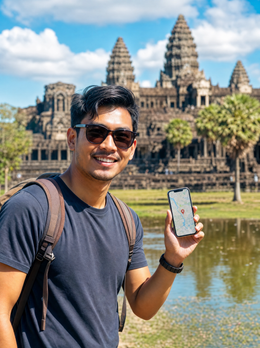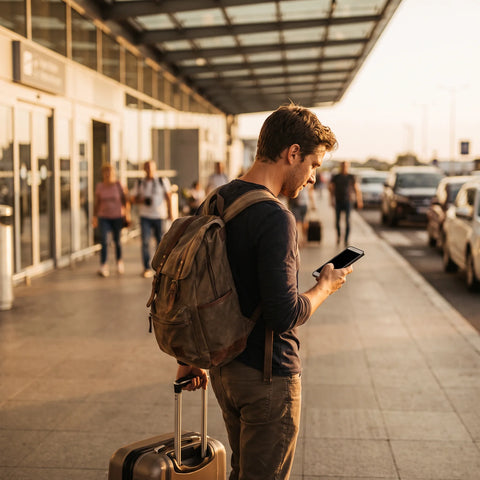
Cambodia is one of those destinations where your phone can get you out of a tight spot: to read the name of a lost temple in Angkor, to haggle the price of a tuk-tuk via Grab, or to let your island hostel know you're arriving on the last ferry. The good news is that internet in Cambodia is cheap and better than many people imagine. The bad news is that there are four or five ways to get it, and each has its own fine print. Here, I'll compare them all so you can land with data on your phone, without airport queues or bill surprises.
What the internet in Cambodia is really like
In Cambodia, you have four realistic ways to connect: roaming (the most expensive), hotel Wi-Fi (free but limited), a local Cambodian SIM (very cheap, with passport), and eSIM (activated before flying and the most convenient). All four rely on Cellcard, Smart, and Metfone.
Cambodia is surprising: the country made a strong commitment to mobile, and today 93% of the territory has 3G and 80% reaches 4G, with urban speeds of 10–25 Mbps, more than enough for maps, messaging, and video. On January 1, 2026, commercial 5G from Cellcard, Smart, and Metfone was also switched on, with over 1,500 antennas currently concentrated in Phnom Penh and major provinces. For a tourist, the network is not the problem.
The problem is access to that network. Your Spanish plan doesn't work at local prices, buying a SIM requires passport paperwork, and Wi-Fi disappears just when you need it most. That's why it's a good idea to decide before you fly and arrive connected from the plane. These are the four options you'll consider:
| Option | Approximate Price (2-week trip) | Advantage | Disadvantage |
|---|---|---|---|
| Roaming from Spanish operator | From €25 with a bundle; €6–12/MB without a bundle | Zero hassle, same number | Highest risk of bill shock |
| Hotel / public Wi-Fi | €0 | Free and widely available | Not available on the street or on the road |
| Local Cambodian SIM | $5–12 (approx. €5–11) | The cheapest in the country | Passport and card change |
| Travel eSIM | From ~€6 depending on data and days | Activated before leaving home | Requires compatible phone |
Roaming with your Spanish operator: convenient and very expensive
This is what many people do out of habit: land in Phnom Penh, turn on their phone, and let their Spanish SIM connect to Smart or Cellcard. It works, yes; the price is the problem. Cambodia is in Zone 3 or "Rest of the World" for almost all Spanish operators, far from the "roaming like at home" that only applies within the European Union. There's no flat rate here.
Without contracting anything, standard rates are around €6/MB with Vodafone and go up to €12/MB with Movistar. Per megabyte. A single Instagram video can cost you more than that night's dinner. International bundles soften the blow, but they are still expensive and full of pitfalls: 20 GB for €25 for 7 days in the best case, or 150 MB for €60 in the worst.
- Check Cambodia's zone on your operator's website before flying.
- Activate the roaming data spending limit if allowed.
- Turn off mobile data on the plane if you're not getting a bundle.
I've seen too many travelers return from Cambodia with a three-figure bill for two weeks of maps and WhatsApp. I break down the detailed numbers in how much international roaming costs, and the full comparison is in eSIM vs. roaming.
Hotel Wi-Fi, public Wi-Fi, and pocket Wi-Fi
Here comes the pleasant surprise: Cambodia has a very generous free Wi-Fi culture. €8 hotels, hostels, guesthouses, cafes, and restaurants offer a connection without asking for anything more than a purchase, and in Siem Reap or Phnom Penh, you can spend the day jumping from network to network. The password is usually on the menu or the ticket itself.
The problem starts when you leave that environment. Cambodian Wi-Fi is abundant but inconsistent: saturated home routers, brief power outages, and networks shared by half a hostel at nine at night. And, above all, it doesn't exist precisely where you need it most:
- When leaving the airport, when you need to order a Grab or PassApp and see the license plate.
- Between the temples of Angkor, looking for the next one on the map.
- On the ferry to Koh Rong or on a night bus to Kampot.
- When the guesthouse is on an unnumbered alley and you need to call.
Hotel Wi-Fi is a great complement to save data at night, but as the only connection for a trip to Cambodia, it falls short at the most inopportune moment.
What about pocket Wi-Fi, the rental router? In Cambodia, it almost never pays off: you pay $4–8 per day plus a deposit for an extra device with 6–10 hours of battery that, if there are one or two of you, does the same thing as your own phone. I compare it in depth in eSIM vs. pocket Wi-Fi. My conclusion is simple: in such a mobile-dependent country, you can't rely on Wi-Fi as your primary plan.
Local Cambodian SIM: Cellcard, Smart, and Metfone
The local SIM is, without question, the best price-to-data option in the country. A tourist package costs around $5 and includes an enormous amount of gigabytes: the most popular Smart SIM offers 25 GB for 15 days for $5, and there are variants up to 30 GB for similar amounts. With these numbers, data in Cambodia is almost a steal compared to Europe.
The three operators have their own characteristics, and it's advisable to choose according to your route:
- Metfone: the leader, with nearly 10 million users and the best rural coverage. If you're going to Ratanakiri, Mondulkiri, or inland villages, this is the one you want.
- Smart: the fastest 4G and the most popular among travelers; strong in cities and major tourist routes.
- Cellcard: very reliable in Phnom Penh, Siem Reap, and the coast, and since 2026, the fastest 5G in the country; slightly weaker in deep rural areas.
As a rule, in Cambodia, coverage matters more than peak speed: I prefer stable 15 Mbps on the way to a distant temple than 400 Mbps in the city center. The local SIM gives you the best price-to-data ratio for your trip, but it has three hidden costs not on the label: passport, queue, and changing your Spanish card. The long analysis is in eSIM vs. local SIM.
Buying a SIM at the airport and passport registration
Cambodia legally requires all SIM cards to be registered with an identification document. For a foreigner, this means handing over your passport, having it photographed or scanned, and having the card associated with your name. It's legal and routine, but it implies two things: don't buy a SIM already activated "without papers" from a street vendor (it's usually registered in someone else's name and can be cut off in days) and you need your passport handy when you land.
At Phnom Penh and the new Siem Reap-Angkor (SAI) airports, there are Cellcard, Smart, and Metfone counters in the arrivals area. The vendor installs the SIM, activates the plan, checks that it browses, and you're good to go in five minutes. Airport packages usually range from $5 to $30 depending on data and days.
That said, it's wise to be careful at the arrival counters:
- They might "upgrade" you to a more expensive plan you didn't ask for.
- Charges in dollars with a poor exchange rate instead of the real price.
- They sell you a lot of GB that expire in a few days.
- "Activation" fees that appear out of nowhere.
My rule: ask for the specific plan by name, check the data and days remaining on your phone before leaving the counter, and distrust a vendor who rushes you. If all this already sounds like a hassle with jet lag, that's precisely why the next option exists.
The eSIM: my recommendation for 90% of travelers
An eSIM is a digital card that is downloaded to your mobile phone: no plastic, no tray, no clip. You buy the plan, scan a QR code, a profile is installed, and when you land in Cambodia, your phone automatically connects to the local network. Your Spanish number remains active on the physical SIM, so you continue to receive bank SMS while browsing with Cambodian data. I explain it without technical jargon in what an eSIM is.
For Cambodia, it solves, one by one, all the friction points we've just seen:
- No queues: you leave the plane already with data, without going through any counter.
- No handing over your passport or photocopies circulating around.
- No surcharges: the amount you see is what you pay, in euros and from home.
- No taking out your Spanish SIM or risking losing it on a ferry.
- The same networks (Cellcard, Smart, or Metfone) as the local card.
The only requirement is that your phone is compatible, which is almost guaranteed if it's from recent years. The best thing, for me, is being able to activate it from the comfort of home and land without thinking about anything. You have the step-by-step guide, with plans and data, in the eSIM guide for Cambodia.
Coverage by area: Phnom Penh, Siem Reap, the coast, and the islands
No matter which option you choose: they all rely on the same antennas. This is what you'll find on the ground.
Phnom Penh: excellent coverage. Solid 4G throughout the city and 5G already active with all three operators since 2026. You won't have any problems here, neither for ordering Grab nor for video calls.
Siem Reap and Angkor Wat: the city works perfectly, and, surprisingly, a good part of the Angkor complex has decent 4G signal, even in the most visited temples like Angkor Wat, Bayon, or Ta Prohm. In the more distant temples of the circuit (Banteay Srei, Beng Mealea), coverage drops, so download the offline map before leaving the hotel.
Coast: Sihanoukville, Kampot, and Kep: on the mainland, the signal is good in urban centers and most nearby beaches. As soon as you move away from the center towards construction areas or secondary roads, it can weaken.
Islands: Koh Rong and Koh Rong Sanloem: here, the signal becomes capricious. There's intermittent 4G near the piers and main villages, but in many isolated beaches and bungalows, it barely works, and the Wi-Fi in accommodations is slow. Assume that the islands offer a semi-disconnection and notify your loved ones before boarding the ferry.
How much data you really need
The question I get most often. The short answer: almost everyone buys too much because they think in gigabytes, not in actual use. An average traveler in Cambodia, who sleeps in hotels with Wi-Fi and uses mobile data only on the street, spends between 300 and 700 MB per day. With a 1 GB daily plan, you'll be fine; the 25 GB local SIM for 15 days is, for most, more than they'll ever use.
| Activity | Approximate Consumption | On a typical day |
|---|---|---|
| Google Maps / navigation | 5 MB/hour | ~30 MB |
| WhatsApp (text and audio) | 1–3 MB per active chat | ~40 MB |
| Grab / PassApp (ordering transport) | 5–10 MB per trip | ~30 MB |
| Instagram / TikTok | 150–250 MB per 15 min | ~400 MB |
| Uploading Angkor photos to the cloud | 3–5 MB per photo | ~150 MB |
| Video call | 250–400 MB/hour | ~250 MB |
In other words: if you don't spend your life on TikTok, 1 GB a day is more than enough for a normal trip to Cambodia. Three tricks I always use: download the offline map of each area, set photo backups to "Wi-Fi only," and download the night bus series from the hotel. This way, you avoid paying for gigabytes you won't use.
Final comparison: local SIM vs. eSIM
Both options rely on the same Cambodian antennas, so the network quality you'll experience is practically identical. The difference lies in what surrounds the connection: time, paperwork, risk, and peace of mind.
| Criterion | Local Cambodian SIM | Travel eSIM |
|---|---|---|
| Data price | Unbeatable (~$5 for 25 GB) | Slightly higher (from ~€6), no surprises |
| Activation time | Upon arrival, at the counter | Before flying, from your sofa |
| Passport and registration | Mandatory, in person | No need to hand it over at any airport counter |
| Your Spanish number | Goes offline (you change cards) | Remains active in parallel |
| Risk of overcharging | Medium-high at the airport | None: fixed price in euros |
| Recharge or extension | In-store, with app in Khmer or English | Online, in two taps |
My take: if you're going to be in Cambodia for two or three months, traveling on a very tight budget, and don't mind spending some time managing it at an official store in the city center, the local SIM wins on raw price. If you're on a trip of 1 to 4 weeks and value your time, the eSIM wins hands down: the real difference is five minutes versus an hour of queuing with jet lag, passport in hand, and a vendor trying to upgrade your plan.
Frequently asked questions
Do I need a passport to have internet in Cambodia?
For a local SIM, yes: Cambodia requires each card to be registered with an identification document, and the vendor will scan your passport. With an eSIM, you buy online and don't have to hand over your passport at any airport counter.
How much does a tourist SIM cost in Cambodia?
Very little. A typical package costs around $5 and includes up to 25 GB for 15 days with Smart. At airport counters, plans range from $5 to $30 depending on the data and days you choose.
Is there good coverage in the Angkor temples?
Yes, in the main ones. Angkor Wat, Bayon or Ta Prohm have decent 4G. In distant temples like Banteay Srei or Beng Mealea the signal drops, so download the offline map before leaving the hotel.
Will I have internet on the Koh Rong islands?
Only partially. There is patchy 4G near piers and villages, but in many isolated beaches and bungalows there's hardly any signal and Wi-Fi is slow. Assume that Koh Rong and Koh Rong Sanloem are a semi-disconnection.
Which Cambodian operator has the best coverage?
It depends on your route. Metfone is the best in rural areas; Smart offers the fastest 4G and is a favorite among travelers; Cellcard stands out in Phnom Penh, Siem Reap and the coast, with the fastest 5G.
Is there 5G in Cambodia?
Yes, since January 1, 2026. Cellcard, Smart and Metfone have it active, especially in Phnom Penh and large provinces. Outside of that, 4G at 10–25 Mbps is normal, enough for everything a tourist does.
How many GB do I need for two weeks in Cambodia?
Between 10 and 15 GB cover a normal 14-day trip if you sleep in hotels with Wi-Fi. If you upload a lot of photos or consume social media non-stop, calculate 1 GB per day and you'll be fine.
Is my mobile compatible with an eSIM?
Almost certainly yes if it's from recent years: iPhone XS or later, Pixel 3 onwards and most recent Samsung Galaxy S20+, Xiaomi and Motorola. Check by dialing *#06#: if an EID code appears, it supports eSIM.
Conclusion
To summarize the internet landscape in Cambodia: roaming is convenient but can ruin your budget; Wi-Fi is available in many places and is a good complement, but never a primary plan; a local SIM is the cheapest in the world, though it requires your passport, queuing, and changing cards. And the eSIM combines the best of all: the same networks as Cellcard, Smart, and Metfone, a fixed price in euros, no paperwork, and your Spanish number remains intact.
If you ask me what I would do for two weeks between Phnom Penh, Siem Reap, and the southern islands, it's clear: buy the eSIM before leaving home, install it with my living room Wi-Fi, and forget about it until I land. It's the difference between starting your trip by ordering a tuk-tuk in two minutes or starting it by queuing with your passport in hand.
Be practical: take a look at PuraSIM's eSIM for Cambodia, choose the days and data you need according to the consumption table above, and arrive in Cambodia connected from minute one.