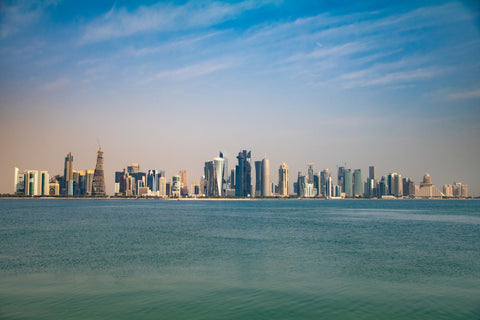
Every time a flight with a layover in Doha comes up, I get the same question: how do I connect in Qatar without breaking the bank and, above all, being able to make video calls? Because there's a detail here that almost no guide mentions: WhatsApp and FaceTime calls are blocked on local networks. Having internet in Qatar is simple, but it's advisable to choose the right option before leaving home so you don't have to deal with either the bill or the calls.
How to connect to the internet in Qatar
To connect in Qatar, you have four options: roaming (expensive, outside the EU), hotel and mall Wi-Fi, local Qatari SIM (Ooredoo or Vodafone, with passport), or travel eSIM. I recommend the eSIM: you arrive connected and, by routing traffic outside the country, it usually allows you to use WhatsApp calls that Qatar blocks.
That's the quick version, but each path has its moment, and in Qatar, there's one factor that changes everything. Two mobile networks operate in the country—Ooredoo and Vodafone Qatar—both with excellent infrastructure: Doha is one of the best-covered capitals in the entire Gulf. The quality of your connection does not depend on whether your card is plastic or virtual, but on which of these two networks your line travels.
The differentiating point here is not coverage, which is abundant, but internet calls. Qatar restricts voice over applications like WhatsApp, FaceTime, or Skype on its networks, and this affects which option is best for you. That's why not all connection methods are equally useful: your choice determines whether you'll be able to call home or just send messages. In the following sections, I break down all four with prices, dedicate an entire section to VoIP blocking, and close with coverage and the typical case of a layover in Doha.
Roaming from Spain: convenient but expensive
I'll start with the most expensive mistake of all. Qatar is not part of the "roaming like at home" zone of the European Union, so your unlimited Spanish data plan is absolutely useless upon landing. If you turn on your mobile and just use data, your operator will apply the international roaming rate, which skyrockets outside the EU.
The numbers are dizzying. Without a contracted bundle, many plans charge for data per megabyte in the Gulf region, and it only takes opening Google Maps a couple of times and uploading photos of the Doha skyline to get a serious shock on your bill. Daily bundles for outside the EU exist, but they cost several euros a day for very little data, and Qatar almost always falls into the most expensive bracket in the catalog.
When does it make sense? Only if you're staying for a few hours on a layover, don't plan to use your phone, and purchase a fixed bundle before leaving to avoid uncontrolled spending. Even so, there's an important nuance: roaming doesn't circumvent call blocking, because your traffic still passes through the Qatari network. I've detailed the numbers in my guide on how much international roaming costs and the comparison of eSIM vs. roaming. For almost everyone, this is the option to avoid.

Hotel, mall, and airport Wi-Fi
Free Wi-Fi is very widespread in Qatar and is a good support, but a bad primary plan. Almost all hotels in Doha, large shopping malls—Villaggio, Mall of Qatar, Place Vendôme—and many cafes offer decent Wi-Fi. Even Hamad Airport has unlimited free Wi-Fi, which is very helpful if you have a layover. For video calls at night, uploading photos, or planning the next day, it's more than sufficient.
The problem is twofold. First, Wi-Fi only exists where there's a router: as soon as you go for a walk in Souq Waqif, cross to The Pearl, or take a taxi to the desert, you'll lose it just when you need the map or to translate a sign. Second, and more serious in Qatar, WhatsApp and FaceTime calls also fail over Wi-Fi, because they go through the local network, which is where the blocking is applied.
There's a security nuance: on open cafe networks, have a VPN handy if you're going to access your bank. And a useful exception: if your operator allows "Wi-Fi calls" (VoWiFi), these often get through, because they are encrypted all the way to your company. That's why it's never advisable to rely solely on Wi-Fi to get around. If you're weighing pocket Wi-Fi against other options, I compare them in eSIM vs. pocket Wi-Fi.
Local Qatari SIM: Ooredoo and Vodafone Qatar
The classic option is to buy a Qatari SIM as soon as you land. At Hamad Airport, you'll find Ooredoo kiosks in the arrivals hall (next to baggage claim and at exits 2, 3, and 4) and also Vodafone Qatar kiosks. They are readily available, but you will need to show your original passport to register the line: it is mandatory by law, and digital copies are not accepted. Your phone must also be unlocked.
The most popular tourist pack is the Ooredoo Visitor SIM. These are the typical options in 2026 (the Qatari riyal is around €0.25):
| Plan | Data included | Approx. price | Validity |
|---|---|---|---|
| Ooredoo Visitor SIM | 5 GB + 25 local minutes | QR 35 (~€9) | 7 days |
| Ooredoo Visitor SIM Pro | 20 GB + 400 minutes + 75 international minutes | QR 150 (~€37) | 30 days |
| Vodafone Qatar (visitor) | Tourist data packs | from ~QR 30 | 7-30 days |
The downside? The hassle and, above all, the blocking. You have to queue after a long flight, hand over your passport, wait for activation, and swap your physical card without losing your Spanish one. And even if the data plan is generous, it's still a Qatari line: WhatsApp calls will remain blocked, because your traffic goes through Qatar. I detail this in depth in eSIM vs. local SIM.
The eSIM: my recommendation for travelers
An eSIM is a virtual card that you buy online before you travel and activate by scanning a QR code. You don't have to visit any store, you don't change your physical card—you keep your Spanish number for banking and messages—and as soon as your phone connects to the network in Doha, you have data. For the average tourist, it is by far the most convenient option, which is why I almost always recommend it.
The advantages over a local card are specific. You don't need a passport or to queue, because the provider manages the registration. Most operate on the Ooredoo or Vodafone Qatar network, so you arrive with the best signal in the country without having to choose an operator. And here's the big extra in Qatar: since many route your traffic through a gateway outside the country, they usually allow you to use WhatsApp and FaceTime calls that local networks block.
All you need is a compatible phone—almost all iPhones from the XR and recent mid-to-high-end Androids—and to install it before landing. If you've never used one, I explain how it works in what an eSIM is, and for this destination, you have my Qatar eSIM guide with activation steps.
WhatsApp and FaceTime: Qatar's VoIP blocking
This is the section that truly differentiates Qatar and that almost no one explains to you before you fly. Voice and video calls via VoIP—WhatsApp, FaceTime, Skype, Viber—are restricted on local Qatari networks. The reason is regulatory: only licensed operators (Ooredoo and Vodafone Qatar) can offer voice services, so apps that provide them for free are blocked. In practice, WhatsApp messages, audio, and photos work normally; what fails are voice and video calls.
And here's the important part: the blocking applies equally with a local SIM, with roaming, and with hotel Wi-Fi, because in all three cases, your traffic leaves through a Qatari network. That's why many travelers land thinking that buying data is enough and are surprised they can't call home. The only way to usually circumvent it is to route data out of the country.
That's where a travel eSIM that routes through an international gateway makes a difference: for blocked services, it's as if you're not in Qatar, and video calls usually work. It's not an ironclad guarantee—it's "blocked but intermittent" and depends on the provider—but it's the most reliable way to be able to call. As a backup plan, have a VPN with obfuscated servers installed and your operator's Wi-Fi calling handy.
My rule for Qatar: if I depend on video calls for work or to talk to family, I don't risk it with a local card or Wi-Fi. I arrive with data that routes outside the country and, just in case, with a backup VPN already installed from home.

Comparison: the four options head-to-head
To give you an overview, here are the four alternatives compared by what truly matters in Qatar: how much they cost, where they work, what hassle they involve, and—most crucially here—whether they allow video calls. Reference prices for a one-week trip.
| Option | Approximate cost | Coverage | VoIP calls | Disadvantage |
|---|---|---|---|---|
| Spanish roaming | Very high (per MB without bundle) | Your associated network's | Blocked (routes through Qatar) | Sky-high bill |
| Free Wi-Fi | €0 | Only where there's a router | Often fail | Useless outside the hotel |
| Local SIM | Low (QR 35-150) | Excellent (Ooredoo/Vodafone) | Blocked | Queue + passport + card swap |
| eSIM | Low-medium | Excellent (Ooredoo/Vodafone) | Usually work (routes outside) | Requires compatible phone |
The takeaway is clear: for the average traveler, the real struggle is between a local SIM and an eSIM, because roaming is too expensive and Wi-Fi isn't enough. Both operate on the same Qatari networks and provide almost identical coverage; what changes is the convenience of getting them and, above all, the issue of calls. If you value your time upon landing and want to be able to talk on WhatsApp, the balance clearly tips towards the virtual card, which offers the best convenience-to-price ratio for this destination.
Coverage in Doha and the rest of the country
Qatar plays in the big leagues here. Doha is one of the best-connected capitals in the entire Middle East: fast 4G throughout the city and widely deployed 5G by Ooredoo and Vodafone Qatar in areas like West Bay, The Pearl, Lusail, and downtown. In practice, you'll see speeds of 50 to 150 Mbps on 4G and much more where 5G is available, which is more than enough for maps, taxi apps, streaming, and messaging. In the entire metropolitan area, you won't have any signal issues.
Outside Doha, the country is small and very well covered. Al Khor, Al Wakrah, Lusail, and the main roads have solid 4G, as do major tourist attractions: World Cup stadiums, Katara Cultural Village, or the Corniche promenade. Being a compact territory, almost any journey can be made with maps and music playing without interruptions.
The only area where the signal becomes irregular is the southern desert, around Khor Al Adaid (the "inland sea"), a landscape of dunes where you'll go on 4x4 excursions. There may be stretches without coverage there. With a strong underlying network, you'll have plenty of signal in the city and only occasional outages among the dunes. My usual trick: download the offline map the night before.
Layover in Doha: connecting during a Qatar Airways stop
This deserves its own section because it happens to many people: Qatar is the hub of Qatar Airways, and a layover in Doha is one of the most frequent in the world. If your stop is short and you stay inside Hamad Airport, the unlimited free Wi-Fi in the terminal might be enough, which works well for messaging and maps. Remember, however, that WhatsApp calls will still be blocked on that Wi-Fi.
Things change if your layover is long or you take Qatar Airways' stopover to explore Doha for a day or two. As soon as you clear passport control and leave for the city, you'll want data to order a taxi, open maps, and book a visit to Souq Waqif or the museums. In that case, a virtual card activated from the plane allows you to leave the terminal already connected, without searching for kiosks or queuing with your luggage.
My advice for a stopover: install the eSIM at home, activate it upon landing, and if video calls are important to you, choose one that routes traffic outside the country. For a couple of days' stop with maps, messaging, and some social media, 1 or 2 GB will be more than enough. And if your plan runs short, you can top up from the app in two minutes without changing anything on your phone.
How much data you need for your trip
The million-dollar question: how many gigabytes should I get? It depends on your usage, but for a typical one-week trip to Qatar—Doha, museums, the Khor Al Adaid desert, and some excursions—3 to 5 GB is more than enough for most people who use data for maps, messaging, social media, and looking up places. This figure assumes that heavy photos, series, and updates are downloaded from the hotel's Wi-Fi at night.
| Traveler profile | Typical usage | Data for 7 days |
|---|---|---|
| Light | Maps, WhatsApp, some email | 2-3 GB |
| Medium | Above + social media and browsing | 3-5 GB |
| Intensive | Streaming, many photos/videos with data | 8-10 GB or more |
| Layover / stopover | Maps and taxi for a couple of days | 1-2 GB |
A couple of tricks to stretch your data: rely on hotel Wi-Fi for heavy tasks, download music, maps, and series before you leave, and disable automatic app updates in the background. With that, even a modest plan will be more than enough for the whole week. And if you run short, almost all eSIMs allow you to top up in two minutes from the app. For a first trip to the country, opt for a 5 GB plan: the sweet spot between price and peace of mind.
Frequently Asked Questions
Do WhatsApp calls work in Qatar?
Messages, audio, and photos do, but voice and video calls via WhatsApp or FaceTime are blocked on local networks and Wi-Fi. The most reliable way to make calls is a travel eSIM that routes your traffic outside the country; as a backup, have a VPN installed.
Why does Qatar block video calls?
It's a regulatory issue: in Qatar, only licensed operators (Ooredoo and Vodafone Qatar) can offer voice services. That's why apps that provide free internet calls are restricted, although messages from those same apps continue to work without a problem.
Where can I buy a SIM card at Doha Airport?
In the Hamad arrivals hall, there are Ooredoo kiosks (next to baggage claim and at exits 2, 3, and 4) and Vodafone Qatar kiosks. You will need your original passport and an unlocked phone. If you prefer to avoid the queue, have an eSIM already installed.
Can I use my Spanish plan without paying extra?
No. Qatar is outside the EU zone, so your unlimited plan does not apply, and you would pay roaming per megabyte. To avoid a shock and, moreover, to be able to make calls, use an eSIM that routes through an international gateway.
Is the coverage good in Doha?
Excellent. Doha has fast 4G and very widespread 5G, among the best connections in the Gulf. You will only notice outages in the southern desert, near Khor Al Adaid. Download the offline map before your 4x4 excursion and you'll be set.
How many GB do I need for a week?
For a 7-day trip with maps, messaging, and social media, 3 to 5 GB is enough for most people. If you do a lot of streaming or upload videos using data, go up to 8-10 GB. For a simple layover of a couple of days, 1-2 GB is more than enough.
Is my mobile compatible with eSIM?
Most recent mobile phones are: iPhones from XR onwards, Pixel, and many high-end to mid-range Samsung and Android devices. Check in Settings by searching for "eSIM" or "Digital SIM." If the option appears, your device is compatible and you can install it before flying.
Conclusion
Getting connected in Qatar is easy if you decide before leaving home. Roaming is convenient but can ruin your bill, Wi-Fi is only useful for the hotel, and a local SIM is cheap in exchange for queuing, a passport, and, worst of all, WhatsApp calls that will still be blocked. For the traveler who wants to move freely around Doha, enjoy a relaxed stopover, and—above all—be able to make video calls, the virtual card wins: you arrive connected from the moment you land, you keep your number, and you get on the best network in the country while bypassing the block. Estimate 3-5 GB for a week, prepare your offline desert map, and you're good to go. If you want to sort it out in two minutes, check out my Qatar eSIM and land without thinking about anything else.