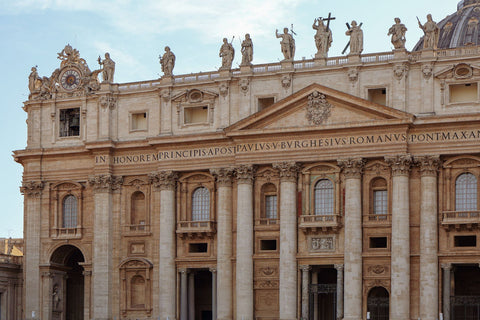
If you're planning a visit to Rome, sooner or later a specific question will cross your mind: what happens with internet in Vatican City when you cross that invisible line in St. Peter's Square and technically enter another country? I'll tell you upfront: it's much less dramatic than it seems, although there are details almost no one mentions that will affect you.
The short answer: your plan doesn't change when you enter
In practice, no. Vatican City does not belong to the European Union, but it does not have its own mobile network for visitors: your phone connects to Italian antennas, so your operator bills it as Italy, and your European plan continues to apply just as it does in the rest of Rome.
That's the answer almost everyone looking for this information wants, and I think it's fair to give it to you now instead of making you scroll to the end. Vatican City is an independent sovereign state, the smallest in the world, with only 0.44 km² and completely surrounded by Rome. It is not a member of the European Union or the European Economic Area.
On the ground, however, that doesn't change your bill, for a technical reason: there is no Vatican mobile network for your phone to connect to, only Italian antennas. And your operator doesn't bill by flags, but by the network you connect to: what it sees is Italy.
That said, there are nuances that do matter during your visit: there's no public Wi-Fi inside the Museums, the signal degrades at several points, and your tickets are on your phone.
A 0.44 km² state with no mobile operator of its own
Here's the detail that makes the Vatican a rare case. The State does have its own telecommunications: there is the Vatican Telephone Service, created in 1930 and integrated since 2002 into the Telecommunications Department of the Governatorate, which manages some 5,000 fixed terminals connected by fiber. What it doesn't have is a mobile phone company for the public.
This service is internal infrastructure of the Holy See, not something a tourist can contract. The integration with Italy even extends to numbering: the Vatican was assigned the international prefix +379, but it was never used, and its phones operate with the Italian +39, the Rome code 06, and the 698 series.
For you, the consequence is direct: the networks covering the basilica, the square, and the Museums are those of the major Italian operators, TIM, Vodafone Italia, WindTre, and Iliad. There is no Vatican network that your mobile could mistakenly connect to and skyrocket your bill, which is precisely the problem in microstates like Monaco or Andorra, where there are local operators with their own antennas. Paradoxically, this makes it one of the simplest destinations in the world: technically, you're already in Italy.

Which network you connect to and how your operator bills it
Let's put names to it, because that's what really determines what you pay. Your phone doesn't read borders: it reads the identifier emitted by each antenna. All those serving the Vatican belong to Italy's network code, so your operator registers consumption as Italian.
| Network available in the Vatican | What it is | How your Spanish plan sees it |
|---|---|---|
| TIM | Good indoor penetration | As Italy, in your European bundle |
| Vodafone Italia | Fast in central Rome | As Italy, in your European bundle |
| WindTre | Broad coverage in the city | As Italy, in your European bundle |
| Iliad | Fourth Italian operator | As Italy, in your European bundle |
| Vatican mobile network | Does not exist: the dedicated service is fixed telephony | Not applicable; your mobile never connects to it |
I want to be honest about the legal nuance: since the Vatican is not a European Union country, European roaming regulations do not protect it as a territory. The protection you enjoy is de facto, not de jure: it comes from the network you connect to, not the ground you walk on. Even so, if your plan is unusual or from a small virtual operator, check it before you travel. I break down the mechanics in how much international roaming costs.
Vatican Wi-Fi: the surprise of the Museums
And now the part that catches everyone off guard, because it goes against what you'd expect from a modern museum. The Vatican Museums do not offer public Wi-Fi in any of their halls, and they state this in their official visitor information: it's a deliberate decision for security reasons, not an infrastructure failure.
It's not that the Wi-Fi fails in the Vatican Museums: it just doesn't exist, by design. If your plan was to connect there to show your ticket, you're too late.
The same applies to the Sistine Chapel, where there is also no Wi-Fi and mobile phone use is strictly prohibited: no photos or videos with any electronic device, absolute silence, and your phone on silent throughout your visit to the Museums.
Outside the premises, the situation changes: free Wi-Fi is available in the bars and hotels in Prati and on Via della Conciliazione, just like anywhere else in Rome. It's useful for heavy downloads and little else, with the usual warning: on an open network you don't control, never enter passwords or bank details. If you were considering a portable router, I'll explain why it's almost never worth it in eSIM vs pocket wifi.
Where the signal weakens: basilica, Sistine Chapel, and dome
Coverage in St. Peter's Square is excellent, with solid 4G and 5G already present in central Rome. The problem is not the city: it's the buildings, with Renaissance walls several meters thick, and that is noticeable as soon as you cross the door. The points where the signal becomes capricious:
- Inside St. Peter's Basilica: there is coverage, but it's irregular; in side chapels and next to pillars, it drops significantly.
- Sistine Chapel: thick walls and an enclosed space, the signal is weakened. It doesn't matter: you can't use your phone there.
- Interior galleries and underground areas of the Museums: long corridors between massive walls where the phone struggles.
- Vatican Grottoes and necropolis: underground and with restricted access; assume you won't have data.
- Climbing the dome: the staircase is a stone tube, although at the top, on the terrace, the signal returns strongly.
A detail illustrates who controls the airwaves here: in May 2025, before the conclave, the Vatican deactivated the mobile signal in its territory and deployed signal jammers around the Sistine Chapel; St. Peter's Square was excluded from the measure. Exceptional, yes, but it makes it clear that the Vatican State controls its space.
Your tickets are on your phone: you need data here
Here, connectivity stops being a luxury and becomes a matter of visit logistics. Vatican Museums tickets are purchased online and arrive as a PDF with a QR code that you show at the entrance. Your ticket lives on your phone, and your phone needs to be working perfectly right at a checkpoint with a line behind you. And you already know that that's exactly where the signal can let you down.
My practical advice, one of the most appreciated: take a screenshot of the QR code and save it to your gallery, not just in your email. This way, you can get in even if your email doesn't load at that moment. If you're traveling in a group, everyone should have their own.
The rest of the visit also relies on data: schedules change depending on the season, the Museums are open Monday to Saturday with last entry well before closing, and the basilica has free entry but its own security check. Checking these on the go, finding somewhere to eat, or ordering a taxi when you leave all require connectivity. For guidance, general admission to the Museums is around €20 plus about €5 in booking fees for advance reservations.

Think of it as a trip to Rome, not a separate destination
I'm going to tell you something you might not expect from someone who sells data plans: don't buy anything just for the Vatican. It makes no sense. It's a state you visit for a few hours as part of a trip to Rome, with no passport control, no currency exchange (it uses the euro), and no network change. Contracting something for that short time would be like contracting electricity for just one room.
Nor is there an option for a local Vatican SIM card, simply because there's no operator selling one. If a website offers you a "Vatican SIM," what it's selling is an Italian card under a different name. I compare this option with the digital one in eSIM vs local SIM.
So the right question isn't how to get connected in the Vatican, but how to get connected in Rome. If you have a Spanish plan with European data and enough gigabytes, you don't need to do anything more than activate roaming data when you land. If your bundle is small, if your plan is old and doesn't include data outside Spain, or if you're coming from outside the European Union, then it's a good idea to have separate data. A complete comparison between the two options can be found in eSIM vs roaming.
Comparison of options for Rome and the Vatican
To see everything at a glance, here are the real options on the table, with the nuance that none of them change when you cross the Vatican border. Choose based on your plan and how many days you'll be in Rome:
| Option | Estimated cost | Advantage | Disadvantage |
|---|---|---|---|
| Your plan with European data | No extra cost if your bundle covers it | You do nothing; it works the same within the Vatican | Uses up your gigabytes; some plans limit them outside Spain |
| Data add-on from your operator | Several euros per day | Useful if your plan doesn't include European data | Expensive for long trips |
| Hotel and bar Wi-Fi | Free | Good for heavy downloads at the end of the day | Non-existent inside the Museums and useless while walking |
| Italian prepaid SIM card | Depends on the Italian operator | Plenty of gigabytes if you stay for weeks in Italy | Requires a store visit, passport, and phone number change |
| Digital travel data plan | From a few euros | Activates before departure, fixed price, and you keep your number | Requires a compatible phone |
If you don't know if your phone supports a digital card, I explain it in simple terms in what an eSIM is: most iPhones since the XS and many recent mid-to-high-end Androids.
How much data do you really need?
The Vatican itself consumes very little data: it's a matter of a few hours, and much of that time you'll be in rooms where you won't even be looking at your phone. What needs to be dimensioned is the entire trip to the Italian capital, with its maps, transfers, and photos. This table will guide you:
| Type of trip | Typical use | Recommended data |
|---|---|---|
| Single day in Rome with Vatican visit | Maps, mobile tickets, messaging, and photos | 1-2 GB |
| Long weekend in Rome | Normal browsing, social media, some video | 3-5 GB |
| One week in Rome and Italy | Constant maps, daily photo uploads, video | 8-10 GB |
| Long trip or remote work from Rome | Video calls and tethering with laptop | 20 GB or more |
One point almost no one considers: in Rome's historic center, you'll use GPS much more than at home, because the street layout is a labyrinth; continuous map usage consumes significantly more data than a normal day. If you're debating between two plan sizes, choose the larger one: running out of data in the middle of a two-hour queue costs a lot in terms of patience. And download an offline map of Rome before you go.
My checklist for arriving connected to St. Peter's
I'll summarize all of the above in concrete actions, because a short list is worth more than three paragraphs of theory. With this, you'll arrive at the square with your homework done:
- Check your European bundle before leaving: some plans reduce roaming gigabytes even if they don't charge extra.
- Download your tickets as PDFs and take a screenshot of the QR; save it to your gallery, not just in your email.
- Offline map of Rome downloaded the night before, with the Museums, the square, and your accommodation marked.
- Activate roaming data upon landing, or install your plan from home with stable Wi-Fi.
- Phone on silent when entering the Museums: it's mandatory, and in the Sistine Chapel, put it away directly.
- Bring an external battery: several hours on your feet with your phone searching for a signal through thick walls will drain it very quickly.
- Don't count on Wi-Fi inside: resolve what you need before passing the security check.
With these seven points, the visit becomes routine in a good way: you arrive, show your code, enjoy the Sistine Chapel without looking at your screen, and leave knowing exactly where you're going to eat and how to get back to the hotel.
Frequently asked questions
The questions that come to me again and again stem from the same confusion: thinking that an independent state necessarily means a different bill.
Will I be charged different roaming rates within Vatican City?
In practice, no. Although the Vatican is not a European Union country, it does not have its own mobile network: your phone connects to Italian antennas from TIM, Vodafone, WindTre, or Iliad, and your operator bills it as Italy.
Is Vatican City in the European Union?
No. It is a sovereign state of 0.44 km², the smallest in the world, and is not a member of the European Union or the European Economic Area. It does use the euro, and there is no border control with Italy: you enter and exit without formalities.
Is there free Wi-Fi in the Vatican Museums?
No. The Vatican Museums state in their official information that no area of the museum has Wi-Fi coverage, and that this is a deliberate decision for security reasons. There is also no connection in the Sistine Chapel.
Do I have coverage inside St. Peter's Basilica?
Normally yes, though it can be irregular. The several-meter-thick walls weaken the signal, especially in side chapels, interior galleries, and the dome staircase. In the square and on the upper terrace, coverage is good.
Can I use my mobile phone inside the Sistine Chapel?
No. Mobile phone use is prohibited in the Sistine Chapel, as are photos and videos with any electronic equipment. In the rest of the Museums, you can take photos without flash, but your phone must be on silent.
Do I need to buy something just for the Vatican?
It's not worth it. The visit lasts a few hours as part of a trip to Rome, and the connection is the same as in Italy. The logical thing is to sort out connectivity for the entire trip, not just for that two-block journey.
What is the telephone prefix for the Vatican?
It was assigned the international prefix +379, but it was never used. Its numbers operate with the Italian +39, the Rome code 06, and the 698 series: further proof of how integrated it is into the Italian network.
How much data do I use on a day trip to the Vatican?
Very little: 1 or 2 GB is more than enough for a full day with maps, tickets, messaging, and photos. Actual consumption is determined by movement around Rome and uploads to social networks, not by hours spent inside the Museums.
Conclusion
In summary: Vatican City is an independent country that does not belong to the European Union, but since it does not have its own mobile operator and its coverage comes from Italian networks, your plan behaves the same as in Rome. What you should keep in mind is the other thing: zero Wi-Fi inside the Museums, irregular signal behind those centuries-old walls, and tickets that live inside your phone.
Treat the issue as what it is, the connectivity of your trip to Rome. If your European allowance is not enough or you want to arrive with your data sorted out and at a fixed price, get it ready from home with the Vatican City eSIM from PuraSIM, and you can find the installation steps and destination details in my Vatican eSIM guide.