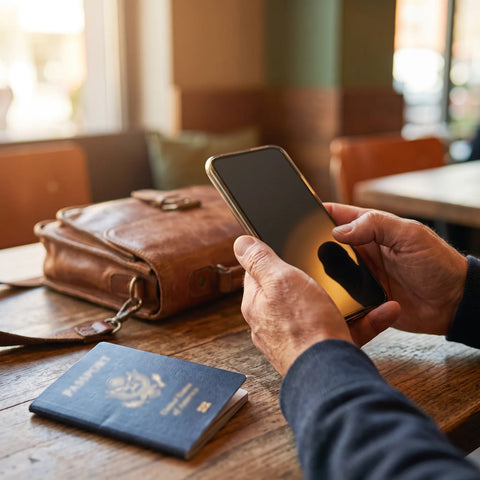
I'm writing this guide because the internet in Fiji hides a trap that almost no one tells you about before booking: you can have impeccable 5G in Nadi and be completely out of touch two hours later, in an overwater bungalow in the Yasawa Islands. Here, I compare all the options for getting connected—roaming, resort Wi-Fi, local Fijian SIM, and eSIM—so you don't take anything for granted in a destination where the signal changes from one island to another.
Your options for staying connected in Fiji
In Fiji, you have four ways to get connected: roaming with your operator (convenient, but expensive), resort Wi-Fi (free in common areas and inconsistent), a local SIM you buy at Nadi airport, and an eSIM, which you activate before flying. For most travelers, the eSIM is the most well-rounded option.
Each option serves a different need, and interestingly, they are not mutually exclusive: many people combine an eSIM for daily use with resort Wi-Fi for downloading movies at night. Before deciding, it's good to understand the four possible paths and their weaknesses.
Roaming is the "do nothing" route: you arrive, and it works, but you pay rates from the most expensive zone in the world. Resort Wi-Fi is free in the lobby and restaurant, though it's weaker in the rooms. A local SIM is very cheap but requires a passport, a counter visit, and physically changing your card. And an eSIM lets you land already connected, without visiting any counter. In the following sections, I break down each with real data on prices, coverage, and speed, so you can choose wisely and not by default.
How mobile coverage works in the archipelago
This is the point I want you to remember, because it dictates everything else. Fiji has more than 300 islands, and mobile coverage is designed for where people live and work: the main islands. On Viti Levu (where Nadi, Suva, and Lautoka are located), you have solid 4G and even 5G in cities. There, getting connected is as easy as in Europe.
The problem begins when you leave the large islands. In remote groups—the Yasawa and the outer Mamanucas—the reality is very different: in much of the Yasawas, there is only 2G or 3G, and in some areas, there is no signal at all. 4G has not yet reached most of these islands. The larger Mamanucas closer to Nadi do have some 4G, but it is inconsistent.
And there is a third scenario that catches many people by surprise: boat transfers between islands. In the open sea, you often lose data for one or two hours. The practical conclusion is simple: whatever you choose, your connection will be excellent on the large islands and precarious or nonexistent on the remote ones. No technology can bypass the lack of antennas.

Roaming with your operator: when it is (not) worth it
Roaming is the most convenient option, and almost always the worst idea for your wallet. Fiji is in the most expensive pricing zone for Spanish and European operators: outside the European Union, and furthermore, in the South Pacific. The "roaming like at home" policy that we enjoy within the EU does not apply here.
In practice, this means that many plans charge daily fees of several euros per day just for activating data, or per-megabyte prices that can skyrocket your bill in a matter of hours. Before you leave, always check the fine print of your plan: how much a day of roaming in Oceania costs and what data limit it includes. If your operator offers an international travel bundle, compare its price with that of an eSIM before assuming it's a good deal.
When does roaming make sense? If you're staying for only a few days, if your company pays the bill, or if you simply don't want the hassle. For everything else, another option is much cheaper. Here are two articles to help you crunch the numbers: my comparison of eSIM vs. roaming and a guide on how much international roaming costs depending on the destination.
Resort Wi-Fi: what to really expect
Almost all resorts in Fiji advertise "free Wi-Fi," but the reality has nuances that you should know before relying on it as your sole connection. The general rule is that Wi-Fi is free and decent in common areas—reception, bar, restaurant, pool—and much weaker, intermittent, or paid in bungalows and rooms.
The quality depends greatly on where you are. In large resorts in the Mamanucas, many have invested in satellite or microwave links and offer reasonable Wi-Fi for browsing and using WhatsApp. In the Yasawas, however, many accommodations have very limited or no connection at all. The good news is that more and more remote resorts are installing Starlink, which has greatly improved the situation in properties that were previously virtually isolated.
My advice: use the resort's Wi-Fi for heavy tasks—uploading photos, long video calls, downloading series—and don't depend on it for getting around, booking excursions, or staying reachable during the day. If remote work or staying connected is important to you, read my comparison of eSIM vs. pocket Wi-Fi, because a portable router won't solve the lack of coverage on remote islands either.
Local Fijian SIM: Vodafone Fiji and Digicel
In Fiji, there are only two operators that sell prepaid cards to tourists: Vodafone Fiji and Digicel. Both have counters in the arrivals hall of Nadi airport, open almost 24 hours, and to purchase one, you will be asked for your passport (it is mandatory to register the SIM). Prices at the airport are the same as in the city, so you lose nothing by buying it as soon as you land.
As for prices, they are ridiculously cheap: Vodafone offers plans like 45 GB for about 10 FJD (≈€4) for 7 days or 130 GB for about 25 FJD for 20 days. Digicel gives away a tourist SIM with 2 GB for 48 hours and then sells similar top-ups. In terms of coverage, Vodafone usually wins, especially on the islands and tourist routes.
The downside? You have to go to the Nadi airport counter, queue after a long flight, show your passport, physically change cards, and keep yours safe without losing it. For many travelers, the price makes it worthwhile; for others, it's a hassle they prefer to avoid. If you're unsure, here I compare eSIM vs. local SIM with their pros and cons.
The eSIM: the option I recommend
After much deliberation, for most trips to Fiji, my recommendation is the eSIM. It's a digital card that installs on your mobile without changing anything physical: you buy it online, activate it whenever you want, and land with data already, no queues or passport needed. You can have it ready from home and turn it on as soon as you arrive in Nadi.
eSIMs for Fiji rely on Vodafone Fiji's network, which has the best coverage, so on the main islands, you'll be well covered. Prices are very competitive—with plans starting from just a few euros for 1 GB—and you can choose the amount of data according to your trip without committing to a huge plan. If your phone is from the last few years, it's almost certainly compatible; you can check it in my guide on what an eSIM is.
The big advantage over a local SIM is not the price (both are cheap), but the convenience and peace of mind: you keep your Spanish number active to receive bank SMS, you don't fiddle with tiny cards, and you arrive connected. You have all the details, plans, and steps in my specific guide to eSIM for Fiji, with everything you need to have it activated before taking your flight.

Coverage by zone: Viti Levu, Mamanucas, and Yasawas
To give you a quick overview of what to expect in each part of the archipelago, I've summarized the actual coverage by zone in a table. This is the information I would have most liked to have before booking, because it explains why sometimes "no internet" isn't your SIM's or eSIM's fault, but simply because there's no antenna nearby.
A trick I always give: ask the resort about their connection type BEFORE booking. If they say "Starlink" or "satellite," good sign; if they say "Wi-Fi only at reception," assume you'll have almost nothing in the bungalow.
| Zone | Mobile Coverage | Resort Wi-Fi | What to Expect |
|---|---|---|---|
| Nadi, Suva, Lautoka (Viti Levu) | Good 4G / 5G | Good | No connection problems |
| Denarau and Coral Coast | Solid 4G | Good | Ideal for working |
| Mamanucas (large islands) | Irregular 4G | Variable | Usually works |
| Yasawas and Outer Mamanucas | 2G / 3G or none | Limited or Starlink | Manage expectations |
| Boat Transfers | Scarce to none | None | Download before sailing |
The takeaway is clear: if your trip stays within Viti Levu, Denarau, or the Coral Coast, any option will work, and an eSIM is the most convenient. If you're going to remote islands, no technology guarantees constant signal, so the key is to prepare for boat transfers and days without coverage in advance.
How much data you need for your trip
One of the most common questions I get is how many gigabytes to contract. The honest answer is that it depends on how you use your phone, but I can give you some general figures that work well for most people. Keep in mind that in Fiji, you'll likely do most heavy video streaming via resort Wi-Fi, so your mobile data consumption is usually less than you think.
| Usage Type | Recommended Data | For Whom |
|---|---|---|
| Maps, WhatsApp, and some social media | 1–3 GB | Short getaway or light use |
| Social media and some video | 5–10 GB | One week of normal travel |
| Family or couple sharing | 15–20 GB | Multiple devices |
| Remote work and video calls | 20 GB or more | Digital nomads and long stays |
My practical recommendation is to calculate based on how you travel and aim for slightly less rather than overshooting: almost all eSIMs allow you to top up in a couple of taps if you run out of data, whereas a giant plan you don't use is wasted money. If you're spending many days on remote islands, remember that you'll use less mobile data there simply because there won't be anywhere to consume it. Adjust your plan to your days in Viti Levu, which is where you'll really be using your connection.
How to choose based on your trip type
There isn't one single good answer for everyone, so I'll present it by profile, which is how decisions are truly made. The key is to cross-reference two things: where you're going within Fiji and how important it is for you to be always connected. From there, the choice almost makes itself, depending on your travel style.
- Honeymoon at a Yasawa resort: Use the resort Wi-Fi for basics and carry a small eSIM for your days in Viti Levu and transfers. You don't need a huge plan.
- Itinerary covering Viti Levu and the Coral Coast: An eSIM with 5–10 GB will cover your entire trip with stable coverage. This is the ideal scenario.
- Digital nomad or remote work: An eSIM with plenty of data and choose accommodation with Starlink or satellite Wi-Fi. Confirm the connection before booking.
- Family with children: A shared eSIM or hotspot to keep everyone connected, plus resort Wi-Fi for tablets.
In almost all cases, you'll see that an eSIM appears as the baseline, and that's no coincidence: it gives you the best coverage connection without friction, and you combine it with the accommodation's free Wi-Fi for heavy consumption. This combination is, in my experience, what works best in Fiji without overspending.
Tips for not losing signal during transfers
Boat transfers between islands are when most people get anxious, because suddenly their phone stops working in the middle of the sea. With a little foresight, those gaps without coverage stop being a problem and become, honestly, one of the best times of the trip to truly disconnect.
The most important thing is to download important things while you still have a good connection in Nadi or at the resort. These are the things I always prepare before setting sail:
- Offline maps from Google Maps or Maps.me for the area you're going to.
- Reservations, tickets, and confirmations saved on your phone or as PDFs, not just in your email.
- Music, podcasts, and series downloaded for the journey.
- A heads-up to your family letting them know you'll be out of communication for a few hours, so no one worries.
Another useful detail: activate your eSIM and check that it works in Nadi, before heading to the islands. That way, when you get coverage again after the transfer, everything will reconnect automatically without you having to struggle with settings in a place without internet. And remember that in many remote resorts, Wi-Fi is only in common areas: don't count on data in your bungalow.
Frequently Asked Questions
Does an eSIM work in Fiji?
Yes. eSIMs for Fiji rely on Vodafone Fiji's network, which has the best coverage in the country, and they work perfectly on the main islands. You only need a compatible phone (almost all recent models) and to activate it before traveling.
Is there mobile coverage in the Yasawa Islands?
It is limited. In much of the Yasawas, there is only 2G or 3G, and in some areas, there is no signal. 4G has not yet reached most of these islands, so there you will mostly rely on resort Wi-Fi, increasingly with Starlink.
Can I buy a local SIM card at Nadi Airport?
Yes. Vodafone Fiji and Digicel have counters in the arrivals hall, open practically 24 hours. You need your passport to register it, and the prices are the same as in the city. It's cheap, but it involves queuing and changing cards.
How much data do I need for a week in Fiji?
For a week of normal use—maps, social media, and some video—5–10 GB should be plenty, especially since you'll likely do heavy video streaming over resort Wi-Fi. If you work remotely or make video calls, estimate 20 GB or more.
Is resort Wi-Fi free?
Usually yes, but with nuances. It tends to be free and decent in common areas (reception, bar, restaurant) and weaker or paid in bungalows. Quality varies greatly between large Mamanuca resorts and more remote Yasawa resorts.
Is roaming worthwhile in Fiji?
Almost never. Fiji is in the most expensive pricing zone for European operators, and EU roaming doesn't apply. Except for very short stays, an eSIM or local SIM is much cheaper. Always check the fine print of your plan.
Will I have internet on boat transfers between islands?
Almost certainly not. In the open sea, you will lose data for one or two hours. The solution is to download maps, reservations, and entertainment before setting sail and inform your family that you will be out of communication during that time.
Conclusion
Getting connected in Fiji is easy on Viti Levu and in cities, but complicated on remote islands, and that difference should guide your decision. Roaming is convenient but expensive, resort Wi-Fi helps but is patchy, a local SIM is very cheap but requires queuing in Nadi, and an eSIM combines good coverage with zero hassle. That's why, for most trips, it's what I recommend as a baseline, and then you supplement it with your accommodation's Wi-Fi. Prepare your data according to your actual days on the main islands, download important things before each transfer, and enjoy those moments without signal, which in Fiji are a gift. If you want to arrive connected from minute one, check out PuraSIM's Fiji eSIM and activate yours before you fly.