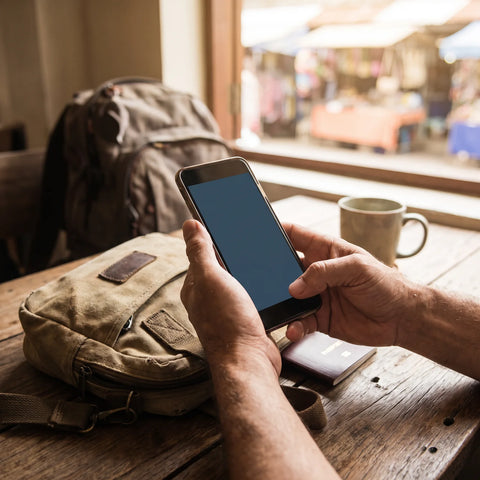
In short: a Cape Verde eSIM gives you mobile data as soon as you land in Sal, Boa Vista, or Praia, with no roaming and no need to change your number. Install it before you leave home, activate it upon arrival, and with 3-5 GB, you'll have more than enough for a week of beach, maps, and social media on the islands.
Cape Verde is an African archipelago outside the European Union, so your Spanish plan does not include data, and roaming will significantly increase your bill. The most convenient solution is a Cape Verde eSIM: activate it before you leave, and you'll land in Sal or Boa Vista with internet ready and no unpleasant surprises on your bill.
Why is roaming in Cape Verde so expensive?
Cape Verde is outside the EU, so your Spanish operator applies international roaming rates: here, megabytes are not included in your data plan and are charged separately, usually in blocks at much higher prices than in Europe. An eSIM avoids this surcharge.
The famous "free roaming within the EU" does not extend to the islands: although they are only a few hours from Lisbon, geographically and for tariff purposes, they are African territory. This means that using your phone to check the map or upload a photo to Instagram can result in charges per megabyte that will surprise you when you return home.
The classic mistake is to disable data "just in case" and end up relying on hotel Wi-Fi, which in many accommodations in Sal or Santiago is slow or goes down. With a data eSIM purchased before your trip, you travel connected without paying the surcharge applied by your operator outside the EU. If you're still unclear about what roaming is exactly and why it's so expensive outside the EU, you should review our guide on what data roaming is before deciding.
Coverage: CVMovel and Unitel T+ island by island
Two main networks operate in Cape Verde: CVMovel (from the CV Telecom group) and Unitel T+. Most travel eSIMs rely on one of these networks, with solid 4G coverage in the tourist areas of Sal, Boa Vista, and Santiago, and more irregular signal in smaller islands or the mountainous interior.
Both operators provide good coverage in tourist centers. In Sal, Santa Maria and the airport work well; in Boa Vista, Sal Rei and the large resorts also have good coverage. In Santiago, the capital Praia has the best signal in the country. You'll notice weakness on islands like Santo Antão, Fogo, or Brava, with deep valleys and mountain roads where 4G appears and disappears.
Before buying, check that the eSIM covers the exact island of your trip: an all-inclusive in Boa Vista is not the same as a trek through Santo Antão, where the signal drops in the valleys.
A travel eSIM usually connects automatically to the local network with the best signal at any given time, which saves you from changing cards every time you jump from one island to another. If you're going to chain another African archipelago on the same trip, take a look at our Comoros eSIM guide: the logic of irregular coverage between islands is very similar.

How many GB do you need for Sal and Boa Vista?
For a week on the beach in Sal or Boa Vista, with maps, WhatsApp, social media, and a few photos, most travelers are comfortable with 3 to 5 GB. If you make long videos, stream, or share data with another phone, go up to 10 GB to be safe.
The key is your usage style. Messaging, offline maps, and uploading compressed photos consume little; however, watching series, making long video calls, or publishing reels uses much more. In a sunny destination like Cape Verde, you usually spend the day on the beach or diving, so actual consumption is usually less than people fear.
| Traveler profile | Days | Recommended GB |
|---|---|---|
| Basic beach getaway (maps, chat, photos) | 5-7 | 3 GB |
| Average traveler (social media, some video calls) | 7-10 | 5 GB |
| Content creator or remote worker | 7-14 | 10 GB or more |
| Couple sharing connection | 7 | 10 GB |
If you want to fine-tune the calculation according to your apps, you have a consumption calculator that avoids overpaying or running out of data halfway through your trip. We explain it in detail in our guide to tricks to save data on a trip with an eSIM, which helps you choose the right plan and not run short.
How to install and activate your eSIM step by step
Installing an eSIM takes 1 minute: after purchase, you receive a QR by email, scan it from your phone's settings, and a new data profile is added. The ideal is to do it at home with Wi-Fi and activate it when you land at Sal or Boa Vista airport.
The general process is simple. First, confirm that your phone is compatible (most iPhones from XS onwards and recent mid-to-high-end Androids are). Then follow these steps:
- Purchase the plan and receive the QR code in your email.
- Connect to your home Wi-Fi to avoid using data during installation.
- Go to Settings, Mobile Data or Network, and add a plan or eSIM by scanning the QR.
- Label the profile as "Cape Verde" to distinguish it from your Spanish line.
- Upon arrival, activate the data for the travel profile and leave your Spanish number only for calls or SMS.
I recommend installing it before you leave and reserving activation for your destination; that way, you arrive with instant coverage without relying on airport Wi-Fi, which is often slow. If it's your first time, follow the step-by-step details in our guide on how to install an eSIM.
Prices: eSIM vs. local SIM card and roaming
As a rule of thumb, a data eSIM for Cape Verde usually falls within a low price range for several GB, compared to roaming from your operator, which can multiply that cost several times. A local SIM card is cheap but requires time, documentation, and a physical store. Check the official operator's website for the exact figures.
Comparing three options helps you decide. Roaming is convenient but expensive and unpredictable. A local SIM is economical in terms of megabytes but makes you waste time in a store as soon as you arrive and change your number. An eSIM combines the best of both: reasonable price, immediate activation, and keeping your Spanish number active.
| Option | Relative cost | Convenience | Keep your number |
|---|---|---|---|
| Spanish operator roaming | Very high | High | Yes |
| Local SIM (CVMovel / Unitel T+) | Low per GB | Low (store and paperwork) | No |
| Travel eSIM | Medium-low | Very high | Yes |
For a short getaway, this option pays off because you save the queue at the local store and avoid the extra cost from your operator. You can see the specific plan in the eSIM for Cape Verde. And if you're still deciding between a physical chip and an eSIM for this trip, we provide a complete comparison in international chip vs. eSIM.
Tips for beaches, diving, and excursions
Cape Verde is a paradise of sun, wind, and marine life. In Sal and Boa Vista, you'll want to share photos of the dunes and natural pools; while diving and snorkeling, your phone will stay on the beach, so data usage will be low during those hours. Plan your data package based on when you'll actually use your phone.
Some practical tips to get the most out of your connection without any surprises:
- Download offline maps of each island before you leave; this way, you can navigate even if the signal fails in rural areas.
- On excursions to Santo Antão or the Fogo volcano, inform someone of your route because coverage is irregular in the valleys.
- Activate data compression in your photo apps to extend your data plan.
- Reserve long video calls for hotel Wi-Fi and use your eSIM for messaging and maps.
- Bring a charger or external battery: heat and camera use drain your phone quickly.
With a little foresight, you'll enjoy the sea and dunes while your connection lasts throughout your getaway without stress. And if you're going to use your mobile for banking or email from a public network at the hotel, it's worth reading our guide on eSIM, VPN, and privacy when traveling.

Myths and what almost no one tells you
There are beliefs about staying connected in Cape Verde that should be debunked before packing your bags, as some will make you spend more, and others will leave you without coverage when you need it most.
- "The resort's Wi-Fi is enough for me." In the all-inclusive resorts of Sal and Boa Vista, the Wi-Fi in common areas usually works well, but in the room, it often drops and is almost never enough for video calls. If you plan to work for a few hours or make video calls, don't rely solely on the hotel's network.
- "With an eSIM, I can't receive bank verification SMS." False: the eSIM only replaces data, not your Spanish operator's voice and SMS line, which remains active in the background if you leave it on. Your bank's code will still reach you.
- "All islands have the same coverage." No. There's a noticeable difference in signal between Santa Maria de Sal and an inland village in Santiago. If your plan includes an excursion to Santo Antão or Pico de Fogo, assume you'll be without data for hours and organize yourself beforehand.
- "The more eSIMs I buy, the better." Buying too much out of fear is the most common mistake: you'll have leftover GB that you won't use and you'll pay for it. It's better to calculate with a reasonable margin (add 1-2 GB to the profile that best matches yours from the table above) than to double the plan "just in case."
- The inter-island ferry trick: if you travel from Sal to Boa Vista or from Praia to Fogo by boat, the signal disappears for much of the journey. Download anything you need (tickets, maps, entrance tickets) beforehand so you don't rely on the connection at sea.
- The airport is not the best place to activate: public Wi-Fi at Sal and Praia terminals is usually saturated upon the arrival of international flights. If you installed the eSIM at home, activate it using the travel profile's mobile data as soon as the plane lands, without relying on that Wi-Fi.
Frequently asked questions
Does the Cape Verde eSIM work on all islands?
Yes, in the tourist areas of Sal, Boa Vista, and Santiago, where 4G coverage is good. On smaller islands like Santo Antão, Fogo, or Brava, the signal is more irregular in valleys and mountain roads, just like with any local SIM card. Check the specific island before purchasing.
Can I still receive calls from Spain with the eSIM?
Yes. The eSIM adds a data-only profile, so your Spanish line remains active for calls and SMS while you browse with the travel plan. To avoid roaming charges for voice calls, keep your Spanish number's mobile data turned off and use the eSIM only for internet.
When should I activate the eSIM, before or upon arrival?
Ideally, install it at home with Wi-Fi and activate the data upon landing in Cape Verde. Installation takes 1 minute, and reserving activation for your destination prevents you from using up your data plan prematurely. Many plans start counting days when they connect to the local network for the first time.
What happens if I run out of data halfway through my trip?
You can top up or buy a new plan from your phone without going to a store, as long as you have a Wi-Fi connection for a moment to manage it. That's why it's advisable to calculate your GB well before leaving; 5 GB is usually enough for a week at the beach with maps, chat, and social media.
Is my mobile compatible with eSIM?
Most iPhones from the XS onwards, recent Google Pixel phones, and mid-to-high-end Samsung, Xiaomi, and other brands support eSIM. Look for the option to add a data plan or eSIM in your settings; if it appears, you are compatible. Also, confirm that your phone is unlocked by the operator.
Does the eSIM work the same in Sal, Boa Vista, and Santiago, or are there differences?
The behavior is the same: the eSIM connects to the local network with the best signal, without you having to configure anything when changing islands. What changes is the quality of that signal, which is better in the tourist centers of Sal, Boa Vista, and Praia than in rural or mountainous areas of Santiago, Santo Antão, or Fogo.
Can I buy the Cape Verde eSIM from my mobile on the same day of the flight?
Yes, the purchase and QR arrive instantly by email, but it's advisable to install it calmly with stable Wi-Fi before leaving home. Leaving the installation for the airport, with rush and saturated public Wi-Fi, is one of the easiest ways to complicate your first day of travel unnecessarily.
Conclusion
Cape Verde is outside the EU, so roaming is expensive and unpredictable. An eSIM gives you affordable data in Sal, Boa Vista, and Santiago, keeps your Spanish number, and installs in 1 minute. All you have to do is choose the GB according to your usage and activate it upon landing. Book your Cape Verde eSIM now and arrive on the islands connected from the very first minute.