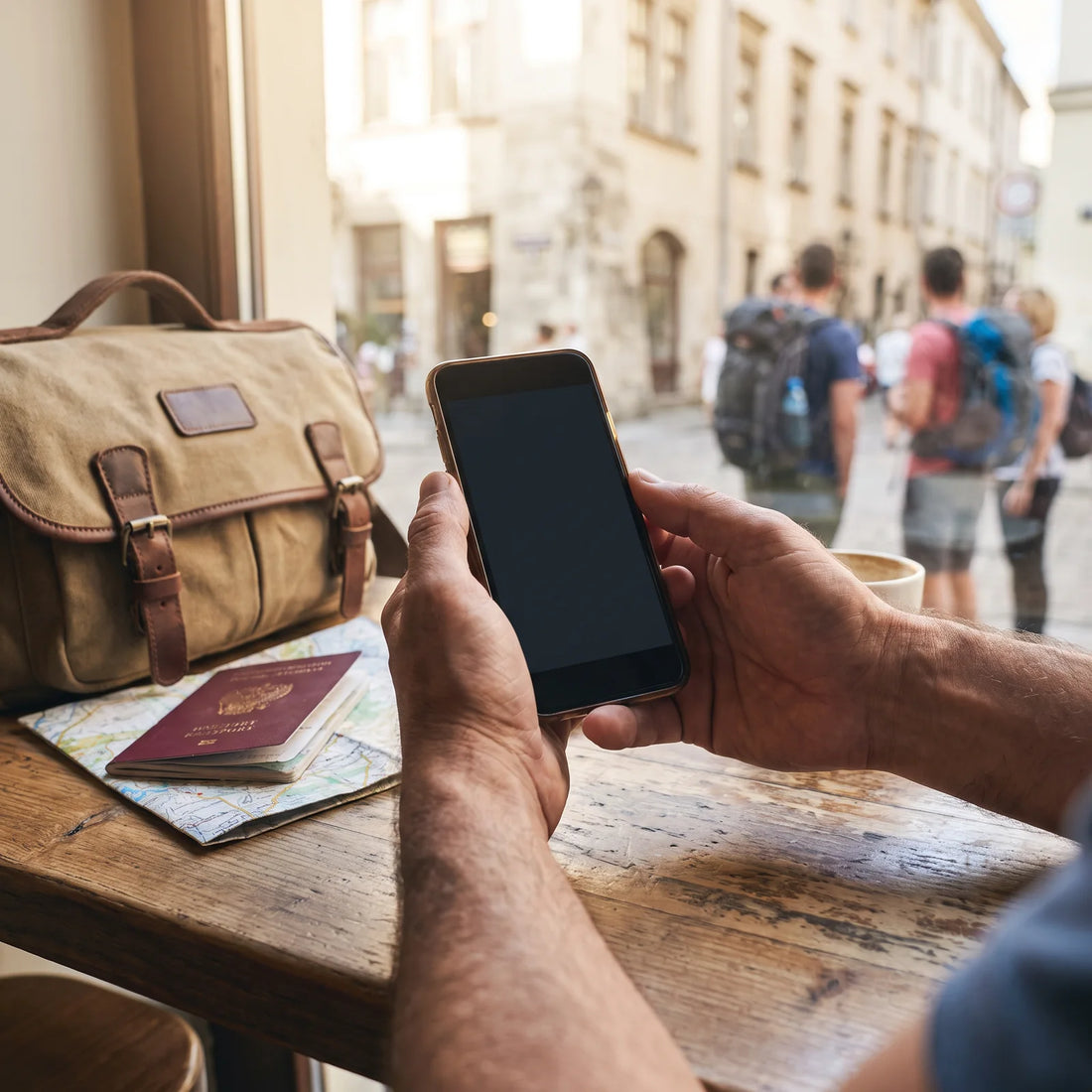
What is roaming and what happens to your cell phone when you arrive in Brazil?
Roaming is the service that allows your cell phone to stay connected to a mobile network when you leave your country, using the infrastructure of a local operator with whom yours has a commercial agreement. In Brazil, your cell phone connects to a local network as soon as you land, and every minute, message, or megabyte is billed according to that agreement.
The latter is key: roaming is not a single service nor is it free by default. It is a contract between two companies (your home operator and one or more operators in Brazil), and the conditions—how expensive it is, how quickly it activates, whether it includes data or only calls—vary depending on each operator and each plan. That's why someone with a postpaid plan in Mexico City can have completely different conditions from someone with a prepaid plan in Santiago or Bogotá, even if both go to the same destination.
When your cell phone arrives in Brazilian territory, a welcome text message from the local operator usually appears, announcing that roaming is active and, in some cases, informing you of the cost. If you don't see that message or ignore it, you can still stay connected and incur charges without realizing it, especially if your cell phone updates apps or backs up in the background.
How roaming works between Chile, Argentina and Brazil?
Chile, Argentina, and Brazil are neighboring countries with a lot of tourist traffic between them, but that doesn't mean that roaming between them is automatic or included in all plans. Each operator separately negotiates its international roaming agreements, so sharing a region or border doesn't guarantee anything by itself.
Some operators in Argentina, Brazil, Paraguay, and Uruguay—the countries that make up Mercosur—offer roaming packages with more accessible conditions among themselves than to other destinations, designed for frequent traffic within the bloc. However, these conditions change over time, not all operators apply them equally, and Chile is not part of this bloc, so a Chilean traveling to Brazil cannot assume they will receive the same treatment as an Argentine.
The most reliable way to find out what you're entitled to is to check directly with your operator, before traveling, if your plan includes roaming in Brazil, how much data it includes, and if there is a daily or usage charge. This information is rarely clear in the operator's app and usually requires a call or a message to customer service.
Can I use my Movistar Chile plan or another operator in Brazil without activating anything extra?
It depends on the type of plan you have. Postpaid plans usually have roaming technically available, but that doesn't mean it's cheap or included at no additional cost: in many cases, it's billed per megabyte, per minute, or through a daily package that you must activate yourself from the app or by dialing a code.
With prepaid plans, the situation is different. Several prepaid operators in Chile, Colombia, Peru, or Mexico simply do not offer data roaming, or they offer it only as an additional package that is purchased separately and with limited validity. If your plan is prepaid, it's safest to assume that you won't have data in Brazil until you activate something manually, and not to trust that "it should work" just because it worked on another trip.
This applies equally to Movistar, Claro, Entel, Tigo, Telcel, or any other operator: the brand name does not determine the outcome, the specific plan you have contracted and the current agreement between that brand and Brazilian operators at that time does.
Are there countries with free or reduced roaming to Brazil?
There is no universal "free" roaming to Brazil for Latin American travelers. What does exist are regional agreements between operators in certain countries that reduce the cost of roaming between them, like the one we mentioned for Mercosur, but "reduced" is not the same as "free," and those conditions depend on the contracted operator, not on the country of origin in general.
Roaming is never free by default anywhere: it always depends on a specific agreement between your operator and a local one, and that agreement can change without you being notified before your next trip.
Therefore, if someone tells you that "in such and such a country, roaming to Brazil is free," it's advisable to take it as incomplete information: it may be true for a specific operator and plan, and false for the rest of the population of that same country. The only way to confirm it is by checking the conditions of your particular contract, not generalizing by nationality.

Why traditional roaming in Brazil is often expensive?
Roaming tends to be costly because, technically, your home operator is "renting" the use of its network from a Brazilian operator to serve you, and that wholesale cost is passed on to you as the end user. In addition, many plans charge for roaming in small data increments, which makes the expense add up quickly if you use maps, social media, or internet calls without paying attention.
Another factor is invisible consumption: apps that update automatically, automatic backups, or push notifications continue to consume data even if you are not actively using your phone. When roaming, this background consumption can represent a significant portion of the final bill, precisely because you are not monitoring it.
Finally, the lack of real-time transparency complicates everything: unlike your local plan, where you check your usage whenever you want, when roaming you often don't know how much you've spent until you see the charge, once you're back in your home country.
What alternatives are there to roaming for data in Brazil?
In addition to traditional roaming, there are other ways to get an internet connection during a trip to Brazil. The most basic is to rely solely on hotel, cafe, and airport Wi-Fi, which works for messaging when you're stationary in one place, but leaves you without data as soon as you go out onto the street, to a beach, or on an excursion.
Another classic option is to buy a local physical SIM card upon arrival, at an airport or a Brazilian operator's store. This usually offers good local data rates but involves finding the point of sale, completing the process in person, and, almost always, temporarily losing your usual number while the local SIM card is inserted.
A third, more recent alternative, is to use an eSIM: a digital chip installed by software on compatible cell phones, without the need for a physical card or a visit to a store upon arrival. This option usually offers the best balance of cost, convenience, and keeping your usual line active for calls or WhatsApp, and it's what we discuss in more detail in the next section.
What is an eSIM and how does it avoid roaming problems in Brazil?
An eSIM (embedded SIM) is a chip integrated into the phone itself, instead of the physical card you insert manually. It is activated by scanning a QR code or installing a digital profile, and once active, your phone is connected to mobile data in Brazil without relying on your home operator's roaming. If you want to understand the concept in more depth, you can check our guide on what an eSIM is and how it differs from roaming in our comparison of eSIM versus roaming.
The practical difference with roaming is that, with a data eSIM for Brazil, you pre-contract a plan with a defined amount of data and a known cost before traveling, instead of depending on the often unclear conditions of your usual operator. It doesn't replace your physical line: most modern cell phones allow you to keep both active at the same time, one for your usual number and the other for data in Brazil.
Before deciding, it's a good idea to confirm that your cell phone is compatible, which you can check in our list of eSIM compatible cell phones, to compare both options with the same information.
Practical example: mobile data for a 10-day trip to Brazil
To illustrate the difference with a concrete example, let's think about Camila, who is traveling from Lima to Brazil for ten days: five in Rio de Janeiro, three in São Paulo, and two in Florianópolis. She uses maps to get around, shares photos on social media, makes short video calls with her family, and requests rides through an app almost every day.
| Day | Typical activity | What data she needs |
|---|---|---|
| 1 | Arrival in Rio, transfer to hotel | Maps, ride-hailing apps |
| 2-4 | Beaches, museums, restaurants | Maps, social media, reservations |
| 5 | Domestic flight to São Paulo | Digital check-in, airport maps |
| 6-7 | Meetings and urban tourism | Video calls, email, maps |
| 8 | Transfer to Florianópolis | Maps, real-time translation |
| 9-10 | Beaches and return | Social media, flight check-in |
If Camila relies solely on roaming from her Peruvian operator and it charges per megabyte, the risk of her bill growing unnoticed is high, especially due to video calls and constant map app updates. If, on the other hand, she contracts an eSIM with a defined amount of data before leaving Lima, she knows from day one how much she has available and can distribute it among the three cities without surprises upon returning.

Roaming vs eSIM vs local physical chip in Brazil: comparison
None of the three options is "the best" in all cases: it depends on how long you stay, how much you use your cell phone, and how comfortable you are with each process. This table summarizes the most practical differences to decide before traveling.
| Option | What you need before traveling | Keeps your number active | Works as soon as you land |
|---|---|---|---|
| Roaming from your home operator | Confirm with your operator if your plan includes it | Yes, it's the same line | Yes, but it can be expensive and unclear |
| Local physical chip in Brazil | Find the point of sale upon arrival | No, while the local chip is inserted | No, requires an in-person process first |
| Data eSIM | Buy and install the profile before leaving | Yes, works in parallel with your line | Yes, just activate it upon arrival |
If your priority is not to lose your number for WhatsApp or depend on finding a physical store in a country you don't know, an eSIM is usually the option with the least friction. If you are traveling for only a few days and your plan already includes reasonable roaming in Brazil, you may not even need anything additional. To delve deeper into the difference compared to a traditional chip, you can check our comparison of eSIM versus physical SIM.
How and when to activate an eSIM for your trip to Brazil?
The first step is to confirm that your cell phone is compatible, as not all models—especially older ones or certain versions sold in some countries with locked chips—support eSIM. With that confirmed, the general process consists of purchasing the data plan for Brazil, receiving a QR code or an installation link, and following the installation steps from your cell phone's settings.
You can install the profile before leaving your country, using Wi-Fi at home, and have it ready to activate as soon as you arrive in Brazilian territory, without having to find Wi-Fi at your destination airport. Our guide on how to install an eSIM explains the step-by-step with screenshots, and if something doesn't work as expected, the guide on common eSIM problems covers the most frequent cases.
A detail that few people take advantage of: on most dual SIM cell phones, you can leave your usual line active only for calls and text messages, and assign mobile data exclusively to the Brazil eSIM. This way, you keep your WhatsApp verification and calls to your usual number, without your home operator charging for data roaming, because all that consumption goes through the eSIM. This adjustment is made in the same network menus of the cell phone, choosing which line uses data and which is reserved for voice.
Frequently Asked Questions
Do I need to activate international roaming before traveling to Brazil?
If you are going to use your usual operator's roaming, yes: in most postpaid plans, you must activate it from the app or by calling customer service, and in prepaid plans, you normally have to purchase a specific package. If you use a data eSIM instead, you don't need to touch your main line's roaming at all.
Does roaming in Brazil work the same for calls, messages, and data?
Not necessarily. The same plan may include voice roaming but not data, or vice versa, and each is usually billed separately. It's best to check all three separately with your operator before assuming everything is covered.
How long does it take to activate an eSIM for Brazil?
Activation usually takes about a minute once you install the profile and have coverage or Wi-Fi available. The longest step is not the activation itself, but calmly installing the profile before the trip.
Do I need Wi-Fi to install the eSIM before arriving in Brazil?
Yes, to install the profile, you need an internet connection, either Wi-Fi or mobile data. That's why it's best to do it from home or from the departure airport's Wi-Fi, and not leave it until you land in Brazil.
Can I use social media, maps, and GPS without roaming in Brazil?
GPS works without mobile data because it relies on satellites, not the cellular network. But to view loaded maps, routes, or any social media, you do need active data, either through roaming, an eSIM, or Wi-Fi.
What if my cell phone is not eSIM compatible?
If your cell phone does not support eSIM, your options are roaming from your usual operator or buying a physical SIM card upon arrival in Brazil. You can check the list of compatible models before deciding which one is best for you.
Does eSIM work throughout Brazil, even outside big cities?
Coverage depends on the local operator's network that the eSIM connects to in each area, just as it would with any physical SIM card from that same operator. In large cities and tourist routes, coverage is usually solid; in very remote areas, such as parts of the Amazon interior, coverage of any mobile network—not just eSIM—can be limited.
In summary: how to stay connected in Brazil without relying on roaming
Roaming can work well for short trips if you confirm with your operator what your specific plan includes beforehand, but it rarely gives you clear control over how much you will spend. For multi-day trips, with constant use of maps, social media, or video calls, an eSIM gives you a defined data plan in advance, activation in approximately 1 minute, and the ability to install it calmly before leaving home.
If your next destination is Brazil, you can check out the eSIM for Brazil with the amount of data that suits your itinerary, and you have 180 days from purchase to activate it whenever you want. Support is available 24/7 in all languages via email and WhatsApp in case you need help before or during your trip, and the same type of eSIM works in over 200 destinations, so it serves as a starting point if after Brazil you continue your journey to another country. To take the first complete step, from installing the profile to understanding which phones are compatible, our definitive eSIM travel guide gathers the entire process in one place.