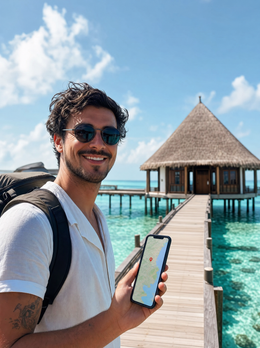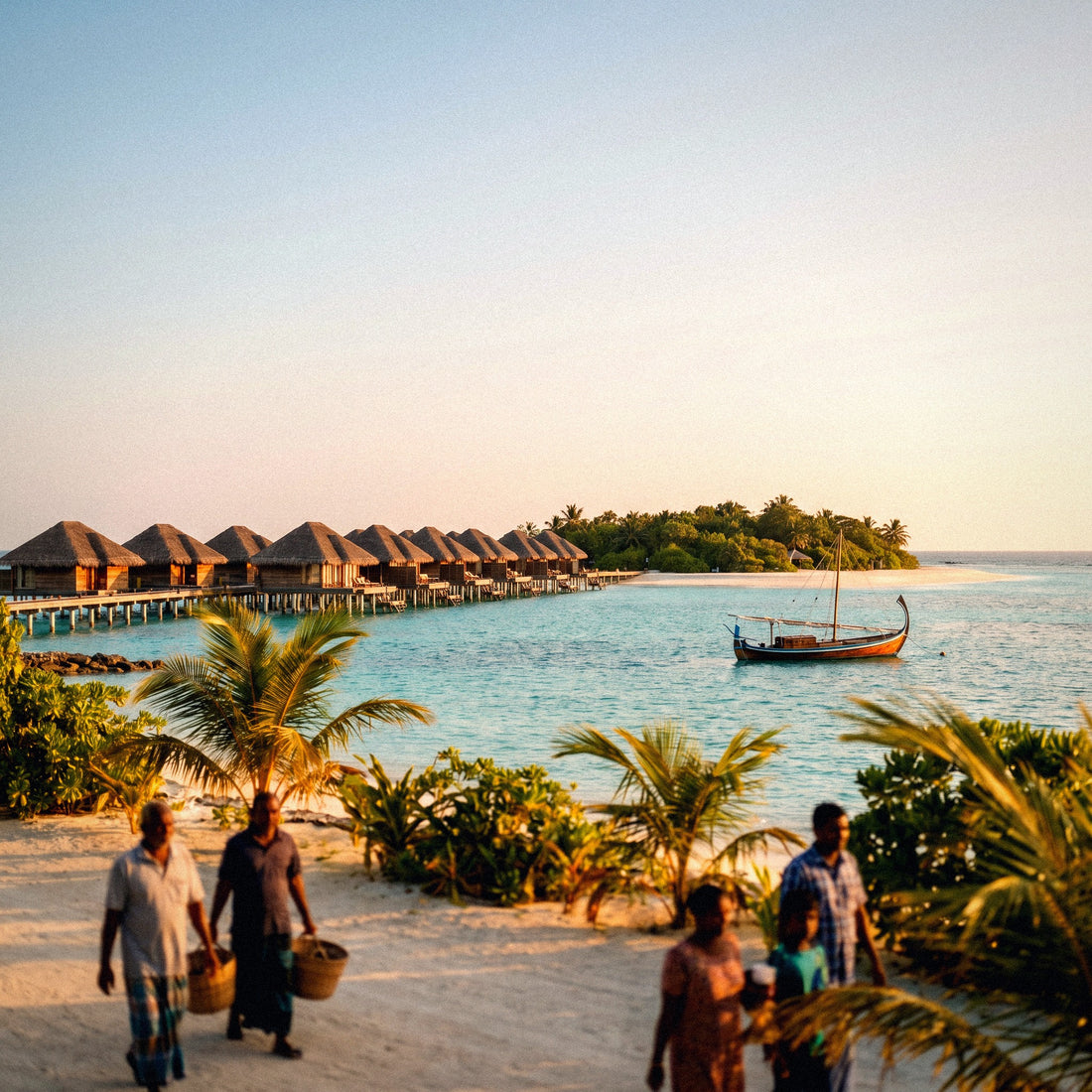
The Maldives is one of those destinations where you think you'll completely disconnect… and then you want to upload a photo of the turquoise water, video call your grandparents, or confirm your seaplane transfer time. That's why it's a good idea to decide before you fly how you're going to get internet in the Maldives. In this guide, I compare all the real options for tourists: your operator's roaming, the resort's Wi-Fi (which has its quirks here), a local Maldivian SIM from Dhiraagu or Ooredoo with counters at Malé airport, and eSIMs. I'll tell you about coverage in Malé, the atolls, and resorts, where you'll lose signal, and how much data you'll need.
Internet in the Maldives: the quick answer
For a tourist, an eSIM is the best way to get internet in the Maldives: it activates in minutes on the Dhiraagu network, works as soon as you land in Malé, and saves you from airport queues. A local SIM performs similarly; resort Wi-Fi is only for backup.
That's the short conclusion, but the Maldives has a nuance you won't find in other destinations: almost everyone stays in a single-island resort, so the accommodation's Wi-Fi plays a more significant role in the equation than usual. The problem is that this Wi-Fi doesn't always reach your villa, let alone the water or the boat.
That's why my general recommendation is to arrive with your own mobile data already working, so you don't depend on a shared network that comes and goes. An eSIM gives you exactly that without changing your card; a local SIM is an equally valid and slightly more traditional alternative; and roaming is an expensive emergency network that I would only keep for an urgent situation. In the following sections, I break down each option with real prices, coverage, and fine print so you can choose based on data, not hunches, and adapt the decision to your resort and the number of days you're staying.
All options at a glance
Before going into detail, here's the complete map. There are four realistic ways to connect in the Maldives, and not all of them carry the same weight in your trip. Focus less on the price and more on the "but" column: that's where this comparison is decided, because in a country of scattered islands, convenience matters as much as cost.
| Option | Approximate price | Procedure | Its big "but" |
|---|---|---|---|
| Operator roaming | €10-15/day or up to ~€12/MB | None | Very expensive and with limited data |
| Resort Wi-Fi | Free or up to ~$20/day | None | Weak in the villa and non-existent off the island |
| Local SIM (Dhiraagu, Ooredoo) | ~$40 for 20 GB / 10 days | Low: passport at the counter | Changing cards and losing your number |
| Travel eSIM | From ~€10 for a few GB | None: QR and done | Requires compatible phone |
As you can see, there isn't a truly cheap option: the Maldives is expensive for data too, and the local counter charges almost the same as an eSIM. A portable router, so popular in other destinations, barely makes sense here because the resort already provides Wi-Fi; if you still consider it for a group, check out the comparison of eSIM vs. pocket Wi-Fi. The real decision is between three contenders: local SIM, eSIM, and the accommodation's Wi-Fi as backup.
Roaming with your home operator
Roaming is the "do nothing" option and, for that very reason, the most expensive. The Maldives is outside the European Union's "roam like at home" zone, so your Spanish gigabytes don't travel with you: you enter international rates, where the bill skyrockets without warning. On a pay-as-you-go basis, some operators charge amounts in the order of €12/MB, which turns any afternoon of using maps into a shock.
To make it more palatable, operators sell daily passes. Typical rates outside Europe range from €7 to €15 per day, and be careful what they include: some passes offer one or two gigabytes, while others are limited to 100 MB daily, a pittance if you're checking Instagram from your villa. Do the math: a week in the Maldives at €10-15/day is €70-105 just for data, and for ten days, you're well over a hundred.
My advice is to treat roaming as an emergency network: activate it if something goes wrong, and that's it. Check your operator's app before leaving to find out what rate applies to you. If you want the detailed figures, you'll find how much international roaming costs and the comparison of eSIM vs. roaming useful.
Resort Wi-Fi: free in common areas, weak in the villa
This is the point that confuses people going to the Maldives the most, so let's take it slow. Since almost all of us stay in a private island resort, the temptation is to think "I'll already have Wi-Fi and save on data." And in part, that's true: today almost all resorts offer Wi-Fi, and many include it for free. The nuance matters, and that's where the fine print is.
It's common for free Wi-Fi to work well in common areas—reception, restaurant, bar, pool—because that's where the router is. However, in the villas, and especially in the famous overwater villas, the signal is weak or completely lost, and some resorts charge extra for a decent connection in the room, around $20 a day. Add to that the fact that bandwidth arrives via satellite or submarine cable and is shared among all guests, so at night, with half the hotel connected, the speed drops.
Practical rule: the resort's Wi-Fi is good enough for checking emails from the bar, but don't count on it for a work video call from your overwater villa. That's where your own connection saves you.
My conclusion: use it as backup to download maps at night or upload photos at your leisure, but not as the backbone of your trip.
Local Maldivian SIM: counters at Malé airport
Buying a local SIM in the Maldives is easy. As soon as you exit arrivals at Velana International Airport (Malé), on your right, you'll find the stores of Dhiraagu and Ooredoo, the country's two operators, with tourist packs designed for travelers. They only ask for your passport, and in ten minutes, you'll have data. Be careful with the "free SIM" machines at the airport: the card is free, but it comes without credit, and you'll need to load a paid plan to use it.
Both operators offer almost identical packs. These are my references for 2026:
- 20 GB + local minutes and SMS for about $40, valid for 10 days.
- 30-50 GB for about $50, valid for 30 days (Dhiraagu adds extra data for social media).
- 125 GB for about $100 for 30 days, designed for long stays or remote workers.
The "but" is not the price, which is similar to an eSIM, but the logistics: taking out your home SIM, storing it without losing it, inserting the new one, and losing your number (goodbye to bank SMS unless you have Dual SIM). If you're staying for weeks and need the largest pack, it's worth it; for a short trip, many prefer to avoid the card juggling. I compare it in detail in eSIM vs. local SIM.
eSIM: the option I recommend
This is where the eSIM shines in the Maldives, and not just for marketing. An eSIM is a digital card that already lives inside your phone: you buy the Maldives plan from home, receive a QR code, scan it, and you're done. No queues, no taking out your home SIM, no stepping foot in a counter after a long flight with jet lag. You arrive in Malé with data already active, and if you have a seaplane transfer, you leave the airport connected.
Travel eSIMs for the Maldives rely on the local operators' networks, especially Dhiraagu, so your coverage is the same as a Maldivian would get with a SIM from the store: 4G reaches Malé and most tourist atolls. The difference is not in the signal, but in how you get it. In terms of price, plans range from about €10 for a few GB and go up to 20 GB for about €40, figures very similar to a local SIM but without changing cards.
Another key advantage: with Dual SIM, you keep your home number active for bank SMS while data goes through the eSIM. If it's your first time, read what an eSIM is and then the eSIM guide for the Maldives, with step-by-step installation.
Local SIM vs. eSIM, head-to-head
This is the comparison that truly matters in the Maldives, because roaming is ruled out by price alone and Wi-Fi isn't enough to rely on completely. The table pits the two options that are playing the game, and you'll see that the battle isn't decided by price—very similar for both—but by convenience: how long you queue, whether you change cards, and whether you keep your number.
| Criteria | Local SIM (Dhiraagu / Ooredoo) | Travel eSIM |
|---|---|---|
| Price | ~$40 for 20 GB and 10 days | From ~€10; ~€40 for 20 GB |
| Documents | Passport | None |
| Where to buy | Malé airport counter, in person | Online, from home, before flying |
| Time to get data | ~10 min plus queue after flight | Minutes: scan QR and done |
| Network used | Dhiraagu or Ooredoo | The same: mostly Dhiraagu |
| Your home number | Lost if your phone has only one slot | Stays active with Dual SIM |
My take: since the price is almost the same, the eSIM wins for convenience for the vast majority of trips to the Maldives, which are one or two weeks long. You arrive with data, you don't change cards, and you keep your number. A local SIM only makes sense to me if you need the giant 125 GB pack for weeks of remote work from the island.
Coverage in Malé, atolls, and resorts
Good news: the Maldives is better connected than you might imagine for an archipelago of over a thousand islands. Mobile coverage relies on towers distributed across inhabited islands and the signal hopping from one island to another, and in tourist areas, 4G is the norm. Here's what you can expect by location:
- Malé and Hulhumalé: the best in the country. Solid 4G throughout the capital and 5G from Dhiraagu already available, with more than enough speed for anything.
- Tourist Atolls (North Malé, South Malé, Ari): Reliable 4G in most resorts and local islands, with speeds of around 70 Mbps download, sufficient for video calls and streaming.
- Distant Atolls and Isolated Resorts: Coverage varies; Dhiraagu usually has the widest reach. Most resort islands have signal, although some corners are weaker.
The general rule is simple: the closer to Malé and the central atolls, the better the signal; the further south or deep north you go, the more advisable it is to check your specific resort's coverage before booking your plan. Even so, for 95% of travelers staying in the central atolls, local 4G is more than enough for everything they'll do on vacation.
Seaplane and speedboat transfers: areas without coverage
Here's the most important warning, and the one fewest people expect. In the Maldives, you don't travel by road, but by sea and air: from the airport to the resort, you go by speedboat or seaplane, and between atolls, you navigate open water. During these journeys, you will lose signal here, because the towers are on the islands and there's nothing to connect to in the middle of the ocean.
What does this mean in practice? That during the transfer—which can be anywhere from 30 minutes to over an hour depending on how far your resort is—you won't have mobile data, no matter how good your SIM or eSIM is. The seaplane also flies during the day and without Wi-Fi on board, so that leg is a mandatory disconnection. The same goes for snorkeling or fishing excursions that move away from the islands.
It's not a problem, just an expectation to manage. My trick: before getting on the boat or seaplane, download anything you want to watch on your phone, send a WhatsApp message that you'll be unreachable for a while, and enjoy the journey, which in the Maldives is half the show. The signal returns as soon as you set foot on your destination island.
How much data you need in the Maldives
The million-dollar question before buying any plan. The short answer: probably less than you fear, but it's worth calculating by days and by actual usage. In the Maldives, you'll mostly be using messaging, social media to show off turquoise water, and some video calls; you'll barely use maps because you won't be driving. This table gives you an approximate reference per activity and day.
| Daily activity | Approximate consumption |
|---|---|
| WhatsApp and messaging | ~20-50 MB/day |
| Social media (scrolling and stories) | ~150-300 MB/day |
| Uploading photos and some videos | ~200-400 MB/day |
| Video call (30 min) | ~300-500 MB |
| Video streaming (1 h) | ~1 GB |
Adding up normal tourist usage, you'll need about 400-800 MB per day. With that reference, for a week in the Maldives, 3-5 GB is enough; for ten or twelve days, a 10 GB plan is more than enough; and if you're going to do live streams, upload daily videos, or work remotely from the villa, go for 20 GB or more. Remember that photo backups and heavy streaming can be saved for the resort's Wi-Fi at night, thus stretching each gigabyte of your data plan.
Frequently Asked Questions
Can I buy a SIM at Malé airport?
Yes, and it's easy. As soon as you exit arrivals at Velana Airport, you'll find the Dhiraagu and Ooredoo stores on your right. They only ask for your passport, and in about 10 minutes, you'll leave with data. Avoid the "free SIM" machines: the card is free, but it comes without credit.
Is the resort Wi-Fi sufficient?
As backup, yes; as a main plan, no. Free Wi-Fi usually works well in common areas (reception, restaurant), but in villas—especially overwater ones—it's weak or paid, around $20 a day. For peace of mind, bring your own data.
Is there coverage in the atolls and between islands?
In the tourist islands of the central atolls, yes: reliable 4G from Dhiraagu or Ooredoo. The problem is sea and seaplane transfers, where you lose signal because there are no towers in the middle of the ocean. Coverage returns upon reaching the island.
Which operator is better, Dhiraagu or Ooredoo?
Dhiraagu is the state operator and usually has the widest coverage between islands and atolls, as well as 5G in Malé. Ooredoo is similar in tourist areas and offers almost identical packs. Most travel eSIMs rely on Dhiraagu due to its reach.
How many GB do I need for a week in the Maldives?
For normal usage—messaging, social media, some photos, and a video call—3-5 GB is fine for a week. If you're doing live streams or working remotely from the villa, choose a 10 or 20 GB plan and save heavy streaming for the resort's Wi-Fi.
Does the eSIM work as soon as I land in the Maldives?
Yes. You install the plan from home with the QR code and activate it upon landing in Malé, so you leave the airport with data. This is the big advantage over a local SIM: no queues or card changes right after a long flight.
Is there 5G in the Maldives?
Yes, but limited. Dhiraagu has 5G in Malé and some more urbanized islands, at no extra cost. In most resorts and atolls, you'll have 4G, which with about 70 Mbps download speed is more than enough for video calls, streaming, and uploading photos.
Conclusion
Getting internet in the Maldives is easy if you understand one thing: the resort's Wi-Fi isn't everything here, as it's weak in overwater villas and disappears as soon as you get on a speedboat or seaplane. A local SIM from Dhiraagu or Ooredoo can be bought in 10 minutes at Malé airport, but it costs almost the same as an eSIM and forces you to change cards. That's why, for most people, an eSIM is the answer: the same Dhiraagu coverage, no queues, and you keep your Spanish number. Install it before you take off and you'll have data from the moment you land. Once you're clear on that, take a look at the eSIM for the Maldives.