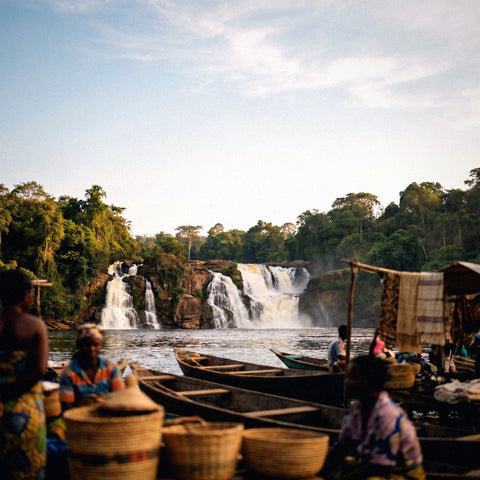
Gabon is one of those destinations where connectivity is split into two worlds: on the one hand, Libreville and Port-Gentil, with normal 4G and even 5G in some neighborhoods; on the other, 88% of the territory covered by jungle, where your mobile becomes an expensive camera. If you're looking for how internet works in Gabon before heading to Loango or Ivindo, this guide tells you the truth: Airtel and Moov Africa prices in CFA francs, where there's coverage and where there isn't, what the satellite Wi-Fi in lodges is like, and which option is best depending on the trip you're planning.
How is the internet in Gabon today?
In Gabon, you only connect with mobile data in the cities: Libreville, Port-Gentil, and Franceville have decent 4G, and the rest of the country is jungle with no coverage. It's practical to arrive with an active eSIM for the cities and rely on the lodge's satellite Wi-Fi inside the parks.
Gabon has just over two million inhabitants spread across a country roughly half the size of Spain, and almost all of that population is concentrated on the coast. This explains the coverage map: antennas are where the people are, and the people are in Libreville, Port-Gentil, Franceville, and a handful of medium-sized cities. The interior, which is where the good stuff is for a traveler, is virtually empty equatorial jungle.
The mobile market is shared by two operators: Airtel Gabon, from the Airtel Africa group, and Moov Africa Gabon (formerly Gabon Telecom / Libertis), from the Maroc Telecom group. Both sell cheap prepaid data compared to Europe, both require passport registration, and both have the same limitation: outside the asphalt, the signal disappears.
The good news is that in Libreville, the experience is more than acceptable. Airtel rolled out 5G in the capital, and 4G+ works well in central areas, at Léon-Mba airport, and in Port-Gentil, the oil capital. You can make video calls, upload photos, and work without drama. The bad news is that as soon as you take the N1 south or fly to Omboué, that experience suddenly ends and you have to plan before leaving home, not when you're already there.
Real coverage: two connected cities and a lot of jungle
I'll be direct because it's the fact that will most impact your trip: in Gabon, there is useful mobile coverage in less than a tenth of the territory. The rest is jungle, and in the jungle, there are no antennas because there is no one to serve or how to power them.
By area, this is what you'll find:
- Libreville: Stable 4G+ in the center, Glass, Batterie IV, and the airport area. Airtel's 5G in specific points of the capital. No problems for working.
- Port-Gentil: Good 4G. It's an oil city, so the infrastructure is well-maintained and there's decent Wi-Fi in business hotels.
- Franceville and Oyem: Reasonable 4G in the urban core, dropping to 3G in the surroundings.
- N1 and N2 roads: Long stretches with no signal at all. Don't count on online navigation between cities.
- Inland villages and areas near parks: 2G at best, and often nothing.
- Inside Loango, Ivindo, Lopé, or Moukalaba-Doudou: Assume zero coverage. A stray bar in a high clearing, but it's not something you can count on.
This contrast is what surprises almost everyone: you arrive in Libreville, see that your phone flies, and you get confident. Two days later you're in a lodge in the Iguéla lagoon with your phone permanently in airplane mode and the only internet access comes from a satellite dish next to the kitchen. It's not a fault with your operator or your card: it's just how Gabon is, and half the charm of the destination lies precisely in that.

The four options, compared
For a trip to Gabon, you have exactly four ways to connect, and each has its moment. I've put them together so you can see at a glance what's worth it:
| Option | Estimated Cost | Where it works | Procedure | For whom |
|---|---|---|---|---|
| Spanish Roaming | Most expensive zone in the catalog; paid in euros, not cents | Cities (same network as local SIM) | None, but needs to be activated | Emergencies and occasional calls |
| Hotel Wi-Fi | Included or paid depending on the place | Hotels in Libreville and Port-Gentil; satellite in lodges | None | Email and messaging at the end of the day |
| Local SIM | 5,800-6,500 XAF per 15 GB per month (€9-10) | Entire national network of Airtel or Moov | Official store + passport + copies | Long stays or fieldwork |
| eSIM | Plans by day or by GB, purchased before departure | Relies on local networks, same coverage | A QR, five minutes, from home | Tourist trip of one or two weeks |
A detailed comparison between the last two can be found in my article on eSIM vs. local SIM, because the nuance changes depending on how many days you stay and whether or not you need a Gabonese number to call.
My honest summary: in a country where you'll be without coverage for half of your trip, the last thing you want is to waste a Libreville morning queuing at a store with passport photocopies. That's why, for a normal tourist trip, the balance clearly tips towards arriving already connected. If you're going to work in Port-Gentil for six months, it's a different story and a local card is worth it.
Spanish roaming: Gabon is outside the EU
There are no half measures here. Gabon does not belong to the European Union or the European Economic Area, so the "Roam Like at Home" regulation — the one that lets you use your domestic data in France or Portugal without paying extra — does not apply. Nor is it an ultra-peripheral region of any European country, nor does it have a special agreement with the EU on roaming.
Translated: when your mobile connects to Airtel Gabon or Moov, it enters the most expensive zone in your Spanish operator's catalog, usually called "Zone 3," "Zone 4," or simply "Rest of the World." And there, megabytes are billed at prices that are counted in euros per megabyte if you don't have a contracted bundle. A couple of WhatsApp videos downloading by themselves in the airport taxi, and you've already got an unpleasant bill.
The most expensive surprise in Central Africa is not a hotel or a transfer: it's the mobile bill of someone who left Barajas without deactivating data roaming.
Before flying, do two things. First, log into your operator's customer area and literally check which tariff zone Gabon is in and how much a single megabyte costs. Second, decide whether to activate an international bundle or deactivate data roaming and rely on another solution. If you want the numbers and fine print of how these bundles work, I break it down in how much international roaming costs, and I compare the two philosophies in eSIM vs. roaming. What I do not recommend under any circumstances is arriving in Libreville without having checked anything.
Hotel Wi-Fi and satellite Wi-Fi in lodges
In Libreville and Port-Gentil, hotel Wi-Fi is what you'd expect from an African capital with an oil sector: high-end and business establishments have reasonable connections, sufficient for email, messaging, and some short video calls. In budget accommodations in the city center, things drop quite a bit, and in the afternoon, when everyone connects, it crawls.
The interesting case is the lodges in national parks. In Loango, Iguéla, Ivindo, or the Moukalaba-Doudou camps, there is no fiber or mobile coverage: internet, when it exists, comes via satellite. And satellite has its own rules that are worth knowing:
- It's usually limited to a specific time, often a few hours at night after dinner.
- Bandwidth is shared among all guests and the lodge staff.
- Many accommodations block video and heavy downloads to prevent the link from getting saturated.
- Tropical rain — and in Gabon, it really rains — degrades the link or knocks it out completely.
- In some places, it's paid separately, by time slots or by device.
My advice here is about managing expectations: lodge Wi-Fi is for sending an "we're fine" message and little else. Don't set up a work meeting or promise to upload the video of elephants on the beach that same night. And if you absolutely need a connection, arrange it as a service with the lodge in writing before booking, because each camp has its own reality. If you were thinking of a portable router, first check the comparison eSIM vs. pocket Wi-Fi: in Gabon, a router doesn't create a signal where there isn't one, so it won't help you inside the parks.
Local SIM: Airtel Gabon and Moov Africa
If you decide to buy a local card, these are the two operators and their prepaid data packages. The Central African CFA franc (XAF) has a fixed exchange rate with the euro: €1 = 655.957 XAF, meaning approximately 1,000 XAF ≈ €1.52. With that, you can convert any price at a glance.
| Package | Airtel Gabon | Moov Africa Gabon | Validity | Approx. equivalent |
|---|---|---|---|---|
| 1 GB | 600 XAF | 550 XAF | 24 hours | €0.85-0.90 |
| 5 GB | 3,000 XAF | 2,700 XAF | 7 days | €4.10-4.60 |
| 15 GB | 6,500 XAF | 5,800 XAF | 30 days | €8.85-9.90 |
| 50 GB | 14,000 XAF | 13,000 XAF | 30 days | €20-21 |
| 100 GB | 25,000 XAF | 23,500 XAF | 30 days | €36-38 |
As you can see, prices are low. The problem is not the money, but the process. SIM registration is mandatory in Gabon and must be done at an official operator store: they will ask for your passport, usually photocopies of your passport and visa, they will take your details, and activation takes between fifteen and thirty minutes if there is no queue. At Libreville airport, there are sales points, but opening hours depend on flights and do not always coincide with your arrival.
A word of caution about street vendors: you will see cards for sale at stalls and neighborhood shops. Many are registered in someone else's name, which is illegal and can leave you without service overnight if the operator purges improperly registered lines. If you buy a local SIM, buy it at an official Airtel or Moov store, with your passport, and keep the receipt.

eSIM: the option I recommend
For a one- or two-week tourist trip to Gabon, an eSIM seems to me the most sensible option, and not just to sell it: because of how the country is set up. Think about it calmly. You'll land in Libreville, probably at night and after a long flight with a layover. The next day you'll head to Omboué or to the park. Your actual window for phone paperwork is a few hours, and those hours are worth much more strolling through the Mont-Bouët market or looking at the Atlantic.
With an eSIM, you install the profile from home, with your Wi-Fi and at your leisure, and upon landing, you activate the data and you already have internet. No photocopies, no queues, no closed store because it's Sunday. The connection relies on the same Airtel or Moov networks, so you have exactly the same coverage as with a local card: no more, no less. No one will give you signal inside Loango, because there isn't any for anyone there.
Where it truly makes a difference is in the logistics of the trip: arriving connected to order a taxi, notify that you've landed, have a live map while crossing Libreville, and be able to manage any internal flight changes — which happen in Gabon — without relying on a counter's Wi-Fi. If you've never used one, in what is an eSIM I explain the step-by-step operation, and in the eSIM guide for Gabon I go into the specific details of the country: mobile compatibility, installation, and what to expect from each network.
How many gigabytes do you need depending on your trip?
People almost always overdo it here, and even more so in Gabon, because days spent inside parks consume practically nothing: no coverage means no usage. Your data will be consumed in cities and during transfers, not in the jungle.
| Trip Profile | Days | Recommended Data | Why |
|---|---|---|---|
| Long layover in Libreville | 1-2 | 1-2 GB | Maps, taxi, messaging, and little else |
| Classic Loango + Libreville safari | 7-10 | 3-5 GB | Four or five days will be without coverage |
| Loango + Ivindo + Lopé circuit | 12-15 | 5-8 GB | Many days offline, peaks upon returning to the city |
| Business trip to Port-Gentil | 7-14 | 10-20 GB | Video calls, heavy email, screen sharing |
| Long stay or remote work | 30+ | 20-50 GB | Continuous daily use in urban areas |
My rule of thumb is to only count the days you'll spend in a city and multiply them by half a gigabyte if you're a normal user, or by one gigabyte if you make video calls. Count park days as zero. A two-week circuit with three or four urban nights will be more than covered with five gigabytes, and if you run short, you can always top up from your phone without going back to any store. Buying a giant package for Gabon upfront is a waste of money: you won't have anywhere to spend it.
Loango, Ivindo, and Kongou, park by park
As promised: what to expect regarding connectivity in the places you'll likely visit in Gabon.
Loango National Park. The famous one, with forest elephants and buffaloes coming out to the beach, and hippos that can be seen in the surf. It's reached by flying to Omboué or by track from the south. Mobile coverage: practically nil within the park. The lodges in the Iguéla and Sette Cama area operate with generators and satellite links, with the limitations I've already mentioned.
Ivindo National Park and Kongou Falls. Deep primary forest in the northeast. Access is an adventure in itself, between tracks and pirogues. Here, there is no mobile network of any kind, and in several camps, there's no Wi-Fi either: serious communication is done by radio or the team's satellite phone. Be mentally prepared to be completely disconnected for several consecutive days.
Lopé National Park. Being next to the Transgabonais line and with a village nearby, it's one of the few where there might be a weak signal at some point. It's not reliable, but it's something.
Libreville and Port-Gentil. Here, yes. Stable 4G+, occasional 5G in the capital, Wi-Fi in hotels and cafes in the center.
The important thing is to let people at home know: tell your family the exact schedule of "no signal" days before you leave. In a country where being out of contact for three days is normal, an unannounced silence causes unnecessary anxiety to those waiting for news.
Tips to avoid being out of contact
With what you already know, preparing for Gabon is simple if you do it before you fly. These are the points I never skip:
- Downloaded offline maps of the entire country, not just Libreville. Google Maps and Maps.me allow you to save entire areas; do this for the complete route, including sections of the N1 and N2.
- Local documents: passport, visa, travel insurance, yellow fever certificate, and internal tickets, all on your phone without relying on the cloud, plus a paper copy.
- Downloaded French translator. French is spoken in Gabon, and English is a minority language outside the oil sector.
- Lodge and local operator contacts noted down, including their radio or satellite number if provided.
- Large power bank. In camps, electricity runs on a generator and has set hours, so charging is not always possible when you want.
- Roaming data deactivated if you haven't purchased a plan, so your phone doesn't connect automatically.
And a non-technical recommendation: make the most of it. Gabon is one of the last places in the world where disconnection is not a marketing promise of a yoga retreat, but a physical condition of the terrain. Having your phone useless in your pocket while a herd of forest elephants crosses the beach at sunset is probably the best part of the trip. Prepare for connectivity in cities and during transfers, where you really need it, and let the jungle do its thing the rest of the time.
Frequently asked questions
Is there mobile coverage in Loango National Park?
No, practically none. Inside Loango, there is no reliable Airtel or Moov network, and nearby villages drop to 2G or lose signal entirely. The only available connection is satellite Wi-Fi at lodges, when they have it and during their specified hours. This is the place where you must be mentally prepared to be disconnected.
Does my Spanish operator's roaming work in Gabon?
It technically works, but it's expensive. Gabon is not in the European Union or the EEA, so the "Roam Like at Home" tariff does not apply, and the country falls into the most expensive international zone for almost all Spanish providers. Check the exact tariff in your customer area before flying, and if you don't purchase a plan, deactivate roaming data.
What do I need to buy a local SIM in Gabon?
Your passport and some patience. Line registration is mandatory: you need to go to an official Airtel Gabon or Moov Africa store, present your passport and usually photocopies of your passport and visa. Activation takes between fifteen and thirty minutes if there's no queue. Avoid cards from street vendors: they are usually registered in the name of third parties.
How much does 1 GB of data cost in Gabon?
Between 550 and 600 XAF, about €0.85-0.90, valid for 24 hours. Monthly packages are much better value: 15 GB costs 5,800 XAF with Moov Africa and 6,500 XAF with Airtel, which is between 9 and 10 euros. The CFA franc has a fixed exchange rate with the euro (1 € = 655.957 XAF), so prices do not fluctuate.
Is there 5G in Gabon?
Yes, but only in Libreville and occasionally. Airtel Gabon deployed 5G in the capital, and Moov Africa is working on its own deployment. Outside the capital, the best you'll find is 4G+ in Port-Gentil and Franceville, and for a tourist trip, the difference between 4G and 5G is irrelevant: the problem in Gabon is never speed, it's the absence of signal.
Is it worth bringing a pocket Wi-Fi to Gabon?
Only in the city, and even there it doesn't offer much benefit. A portable router connects to the same mobile networks as your phone, so in Loango or Ivindo, where there are no antennas, it won't give you internet. It just adds another device to charge and keep track of. For a trip to Gabon, it's luggage you can save.
Can I work remotely from Gabon?
From Libreville or Port-Gentil, yes; from the parks, no. In the two main cities, you have stable 4G+ and sufficient hotel Wi-Fi for video calls and normal work. As soon as you head inland, the lodges' satellite link is not enough for meetings or uploading heavy files. Plan your work for urban days and block out park days as unavailable.
Conclusion
Gabon connects at two speeds: reliable 4G in Libreville, Port-Gentil, and Franceville, and absolute silence in the 88% of the country that is jungle. A local SIM is cheap—15 GB for less than ten euros with Airtel or Moov—but requires an official store, passport, and photocopies; Spanish roaming significantly increases the bill because the country is outside the EU; and lodge Wi-Fi is rationed satellite, good for a message and little else.
My practical recommendation: arrive already connected, with three to five gigabytes for a one- or two-week circuit, and use that data where it's really needed—airport, transfers, city—assuming that you'll spend your days in Loango and Ivindo offline and that this is part of the plan. If you want to have it sorted before boarding, here's our eSIM for Gabon: install it from home, activate upon landing, and save yourself the only queue you won't want to make in Libreville.