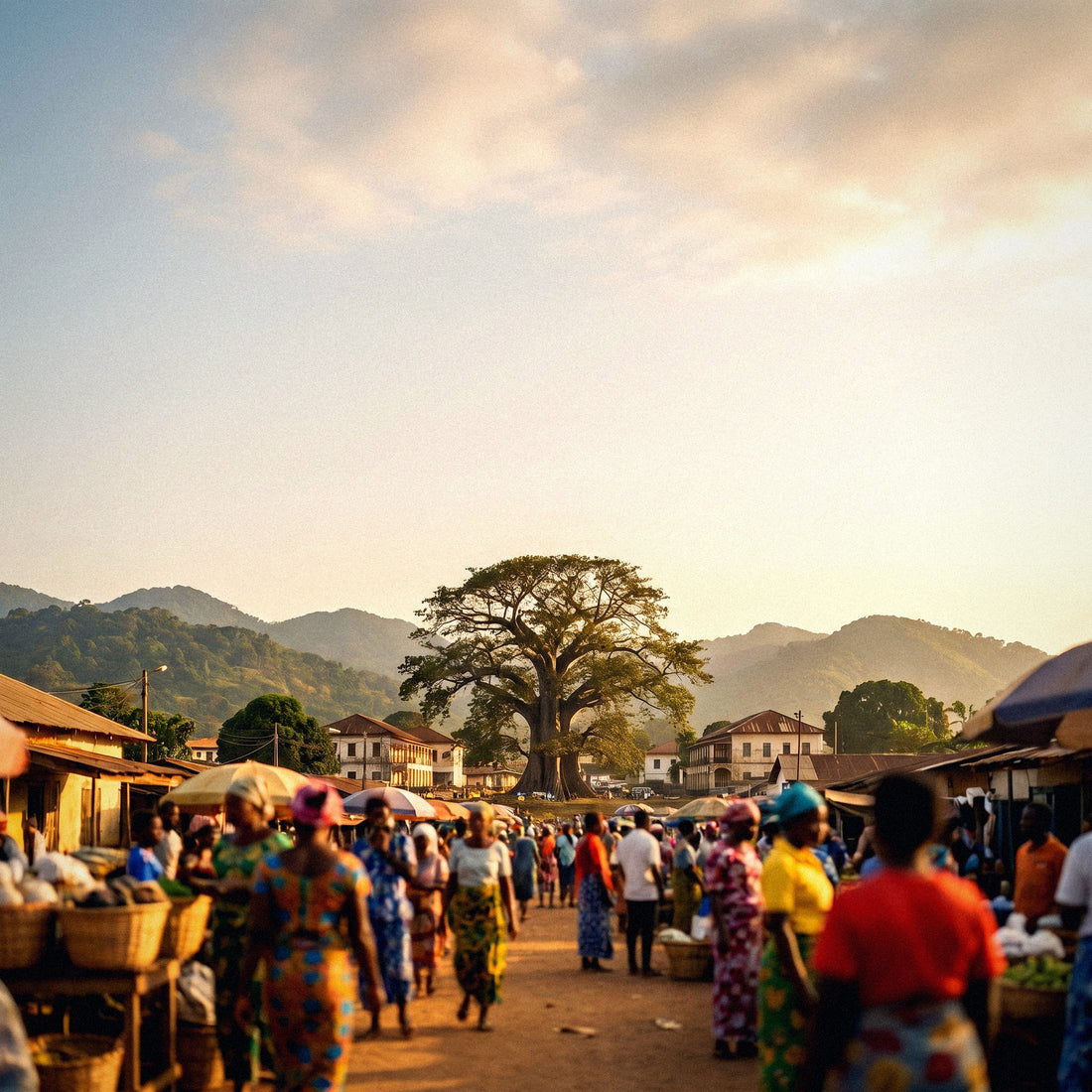
Sierra Leone is one of those places still whispered about among travelers: huge, almost empty beaches half an hour from the capital, chimpanzees on the outskirts of Freetown, and a tough history the country has been leaving behind. What almost no one tells you before flying is how internet in Sierra Leone works, and that's where many first days go wrong: you arrive at Lungi airport at night, have to cross the estuary by boat to Freetown, and have no way to message anyone. In this guide, I'll tell you, without embellishment, what network is available, what it costs to connect, and which option suits you best depending on how you travel.
Landing in Lungi: the critical moment
Short answer: There's no European roaming in Sierra Leone, so the most convenient option is a data eSIM activated before flying; the cheap alternative is a local Orange or Africell SIM, which registers with a passport and costs a few euros with data included.
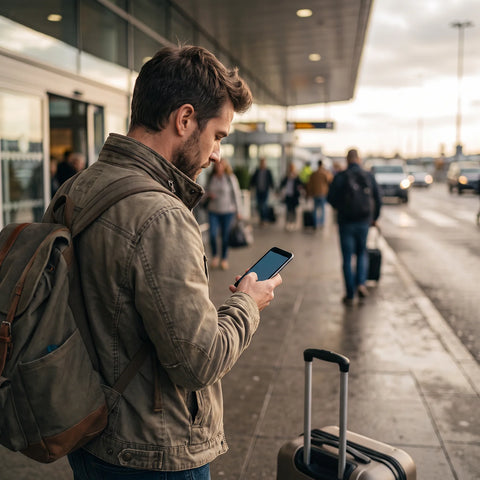
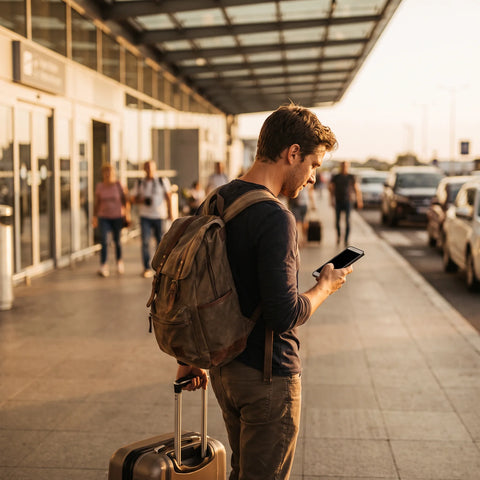
Lungi International Airport is across the Sierra Leone River estuary, not in Freetown. To reach the city, you have to take a boat (water taxis like SeaCoach or Sea Bird) or make a very long detour by road. This journey is almost always booked via WhatsApp or phone, and the hotel will message you there to confirm the transfer. Translation: if you land without data, you depend on someone lending you their phone or on the counter having availability.
There are local provider stands at the airport itself, but operating hours depend heavily on your flight and arrival time. With a night flight—which is common from Europe via Brussels, Casablanca, Istanbul, or Nairobi—it's easy to find everything closed. There's also Wi-Fi in the terminal, but it's slow and doesn't always work.
My advice is simple: arrive already connected. Whether it's with an eSIM activated before leaving Spain or with enough data for the first few hours, what you need is to be able to open WhatsApp and Google Maps as soon as you step onto the tarmac. Afterward, once you're in Freetown and settled, you can decide whether to also buy a local SIM for calls and the rest of your trip.
The four ways to get connected
As in any destination, you have four paths, and in Sierra Leone, the differences between them are significantly greater than on a European trip. Here, there's no safety net: if plan A fails, plan B takes hours or days to set up. Here's an honest comparison of the options:
| Option | Estimated Cost | Pros | Cons |
|---|---|---|---|
| Spanish roaming | Several euros per megabyte outside plan; expensive daily add-ons | You do nothing, works on landing | Sierra Leone is in the most expensive zone for almost all tariffs |
| Hotel Wi-Fi | Included or paid at some lodges | Free and sufficient for messages at night | Depends on generator and connection; often weak at the beach |
| Local SIM (Orange / Africell) | SIM from about 15-30 SLE plus data bundle | Cheapest per gigabyte and gives you a local number | Passport registration, queue at store, unlocked phone required |
| Travel eSIM | Fixed price in euros, purchased before flight | Activate and go, no paperwork or language barrier | Data only; requires an eSIM-compatible phone |
For a short trip to the beaches and peninsula, the eSIM wins for convenience: you save on registration, don't waste half a morning at a store on Wilkinson Road, and don't depend on whether the airport stand is open. If you're staying three weeks, doing fieldwork, or need to call local numbers daily, a local SIM is cheaper and worth the paperwork. Many people do the sensible thing: eSIM to arrive and a local SIM two days later.
Roaming with your Spanish provider: the surprise bill
No half measures here: Sierra Leone is not part of the European Union or the European Economic Area, so the "Roam Like at Home" you use in Lisbon or Rome does not apply. Your Spanish 20 or 40 GB plan stays at the aircraft door. Spanish providers place sub-Saharan Africa in their most expensive zone, where the price per megabyte outside your plan is counted in euros, not cents. Two Instagram videos accidentally loaded and you're looking at an unpleasant figure.
The worst part is often not deliberate browsing, but the trickle: apps syncing photos, backups, maps downloading in the background, and updates. If you plan to keep your Spanish chip active just in case, go into settings and disable mobile data roaming before takeoff. Leave only calls and SMS, which will serve you for receiving bank codes.
The rule I apply in West Africa: the Spanish number enters the plane with data off and leaves it the same way. Everything else goes through the data line I specifically purchased for the trip.
If you still want to check your specific case, look at your company's international roaming plan and calculate the price per gigabyte: it will almost always be ten or twenty times higher than any local alternative. I break it down in the comparison of eSIM versus traditional roaming and in the analysis of how much it really costs to connect outside the EU. Spoiler: it's not worth it except for a ten-minute emergency.
Local SIM: Orange, Africell, and your passport
The Sierra Leonean market is shared by three names. Orange Sierra Leone is the operator with the largest market share and, generally, the best 4G network in Freetown and larger cities. Africell is the eternal rival, historically very strong and with aggressive prices, including data packages with limited speed. And Qcell, the third, is a minority player with more inconsistent coverage outside the capital. For a tourist, the practical choice is between the first two.
Buying is easy, but not instant. SIM registration with a passport is mandatory and is done at the point of sale: they take your document details and, in official stores, sometimes a photo too. Go to a brand-owned store (in Freetown you'll find them in Lumley, Wilkinson Road, or the city center) and not a street vendor: improperly registered lines get deactivated within a few days. You need an unlocked phone.
| Operator | Bundle | Price | Approx. Equivalent | Code |
|---|---|---|---|---|
| Orange | 2.5 GB / month | 37.50 SLE | ~€1.40 | *800# |
| Orange | 6.5 GB / month | 100 SLE | ~€3.70 | *800# |
| Orange | 10 GB / month | 150 SLE | ~€5.50 | *800# |
| Orange | 20 GB / month | 300 SLE | ~€11 | *800# |
| Africell | 300 MB / month | 23 SLE | ~€0.85 | *113# |
| Africell | 4 GB / month | 120 SLE | ~€4.50 | *113# |
| Africell | Daily package at 2 Mbps | 15 SLE | ~€0.55 | *499# |
Reference prices consulted in July 2026; they change frequently. Be careful with the currency: the leone was redenominated in 2022 by removing three zeros, so many people still say "one hundred thousand" when the price is 100 SLE. Africell's unlimited volume packages run at top speed with a fair usage policy; don't expect to download movies. If you're weighing this option against a digital one, here's a head-to-head comparison of eSIM versus local card.
Travel eSIM: how it works here
An eSIM is a digital profile you install on your phone by scanning a QR code: no plastic, no store, no queue. You buy it from home, activate it on landing, and your Spanish number remains in your phone to receive bank SMS. In a country where local SIM paperwork eats up a morning, that convenience is noticeable. If it's your first time, I explain the technology without jargon in this guide on what an eSIM is.
An important and honest nuance: Sierra Leonean operators do not sell prepaid eSIMs for tourists. Their product is the traditional physical SIM. What a travel eSIM does is connect you to available local networks through wholesale agreements, so the coverage you'll have is the same as the antenna above you: good in Freetown, decent on the peninsula road, and weak in the deep interior. No technology invents a signal where there isn't one.
What does change is cost control: you pay a fixed rate in euros, you know how many gigabytes you have, and there are no surprises upon your return. For a short getaway of one or two weeks focused on Freetown, River No. 2, Bureh, and Tokeh, with excursions to Tacugama and Bunce, this is the formula that generates the least friction. You can find details on coverage, activation, and compatibility in the specific guide to eSIM for Sierra Leone, including a list of phones that support it without issues.
Real coverage in Freetown and the peninsula
Let's get specific, because this is the difference between a reasonable expectation and a disappointment. In Freetown, there's functional 4G throughout most of the city: downtown, Aberdeen, Lumley, Congo Cross, Hill Station. Typical speeds range from a few megabits to double-digit figures in good conditions, sufficient for video calls, maps, and uploading photos. There's no commercial 5G: if you see that icon, be suspicious. And during peak hours, with the whole city connected, the network gets congested, and everything slows down.
Heading south along the peninsula road, things become patchy but reasonable. Coastal villages—Goderich, Sussex, River No. 2, Tokeh, Bureh Beach, Kent—have cell towers, and you can usually browse without drama in the village center. The problem arises in coves nestled between hills and the jungle of the sierra that gives the country its name: go down a hundred meters to the sand, and you'll be left with a shaky bar or no data at all. In Bureh, with its surf community, it's common to have a signal at the beach bar but lose it at the point where the waves break.
Rain also matters. In the wet season, from May to November, tropical downpours degrade the signal, and power outages leave cell towers running on generators. It's normal for the service to drop for a while and then come back on its own.
Tacugama, Bunce, Turtle Islands, and the interior
The places that make Sierra Leone special are, coincidentally, the least covered. At the Tacugama Chimpanzee Sanctuary, in the peninsula national park above Regent, coverage is intermittent: in the reception area and some eco-lodges, you usually get a signal because the city is nearby, but deep in the forest, between hillsides, forget about streaming. It doesn't matter: there, the point is to listen to the chimpanzees, not stare at your phone.
Bunce Island, in the middle of the estuary, is a curious case. Being a riverine island surrounded by water, sometimes you pick up the shore's antenna, and sometimes you don't. The ruins of the fort where thousands of enslaved people were embarked to America—a candidate on UNESCO's tentative list—are visited by boat from Freetown or Pepel, and on that journey, the connection comes and goes. Download the location and the boatman's contact before you leave.
In the Turtle Islands, to the southwest, the reality is stark: fishing communities with unstable electricity and only patchy or non-existent mobile coverage depending on the islet. The same goes for Tiwai Island and Outamba-Kilimi. Inland, Bo, Kenema, Makeni, and Koidu have 4G in urban areas and 3G or 2G as soon as you hit the road. Let folks back home know that you might be unreachable for a couple of days, and download maps before you set off.
Hotel and eco-lodge Wi-Fi
Wi-Fi exists, but it's worth understanding where it comes from. Sierra Leone relies heavily on the ACE submarine cable, which makes landfall in Freetown; when there have been incidents with West African cables—such as the multiple outages in March 2024 that affected several countries in the region—the entire country experienced slowdowns. Add to that an irregular power supply: many accommodations run on generators at specific hours, and the router goes with it.
In practice: high-end hotels in Aberdeen and Lumley, Freetown, have decent Wi-Fi for morning work. Coastal eco-lodges—River No. 2, Tokeh, Bureh—range from "enough for WhatsApp" to "exists on paper." Some have set up satellite links and work surprisingly well; others share a mobile connection among twenty guests, and by nine at night, not even a message loads. Ask before booking if you say you need to connect for work.
Pocket Wi-Fi makes little sense here: it's not a destination where you'll find router rentals at the airport, and carrying an extra gadget that also relies on the local network doesn't offer any advantage over your own phone. If several of you are traveling, it's logical for one person to have data and share the connection via hotspot. I compare both approaches in the article on eSIM and portable routers, although in West Africa, the conclusion is almost always the same: it's better to have the connection in your pocket.
How much data you need and how to stretch it
Travelers often overestimate what they'll spend on a trip like this. Here, you spend the day on the beach, in a boat, or in a car on dirt roads, not watching series. Here's my estimation by profile, including maps, messaging, some social media, and occasional WhatsApp calls:
| Travel Profile | Duration | Recommended Data |
|---|---|---|
| Beach getaway on the peninsula | 5-7 days | 3-5 GB |
| Freetown + Tacugama + Bunce + coast | 10-14 days | 8-10 GB |
| Long trip with interior (Bo, Kenema, Tiwai) | 3 weeks | 10-15 GB |
| Remote work or daily video calls | Per month | 20 GB or more |
| Family or group sharing via hotspot | 1-2 weeks | 15-20 GB |
Truly effective tips for Sierra Leone: download offline maps for the Freetown peninsula and interior routes before leaving your hotel; disable automatic photo backup and upload them at night; lower video quality on WhatsApp; and use voice notes instead of video calls when the signal is weak. Carry a power bank: power outages are frequent, and running out of phone battery here is a bigger problem than in Europe.
And always leave some buffer. In a country with an inconsistent network, having an extra gigabyte on your last day is worth more than the euro you might have saved by buying just enough. If you run short, you can always top up on the go directly from your phone, without returning to a store.
Frequently asked questions
Does my Spanish plan work in Sierra Leone?
It works, but you'll pay extra: Sierra Leone is not in the EU, so your included data doesn't travel with you. Spanish operators place the country in their most expensive international zone, with out-of-bundle data prices counted in euros per megabyte. The sensible thing to do is to disable data roaming before you take off and purchase a separate data plan.
Can I buy a SIM at Lungi airport?
Yes, there are operator stalls in the terminal, but don't count on them being open if your flight arrives in the early hours of the morning. As most connections from Europe land at night, it's common to find everything closed. Additionally, you'll have to cross by boat to Freetown, a journey that is coordinated by phone. Arriving with data already available takes that problem off your hands.
Which operator has better coverage, Orange or Africell?
Orange Sierra Leone usually provides the most consistent 4G network in Freetown and large cities; Africell competes with lower prices and a good historical presence. Qcell lags behind outside the capital. In the peninsula and inland, both falter in the same areas: enclosed valleys, jungle, and small villages. No operator covers the Turtle Islands well.
Do I need my passport to buy a local card?
Yes, SIM registration with an ID document is mandatory and is done at the time of purchase. Bring your physical passport and buy from an official operator store, not an informal stall: if the registration is not completed correctly, the line may be deactivated within a few days. Your mobile phone must be unlocked by the operator.
Is there coverage on the beaches of the Freetown peninsula?
Yes, in the towns —River No. 2, Tokeh, Bureh, Kent— and irregularly in coves surrounded by hills. It's normal to have a signal in the restaurant area and lose it when you move away along the sand or into the vegetation. This is enough coverage for messages and maps, but not to rely on it for a work video call.
How much does mobile data cost in Sierra Leone?
Local bundles are cheap: around 150 SLE (about €5.50) for 10 GB per month with Orange, or 120 SLE (about €4.50) for 4 GB with Africell. Prices are as of July 2026 and change frequently. Remember that the Leone was redenominated in 2022, so you'll see old figures with three extra zeros on forums and blogs.
Is it safe to travel and connect in Sierra Leone today?
The country has been stable for years after the civil war and the Ebola outbreak, and tourism is slowly reopening. Even so, in isolated episodes of political tension, temporary restrictions on access to social networks have been recorded. Download maps and important documents, write down contact numbers on paper, and always consult travel advisories before leaving.
Can I use an eSIM in Sierra Leone with any mobile phone?
Only with compatible and unlocked phones: iPhones from XS, most recent Samsung Galaxy S and Note, Google Pixel from 3, and many high-end models from other brands. Activate it with Wi-Fi before you fly, because you need a connection to install the profile. Once installed, it activates upon landing even if you don't have a network yet.
Conclusion
Sierra Leone rewards the prepared traveler. You'll find decent 4G in Freetown, adequate coverage in the peninsula villages like River No. 2, Tokeh, and Bureh, and entire areas—the Turtle Islands, much of the interior, the Tacugama forest—where there simply won't be a signal. No technology can overcome that: you need to plan, download maps, and notify home.
What you can control, however, is how you arrive. With your phone already connected upon landing at Lungi, you can sort out the boat, the hotel, and your first taxi without relying on anyone, and calmly decide if you also want to get a local SIM card for the rest of your trip. If you want that peace of mind from minute one, take a look at the Sierra Leone data eSIM: install it at home, activate it there, and forget about it to focus on what you've come to see.