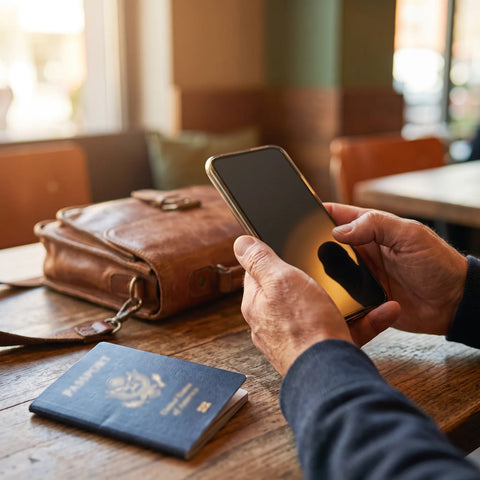
If you're planning your trip, internet in Iceland is one of those things you should sort out before leaving home. The island has excellent connectivity in Reykjavik and on tourist routes, but as soon as you venture into the Highlands or remote sections of the Ring Road, the signal disappears. In this guide, I'll compare all your options, without any fluff, so you can choose the one that truly suits your travel style.
Your connectivity options
In Iceland, you have four ways to connect: roaming with your Spanish plan (included by law as Iceland is in the EEA), accommodation Wi-Fi, a local SIM, or a data eSIM. For most travelers, an eSIM or reasonable roaming are the most convenient options.
There's no single answer: the best option depends on your traveler profile, your current plan, and where you'll be traveling. A weekend tourist in Reykjavik doesn't need the same as someone doing a full island tour in a campervan for ten days. That's why the first step is to understand the four alternatives and what each offers in terms of coverage, price, and convenience. Then, in the following sections, I'll go into detail on each and the actual coverage by area, which is where it all matters. A heads-up right away: in such a large and sparsely populated country, the connection you choose matters less than you think compared to a factor you don't control, which is whether there's an antenna nearby. Here's a general overview to help you decide:
| Option | Coverage | Estimated Cost | Ideal for |
|---|---|---|---|
| Roaming (Spanish plan) | Associated Icelandic operator network | Included in your plan, with data limit | Short stays and moderate consumption |
| Accommodation Wi-Fi | Only within the hotel or apartment | Free | Checking things and uploading photos at night |
| Local SIM | Excellent, especially with Síminn | €15-25 for 10-20 GB | Long stays and unlocked phone |
| Data eSIM | Country's leading operator network | From €5-15 for 5-10 GB | Convenience and immediate activation |
Roaming in Iceland: Is it included?
Here's the honest part that almost no one tells you: Iceland is part of the European Economic Area (EEA), so the European "Roam Like At Home" regulation applies. In practice, if you have a recent Spanish mobile plan, your data and minutes work in Iceland just like in the European Union, with no additional cost. This means that for many people, the answer is yes, you already have internet included without doing anything special.
But there are important nuances. The regulation includes a fair use policy: operators can limit the data you consume outside of Spain depending on your plan, especially for high-volume or unlimited plans. Permanent use abroad is also not allowed (it's for travel, not for living abroad). And in 2026, the wholesale data cost between operators dropped to €1.10/GB, which keeps the system cheap but explains these caps. Before traveling, check the fine print of your plan or consult my comparison of eSIM vs. roaming to see where the limit for each option lies. The quick conclusion: if your plan is modern, you're almost certainly covered.


When it pays to switch to an eSIM
If roaming is included, why bother complicating things? Because it's not always worth it. There are very specific profiles for whom a data eSIM is clearly a better idea, and it's worth identifying with one of them before deciding:
- Old or low-cost plans that don't include EEA roaming or give you very little data outside of Spain.
- Travelers from outside the EEA (e.g., with a UK, Latin American, or US line): the European regulation doesn't cover you, and roaming rates can cost a fortune.
- Heavy data users: if you're going to be using navigation, maps, and video all day, it's easy to hit your plan's fair use cap.
- Prepaid plans with little data, where every gigabyte abroad is used up too quickly.
An eSIM gives you a set amount of data, with no surprises on your bill and at a pre-known price. If you want to know how much an underestimated bill can skyrocket, I've broken it down in how much international roaming costs. The rule I use: if your plan is modern and you use little data, stick with your operator; in all other cases, an independent data package saves you hassles and bill shocks the following month.
Hotel and accommodation Wi-Fi
Almost all Icelandic hotels, hostels, and apartments offer free Wi-Fi, and in cities, it usually works well. It's perfect for the usual: uploading daily photos, making video calls at night, planning the next day's route, or downloading maps and podcasts for the journey. Cafes, large gas stations, and visitor centers also often have open networks you can use.
The problem is obvious: Wi-Fi stays within the building. In a country where you spend your day on the road, among waterfalls, glaciers, and black sand beaches, relying solely on accommodation Wi-Fi means being without a connection for most daylight hours, which in summer are many. And just when you need it most—for GPS, to check road conditions or weather alerts—you don't have it. That's why I see it as a great complement, never as your only solution. If you're debating between this, a portable router, and other alternatives, my guide on eSIM vs. pocket Wi-Fi can help. My practical advice: use Wi-Fi for heavy data tasks at night and save your mobile data for the day's route.
Local Icelandic SIM: Síminn, Vodafone, and Nova
Iceland has three main operators, and knowing them helps understand the country's coverage. Síminn is the historical one and has the best coverage in rural areas, a good part of the Ring Road, and some inland sections; it's the safest bet if you're venturing off the typical routes. Vodafone Iceland provides good service in cities and tourist areas, with solid speeds. Nova stands out for its price, with good network in urban centers and main roads, and 5G mostly in Reykjavik.
You can buy a prepaid SIM at Keflavík Airport, at gas stations, and in operator stores. As a guide, a Síminn SIM costs around $21 for 10 GB, and Nova offers packages of 20 GB for about $20. The downside: you need an unlocked phone, physically change the card (and keep yours safe), and sometimes register it with your passport. For a direct comparison with the digital alternative, see eSIM vs. local SIM. If you're traveling for many weeks or want an Icelandic number for local calls, a local SIM makes sense; for most short trips, it's more cumbersome than other modern options.
eSIM for Iceland: How it works
An eSIM is a digital SIM card that comes integrated into most modern mobile phones. Instead of waiting to arrive at the airport and looking for a store, you buy the plan online, receive a QR code, scan it, and get connected in minutes. You can have everything ready from home and activate it as soon as you land. If this concept sounds foreign to you, start with my explanation of what an eSIM is and then come back here.
The big advantage for Iceland is convenience without compromises: the eSIM connects to the country's leading operator network, so you get coverage equivalent to a local SIM, but without changing cards or losing your Spanish number, which remains active to receive bank SMS or calls. Since it coexists with your main line, you can use the eSIM data for browsing and keep your Spanish WhatsApp or phone for whatever you need. You choose a data package suitable for your trip, you know exactly what you're paying for, and you don't depend on finding an open store at certain times. For many travelers, it's the sweet spot between price, coverage, and zero hassle upon landing.


Coverage by area: from Reykjavik to the Highlands
Mobile coverage in Iceland is excellent where people live and congregate, and very weak where they don't. Reykjavik and its metropolitan area have plenty of connectivity, with 5G in many places. The Golden Circle—Thingvellir, Geysir, and Gullfoss—is a heavily trafficked tourist route with stable 4G signal. The south coast, up to Vík and along the main road, maintains good coverage, though with some gaps between towns.
The change comes when you leave these areas. In the East Fjords, in remote sections, and inland, the signal becomes erratic and dead zones appear. And in the Highlands and F-roads, there is simply no reliable coverage with any operator. Neither the best eSIM nor the best local SIM can work magic: if there's no antenna, there's no internet. This is not a specific defect; it's the reality of a huge and sparsely populated country. That's why it's advisable to plan where you'll have a connection and where you won't before you leave. Here's an indicative summary by area to help you get a mental map:
| Area | Mobile Coverage | Notes |
|---|---|---|
| Reykjavik and metropolitan area | Excellent, with 5G | No connectivity issues |
| Golden Circle | Very good (4G) | Tourist route, stable signal |
| South Coast (up to Vík) | Good (4G) on the main road | Some gaps between towns |
| East and remote fjords | Irregular | Sections without signal |
| Highlands and F-roads | None or very weak | Don't rely on your phone |
Ring Road and Highlands: the key to your road trip
If you're going around the island, this is the section that matters most to you. The Ring Road (Route 1) is about 1,332 km long and has 4G coverage for about 90% of its length: in towns and populated areas, you'll be fine. But that remaining 10% exists and is concentrated in the most remote sections, especially in the East Fjords and sparsely populated areas, where you might lose signal for quite a while.
The Highlands are another level: crossing them on F-roads means assuming you'll be without coverage almost all the time. The same applies to remote parts of the Westfjords. This has real safety implications; it's not just about not being able to check social media; it's about not being able to call if you get a flat tire 40 km from the nearest town.
Road trip tip: download offline maps for your route (Google Maps or similar) before leaving Reykjavik, and note down 112. In the Highlands, you can go hours without signal, and an offline map with a charged battery can save you a lot of trouble.
No type of connection solves this for you, so the key is not just what you contract, but being prepared: downloaded maps, planned route, and checking road websites (vegagerdin) and safety websites (safetravel) before entering isolated areas.
How much data do I really need?
The million-dollar question. The good news is that on a road trip in Iceland, your main consumption will be navigation, and maps use less data than you might think: Google Maps consumes around 50-100 MB per hour. What really drives up data usage is social media, video streaming, and tethering to other devices. For a trip of 7 to 10 days, here are my recommendations based on how you use your phone:
| Profile | Typical Use | Data for 7-10 days |
|---|---|---|
| Light | Maps, WhatsApp, and some social media | 3-5 GB |
| Medium | Daily navigation, photos, and some video | 5-10 GB |
| Heavy | Streaming, tethering, and remote work | 10-20 GB or unlimited |
For most travelers, a data package of 5-10 GB is just right: it covers navigation, messaging, and a few daily photos without running out or overpaying. If you're sharing your connection with a partner or family from a single device, or you upload videos daily, go up a notch. And remember: since part of the trip will be without coverage, many days you'll use less data than you imagine. Downloading music, series, and maps via Wi-Fi at the hotel also significantly extends your monthly data allowance.
Frequently asked questions
Do I have roaming in Iceland with my Spanish plan?
Yes. Iceland is in the European Economic Area, so "Roam Like At Home" applies and your data works just like in the EU, at no extra cost. Be mindful of old plans and fair use policies, which may limit your data.
Is there coverage on the Ring Road and in the Highlands?
The Ring Road is covered by 4G for about 90% of its length, with gaps in remote sections of the east. In the Highlands and on F-roads, there is no reliable coverage with any operator, so travel with offline maps downloaded.
How many GB do I need for a week in Iceland?
For normal use during a week, between 5 and 10 GB is the most balanced. For light use (maps and messaging), 3-5 GB is enough; if you're going to stream or share your connection, aim for 10-20 GB or an unlimited plan.
Does 5G work in Iceland?
Yes, but mostly in Reykjavik and in some larger towns and villages. Outside populated areas, 4G is the norm, which works perfectly for browsing and using maps. On the main tourist routes, you won't notice a lack of speed.
Is a local SIM worth it, or is an eSIM better?
A local SIM is worth it if you're staying for many weeks or want an Icelandic number. For short trips and normal road trips, an eSIM usually wins: same coverage from the leading operator, without changing cards and without losing your Spanish number.
Can I call and use WhatsApp with a data eSIM?
WhatsApp, Telegram, and video calls work perfectly because they use data. For regular phone calls, your Spanish line remains active in parallel, so you can receive SMS and calls as usual while browsing with the eSIM's data.
Is hotel Wi-Fi reliable?
In cities and towns, it usually works well and is free, ideal for uploading photos and downloading maps at night. But you only have it inside the accommodation: for the road and excursions, you definitely need mobile data.
Conclusion
Sorting out internet in Iceland is simpler than it seems if you understand the rules of the game. Since you're in the EEA, many Spanish plans already cover you; if yours is old, you use a lot of data, or you're traveling from outside Europe, a data package gives you peace of mind and a fixed price. Hotel Wi-Fi helps, but isn't enough, and a local SIM is only worth it for long stays. And above all: in the Highlands and on remote sections of the Ring Road, there's no coverage for anyone, so travel with downloaded maps.
If you want to fine-tune your choice for this destination, here's my specific eSIM guide for Iceland, and once you've decided, you can have everything ready from home with PuraSIM's Iceland eSIM and land already connected. Have a great trip.