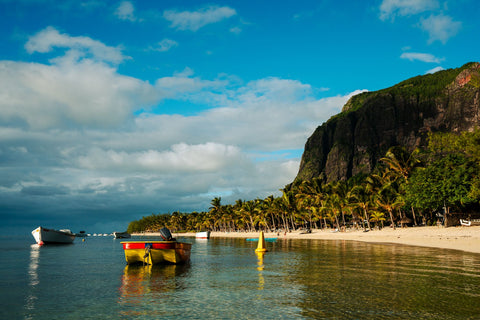
Mauritius is one of those honeymoon and beach destinations where you imagine completely disconnecting... until you want to upload a photo of the turquoise lagoon, confirm your catamaran excursion, or make a video call home. That's why it's wise to decide before you fly how you're going to get internet in Mauritius. In this guide, I compare all the real options for tourists: your operator's roaming, resort Wi-Fi, local Mauritian SIMs from Emtel, my.t or MTML with counters at SSR Airport, and eSIM. I'll tell you about coverage across the island, where the signal is weak, and how much data you'll need.
Internet in Mauritius: the quick answer
For a tourist, eSIM is the best way to get connected in Mauritius: you activate it in minutes on the Emtel or my.t network, it works as soon as you land, and it saves you the airport queue. A local SIM performs almost as well; resort Wi-Fi is only for backup.
That's the short conclusion, but nuance is important. Mauritius is a small, very well-connected island: the signal reaches almost the entire coast, towns, and main roads, so you won't suffer from coverage issues here like in a dispersed archipelago. The debate isn't "will I have internet," but "how much will I pay and how much hassle will it be to get it."
That's why my general recommendation is to arrive with your own mobile data already working, rather than relying on shared hotel Wi-Fi, which comes and goes. eSIM gives you just that without changing cards; a local Mauritian SIM is an equally valid and slightly more hands-on alternative; and roaming is an expensive emergency network that I would only use for a specific bind. In the following sections, I break down each option with real prices, coverage, and fine print, so you can choose based on facts and not hunches, whether you're on a week-long honeymoon or staying for a whole month.
All options at a glance
Before diving into details, here's the full picture. There are four realistic ways to get connected in Mauritius, and not all of them hold the same weight for your trip. Focus less on the price and more on the "but" column: that's where this comparison is decided, because in such a well-covered destination, convenience matters as much as cost.
| Option | Approximate Price | Process | Its big "but" |
|---|---|---|---|
| Operator Roaming | €10-15/day or per MB rates | None | Very expensive and with limited data |
| Resort or hotel Wi-Fi | Free (sometimes charged in the room) | None | Weak in the room and non-existent outside |
| Local SIM (Emtel, my.t, MTML) | ~1,500 Rs (~€30) unlimited data / 30 days | Low: passport at the counter | Change card and lose your number |
| Travel eSIM | From ~€10 for a few GB | None: QR and ready | Requires compatible phone |
As you can see, the local Mauritian counter has a major advantage—tourist packages with unlimited data—but it requires you to queue and change cards. The pocket router, so popular in other destinations, loses its meaning here because mobile coverage is good and the hotel already provides Wi-Fi; if you still value it for a large group, check out the comparison of eSIM versus pocket Wi-Fi. The real decision is between three candidates: local SIM, eSIM, and accommodation Wi-Fi as backup.

Roaming with your Spanish operator
Starting with roaming is starting with the most convenient, and at the same time, the most expensive. Mauritius is outside the European Union's "roam like home" zone, so your Spanish gigabytes don't travel with you: you enter international rates, where the bill skyrockets without warning. For pay-as-you-go, many operators charge several euros per megabyte, turning a simple afternoon of maps into a hundreds-of-euros shock when you return.
To make it more palatable, they sell daily bundles. Typical rates outside Europe range between €7 and €15 per day, and pay attention to what they include: some bundles offer one or two gigabytes, while others only provide 100 MB daily, a pittance if you're heavily using Instagram from the beach. Do the math: a week in Mauritius at €10-15/day is €70-105 just for data, and for a two-week honeymoon, you'll be well over €150.
My advice is to treat roaming as an emergency network: activate it if something goes wrong and that's it. Check your operator's app before you leave to find out what exact rate applies to you. If you want the detailed figures, these guides will be helpful: how much international roaming costs and the comparison of eSIM versus roaming.
Resort and hotel Wi-Fi: free but limited
Most people who travel to Mauritius stay at a beach resort, so the temptation is to think, "I'll have Wi-Fi there and save on data." And in part, that's true: today, almost all resorts and hotels offer free Wi-Fi to their guests, and it usually works well. The nuance matters, and there's the fine print.
Typically, free Wi-Fi works well in common areas—reception, restaurant, bar, pool—because that's where the access points are located. However, in rooms further from the main building, in villas, or in beach bungalows, the signal can be weak or drop out intermittently, and some resorts charge extra for a better connection. Add to that the fact that bandwidth is shared among all guests, so at night, with half the hotel connected, speeds drop.
Practical rule: resort Wi-Fi is fine for checking email from the bar, but don't count on it for a work video call from your room or for using maps on the road. That's where your own connection saves you.
And there's an obvious limit: hotel Wi-Fi stays at the hotel. As soon as you go out to a public beach, the Port Louis market, a drive south, or an excursion, you lose signal. Use it as a backup to download maps at night or upload photos at your leisure, not as the backbone of your trip.
Local Mauritian SIM: counters at SSR Airport
Buying a local SIM in Mauritius is straightforward. Right after exiting arrivals at Sir Seewoosagur Ramgoolam (SSR) Airport, in the south of the island, you'll find the stores for Emtel and my.t (Mauritius Telecom, formerly Orange) side by side, with tourist packages designed for travelers. There's also MTML (Chili) as a third, more economical option. You'll need your passport and accommodation address—hotel confirmation is usually sufficient—and within about ten minutes, you'll have data.
The two major providers offer very competitive tourist packages. These are my references for 2026:
- Emtel Tourist SIM: about 1,500 Rs (~€30) with unlimited 5G data, unlimited local SMS, and 200 Rs call credit, valid for 30 days.
- my.t 5G Tourist SIM/eSIM: about €30 with unlimited 5G data, calls, and SMS for 30 days. They also have a digital kiosk near baggage claim (eSIM only) in addition to the counter.
- MTML (Chili): a cheaper alternative with data volume packs, useful if you want to spend less and don't mind a slightly less extensive network.
The "but" isn't the price, which is very reasonable, but the logistics: taking out your Spanish SIM, storing it without losing it, inserting the new one, and losing your number (goodbye to bank SMS unless you have Dual SIM). If you're staying for weeks and want unlimited data for €30, it's worth it; for a short getaway, many prefer to avoid the card juggling. I compare it in detail in eSIM versus local SIM.
eSIM: the option I recommend
This is where eSIM shines in Mauritius, and not just for marketing. It's a digital card that already lives inside your phone: you buy the Mauritius plan from home, receive a QR code, scan it, and you're all set. No queues, no taking out your Spanish card, no visiting a counter after a long, jet-lagged flight. You arrive on the island with active data and leave the airport connected to arrange your transfer or open the map to your hotel.
Travel eSIMs for Mauritius rely on the networks of local operators, especially Emtel and my.t, so your coverage is the same as a Mauritian would have with a store-bought SIM: 4G and 5G across almost the entire island. The difference isn't in the signal, but in how you access it. In terms of price, plans start from around €10 for a few GB and increase depending on the number of days and gigabytes you need, which are very reasonable figures for a beach trip.
Another key advantage: with Dual SIM, you keep your Spanish number active for bank SMS while data runs on the eSIM. If it's your first time, read what an eSIM is and then the eSIM guide for Mauritius, with step-by-step installation and compatible phone models.

Local SIM vs. eSIM, face to face
This is the comparison that truly matters in Mauritius, because roaming is ruled out by price alone, and Wi-Fi isn't enough to live by. The table pits the two options that are vying for the win, and you'll see that the battle isn't decided by coverage—identical for both, as they use the same networks—but by convenience: how much queuing you do, whether you swap cards, and if you keep your number.
| Criterion | Local SIM (Emtel / my.t) | Travel eSIM |
|---|---|---|
| Price | ~1,500 Rs (~€30), unlimited data for 30 days | From ~€10, depending on days and GB |
| Documents | Passport and accommodation address | None |
| Where to buy | SSR Airport counter, in person | Online, from home, before flying |
| Time to get data | ~10 min plus queue after flight | Minutes: scan QR and ready |
| Network used | Emtel, my.t or MTML | The same: Emtel or my.t |
| Your Spanish number | You lose it if your phone has only one slot | Remains active with Dual SIM |
My take: if you truly need unlimited data for a whole month, the €30 local pack is unbeatable. But for a typical trip to Mauritius—one or two weeks of beaches and excursions—the eSIM wins for convenience: you arrive with data, don't change cards, and keep your number, with a plan tailored to the number of days you're there. The price difference with what you'll actually consume is small.
Coverage in Mauritius: beaches, inland, and hiking
Good news: Mauritius is better connected than you might imagine. It's a small island, about 65 km long, with three competing operators, and that shows in the coverage map. 4G reaches almost the entire coast and towns, and 5G already covers a good part of the country—Emtel boasts 5G reaching around 80% of the island. Here's what you can expect by area:
- Cities and tourist areas: the best. Solid 4G and 5G in Port Louis, Quatre Bornes, Grand Baie, Flic en Flac, or Belle Mare, with plenty of speed for anything.
- Beaches and coast: reliable coverage along almost the entire coastline, including the coves and resorts in the east and north, which are the most touristy.
- Mountainous interior and hiking: here's the warning. In Black River Gorges National Park, the gorges, waterfalls, and some mountain sections inland, the signal can drop or disappear, as in any area of closed valleys.
The general rule is simple: on the coast and in cities, you'll have more than enough, and only on inland hiking trails should you download maps in case you lose data for a while. If your trip includes Rodrigues Island, which has 4G from Emtel and my.t, or excursions to nearby islands, coverage remains good in inhabited areas. For 95% of travelers, the signal is more than adequate throughout the trip.
How much data you need in Mauritius
The million-dollar question before buying any plan. The short answer: probably less than you fear, but it's worth calculating by days and actual usage. In Mauritius, you'll mostly be using messaging, social media to show off the turquoise lagoon, maps to get around the island by car, and some video calls. This table gives you an approximate reference per activity and day.
| Daily Activity | Approximate Consumption |
|---|---|
| WhatsApp and messaging | ~20-50 MB/day |
| Social media (scrolling and stories) | ~150-300 MB/day |
| Maps and car navigation | ~50-100 MB/day |
| Uploading photos and some video | ~200-400 MB/day |
| Video call (30 min) | ~300-500 MB |
| Video streaming (1 h) | ~1 GB |
Adding up normal tourist use, you'll need about 500-900 MB per day. With that reference, for a week in Mauritius, 3-5 GB will suffice; for a twelve or fourteen-day honeymoon, a 10 GB plan will be more than enough; and if you're going to livestream, telework, or upload videos daily, go for 20 GB or more—or the unlimited local operator package. Remember that you can save photo backups and heavy streaming for the resort Wi-Fi at night, thus stretching every gigabyte of your data plan.
Frequently asked questions
Can I buy a SIM at Mauritius airport?
Yes, and it's easy. As soon as you exit arrivals at SSR airport, you'll find Emtel and my.t stores, next to each other. They will ask for your passport and your accommodation address, and in about 10 minutes you'll leave with data. my.t also has a digital eSIM kiosk next to baggage claim.
How much does a tourist SIM cost in Mauritius?
Emtel and my.t packages cost around 1,500 Rs (~€30) and include unlimited 5G data, local calls, and SMS for 30 days. MTML (Chili) is slightly cheaper by data volume. For a one-month stay, it's a very competitive option compared to eSIM.
Is there good coverage throughout the island?
Yes. Mauritius is small and has three operators, so 4G reaches almost the entire coast and towns, and 5G covers cities and tourist areas. The only weak point is the mountainous interior and hiking trails, such as Black River Gorges, where the signal may drop in the gorges.
Is resort Wi-Fi enough?
As backup, yes, as a primary plan, no. Free Wi-Fi usually works well in common areas (reception, restaurant), but in distant rooms or beach bungalows it's weak, and sometimes an extra charge applies. And as soon as you leave the hotel, you lose it. To be safe, carry your own data.
How many GB do I need for a week in Mauritius?
For normal use—messaging, social media, maps, some photos, and occasional video calls—3-5 GB will be fine for a week. For a two-week honeymoon, a 10 GB plan will be more than enough. If you stream live or telework, choose 20 GB or the unlimited local package.
Does eSIM work as soon as I land in Mauritius?
Yes. You install the plan from home with the QR code and activate it upon landing, so you leave the airport with data. This is the big advantage over a local SIM: no queues or changing cards right after a long flight. It relies on Emtel or my.t networks.
Is there 5G in Mauritius?
Yes. All three operators (Emtel, my.t, and MTML) offer 5G, and Emtel claims to cover around 80% of the island. You'll primarily find it in Port Louis, Quatre Bornes, Grand Baie, and tourist areas. Outside these areas, you'll still have 4G, which is more than enough for everything you'll do on holiday.
Conclusión
Getting internet in Mauritius is easy, and that's the good news: being a small island with three operators, coverage reaches almost the entire coast and only falters in the mountainous interior. The resort's Wi-Fi is helpful, but it's weak in the room and disappears as soon as you go to the beach or the road. A local SIM from Emtel or my.t can be bought in 10 minutes at SSR airport and includes unlimited data for about €30, although it requires you to change your card and lose your number. That's why, for the typical beach trip or honeymoon, an eSIM is the answer: same local network, no queues, and you keep your Spanish number. Install it before you take off and you'll have data from the moment you land. When you're ready, take a look at the eSIM for Mauritius.