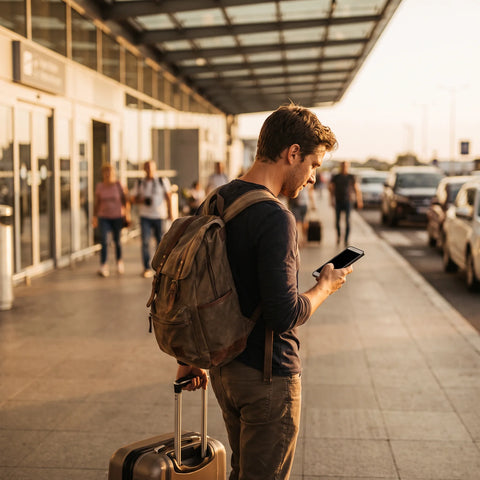
In short: The best eSIM for Turkey is one that combines coverage on a local Turkish network, the data you'll actually use, and support in English if something goes wrong. It's not always the cheapest: land in Istanbul with internet, no roaming, and no nasty surprises on your bill when you get back.
Choosing an eSIM for Turkey isn't about blindly picking the cheapest option. It's about looking at real coverage, useful data, and what happens when things go wrong in Cappadocia in the middle of the night. In this guide, you'll see what criteria really matter, how to cover Istanbul and the coast, how much data you need depending on your trip, and how to activate everything in a minute for a peaceful flight. Let's get to the point.
What an eSIM is and why it's so well-suited for Turkey
An eSIM is a digital SIM that's already integrated into your phone. Instead of inserting a plastic card, you install a profile (usually by scanning a QR code) and your phone connects to a mobile network at your destination. No need to look for a store upon landing, no waiting in lines at Istanbul airport with your map closed.
Turkey is a classic case for eSIMs for one very specific reason: it's outside the European roaming zone for most Spanish plans. This means that your usual card, which works in France or Italy without surcharge, can skyrocket in price here. A local eSIM avoids this problem entirely: you buy data in advance, use it on the Turkish network, and control your spending from the app. If you've never used one, the idea is simple: install a digital data profile and you're good to go.
The key takeaway is this: the eSIM gives you data. Your Spanish number remains active in parallel for bank SMS and calls. You're not giving up anything; you're just adding a cheap data line during your trip.
What makes an eSIM better for Turkey
Price matters, but it alone doesn't define the best option. A super cheap eSIM that loses signal on the coast is useless to you. These are the five criteria that really make a difference and should be reviewed before buying:
- Coverage on a local network: that it relies on Turkish operators with good signal in your specific destinations, not on a generic, distant network.
- Adequate data: neither buying too much "just in case" nor running out halfway through your trip.
- Clear price per GB: a fixed rate, with no hidden charges or fine print to surprise you.
- English support: quick and human help if the QR doesn't scan or there's no service upon landing.
- Easy activation: installation in a couple of minutes, with no strange procedures or paperwork.
With that list in mind, it's easy to discard weak options. These same principles apply to Turkey, Thailand, or Morocco: the destination changes, but not the way you compare.
Local network versus "global" network: the difference almost no one looks at
Here's one of the most silent and most important factors. Some cheap eSIMs connect to an intermediary network instead of the main Turkish operators. On paper, they work, but in practice, they can give you a slower or less stable signal outside big cities. An eSIM that claims to rely on local Turkish networks usually performs better on the coast and in less touristy areas. You won't always see it advertised with those words, but if the support responds in English, it's a good question to ask before buying.
Coverage: Istanbul, Cappadocia, and the coast
Good news: Turkey has very solid mobile coverage in tourist areas. Istanbul, Cappadocia, Antalya, Ephesus, and Pamukkale all have stable 4G signal, and 5G is already deployed in major cities. An eSIM using a local Turkish network will give you fluid internet throughout virtually any classic itinerary.
Where should you temper expectations? In the deep interior of Anatolia and on some mountain routes, where the signal can weaken or disappear at times. But for the bulk of trips (Istanbul, plus Cappadocia, plus the Aegean or Mediterranean coast), you won't notice annoying interruptions. If your getaway is mainly focused on the city, you have extra context in the eSIM for Istanbul guide. And if you're staying for two weeks and doing a long road trip, check out eSIM Turkey for 2 weeks, which goes into detail about the stages.
Cappadocia tip: if you get up early for a hot air balloon ride, download the pickup point location the night before with Wi-Fi. At dawn, between valleys and at odd hours, the signal sometimes falters, and you don't want to miss your transfer because of a map that won't load. The same applies to e-tickets and reservations: have them saved offline.
How much data you need based on your trip
By far the most common mistake is buying too much data for fear of running out. The reality is that much of the heavy consumption is covered by hotel Wi-Fi, and when you're out and about, you're mostly using maps, messaging, and social media, which consume much less data than people think. This table gives you an honest reference based on how many days you're traveling and how you use your phone.
| Trip Type | Moderate Use (maps, social media, messaging) | Intense Use (video, hotspot, uploading photos) |
|---|---|---|
| Weekend in Istanbul | 2-3 GB | 4-5 GB |
| 1 week (Istanbul + Cappadocia) | 4-6 GB | 8-10 GB |
| 2 weeks (grand tour) | 8-10 GB | 15-20 GB |
| Layover or 2-3 single days | 1-2 GB | 3-4 GB |
If you're sharing via hotspot to work on your laptop or uploading a lot of videos to social media, definitely lean towards the intense use column. To fine-tune the calculation according to your specific travel style, the guide on how much data you need for travel breaks down consumption by application. And a truly data-saving idea: take advantage of your accommodation's Wi-Fi for heavy downloads (series for the return flight, offline maps, updates) and save your eSIM data for when you're out and about.
How to stretch your data without losing communication
Even if you calculate well, it's always good to optimize consumption. Download maps of Istanbul and your region on Google Maps before leaving the hotel; they will continue to work with GPS even if data falters. Lower the auto-play quality on social media and disable video auto-play. And check which apps sync photos in the background: that's almost always the silent data leak that consumes your plan without you doing anything.
eSIM price vs. roaming
This is where a Turkish eSIM wins by a landslide. Since Turkey is outside the European roaming zone for most Spanish plans, using your usual card can cost several euros per day, or be charged per megabyte at unpleasant prices. On a week-long getaway, that bill can skyrocket without you realizing it until it arrives.
An eSIM works the other way around: it's a fixed rate for the entire trip. You pay once for the GB you estimate and control consumption from the app, with no surprises when you land back home. If you're coming from classic roaming and want to see the difference with well-explained concepts, you have the complete comparison in eSIM vs. roaming. The summary is simple: in a non-EU destination like Turkey, the eSIM is not only more convenient, it's also usually much cheaper.
An important note on prices: don't trust the first large, eye-catching figure you see. To know what you're really paying, divide the total price by the GB included and compare that "price per GB" between plans. A plan that seems expensive can be more cost-effective than a "sale" plan with very little data. Always check the current price with the store before buying, because rates change.
Unlimited data: the fine print you should read
Many comparisons tout "unlimited data" as the big selling point, but it's worth reading the fine print before being dazzled. In practice, almost all "unlimited" plans apply a fair usage policy (the famous FUP) regarding speed: you can browse without volume limits, yes, but after a certain daily amount at high speed, the connection slows down significantly.
For a normal trip to Turkey, a plan with well-calculated GB is usually more transparent (and often cheaper) than an "unlimited" plan with hidden restrictions. Only if you're going to do a lot of streaming, long video calls, or telework several hours a day is it worth scrutinizing the unlimited plan, comparing the guaranteed speed after the threshold. The golden rule: look at the speed after the daily limit, not just the word "unlimited."
What almost no one tells you about eSIMs for Turkey
Beyond the basics, there are details that make the difference between a friction-free connected trip and an afternoon fighting with settings. These are the ones you'll appreciate knowing beforehand.
- Install the eSIM at home, activate it in Turkey. Most plans start counting when the profile first connects to a Turkish network, not when you install it. So, have everything ready with Wi-Fi at home and activate data upon landing, without spending a single MB prematurely. Even so, review your plan's specific conditions.
- WhatsApp still uses your usual number. WhatsApp is linked to your number, not your data card. With the eSIM, you browse, and the app works with your Spanish number completely normally. No need to reconfigure anything.
- Save the QR email. If you change phones or accidentally delete the profile, that code and its instructions are your lifeline. Don't delete it halfway through your trip.
- Have an alternative payment method handy. Turkey is a destination where cash still rules in many places. Having internet allows you to pay and use transportation apps, but also carry some lira just in case.
- Istanbul airport has Wi-Fi. If for some reason the eSIM doesn't start on the first try, breathe: you can connect to the airport Wi-Fi to write to support and resolve it before heading into the city.
These kinds of details don't appear on the product sheet, but they are exactly what prevent first-day anxiety. A little preparation on the couch at home is worth ten emergency calls in a taxi.
How to buy and activate your Turkey eSIM
Once you've chosen your plan, buying and activating it takes just a couple of minutes from your phone, with no shipping or physical stores involved. The idea is to have the eSIM installed at home so you can land in Istanbul with data immediately. The process is as follows:
- Buy your Turkey eSIM and receive the QR or installation link in your email. If your trip is short and for light use, the basic Turkey eSIM version may be more than enough.
- In Settings > Mobile Data, select "Add eSIM" and scan the QR. The profile installs automatically.
- Keep your Spanish SIM as your primary line for calls and SMS.
- Upon landing in Turkey, select the eSIM as your data line and enable its data roaming. Done.
Before buying anything, confirm that your phone is eSIM compatible, as very old models may not support it. And if you get stuck at any step, the guide on how to install an eSIM explains it screen by screen. With that done, the Turkey eSIM stops being a doubt and becomes something you resolve from the comfort of your home before flying.
What if Turkey is just one stop on a larger trip that includes European countries? In that case, it might be worth combining a regional eSIM for the European leg with a Turkey eSIM for the Turkish leg. Each destination gets its optimal coverage.
Frequently Asked Questions
What is the best eSIM for Turkey?
The one that combines good coverage on a local Turkish network, the data you'll actually use, and English support if something goes wrong. It's not always the cheapest: a cheap eSIM that loses signal on the coast isn't worth it. Compare coverage, price per GB, and ease of activation, and choose the plan that fits the specific duration of your trip.
Does the eSIM work in Cappadocia and on the coast, or only in Istanbul?
It works in tourist areas throughout the country. Istanbul, Cappadocia, Antalya, Ephesus, Pamukkale, and the Aegean and Mediterranean coasts all have good 4G coverage. Only in the deep interior of Anatolia or on some mountain routes might the signal weaken. For a normal tourist itinerary, you won't notice significant interruptions.
How many GB do I need for a week in Turkey?
For moderate use (maps, social media, and messaging), 4 to 6 GB is usually enough for a week combining Istanbul and Cappadocia. If you share via hotspot, upload a lot of videos, or make long video calls, aim for 8-10 GB. Remember that hotel Wi-Fi covers much of the heavy consumption during your trip.
Is the Turkey eSIM cheaper than my operator's roaming?
Generally, yes. Turkey is outside the European roaming zone for most Spanish plans, so your operator may apply high daily or consumption-based surcharges. An eSIM has a fixed rate for the data you buy, with no surprises on your bill. For a multi-day trip, the difference is usually significant. Always check your operator's current conditions.
Are unlimited data plans for Turkey worth it?
It depends on your usage. Almost all "unlimited" plans apply a fair usage policy: after a certain daily consumption, the speed decreases. For a normal trip, a plan with well-calculated GB is usually more transparent and economical. Only if you're going to do a lot of streaming or intensive remote work should you scrutinize unlimited plans and compare the speed after the threshold.
Can I still use WhatsApp and my Spanish number in Turkey?
Yes. The eSIM gives you data, and WhatsApp works with your usual number because it's linked to the number, not the data card. You can keep your Spanish SIM active for SMS and bank calls while the eSIM handles browsing. This is the usual setup for traveling without roaming.
When should I activate the eSIM, before or upon arrival?
Install it at home with Wi-Fi, but activate the data once you're in Turkey. Most plans start counting time or data when the profile first connects to a Turkish network, not when you install it. This ensures you get the full validity of the plan during your trip. Check your plan's specific conditions just in case.
Conclusion
The best Turkey eSIM is one that gives you reliable coverage in Istanbul and on the coast, data adjusted to your actual trip, and activation in just a couple of minutes, without the expensive roaming that your operator applies outside the EU. Compare wisely, look at the price per GB, and buy before you fly. Plan your route with your eSIM ready from home and land with internet, no roaming, and no stress, connected from the first minute in Istanbul.