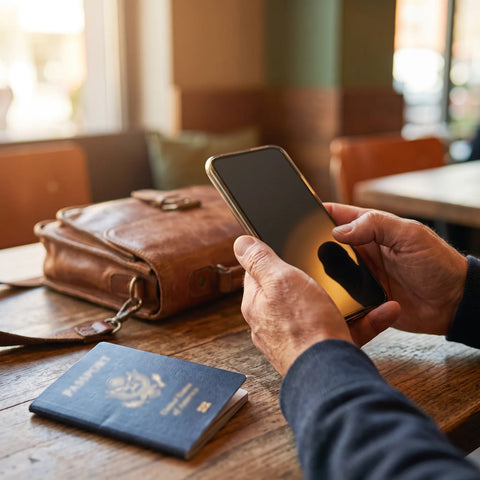
What is roaming and how does it work when you travel?
Roaming is the service that allows your cell phone to stay connected to a mobile network when you leave your operator's country, using the infrastructure of a local company through an agreement between the two. Without that agreement, your cell phone simply won't find a signal upon landing.
When you travel with your ETB line (or any other operator from Colombia, Mexico, Argentina, Chile, or Peru) outside your country, your phone automatically searches for an associated network through international roaming agreements. If it finds one, you'll see the name of that foreign network in the status bar instead of your usual operator's name. From then on, every call, message, or megabyte you use goes through that visiting network and is billed according to the conditions your original operator has agreed upon with it. These conditions vary greatly depending on the destination and should be confirmed directly with your operator before traveling, as they change frequently.
The key point for frequent travelers is this: traditional roaming depends on the commercial relationship between two operators, not on a fixed and transparent cost that you can calculate in advance. That's why, in recent years, more and more travelers are opting for independent data solutions—like a travel eSIM—that do not depend on any bilateral agreement and whose cost and coverage are known before boarding the plane.
How to activate international roaming on ETB
If you have an ETB line and are going to travel, the procedure to enable international roaming depends on the type of plan you have (postpaid or prepaid) and may change over time. Therefore, the mandatory step is always the same: confirm it directly through ETB's official channel (their app, website, or customer service) before your travel date, to find out which countries are covered, what the cost is, and if your specific plan includes it or if it needs to be activated separately.
What is useful to know, regardless of the operator, is what to ask to avoid surprises:
- Does my current plan include international roaming or do I need to contract it as an additional service?
- Which countries are covered and which are not?
- Is billing based on consumption (data, minutes, SMS) or a package of days with a data limit?
- What happens if I exceed the package limit: does the service cut off or does it continue charging for additional consumption?
- Is there a cap or automatic block to avoid unexpected charges on the bill?
These five questions apply equally whether your line is from ETB, any other Colombian operator, or an operator from another country in the region. This is information that only your operator can confirm accurately for your plan and travel date, as roaming conditions change due to commercial agreements that are renegotiated over time.
How to activate roaming with any operator
Beyond ETB, the general process for enabling international roaming usually follows a similar logic across most operators in the region, although the exact channel (app, dialing code, customer service line) varies by company:
- Check your current plan. Some postpaid plans include basic roaming; others require activation as an additional service before traveling.
- Contact the operator through their official channel (app, website, or customer service) and ask them to confirm coverage, cost, and activation method for your specific destination.
- Activate the service in advance. Some operators need one or two business days to process activation; leaving it until the airport can mean traveling without service for the first few days.
- Upon landing, verify that the cell phone connected to a network authorized by your operator (not just any visible network) and that data roaming is enabled in the phone settings, in addition to activation on the operator's side.
- Monitor your consumption from the operator's app during the trip, if that function is available, to avoid charges accumulating unnoticed.
Traditional roaming does not notify you in real time how much you have spent unless the operator explicitly offers that function. That's why many travelers only find out the real cost when they see the bill the following month, when there's nothing left to do about it.

In which countries is roaming free or included?
The idea of "free" roaming in the strict sense—without any additional charge to your usual plan—exists only when your operator explicitly includes certain countries within your data plan, at no extra cost for using it outside your home country. It is not a universal or automatic benefit: it depends on each operator, each contracted plan, and agreements that may be modified over time.
To find out if your specific destination is covered without additional cost, the only reliable source is your operator: check your plan details in the app or directly ask which countries are included and under what conditions (data limit, day limit, reduced speed after exceeding certain consumption, etc.). Any list of "countries with free roaming" that does not come directly from your operator and with a consultation date may be outdated, because these agreements are renegotiated.
It is precisely this uncertainty—"am I covered or not?", "how much will it really cost me?"—that leads many travelers to prefer a solution where the cost and coverage are known in advance, without depending on what agreement your operator has in force with each country at the exact moment of your trip.
How much does international roaming cost?
There is no single figure: the cost of international roaming depends on the operator, the contracted plan, the destination country, and whether or not you activated a specific package before traveling. The only way to know the real cost for your case is to consult directly with your operator before leaving, with the exact date and destination.
What can be explained, without needing to cite a specific figure, are the components that usually add up to the total cost of traditional roaming:
| Charge Type | What it Covers | Why it Causes Surprises |
|---|---|---|
| Mobile Data | Browsing, maps, apps, social media | Consumed without you noticing: automatic updates, notifications, background synchronization |
| Calls | Outgoing calls and, in some plans, also incoming calls | Receiving a call while roaming can incur a cost even if you didn't initiate it |
| SMS | Text messages sent from abroad | Verification codes from banks or apps via SMS also fall into this category |
| Exceeding the Package Limit | Consumption that exceeds the contracted data, minutes, or days limit | If the operator does not automatically block, additional consumption continues to be billed |
This lack of predictability is, in practice, the main reason why alternatives like travel eSIMs exist: instead of relying on variable costs per consumption, you buy a data plan with a fixed amount of gigabytes for your destination, you know the cost before traveling, and there are no surprise overages because, when the limit is reached, the plan simply runs out.
Roaming vs. Travel eSIM: Real Differences
If you've never used an eSIM, the short explanation is that it's a digital SIM card: instead of inserting a physical chip, your cell phone downloads it with a QR code and it functions as an additional data line for your trip, without touching your main line from ETB or any other operator. You can delve into how it compares point by point in our guide on eSIM vs. roaming, but the following table summarizes the essentials:
| Aspect | Traditional Roaming | Travel eSIM |
|---|---|---|
| How it's activated | Through your home operator, in advance and sometimes with paperwork | You buy the plan online and activate it yourself from your phone |
| Cost known beforehand | Not always; depends on the agreement between operators for that destination | Yes, the price of the data plan is known before traveling |
| Your usual number | Maintained, along with calls and SMS | Does not include your number; it's used only for data (you can keep your main line active for calls) |
| Coverage | Depends on your operator's current agreements with each country | Covers more than 200 destinations with the same type of product |
| Support during the trip | Varies depending on the operator and the country you are in | 24/7 support in all languages via email and WhatsApp |
Neither option is "better" in the abstract: if you need your number to continue receiving calls and SMS during the trip, roaming (or keeping your physical SIM active alongside a data eSIM) is still necessary. If what you need is a reliable and predictable internet connection on your cell phone, a travel eSIM usually solves it with less friction and without depending on what agreement your operator has in force at that specific moment.
Example: A trip from Bogotá to Mexico City
Let's consider a specific case. Someone in Bogotá, with an ETB line, books a flight to Mexico City for five weeks from now, an eight-day trip. They have two ways to avoid being without internet upon arrival:
Path 1 — Roaming with their operator. Before traveling, they contact ETB to ask if their plan covers Mexico, what the cost of data roaming is there, and if they need to activate it in advance. They receive the answer, decide if it's convenient or not, and if they accept, they wait for the activation to be ready by the flight date.
Path 2 — Travel eSIM. They buy a data plan for Mexico from their cell phone, at any time between booking the flight and the day of the trip—they have 180 days to activate the eSIM from the moment of purchase, so there's no rush. Activation takes approximately 1 minute and is ready before leaving Bogotá, without relying on paperwork with a third-party operator.
Upon landing in Mexico City, on Path 2, the cell phone already has data working from the moment it comes out of airplane mode, without needing to coordinate anything additional. If something doesn't connect properly, they have 24/7 support in all languages via email and WhatsApp to resolve it while traveling, without having to search for a physical store or wait for office hours.

How to activate a travel eSIM step-by-step
The process is the same regardless of the destination, because it does not depend on agreements between operators but on a data plan you buy directly:
| Step | What you do | When it's best to do it |
|---|---|---|
| 1. Choose destination and plan | Select the country or region and the amount of data you'll need | As soon as your trip is confirmed, even if it's weeks or months away |
| 2. Purchase the eSIM | Pay for the plan and receive a QR code by email | You have up to 180 days from purchase to activate it, so you can buy it calmly |
| 3. Install the profile | Scan the QR from your phone's settings, with Wi-Fi available | Ideally a few days before traveling, to test that it's properly installed |
| 4. Activate upon arrival | Turn on data roaming for that line; activation takes about 1 minute | Upon landing or arriving in the coverage area/country of the plan |
For step 3, if this is your first time installing an eSIM, the guide on how to install an eSIM details the process with screenshots for Android and iPhone.
What to check before you travel
Before deciding between roaming, eSIM, or both combined, it's worth checking a few basic points that prevent most inconveniences:
| Item to Check | Why it Matters |
|---|---|
| Cell phone compatibility with eSIM | Not all models support it; it's advisable to confirm before purchasing any plan |
| Unlocked cell phone (no operator lock) | A cell phone locked to a specific operator may not accept eSIM profiles from other providers |
| Wi-Fi available to install the profile | QR installation requires an internet connection; doing it before leaving avoids relying on airport Wi-Fi |
| What happens to your ETB line during the trip | If you need to continue receiving calls or verification SMS, define whether you keep that line active in roaming mode or without data |
| Data amount according to your usage habits | Maps and messaging consume little; video streaming and video calls consume much more |
Regarding compatibility, the complete list of models is available at eSIM-compatible phones, and if anything goes wrong during installation or use, the guide on common eSIM problems covers the most frequent causes and how to resolve them.
A fact that few take advantage of: since you have 180 days from purchase to activate the eSIM, there's no need to wait until the last minute to buy it. You can do it as soon as you confirm your flight—even months in advance—and have it installed and ready, untouched, until the day you land. This avoids the last-minute rush at the airport and gives you plenty of time to resolve any questions with support before your trip begins.
Frequently Asked Questions
Does the eSIM replace my ETB line during the trip?
Not necessarily. The travel eSIM is used for mobile data; your physical ETB line can remain active on your cell phone (many models allow two lines at the same time) to receive calls or SMS if you need it, while the eSIM handles the internet connection.
Do I need Wi-Fi to use the eSIM once I arrive at my destination?
Only to install the profile for the first time, using the QR code. Once installed, activation and data usage at the destination do not require Wi-Fi: it works like any mobile line.
Can I use WhatsApp and social media with a travel eSIM?
Yes. Once active, the eSIM functions like any mobile data connection: WhatsApp, maps, social media, email, and the rest of your apps work normally within the data available in the plan.
What if I run out of eSIM data before my trip ends?
You can purchase an additional or higher capacity plan for the same destination from your cell phone whenever you need it, without having to rely on a physical store.
Does eSIM work the same as roaming in terms of connection speed?
eSIM connects to local mobile networks in the destination country, just as a roaming line would; the speed depends on the coverage of those networks in your area, not on the type of technology (eSIM or roaming) you use.
Can I buy the eSIM long before the trip?
Yes. You have 180 days from the date of purchase to activate it, so you can buy it as soon as your itinerary is confirmed and activate it only upon arrival at your destination.
What do I do if I have a problem with the eSIM during my trip?
You have 24/7 support in all languages by email and WhatsApp, available while you are traveling, without needing to call or look for physical offices.
Conclusion and next step
International roaming with ETB, or with any operator in the region, may work well for your trip, but its cost and coverage depend on agreements between companies that only your operator can confirm precisely before you leave. If you prefer to know the price and coverage beforehand, without relying on that negotiation between operators, a travel eSIM is the alternative: you buy it whenever you want within 180 days before your flight, you activate it in approximately 1 minute upon arrival, and you have 24/7 support in all languages by email and WhatsApp throughout your journey.
If this is your first time using this type of solution, the definitive guide to traveling with eSIM walks you through everything from purchase to activation. And if you already know where you're going, you can directly check the available plans for more than 200 destinations in the international eSIM collection.