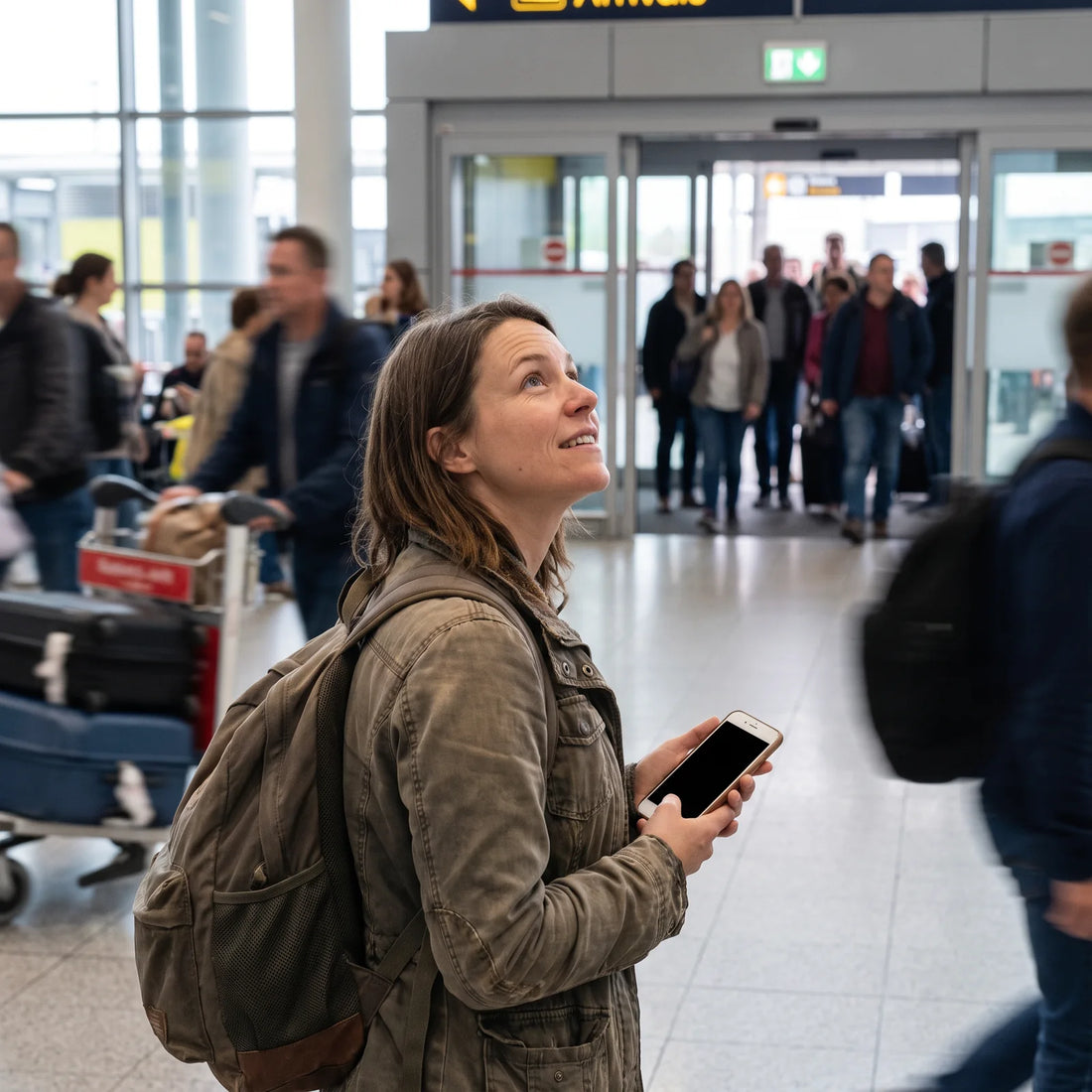
If you're searching for "Tigo Bolivia international roaming," you probably have a trip coming up: you're either leaving Bolivia with your Tigo line, or you're arriving in Bolivia with a line from another country and you're not sure if you'll have signal for maps, WhatsApp, or work email. This guide explains how roaming works in both directions, what you can expect, and when it's better to consider an alternative like a travel eSIM.
What is Tigo Bolivia international roaming?
Tigo Bolivia international roaming is the service that allows you to continue using calls, messages, and data with your Tigo line when you travel outside the country, thanks to agreements between Tigo and operators in other countries. You don't change your number or SIM card: your cell phone automatically connects to a local network through this agreement.
The key word is "agreement." Tigo doesn't have its own antennas all over the world, so when you're outside Bolivia, your line depends on an agreement existing between Tigo and the local operator in the country you're in. If that agreement exists, your cell phone picks up a signal as if it were just another operator in that country. If it doesn't exist, there's simply no service, even if your line is up-to-date on payments.
This explains why roaming sometimes "works perfectly" in one country and doesn't get any signal in a neighboring country: it doesn't depend on how good your line is, it depends on which operator has an agreement with Tigo in that specific destination.
How to activate Tigo Bolivia roaming?
The process for activating roaming is similar with almost any operator, including Tigo. Before buying your plane ticket, it's a good idea to calmly review these points:
- Confirm that your line has roaming enabled. On some plans, it's active by default; on others, you have to request it via the app, at a service point, or by phone before traveling. Don't take it for granted: check it in advance, not at the airport.
- Ask if there's a roaming package for your destination. Many operators sell data packages with a fixed limit designed for travelers, which are usually more straightforward than paying per MB consumed without control.
- Check the saved data APN on your cell phone. This is a detail that almost no one checks and is the silent cause of more than one "roaming isn't working for me": if the data access point (APN) is not properly configured on the phone, voice roaming may work while data simply doesn't load, even if the service is activated on your line. If you have doubts, ask your operator to confirm the correct APN for roaming before you leave.
- Upon landing, activate airplane mode and then turn it off again. This forces the cell phone to search for the available network again and usually resolves most of the "no signal" issues in the first few minutes.
- Monitor consumption from the official app. Data roaming can go quickly without you noticing, especially with automatic updates or background video.
If any of this is unclear for your particular line, the most reliable channel is the official Tigo app or Tigo Bolivia customer service: roaming conditions change from one plan to another and from one moment to another, so it's worth confirming close to your travel date, not months in advance.
How to activate Tigo roaming in Mexico?
This is a particular case that causes confusion: Tigo does not operate with its own network in Mexico. When a Tigo line (from Bolivia or any other country where the group operates) travels to Mexico, it does not connect to a "Tigo Mexico," but to the Mexican operator with which Tigo has a roaming agreement at that moment. You don't choose which one; the phone automatically connects to the one that corresponds to that agreement.
In practice, the step-by-step is the same as for any other destination: confirm that roaming is enabled on your line, check if there's a data package for Mexico, verify the APN, and, upon landing, restart the connection from airplane mode. The difference is that, since there's no Tigo network in the country, the quality of coverage and the price depend entirely on the partner operator, and that can vary more than in a country where Tigo does have its own infrastructure.
Therefore, if your trip to Mexico is short or you need stable data from the airport (maps, transport, accommodation), it's worth having a backup plan that doesn't depend on which operator has an agreement that month with your home line.

How to activate roaming in Bolivia?
If the question is reversed—you're coming from another country and want your line to work in Bolivia—the mechanism is the same but viewed from the other side: your home operator needs to have a roaming agreement with a Bolivian operator (Tigo, Entel, or Viva). This is activated before leaving your country, not upon arriving in Bolivia.
The practical steps are:
- Before traveling, ask your operator if they have active roaming in Bolivia and if there is a specific data package for the country.
- Confirm the cost per MB or per day if there is no package, so you don't get a surprise when you return.
- Upon arriving at El Alto, Viru Viru, or any other entry point airport, restart your data connection (airplane mode) so your phone searches for the available Bolivian network.
- If your operator doesn't have an agreement with any Bolivian operator, roaming simply won't work, no matter how much you try from your phone: in that case, your options are to buy a local SIM card upon arrival or activate a data eSIM for Bolivia before your trip.
This latter situation—an operator without an agreement in Bolivia—is more common than it seems with lines from outside the region, and it's the main reason many travelers end up looking for an alternative that doesn't depend on agreements between operators.
In which countries does Tigo work?
Tigo's own coverage changes from time to time due to mergers, operational sales, and new regional agreements, so any fixed list you read today might be outdated in a few months. The most reliable thing is to check Tigo's official coverage map before each trip, instead of relying on what an article or forum comment says.
What is useful to understand is the logic: in countries where Tigo has its own network, roaming is usually more stable because the group itself controls the quality of service. Outside those countries—like the case of Mexico we saw earlier—you depend on agreements with third-party operators, and there the experience can vary from one trip to another.
Roaming is not a switch that Tigo turns on or off from Bolivia: it depends on what agreement exists, at that moment, between your operator and the operator in the country you are in. That's why the same line can work perfectly in one destination and have no data service in the neighboring country.
Precisely because of this dependence on third parties, a travel eSIM, contracted directly for the destination you're going to, doesn't have this problem: it doesn't depend on what agreement your home operator has that month, because it's not a roaming service on your line, but a new data line designed for that country.
How much does roaming cost and what are its limitations?
There's no single figure: the cost of roaming depends on the operator, the plan contracted, the destination country, and whether or not you purchased a data package in advance. What can be anticipated are the points where surprises usually occur, so you can check them with your operator before traveling instead of discovering them on your bill:
- Roaming without a contracted package. It's usually charged per MB or per time block, and without a clear limit, consumption can skyrocket quickly with apps that update automatically.
- Packages with a fixed expiration date. Some roaming packages start running from the day you activate them, not from when you use them, so a delayed flight or a change of itinerary can "eat up" days of the package without you even having landed.
- Speed or data limits. It's common that, upon reaching a certain consumption, the speed drops significantly even if the package "hasn't run out."
- Uneven coverage within the same country. Rural areas, borders, or tourist spots far from cities usually have worse roaming signal than capitals, regardless of the operator.
| Your situation | What to check before traveling | Most practical option |
|---|---|---|
| You live in Bolivia, travel with Tigo to another country where Tigo has its own network | If your plan includes active roaming and if there's a data package for that destination | Roaming with a pre-contracted package |
| You live in Bolivia, travel with Tigo to a country where Tigo relies on a partner (like Mexico) | Which partner operator you'll get and if it has good coverage in the areas you'll visit | Roaming if the cost is clear, or an eSIM for the destination if you're looking for predictability |
| You live outside Bolivia and your operator has an agreement with a Bolivian operator | Cost per MB or per day, and if it's worth buying a specific package for Bolivia | Roaming with a package, comparing the cost against an eSIM for Bolivia |
| You live outside Bolivia and your operator doesn't have an agreement with any Bolivian operator | Confirm directly with your operator before leaving, don't assume | Local SIM card upon arrival or data eSIM for Bolivia activated before the trip |
eSIM vs. roaming: what really changes for your trip?
An eSIM is, essentially, a digital SIM card: instead of inserting a physical card, you activate a data profile directly in your phone's settings. It doesn't replace your phone number, but it does give you an independent data connection in the country where you activate it. To understand if it's more convenient than your operator's roaming, the fundamental comparison is this:
| Criterion | International roaming | Travel eSIM |
|---|---|---|
| How it's activated | Depends on your home operator and an existing agreement with the destination | You activate it yourself from your phone before or upon arrival at the destination |
| Requires physical SIM | No, uses your current SIM | No, it's digital; installed as a profile on the phone |
| Expense control | Variable: depends on the plan and whether a package was purchased | You define upfront how many GB you purchase for the trip |
| Depends on agreements between operators | Yes, always | No, it's a data line specific to the destination |
| Your original number | Remains active for calls and SMS | Remains the same; the eSIM is only for data |
The key difference is in the third row: roaming depends on a third party (the agreement between operators) and you don't control that agreement. A data eSIM for the destination is a connection you purchase directly for that country, so it doesn't matter if your home operator has an agreement there or not. You can review the full comparison in this guide on eSIM and roaming.

Practical example: a trip through Bolivia with mobile data
Imagine a typical trip: you leave your city for La Paz for a week of work and tourism, with a final jump to Uyuni to see the salt flat. Your home operator is not Tigo Bolivia, so before you leave, you have two paths.
The first is to activate roaming with your usual operator, if they have an agreement with a Bolivian operator. This means a call or a process in the app before traveling, confirming if there's a data package for Bolivia, and accepting that if the flight is delayed or your plans change, the package might start running sooner than expected.
The second path is to activate a data eSIM for Bolivia before leaving home. You install it with Wi-Fi from your phone, calmly, without the airport hustle, and it's ready to connect as soon as you land: you don't need to go to a sales point in Bolivia or depend on which operator your line gets that day. For La Paz and large cities, coverage is usually good; for stretches like the Uyuni salt flat, where the signal in general is more limited no matter the operator, it's advisable to download offline maps in advance, something that applies whether you use roaming or an eSIM.
The decision between one or the other usually comes down to this: if your operator has a clear and economical agreement with Bolivia, roaming might be enough. If not, if the cost isn't transparent, or if you simply prefer to know in advance how many GB you have for the entire trip, an eSIM for Bolivia solves that point before you even get on the plane.
How does an eSIM work for Bolivia, step by step?
The process, in general, is shorter than activating roaming because it doesn't depend on a third-party operator to negotiate coverage with. These are the usual steps:
- Verify that your cell phone is eSIM compatible. Most mid-range and high-end models from recent years are, but it's worth confirming before purchasing. You can check the list in this guide to eSIM compatible phones.
- Purchase the eSIM for Bolivia in advance. You don't have to wait until you're at the airport; you can activate it from home with Wi-Fi.
- Install the profile with the QR code or link you receive. The complete step-by-step, with screenshots by operating system, is in this eSIM installation guide.
- Activate it upon arrival in Bolivia (or before, depending on the plan). Activation usually takes about 1 minute once the phone picks up the destination's network.
- Keep your physical line active only for calls and SMS. Data runs through the eSIM, so you can keep your original SIM without using its data plan abroad.
If this is your first time using an eSIM, this complete guide to eSIM for travel reviews common questions before your first trip, and if you encounter any issues during the process, this other guide on common eSIM problems covers the most frequent cases and how to resolve them.
Frequently asked questions
Does international roaming cost the same as using data in your own country?
Not necessarily. The cost depends on the operator, the plan, and whether you purchased a roaming package in advance. Without a package, it's common for charges to be per MB or per time block, which can be more expensive than your normal plan.
Do I need a physical SIM card to use an eSIM in Bolivia?
No. An eSIM is a digital profile that is installed directly into your phone's settings, without the need to insert or remove any physical card.
What if my phone isn't eSIM compatible?
In that case, your operator's roaming or a local physical SIM card are still your options. Before buying an eSIM, confirm the compatibility of your specific model.
Can I still use WhatsApp with my normal number if I activate a data eSIM?
Yes. WhatsApp works over the available data connection, whether it's Wi-Fi, roaming, or eSIM, and remains associated with your original number. The eSIM only provides the internet connection; it doesn't change your phone number.
How long do I have to activate the eSIM after purchasing it?
You have 180 days from purchase to activate it, so you can buy it well in advance of your trip without rushing to use it immediately.
What do I do if I have a problem with the eSIM during my trip?
You can write by email or WhatsApp: support is available 24/7 in all languages, which is useful if the problem arises in the middle of the night or on a local holiday.
Does the same Bolivia eSIM work if I continue my trip to another country?
No: this eSIM is designed for use within Bolivia. If your itinerary includes other countries, check if there is a specific eSIM for each destination before you leave.
Does Tigo roaming activate automatically when I arrive in another country?
It depends on the plan: in some cases, it's active by default, and in others, you have to request it before traveling via the app, a service point, or with the operator. Don't assume it without confirming it in advance.
Conclusion
Tigo Bolivia roaming can be a good option when your operator has a clear, economical agreement with good coverage at your destination. The problem is that this agreement doesn't depend on you: it changes depending on the country, the partner operator, and the moment, and that's precisely what makes it difficult to calculate in advance how much you'll spend or how good the signal will be.
If you prefer to know how many GB you have available before traveling, without depending on what agreement your operator has with Bolivia that month, a data eSIM for the country is the most direct alternative: it's purchased and installed before leaving, with up to 180 days to activate it from the purchase, and with 24/7 support via email and WhatsApp if you need help during the trip. You can check the eSIM for Bolivia and, if it's your first time using this type of connection, review the eSIM getting started guide we saw before planning the rest of your itinerary.