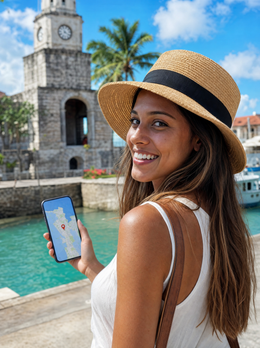
If you've made it this far, it's because you already know you want data for your trip and the only thing left is to decide on the package size. So let's get straight to it: I'll tell you how many GB you need for Antigua and Barbuda depending on how you travel, with real consumption figures and without inflating the number to oversell you. Spoiler: people spend less on this island than they imagine.
The short answer: how many GB for Antigua and Barbuda
For 7 days in Antigua and Barbuda, 3 GB is usually enough for most people. If you upload photos and videos daily, count on 5 GB. If you work remotely from the island, 10 GB or more. The average tourist, using maps and WhatsApp, rarely exceeds 400 MB per day.
That's the number, and I'm not hiding it at the end. However, it's important to understand where it comes from, because the number isn't the same in Antigua as it is on a trip through Asia or the United States. Three things work in your favor here: the country is English-speaking (you won't need a camera translator running all day), the island is small—about 280 km², half an hour by car from end to end—so you won't use GPS navigation much, and accommodations often have Wi-Fi in common areas.
And three other things work against you: you spend the day out, at the beach, with your phone in hand and wanting to share; the Wi-Fi in the room is often the weak point of many resorts; and if you arrive by cruise or sailing, there are hours when you simply won't have any network connection. The balance between these two factors will give you your number.
If you're coming from the general cluster guide, how much data do I need for travel provides the basic method; here I'll adapt it to the Eastern Caribbean, which has its own quirks.
What each application actually consumes
Before choosing a plan, you need to know what consumes data. People believe WhatsApp is the culprit, but it almost never is: messages and audio are tiny compared to a short video in vertical format. These are the figures I use, rounded up so you're not caught off guard:
| Activity | Approximate consumption | Comment |
|---|---|---|
| Maps with active navigation | 5-10 MB per hour | Almost zero if you download the map |
| WhatsApp: text, audio, and photos | 10-20 MB per day | The cheapest thing you'll do |
| WhatsApp video call | 300-500 MB per hour | 5-12 MB per minute depending on quality |
| Instagram (feed, stories, reels) | 250-300 MB per hour | 70-100 MB every 20 minutes |
| TikTok | 800 MB - 1.2 GB per hour | 400-500 MB with the app's data saver |
| Uploading photos instantly | 3-5 MB per photo | A batch of 20 photos: ~80 MB |
| Uploading a short video | 50-80 MB every 30 seconds | This is where your data plan goes |
| Music streaming | 70-150 MB per hour | Download it via Wi-Fi beforehand |
| Video (Netflix, YouTube) on mobile | 0.5-1 GB per hour | Up to 3 GB/h in high quality |
| Email and web browsing | 20-40 MB per hour | Irrelevant unless for marathons |
| Work video call (Zoom, Meet) | 600-900 MB per hour | In HD; less with camera off |
With this table, the pattern is clear: video is everything. Those who don't watch videos on mobile data easily stay under 300 MB per day; those who spend an hour on TikTok lying in a hammock can burn through a gigabyte in an afternoon. You can find a complete breakdown by usage type in the mobile data usage statistics by activity, with more apps and details.
Why you spend less in Antigua than you think
Here's the part that no generic calculator will tell you. Antigua is a low-consumption destination for very specific reasons. The first: the official language is English. In Japan, Thailand, or Morocco, people rely on camera translators to read menus and signs, and that's constant megabytes; in Antigua, you won't open a translator even once.
The second: distances. The island is about 280 km², and from the airport to English Harbour is a long half-hour drive. No one spends three hours a day navigating with GPS. The third: the pace of the famous 365 beaches. A day at Half Moon Bay or Darkwood Beach is a day with your phone in mental airplane mode—swimming, eating, sleeping—with short bursts of photos.
What does increase the number is the Wi-Fi in all-inclusive resorts. The pattern repeats in many accommodations: at reception, by the pool, and at the bar, it works decently, but in the room, it often drops or is spotty. Exactly where you'd use it most at night. Result: you end up using mobile data precisely during peak consumption hours.
| Time of day | What you do | Mobile data |
|---|---|---|
| Breakfast at the buffet | News and email with resort Wi-Fi | ~0 MB |
| Beach morning | Photos, WhatsApp, a couple of stories | 40-80 MB |
| Lunch out | Maps, finding a place, checking reviews | 15-30 MB |
| Excursion (Shirley Heights, Devil's Bridge) | Maps, photos, and some video | 60-120 MB |
| Back to the room | Wi-Fi is weak, so you use data | 100-250 MB |
| Night | Video call home or watching an episode | 150-400 MB |
Summing up a typical day yields between 350 and 900 MB. Multiply by seven, and you understand why 3 GB covers most people, and 5 GB provides plenty of peace of mind.
Recommendation by profile and trip duration
This table is the core of the article. Find your profile, cross-reference it with the number of days you're staying, and you'll have your package. I've added the 7-day column because it's the most common duration in Antigua: the classic resort week.
| Traveler profile | 5 days | 7 days | 10 days | 15 days | 30 days |
|---|---|---|---|---|---|
| Tourist with maps and WhatsApp | 1 GB | 2 GB | 3 GB | 5 GB | 8-10 GB |
| Daily photos and social media | 3 GB | 5 GB | 8 GB | 10 GB | 20 GB |
| Digital nomad / remote work | 10 GB | 12-15 GB | 20 GB | 30 GB | 50 GB or unlimited |
| Family sharing one mobile | 5 GB | 8 GB | 10 GB | 15-20 GB | 30-40 GB |
| Sailor (sailing, charter) | 1 GB | 1-2 GB | 2 GB | 3 GB | 5 GB |
| Cruiser (stopover in Saint John's) | 500 MB - 1 GB for the entire cruise | ||||
Two important caveats. The family one assumes that one person acts as a router for the others: if each member has their own plan, divide. And the sailor one seems low on purpose, because it is: at sea there is no terrestrial coverage and those hours consume nothing, no matter how many days the journey lasts.
My golden rule for the Caribbean: calculate your daily consumption at home, subtract 30% for accommodation Wi-Fi, multiply by the number of days, and add a 20% buffer. In Antigua, this calculation almost always lands between 2 and 5 GB for a week.
If you're torn between two sizes, choose the smaller one: topping up takes minutes and is always cheaper than paying for unused gigabytes.
If you arrive in Saint John's by cruise: beware of the ship's network
This section addresses half the questions I receive about Antigua, because Saint John's is one of the busiest stops in the Eastern Caribbean, and many people visit the island from a ship. There's one thing you need to understand before buying anything: no eSIM works on board.
The reason is technical and unchangeable. On the high seas, the ship connects not to a land antenna but to satellites, and that network is a proprietary service of the cruise line with its own rates. Your data plan, whatever type it is, relies on local mobile networks; once you move a few miles from the coast, there's simply nothing to connect to. The same applies to the maritime antennas that some ships activate, which bill at exorbitant prices.
Translated into gigabytes: if your plan is to use data only during port calls, a small package will be more than enough. A day ashore allows for maps, photos, messages, and looking for places to eat, easily consuming 100-200 MB. With 500 MB or 1 GB, you can cover several stops on a full cruise.
Practical advice: activate the plan when you disembark and turn off data when you return on board, so that updates don't try to work without a network. In internet in Antigua and Barbuda, I explain in detail the connection options on the island and which one suits each traveler.
Sailing, regattas, and Antigua Sailing Week: hours without coverage
Antigua is a sailing sanctuary. Antigua Sailing Week is held at the end of April from English Harbour and Falmouth, and throughout the season there are charters, regattas, and voyages departing from Nelson's Dockyard. If your trip involves sailing, your data consumption will be very different from that of a resort tourist.
The sailor's profile is unique: you spend hours without terrestrial network coverage. Around the island, with the coast in sight, you usually maintain a signal; as soon as you move away from land, coverage drops and doesn't return until you approach again. This means two things. A good one: you don't consume data while sailing, so a 1 or 2 GB plan for a week-long regatta is usually sufficient. And a bad one: you can't rely on the connection for anything critical.
Therefore, if you're sailing, prepare as follows:
- Download nautical charts and maps of the area before setting sail, never in the middle of a voyage.
- Download weather forecasts and predictions in port, using dockside Wi-Fi.
- Notify your family that there will be hours without a signal: this prevents unnecessary worries.
- Save data for returning to port, which is when everyone uploads the day's video at once.
- For real safety at sea, a mobile phone does not replace a VHF radio or a satellite device.
The sailor's paradox is pleasant: they are the profile that needs the fewest gigabytes in the entire article, precisely because they spend half the trip disconnected.
Barbuda, English Harbour, and areas where the signal is weak
Coverage in Antigua is solid for what one expects from a Caribbean island. The two local operators provide 4G across almost the entire main island, and it works well in tourist areas. What is not yet widespread is 5G: no matter what phone you have, you'll typically browse on 4G, which is more than enough for what you'll be doing.
Barbuda is another story. It's about 40 km north, much more remote, still recovering from hurricane damage, and its population is a fraction of Antigua's. Coverage exists in Codrington and its surroundings, but in the long northern beaches and empty stretches, it can disappear. If you take a day trip, have everything downloaded.
| Area | What to expect | What to do |
|---|---|---|
| Saint John's and cruise port | Best signal in the entire country | Take advantage to upload heavy photos |
| English Harbour and Nelson's Dockyard | Good coverage and bars with Wi-Fi | Ideal spot for video calls |
| Coastal resorts (Dickenson Bay, Jolly Harbour) | Good 4G outside, inconsistent Wi-Fi in rooms | Compare before assuming Wi-Fi is good |
| Interior and viewpoints (Shirley Heights) | Decent, with occasional dead spots | Have your map downloaded and ready |
| Barbuda (Codrington, northern beaches) | Inconsistent, with stretches of no data | Download everything before embarking |
| At sea | No coverage when away from the coast | Don't count on a connection |
These areas without signal work in your favor financially: those are hours that don't consume data. If you want details on operators and compatibility, you can find them in the eSIM for Antigua and Barbuda guide.
How to calculate your real consumption before leaving home
All the tables in the world are worth less than your own data. And you have it in your pocket, for free, right now. On Android, go to Settings, Network & internet, SIMs or Data usage; on iPhone, go to Settings, Cellular, and scroll down to the period summary. See how much you've spent in the last full month and divide it by 30. That's your real daily mobile data consumption.
Now adjust it for your trip. At home, you spend many hours on home and office Wi-Fi; in Antigua, you'll have Wi-Fi at your accommodation for a good part of the time, so the proportion isn't as different as it seems. I apply this simple correction:
- Subtract 30% if you're staying at a resort with decent Wi-Fi in common areas.
- Add 25% if you're keen on uploading stories and videos on the fly, which skyrockets at the beach.
- Add your work usage separately: a daily one-hour video call is 600-900 MB per day, and that changes the entire package.
- Ignore the month you went on vacation elsewhere: it skews the average.
An example with numbers. If you spend 6 GB per month, that's 200 MB per day. Minus 30% for hotel Wi-Fi, 140 MB. Plus 25% for photo uploads, about 175 MB daily. For seven days: 1.2 GB. With 2 or 3 GB, you'll be more than covered. This two-minute calculation saves you from choosing blindly and usually shows you need less than you feared.
Tips to stretch your gigabytes on the island
If you still want to make the smaller package last, there are a few adjustments that make a huge difference and only need to be done once. None of them will change your travel experience, and together they can cut consumption by half.
- Download an offline map of Antigua before leaving. It fits easily and makes navigation virtually free.
- Backups only via Wi-Fi. This is the most expensive mistake: Google Photos or iCloud uploading 300 beach photos at 4 MB each from mobile data.
- Disable automatic video playback on Instagram, Facebook, X, and TikTok. This is where most data goes without you even enjoying it.
- Activate the system's data saver mode, and also for any app that has it.
- Download music and series at the hotel for a beach day, travel, or boat trip.
- App updates only via Wi-Fi. A batch of updates can silently consume half a gigabyte.
- Video calls via Wi-Fi whenever possible: they are the most expensive thing you'll do with data.
- Medium video quality on streaming services; you won't notice the difference on your mobile screen.
And a warning about resort Wi-Fi: use it for heavy tasks, yes, but not for banking or anything sensitive on open networks without individual passwords. In how to save data while traveling, I explain each trick step-by-step. With these settings in place, many people finish their week in Antigua without using even 2 GB.
What happens if you run out (and why I prefer it to having too much)
Let's get to what really worries people: running out of data halfway through your trip. The answer is that nothing dramatic happens. When you exhaust your package, the connection stops, and that's it. There are no surprise bills or overage charges: you stop browsing until you recharge.
And recharging is the fastest part of the whole process. It's done from your phone, using the hotel's Wi-Fi or any bar's, in a couple of minutes and without changing any settings. That's why my advice is always the same: buy short and recharge if necessary. Buying too much means paying for gigabytes that evaporate when the plan expires, and no one gives you a refund.
Furthermore, running short in Antigua carries little real risk. You are in a place where Wi-Fi is available in all accommodations, in most restaurants in Saint John's and English Harbour, and in beach bars. It's not a remote destination where losing connection leaves you stranded.
What is advisable, however, is not to use up every last megabyte if you arrive at night or have a connecting flight: leave some margin to call a taxi or show your boarding pass. If you don't know how these plans work internally, I explain it without jargon in what an eSIM is. Honesty is simple: I prefer to sell you 3 GB that you'll use than 20 GB that you won't.
Frequently Asked Questions
These are the most common questions I receive about package size for this destination, answered in two lines each.
How many GB do I need for a week in Antigua?
3 GB is enough for the vast majority of 7-day travelers. This is the most typical duration and covers maps, messaging, social media, and photos, with the accommodation's Wi-Fi helping out. If you upload videos daily or share your connection, upgrade to 5 GB.
Does the data work while I'm on a cruise?
No: no mobile data plan works on board. The ship connects via satellite, and that network belongs to the cruise line itself, with its own separate rates. Your data only works on land, so 500 MB or 1 GB is enough to cover all port calls.
Is there good coverage in Barbuda?
It's much more irregular than in Antigua. In Codrington and its surroundings, there's usually a signal, but on the northern beaches and in unpopulated stretches, it can disappear. Download maps and everything you need before crossing from Antigua.
Does resort Wi-Fi really save me data?
Yes, but less than the brochure promises. The usual pattern in all-inclusive resorts is a decent signal at reception, the pool, and the bar, and weak or intermittent in the room. Expect to use data at night, which is when most consumption occurs.
Do I need more gigabytes because it's a beach destination?
A bit more than you would spend in a city, yes. The 365 beaches encourage taking and uploading photos and videos, and that's where most of the consumption lies. Uploading 20 photos is about 80 MB; 30 seconds of video, up to 80 MB more.
What if I'm sailing or attending Antigua Sailing Week?
You need less data than anyone: 1 or 2 GB for the week. When you move away from the coast, you lose terrestrial coverage, and those hours don't consume data. Download charts, maps, and weather forecasts in port and don't rely on your phone for anything critical at sea.
What happens if I run out of data halfway through my trip?
You simply stop browsing until you recharge. There are no overage charges or surprises on your bill. Recharging from your phone takes a couple of minutes with any Wi-Fi, so it's smarter to buy short than to have too much.
Is a camera translator necessary, as it consumes so much?
No: in Antigua and Barbuda, the official language is English. You won't need a translator to read menus or signs, and that saves you constant consumption that is significant in destinations with a different alphabet. This is one reason why the figure is low here.
Conclusion
To summarize without beating around the bush: 3 GB for a week in Antigua and Barbuda covers most people, 5 GB if you upload content daily, and 10-15 GB if you plan to work from there. If you arrive on a cruise, 500 MB or 1 GB will cover all port calls, because no plan works on board. And if you're sailing, 1 or 2 GB is more than enough: the sea doesn't consume data.
My usual recommendation is to underbuy rather than overbuy. Recharging takes two minutes from your phone; nobody refunds you for unused gigabytes. And on an island where Wi-Fi is in the hotel, in the bars of English Harbour, and in half of Saint John's, running short is a minor problem.
Once you have your number, choose the plan that fits and forget about it for the rest of your trip: your eSIM for Antigua and Barbuda is ready to activate before you leave home and will work as soon as you land at V. C. Bird Airport.