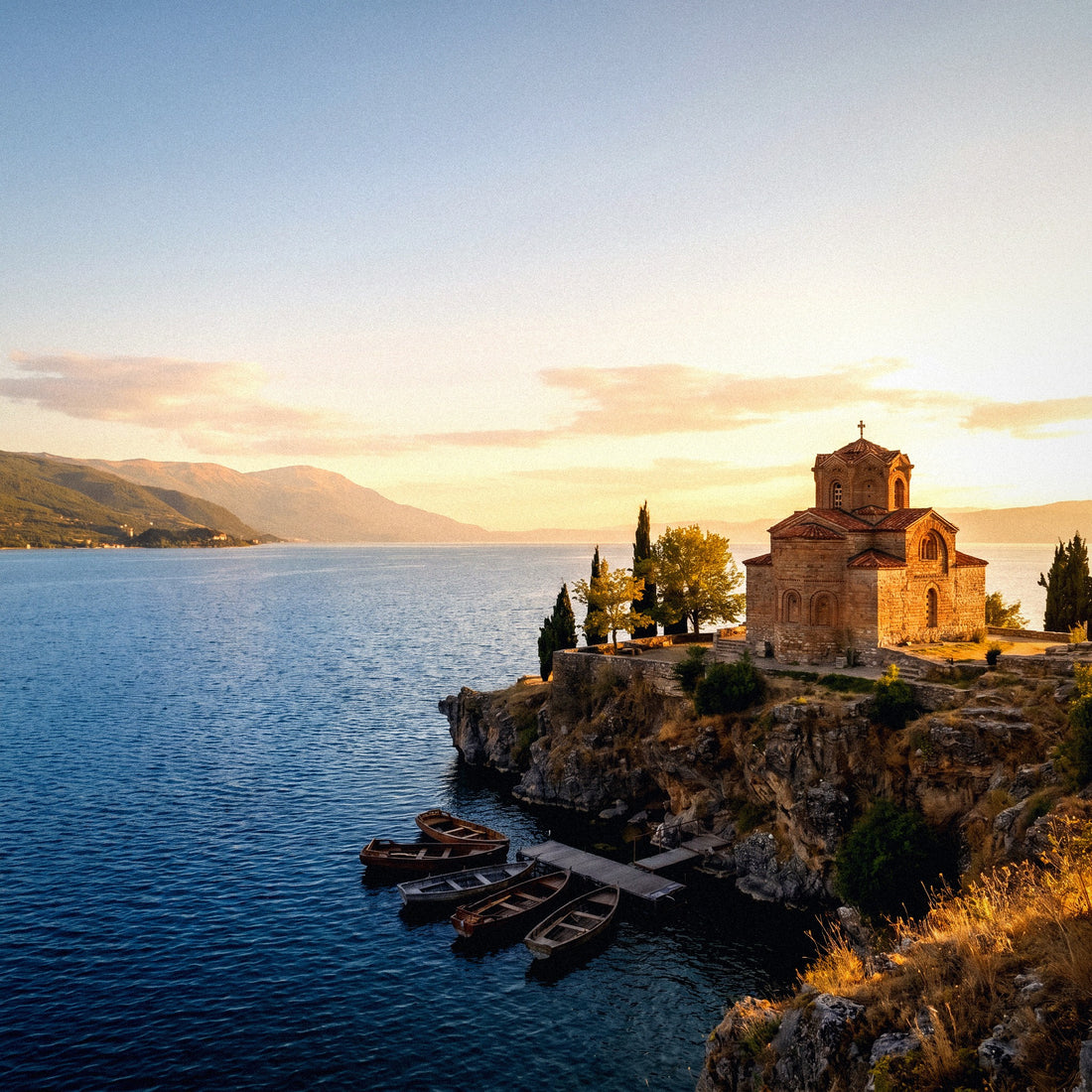
If you already know you're going to buy data and the only thing left is to decide on the package size, this guide is about that: how many GB you need for North Macedonia and not one more. I'll tell you with real consumption figures per application, with the country's peculiarities (which it has, and some save you money), and with a table by traveler profile and days. No inflated numbers: I'd rather you have three euros left over than three gigabytes.
The short answer: how many GB for North Macedonia
For a 5 to 7-day trip to North Macedonia, most people will find 3 GB sufficient: about 400-500 MB per day for maps, WhatsApp, some social media, and uploading photos of Lake Ohrid. If you work remotely or share data with family, increase to 10 GB.
That's the number I give to nine out of ten people who ask me. And I say it knowing that we sell larger packages: you don't need 20 GB for a five-day getaway, no matter how much cheaper the larger package seems per gigabyte.
North Macedonia is a moderate consumption destination for three specific reasons. First, it's a short trip: the average is around 4-7 days, or even a two-night stop within a longer Balkan itinerary. Second, hotel, apartment, and cafe Wi-Fi works reasonably well in Skopje and Ohrid, so you'll do much of your heavy downloading without touching your data. And third, much of what you'll do here—walking through Ohrid's old town, rowing through Matka Canyon, visiting a monastery—is time with your phone in your pocket.
What does change the calculation is the starting point: your Spanish plan doesn't travel with you here. If you want a general overview of how to size data for any destination, I have the main article on how much data I need for travel. Here we'll focus on the specific case.
North Macedonia is not the EU: what that changes in your calculation
This is the first thing to make clear, because it's the most expensive mistake. North Macedonia is not part of the European Union, so the European flat rate you use in Lisbon or Berlin does not apply: your operator will bill you separately, with its international roaming price or a costly daily bonus. The EU and the Western Balkans have been lowering these prices by agreement for years, and in June 2026 the Council authorized opening negotiations to extend "Roam Like at Home" to the six countries in the region, but until it's signed, you're still paying separately.
The important detail is that North Macedonia is almost never visited alone. It's crossed. And on a Balkan route, your phone jumps networks and tariffs every few hours:
| Country on the route | EU? | Your Spanish plan |
|---|---|---|
| Greece | Yes | Included (European flat rate) |
| Bulgaria | Yes | Included (European flat rate) |
| North Macedonia | No | Billed separately |
| Albania | No | Billed separately |
| Serbia | No | Billed separately |
| Kosovo | No | Billed separately |
| Montenegro | No | Billed separately |
In other words: you enter from Thessaloniki with data included, cross the border, and suddenly you're out. And if you re-enter Bulgaria, you're in again. This alternation is what wrecks bills, because your phone connects automatically and you don't even realize it. If you want the details of which option is best in each case, I break it down in internet in North Macedonia.
How much each app actually consumes
Before choosing a size, look at what the things you'll be doing consume. These are common reference figures, in ranges because they depend on quality and signal. The surprise is usually twofold: maps consume much less than people think, and video much more.
| Activity | Approximate consumption | Translated to your trip |
|---|---|---|
| Google Maps navigating (standard map) | 3-5 MB/hour (up to ~10 MB/h with live traffic and heavy zoom) | Skopje-Ohrid by car: about 10-15 MB |
| Maps in satellite or immersive view | Up to 10 MB per minute | Five minutes and you've used 50 MB |
| WhatsApp: text and photos | 5-15 MB per day | Irrelevant to the total |
| WhatsApp: voice call | 0.3-0.5 MB/min (18-30 MB/hour) | Daily 15 min call: ~7 MB |
| WhatsApp: video call | ~5 MB/min (~300 MB/hour; up to 480 MB/h in HD) | Showing the lake for 10 minutes: 50 MB |
| Instagram or Facebook, browsing feed | 100-200 MB/hour (Reels and Stories, 10-20 MB/minute) | Half an hour on the terrace: ~75 MB |
| TikTok | ~840 MB/hour (~360 MB/h with Data Saver) | The biggest data hog of all |
| Uploading photos | 3-5 MB per photo; 50-100 MB for a 1-minute video | 30 photos of Ohrid: ~120 MB |
| Music streaming | 40-70 MB/hour in normal quality; ~150 MB/h in high | 3-hour journey: ~150 MB |
| Video (YouTube, Netflix) | ~700 MB/hour at 720p; 1-3 GB/hour in HD | A movie at the hotel will eat up your package |
| Browsing, searching for restaurants, checking schedules | 10-25 MB/hour | Not much |
If you like numbers, in mobile data usage statistics by activity you'll find the longer table. The practical conclusion is just one: video rules.
How many GB according to your profile and days
This is the table you came for. Choose the row that best matches you and the column for your number of days. They are calculated assuming you'll sleep in places with Wi-Fi and with a reasonable margin, not cutting it close.
| Profile | Daily consumption | 5 days | 10 days | 15 days | 30 days |
|---|---|---|---|---|---|
| Map and WhatsApp tourist | 150-250 MB | 1-2 GB | 3 GB | 5 GB | 8 GB |
| Photos and social media (uploads all day) | 500-800 MB | 3 GB | 5-8 GB | 10 GB | 20 GB |
| Digital nomad or remote work | 1-1.5 GB | 8 GB | 15 GB | 20 GB | 50 GB or unlimited |
| Family sharing via hotspot | 1-1.5 GB | 5-8 GB | 15 GB | 20 GB | 30 GB |
A couple of honest nuances about this table. If you're in the first profile and your trip is a four-day stop on a route, 1 GB will be more than enough, and there's no need to sell you more. The remote work profile is the only one that genuinely runs short: work video calls, with screen sharing and lasting a long hour, easily consume 500-700 MB each, and there the calculation changes completely.
Family sharing is often underestimated for the opposite reason: it's not that parents consume a lot, it's that two teenagers' phones hooked to the hotspot in the car on the way to Bitola do more damage than everything else combined. If you're going to share, count one "photos and social media" phone per person and add it up.
What drives up consumption in this destination
Every country has its particular pitfalls, and North Macedonia's are quite identifiable. These are the four I see repeated most often.
- Lake Ohrid is a data-guzzling machine for uploads. It's a World Heritage site, has beaches, monasteries clinging to the water, and deceptive sunset light. People take hundreds of photos, and if automatic backup is enabled, they upload automatically to the cloud via mobile data. That's where gigabytes disappear without anyone knowing how.
- Matka Canyon by kayak and video. A one-minute video is 50-100 MB. Five videos of the canyon and a daily story, and you've already used half a gigabyte without barely looking at your phone.
- Mountain roads with the map open. Journeys to Mavrovo, Galichica, or towards Prespa are long, winding, and with the navigator running for hours. The good news: navigation costs very little (3-5 MB/hour). The bad news: if the map isn't downloaded and you lose signal, the app reconnects and reloads sections again and again.
- The Cyrillic alphabet and the camera translator. In Skopje and Ohrid, you'll see many signs in the Latin alphabet, but on village menus, bus signs, or in supermarkets, you'll have to point your camera at the translator. Each online query is a few MB, but they add up if you rely on it twenty times a day. With the Macedonian package downloaded, zero.
Add a fifth, less obvious one: searching for transportation. Bus schedules between cities are not always in a convenient app, and you end up browsing websites and groups, or asking via WhatsApp. It's small but constant consumption.
Where you won't spend: Wi-Fi and areas without coverage
Now for the part that works in your favor, and which is the main reason why the recommendation here is moderate. In Skopje and Ohrid, hotel, apartment, and cafe Wi-Fi is abundant and sufficient for heavy tasks: uploading the day's album, downloading a series, updating apps, or making a long video call home. In very budget accommodations, the speed decreases, but for messaging and photos, it works.
Mobile coverage also helps set realistic expectations. In the main cities—Skopje, Ohrid, Bitola, Tetovo—there's solid 4G, and 5G is gradually arriving, especially in the capital. In Matka Canyon, there's decent signal at the entrance and along the main path. On the Skopje-Ohrid road, including much of the mountain passes, coverage holds up well.
Where it drops is in the higher areas of Mavrovo and Galichica parks and in rural villages near the Albanian border, which drop to 3G or directly to nothing. And that, for your gigabyte calculation, is good news disguised as bad: hours without coverage mean zero consumption.
A rule I always use: only count the hours you'll be out of the hotel, with coverage and your phone in hand. On a hiking and monastery trip, that's three or four hours a day, not sixteen.
Translated: if you sleep in the city and spend the day out, your actual mobile data consumption is much lower than your normal month at home.
Calculate your real consumption before leaving home
Everything above is an average. Your exact number is in your pocket and takes two minutes to check, so do it before buying anything. It's the only piece of data in this guide that's truly yours.
- On Android: Settings → Network & internet → SIM or Data usage. You'll see mobile data consumed in the current cycle and the breakdown by application.
- On iPhone: Settings → Mobile Data. Scroll down to the app list. Be careful: this counter accumulates since you last reset it, so check the date at the bottom of the screen and, if it doesn't add up, reset it and wait a week.
With the figure from the last month, divide by 30 and you have your daily mobile data consumption. Now adjust it with two corrections. Upwards: when traveling, you spend many more hours away from a trusted Wi-Fi network, so multiply by 1.5 comfortably. Downwards: in North Macedonia, you'll return to accommodation with Wi-Fi almost every night, and hiking or kayaking hours don't count.
Between the two corrections, most people end up with a number very similar to their normal life. Multiply it by the days of your trip, round up to the next package, and you're done. That two-minute calculation is worth more than any generic table, including mine. If the result is much higher than you expected, check which app is taking the lion's share: it's almost always just one.
How to stretch your GB in North Macedonia
With four adjustments made before leaving, consumption plummets. These are the most effective here, in order of real impact.
- Download the offline map at home. In Google Maps, select the Skopje-Ohrid-Bitola area and download it with Wi-Fi. It takes up a few hundred MB that you don't pay for and covers mountain roads even if you lose signal.
- Photo backups, Wi-Fi only. This is the number one cause of unexpected charges. Google Photos and iCloud have the option just a couple of taps away, and here it matters twice as much, with the number of photos you'll take at the lake.
- Activate Data Saver for the system and for each large app. On TikTok, it drops from ~840 to ~360 MB per hour, which is almost half.
- Disable auto-play video on Instagram, Facebook, and X, and lower video quality to 480p when not on Wi-Fi.
- WhatsApp: automatic download of photos and videos only via Wi-Fi. Family groups are a silent drain.
- Download offline what you'll consume en route: music, podcasts, series, and the Macedonian language pack for the translator. Road trips are long.
- App updates only via Wi-Fi. A batch of updates can take up 1 GB at once.
With this, an average traveler easily goes from 700 MB a day to less than 300. These are ten minutes of adjustments worth more than doubling your package, and they also prepare your phone for your next trip. I have the complete list, with screenshots and examples, in tricks to save data while traveling.
If Macedonia is just one stop on your Balkan route
Many people don't travel to North Macedonia: they travel through the Balkans and spend two or three nights here. If that's your case, the gigabyte calculation is done per route, not per country, and you have to consider a little-known detail: the six Western Balkan countries have their own surcharge-free roaming agreement since 2021. This means that a local Macedonian line works at home prices in Albania, Serbia, Kosovo, Montenegro, and Bosnia... but it's useless in Greece or Bulgaria, which are EU and outside that agreement.
In other words, the trap is symmetrical and quite amusing: your Spanish line covers Greece and Bulgaria but not the non-EU Balkans; a Macedonian line covers the non-EU Balkans but not Greece or Bulgaria. If your itinerary mixes both blocks—typically: Thessaloniki, Ohrid, Skopje, Sofia—you have two reasonable paths.
- Route with most days outside the EU: look for a regional plan that covers several Balkan countries and use your Spanish plan in the EU segments. Buy gigabytes for the total days of the route, not just for Macedonia.
- Route with only two or three nights here: a small country-specific package, 1 to 3 GB, and you're good. It's not worth overcomplicating it.
Whatever the case, make sure your settings are ready before crossing the border, because your phone will connect to the Macedonian network as soon as you pass through customs and won't wait for you to decide. You can find the installation and activation details for this country in the eSIM guide for North Macedonia.
What happens if you run short (and why that's better)
Let's be clear: running short is not a disaster, and overbuying is just throwing money away. If you run out of data, the connection simply stops working —there's no surprise bill or excess charge— and you can top up in a minute from your hotel's Wi-Fi or any cafe. It takes less time to top up than to order a coffee.
On the other hand, unused gigabytes don't carry over. They are not refunded and do not accumulate for the next trip: they expire with the plan's validity. That's why my recommendation is always to buy the package that covers your estimated consumption with a small margin, and not the next one up "just in case."
If you're debating between 3 and 5 GB for a week in North Macedonia, take 3. If you run short on day six, you top up. If you have 2 GB left over, you've given them away for free.
A couple of practical things to avoid surprises. Activate consumption alerts in your phone's settings (Android and iPhone allow you to set a limit and an alert), set the alert around 70-80% of the package, and check it halfway through your trip: if you've used half after three days, you know you're cutting it close and can adjust with the tricks from the previous section before having to pay.
And consider the validity, not just the volume: a 10 GB package valid for 7 days is of little use if your trip lasts twelve. Always look at both figures together, gigabytes and days, because the one that expires first takes precedence.
Frequently Asked Questions
How many GB do I need for 7 days in North Macedonia?
3 GB is more than enough for a normal traveler. That's about 430 MB per day, sufficient for maps, messaging, social media, and uploading photos, assuming you'll sleep somewhere with Wi-Fi. If you make long video calls or share data with another phone, go for 5 GB.
Will my Spanish plan work in North Macedonia?
Not without added cost: the country is not in the EU. The European flat rate does not apply, so your operator will charge you separately for each MB or sell you a daily pass. In June 2026, negotiations to extend surcharge-free roaming to the region were authorized, but it is not yet in effect.
What if my itinerary includes Greece or Bulgaria?
Those two are in the EU and are included in your Spanish plan. The problem is the alternation: you cross in and out of the European zone multiple times, and your phone changes networks automatically. Buy data for the days you are outside the EU (North Macedonia, Albania, Serbia, Kosovo, Montenegro) and use your plan in the EU segments.
Is there good Wi-Fi in Ohrid and Skopje?
Yes, and that's why you'll need fewer gigabytes than you think. Hotels, apartments, and cafes generally offer Wi-Fi in both cities. Save photo uploads, downloads, and updates for those times, and your mobile data will last twice as long.
How much data does the GPS navigator use on mountain roads?
Very little: 3-5 MB per hour with the normal map. Navigation is not the problem. What does consume data is satellite or immersive view (up to 10 MB per minute) and constantly reconnecting in areas with poor signal. Download the offline map of the area and that consumption drops to zero.
Do I need data if I go to Matka Canyon or Mavrovo?
In Matka, you'll have decent signal at the entrance and along the main path; in the high areas of Mavrovo and Galichica, no. Have the map downloaded and send a WhatsApp message before entering. Without coverage, you don't consume anything, so don't count those hours in your calculation.
Can I buy a local SIM card at Skopje airport?
Yes, there are local operators and data is cheap, but you lose time and your number. You have to queue, identify yourself, and change the physical SIM card. I explain the digital alternative in what an eSIM is: it's activated before you leave home and you keep your Spanish line for SMS and calls.
What do I do if I run out of gigabytes halfway through my trip?
Top up, and it takes a minute. When your plan runs out, the connection is cut off without extra charges or surprises on your bill. You connect to your accommodation's Wi-Fi, add the package you need, and continue. This is preferable to buying too much out of fear.
Conclusion
To summarize bluntly: for a 4-7 day getaway in North Macedonia, 3 GB covers the vast majority; if it's a two-night stop on a route, 1 GB is plenty; and if you telecommute or share with family, aim for 10-15 GB. The two numbers that truly drive your consumption are photo backups and video: tame those, and everything else is small change.
Remember the essentials of the destination: there's no European flat rate here to save you, city Wi-Fi is your ally, the mountains will leave you without coverage (and without consumption) more than once, and downloaded maps are worth their weight in gold. With that clear, choose a small package and top up if necessary.
Once you've decided, check the data plans for North Macedonia and activate it before leaving home: you'll cross the border with internet working from the first minute, without queues or changing SIM cards.