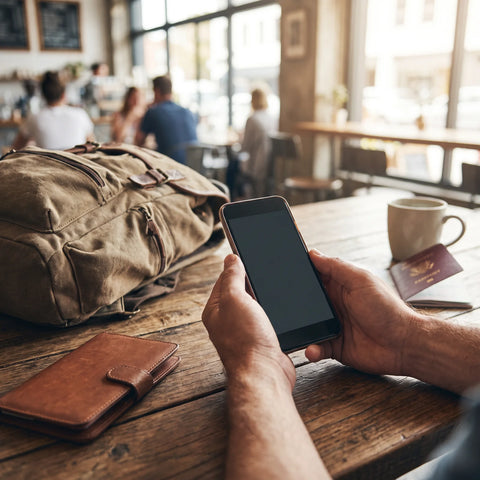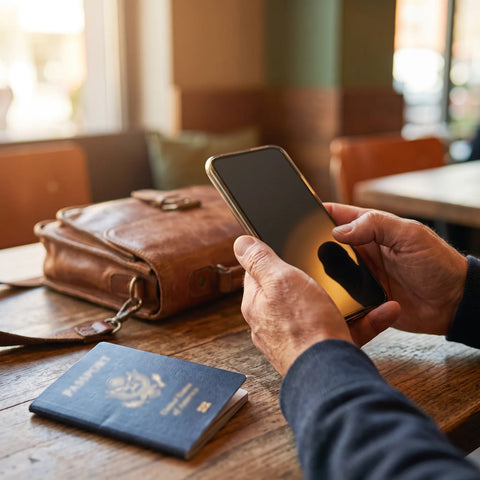
In short: the eSIM for Berlin is actually a German eSIM that you activate as soon as you land at BER airport, with no roaming or physical cards. With 3-5 GB, you'll cover a weekend of maps, subway, and social media, and the price is set before you leave home.
A three-day getaway to Berlin requires getting around by subway, finding places, and sharing your trip without worrying about the bill. An eSIM for Berlin connects you to the internet as soon as you land at BER airport, with a fixed price and no need to change cards. Here's how many GB you'll need for a city break, how it works at airports, and why a German eSIM works for Berlin and the entire country.
Is an eSIM only for Berlin?
Yes. There is no "Berlin-exclusive" eSIM: the city is covered by a German eSIM, which works the same in Berlin, Munich, or Hamburg. You buy the German plan, install it before you leave, and browse in the capital with local data. It's the right choice whether you're only visiting Berlin or continuing to other German cities.
The difference from a country guide is only the focus: on a city break, you use your phone differently, especially for transport, maps, and finding places on the go. That's why we focus on city use here. If your plan includes more of Germany, the Europe eSIM covers the entire country and its neighbors with a single plan.
And if Berlin is just one stop on a longer trip through Central Europe, consider that regional eSIM: with a single plan, you can browse in Germany and its neighbors, ideal if you're combining Berlin with Prague or Vienna. If you're still debating between a physical chip and an eSIM for that itinerary, compare the two options in international chip or eSIM.

Internet from BER Airport
You land at Berlin-Brandenburg Airport (BER) and the first thing you want to do is order transport to the city center or open your map. With the eSIM already installed, you activate the data and you have internet before leaving the terminal, without looking for airport Wi-Fi or a SIM card store. That's precisely when it's most appreciated.
BER is about 25 km from the center and connects to the city by train (S-Bahn and regional lines). To buy a ticket, check schedules, or order a taxi via an app, you need data from minute one, and that's where an eSIM ready in advance makes all the difference compared to hoping to "catch some Wi-Fi."
Airport tip: leave the eSIM installed at home and with data activated as soon as you land, with airplane mode deactivated. This way, your phone connects to the German network automatically while you wait to pick up your luggage.
The same applies to the return trip: you keep your data until check-in, so you can check your flight, boarding gate, or any delays without relying on the terminal's overcrowded Wi-Fi.
How many GB for a getaway
For a weekend getaway to Berlin, most people will find 3 to 5 GB more than enough. In the city, you mainly use your phone for maps, transport, finding restaurants, and social media, which consume little data. Video and tethering to a laptop are what drive up consumption. Here are the recommendations by profile:
| Duration | Typical Use | Recommended GB |
|---|---|---|
| 2-3 days | Maps, subway, social media, photos | 3-5 GB |
| 4-5 days | The above + some video | 5-8 GB |
| Week | Intensive use or tethering | 10 GB or more |
As you can see, for a short getaway you don't need a huge plan. If in doubt, err slightly on the high side: it's cheaper than running out of data on Sunday afternoon. To make those GB last as long as possible, here are tips for saving data while traveling.

Coverage in the city and subway
Berlin has excellent mobile coverage. You'll have 4G and 5G throughout the city, and an eSIM relies on German operators, so the signal is the same as what a local uses. In the U-Bahn (subway), coverage has improved greatly, and there's a signal in most of the network, although in a specific tunnel it might drop for a moment, like in any subway in the world.
Practical points about coverage in Berlin:
- City center and neighborhoods: 4G/5G without problems for everything.
- U-Bahn and S-Bahn: signal in most of the network; some specific tunnels without coverage.
- BER Airport and trains: continuous coverage.
- Parks and outskirts: good general signal.
In practice, on a trip to Berlin, you won't notice any significant signal drops. Downloading an offline subway map is a good habit in case your phone loses signal for a second underground, but for the rest of the trip, the connection will be more than enough.
Physical SIM with data in Berlin or eSIM: what suits you best
If, in addition to "eSIM Berlin," you've also searched for something like "SIM data Berlin," you're probably also looking at the classic option: buying a prepaid SIM card upon arrival. It exists, and Telekom, Vodafone, and o2 stores have points at Hauptbahnhof (central station) and BER airport. But for a short getaway, it has three drawbacks that an eSIM doesn't: you have to queue, activate the line by presenting your passport—sometimes a ten or fifteen-minute process—and remember to take out your Spanish SIM to insert the new one, with the risk of losing the tiny piece of plastic in your coat pocket.
The eSIM avoids all three: there's no queue because you buy and install it from home, you don't touch your phone's physical tray, and you continue to receive SMS and calls from your Spanish number while browsing with German data. The only real drawback is that you need a compatible phone and have to buy it before you leave, because once you're on the streets of Berlin, you can't scan the QR code without having some data or Wi-Fi first.
| Option | Where to get it | Time to get data | Keeps your Spanish number |
|---|---|---|---|
| Physical prepaid SIM | Telekom/Vodafone/o2 stores at Hauptbahnhof or BER | 10-20 min (queue + registration) | No, it replaces it |
| eSIM | Online, before leaving home | Instant upon landing | Yes, it remains secondary |
If your phone runs out of battery to scan the QR code or your flight arrives in the middle of the night and the airport stores are closed, a physical SIM is no longer a real option. In practice, that's why for a weekend getaway, the eSIM almost always wins.
eSIM vs roaming for a weekend
Germany is in the EU, so if your Spanish plan includes European roaming, you can use your home GBs in Berlin. The question is whether it's worth it. With EU roaming, you use your usual allowance, and if it's small, you'll run out or pay extra when it's exhausted. With an eSIM, you have GBs dedicated to your trip and a known fixed price in advance.
For a short getaway, the decision is usually this:
- EU roaming included and large allowance: it may be enough, don't buy anything.
- Small allowance or no EU roaming: the eSIM is better and avoids surprises.
- Coming from outside the EU: the eSIM is almost mandatory, roaming costs skyrocket.
If you want the details of when each one wins, we break it down in eSIM vs roaming. And if you're still doubtful about the technology, start with what a virtual eSIM is to get a clear picture before buying.
How to activate it before leaving
Installation is done in 1 minute with Wi-Fi, and it's best to have it ready at home. The goal is that when you land in Berlin, you only have to activate the data, without any hassle at the terminal. The process is straightforward:
- Buy the German eSIM and receive the QR code or automatic installation.
- Install it at home with Wi-Fi following the guide on how to install the eSIM.
- Upon landing at BER, activate the eSIM data and deactivate roaming on your main SIM.
- Check the signal and you can now order transport to the city center.
Before buying, confirm that your phone is eSIM-compatible: almost all recent iPhones and mid-to-high-end Androids are. If something doesn't connect upon arrival, Spanish-speaking support is available 24/7 to resolve it without you wasting time on your getaway.
Myths and what almost no one tells you about eSIM in Berlin
Myth: Any "European" eSIM covers Germany equally well. Not always. Some regional plans split GBs among many countries, and in high-traffic destinations like Berlin, you might notice the speed drops when sharing the network with thousands of travelers at once. If Berlin is your only destination, a specific German eSIM usually performs better than a generic regional one.
Myth: BVG (subway) Wi-Fi is available at all stations. It's only available at a handful of central stations, and to use it, you usually need to register with an email or a German number that you don't have. Don't count on it as a backup: mobile coverage underground is more reliable than that Wi-Fi.
Myth: Hotel and café Wi-Fi is always free and fast. In hostels and mid-range hotels, the network gets saturated at night when everyone connects at once. And in several cafés in Kreuzberg and Neukölln, they directly don't offer Wi-Fi to customers so that people don't spend hours working at the table. With your own data, you don't depend on either; and if you still connect to a public network, it's advisable to protect yourself with these tips for privacy and VPN while traveling.
What almost no one tells you: If you take the train to Potsdam (S7 line) to see Sanssouci Palace, you leave the city and pass through wooded areas of Grunewald where the signal weakens for a couple of minutes. Download your VBB app ticket and the route map before leaving the area with good coverage, not when you're already in the forest.
And it also needs to be said when it's not worth it: if your layover in Berlin is only a few hours in transit and you're not going to leave the airport, you probably don't need city data; the BER Wi-Fi for checking your boarding gate will suffice. Save the eSIM for when you actually hit the streets.
Frequently asked questions
Is there a specific eSIM for Berlin?
Not as such: Berlin is covered by a German eSIM, which works the same in the capital and the rest of the country. You buy the German plan, install it, and browse in Berlin with local data. It's the right choice whether you're only visiting the city or traveling to other places in Germany.
Will I have internet as soon as I land at BER airport?
Yes, if you leave the eSIM installed at home. Upon landing in Berlin-Brandenburg, you just activate the data and connect to the German network before leaving the terminal, ideal for ordering the train to the city center or opening the map without looking for airport Wi-Fi.
How many GB do I need for a weekend in Berlin?
With 3 to 5 GB, you'll have more than enough for two or three days using maps, subway, social media, and photos. If you watch videos or share your connection with a laptop, increase it to 8 GB. On a city break, data consumption is low, so you don't need a large plan.
Does the eSIM work on the Berlin subway?
There is coverage in much of the U-Bahn and S-Bahn network, so yes, it works. In some specific tunnels, the signal may drop for a moment, as in any subway. Downloading an offline subway map is a good backup, but for the rest of the trip, the connection is continuous.
Will my Spanish plan's roaming work in Berlin?
If your plan includes EU roaming, yes: Germany is a member and you would use your home GBs. The eSIM is worth it if your allowance is small, doesn't cover roaming, or you want a fixed price dedicated to your trip. If you're coming from outside the EU, the eSIM is practically essential.
Is a physical SIM with data or an eSIM better in Berlin?
For a short getaway, the eSIM almost always wins: you buy and install it before leaving home and have data as soon as you land, without queues at Telekom, Vodafone, or o2 stores at Hauptbahnhof or paperwork with your passport. Plus, you keep your Spanish number active for SMS and calls while browsing with German data.
Which phones are eSIM compatible for traveling to Berlin?
Most iPhones from the XS onwards and mid-to-high-end Androids from recent years have eSIM. Before buying, check your phone's settings to see if it has the option to add an eSIM plan; if the phone is unlocked, there shouldn't be any problem.
Conclusion
For a trip to Berlin, a German eSIM gives you internet from BER airport, excellent coverage in the city, and a fixed price without roaming surprises. With 3 to 5 GB, you'll cover a weekend of maps, subway, and photos with plenty to spare. Install the profile before leaving and land in Berlin with your phone already connected, ready to get around from the very first minute.