In short: To have Chiang Mai internet as soon as you land at Chiang Mai Airport (CNX), you need a Thailand eSIM, not a city-exclusive one: it's installed at home with Wi-Fi and activated upon landing. Urban coverage is solid in Nimmanhaemin, Tha Phae, and Doi Suthep; for mountain treks, it's advisable to download the map.
Why in Chiang Mai the right question is "internet", not "SIM"
When someone searches for "Chiang Mai internet," they usually don't want a physical card or a contract: they want to open the map, order a Grab, and let people at home know they've arrived as soon as they leave the terminal. That's exactly what a Thailand eSIM activated before flying solves. There isn't a "Chiang Mai only" product: the city is covered by the same national operators that serve Bangkok, Phuket, or Pai, so you buy the country plan and use it wherever you go.
The practical difference is in how you calculate the data, not what you buy. If your trip focuses on the north—temples, night markets, the ascent to Doi Suthep, or a getaway to Chiang Rai—you adjust the GB to those days, and that's it. If you then go down to the capital or up to Pai, you continue with the same line without touching anything on your phone.

Internet from Chiang Mai Airport (CNX)
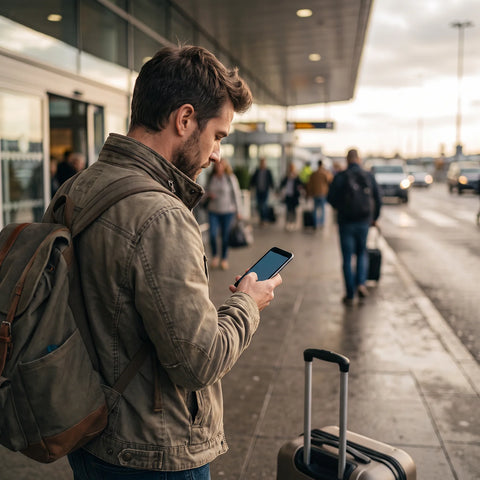
Chiang Mai International Airport (CNX) is small and located 10-15 minutes from the old city, which works in your favor: there are no long transfers where you're "blind." The beauty of an eSIM is that you install it at home, with your Wi-Fi, days before flying, and leave it dormant until you land. At that moment, you just activate the data for that line and data roaming, and in less than a minute, you have coverage.
Compare that to the classic alternative: queuing at an operator's counter inside the terminal, handing over your passport for registration, waiting for them to activate the physical card, and meanwhile, the rest of your group waiting with luggage. With an eSIM already installed, you skip that entire queue. A detail that applies to any Asian airport, not just CNX: activate data as soon as you're on the jet bridge, before reaching passport control, so your Grab is already ordered when you step out into the humid Chiang Mai heat.
Real tip: Install the eSIM at home but don't activate it until you set foot in Thailand. Most plans start counting days from the first connection to the local network, not from the moment of purchase, so activating too early is a waste of plan days.
If you've never installed an eSIM and want to see it calmly before boarding the plane, what an eSIM is provides the basic explanation without technical jargon.
Coverage in the city, at temples, and in the mountains
Within the walled city, in Nimmanhaemin (the area with cafes and co-working spaces where half the digital nomad community gathers), at the Chang Klan Night Bazaar, and in the Tha Phae Gate area, 4G/5G coverage is solid throughout the day. You won't have problems uploading photos from the Sunday market, making a video call from your hostel, or browsing while bargaining at the market.
Where you should lower your expectations is outside the urban ring. Climbing Doi Suthep, the signal holds up reasonably well almost to the top, but on trekking excursions in the Mae Wang area, at remote waterfalls, or in mountain tribal villages, coverage often drops, and in some stretches, it disappears entirely for minutes. The solution is not technological; it's common sense: download the offline map of the area the night before at your hostel, using Wi-Fi. For daily use in the city, the transfer to Chiang Rai, or the getaway to Pai via the winding road, the eSIM performs without a hitch.
A nuance that surprises those coming from other Asian destinations: in Thailand, you don't need a VPN to use WhatsApp, Google Maps, or Instagram normally, unlike neighboring countries with restrictions. If you are still concerned about privacy when connecting your banking app from a cafe's Wi-Fi in Nimman, eSIM and privacy while traveling provides criteria for when a VPN is useful and when it is unnecessary.

How many GB to get depending on your trip
Chiang Mai is usually a mid-stay stop on a longer trip through Thailand: many people dedicate between 3 and 7 days to it. To calculate GB, think about what actually consumes data: maps and messaging use little, social media a bit more, and what significantly increases consumption is video streaming and long video calls. This table is a general reference, not a fixed promise, because each usage profile is different:
| Duration | Expected use | Estimated GB |
|---|---|---|
| 3-4 day getaway | Maps, chat, social media | 2-3 GB |
| 1 week in the north | Normal use + photos | 4-6 GB |
| 2 weeks in Thailand | Intensive, some video | 8-10 GB |
| Digital nomad / remote work | Daily video calls from Nimman | 15 GB or unlimited |
If you're tight on data, Wi-Fi in Chiang Mai cafes and guesthouses is abundant and almost always free with a minimum drink purchase, so you can save it for heavy downloads and use the eSIM for getting around town. If you prefer to stretch your plan as much as possible without running out halfway through your trip, tips for saving data with an eSIM provides specific mobile settings that add up more than they seem. It's better to get a bit more than to run out: topping up data halfway through your trip is inconvenient if you don't have Wi-Fi nearby.
eSIM, physical SIM, or roaming: what's best in Chiang Mai
Before deciding, it's worth comparing the three real options you have when landing in Thailand, because not all are worth the same depending on how you travel:
| Option | Main advantage | When NOT advisable |
|---|---|---|
| Thailand eSIM | Activate before flying, no queues, your home line intact | Old phones without eSIM (check beforehand) |
| Local physical SIM | Usually offers more data for the same price | You lose your home number while it's inserted, and you have to queue and show your passport |
| Roaming from your Spanish operator | Zero configuration, same number always | Cost skyrockets outside the European Union; check the current price with your operator before activating |
If you've never fully understood the difference between roaming and data roaming and why some operators charge a fortune outside Europe while others don't, I explain it clearly in what data roaming is. And if you're debating whether to activate your Spanish company's roaming or buy a Thailand eSIM, the full comparison is in eSIM vs. roaming, with scenarios where each genuinely pays off.
A specific case where you DON'T need to buy anything: if you fly to Chiang Mai with a short layover of a few hours at a European airport and don't leave the terminal, you don't need to activate any data plan for that layover. Use it only when you reach your final destination.
Songkran, rain, and what almost no one tells you
If your trip to Chiang Mai falls in April, you're right in the middle of Songkran, the Thai New Year and the biggest water fight on the planet: the entire city, especially the moat around the old town, turns into a battle zone with water guns and buckets. Your phone is at real risk, not of coverage, but of drowning. Experienced people carry it in a waterproof case around their neck or simply leave it at the guesthouse those days and go out with minimal belongings. The eSIM itself isn't affected by water, but the device is, so plan how you'll carry it before heading out to get wet.
Another detail almost no one mentions: between June and October, during the rainy season, intense afternoon downpours can temporarily degrade the outdoor signal during the deluge, especially if you're in more open areas outside the city center. This isn't the norm, many people don't even notice it, but if you get caught in a strong storm while waiting for a Grab under a porch, don't be surprised if the map takes a few seconds longer to load.
And the most repeated myth that needs debunking: many people assume that in Southeast Asia, you need a VPN for everything, just like in China. In Thailand, this isn't the case: WhatsApp, Google, Instagram, and banking work without network restrictions. Confusing Thailand with its neighbors leads to buying extra services that you don't need for this destination.
How to activate it step-by-step
The process is practically identical on iPhones and modern Androids, and it has no hidden tricks beyond doing it calmly before traveling:
- Purchase the Thailand eSIM and receive the QR code by email, usually within minutes.
- At home with Wi-Fi, go to Settings > Mobile Data (or Connections, on Android) > Add eSIM and scan the QR.
- Label the line as "Travel" or "Thailand" to avoid confusing it with your usual line when choosing which data to use.
- Upon landing in Chiang Mai, activate mobile data for that eSIM and data roaming for that same line, not your home line.
- Wait a few seconds for it to connect to the local network; it usually takes less than a minute.
If this is your first time installing an eSIM and you prefer to see it with step-by-step screenshots instead of relying on memory at the airport, how to activate an eSIM provides the complete process explained for both operating systems. Your physical home card remains intact and still receives bank SMS, because the eSIM adds to, rather than replaces, your existing setup.
If your route continues beyond Chiang Mai
Chiang Mai is rarely a sole destination: it's often a stop on a longer route through Southeast Asia or the starting point for another country. If, after Thailand, your itinerary continues to East Asia, for example with a stop in Seoul or Busan, you'll want to check the eSIM guide for South Korea, because you'll need a different line when crossing countries.
And if your return flight to Spain has a long layover at a European airport where you'll be going into the city—Amsterdam, Frankfurt, or Rome are classics on routes to Asia—the Europe eSIM will give you data for those layover hours too, without touching your Thailand line or relying on the connection airport's Wi-Fi.
Frequently Asked Questions
How do I get internet in Chiang Mai as soon as I land?
By installing the Thailand eSIM at home, with Wi-Fi, before flying, and activating it upon landing at CNX airport. You only need to activate mobile data and data roaming for that line; in less than a minute, it connects to the local network, and you can order a Grab or open the map directly from the terminal.
Do I need a different eSIM if I go from Chiang Mai to Bangkok or Pai?
No. The Thailand eSIM covers the entire country, so the same line works in Chiang Mai, Bangkok, Chiang Rai, Pai, or the southern islands. There's no need to buy anything new or reconfigure your phone when moving within the country.
How many GB do I use on a 4-day trip to Chiang Mai?
With normal use of maps, chat, and social media, 2-3 GB are usually enough for a 3-4 day getaway. If you plan to make long video calls or watch streaming video from your phone, increase it to 4-5 GB or consider an unlimited data plan to avoid constantly checking your usage.
Is there coverage at temples, Doi Suthep, and on mountain excursions?
At the city's temples and climbing Doi Suthep, coverage is good almost all the way. On treks in areas like Mae Wang, remote waterfalls, or mountain villages, the signal may drop in sections, so it's advisable to download offline maps the night before from your hostel.
Do I need a VPN to use my phone normally in Chiang Mai?
No, unlike other countries in the region, Thailand has no restrictions that block WhatsApp, Google Maps, Instagram, or online banking. You can use a VPN if you're concerned about privacy when connecting to cafe Wi-Fi, but it's not a requirement for apps to function.
What happens to my phone during Songkran if I travel in April?
Songkran is Thailand's water festival, and your phone is at real risk of getting wet, especially near the moat of Chiang Mai's old town. The eSIM itself is not affected by water, but it's advisable to carry your device in a waterproof case or leave it stored while the street water battle lasts.
Can I use WhatsApp and share data with another phone from the eSIM?
Yes. You can browse and use WhatsApp normally, and on most phones, you can share the connection via hotspot with a tablet or your companion's phone. Sharing data consumes from the same plan, so if you plan to do so, factor in a few extra GB of margin.
Conclusion
To have internet in Chiang Mai, the formula remains the same: buy a Thailand eSIM, install it at home with Wi-Fi, and activate it upon landing at CNX. You'll have coverage directly from the terminal, plenty of signal in the city, in Nimmanhaemin, and at the temples, and sufficient margin on most mountain excursions if you download an offline map before heading out. Budget 2-3 GB for a short getaway or 4-6 GB for a week, get your eSIM ready before takeoff, and be connected as soon as you step off the plane, with no queues or surprises.