In short: an eSIM for Delhi gives you internet as soon as you land at Indira Gandhi Airport, without queues or Indian SIM paperwork (passport, visa, photo, hours of verification). It’s installed before you fly, activated on your mobile when you arrive, and also covers Agra, Jaipur, or the rest of India, because it’s not a city eSIM: it’s for the whole country.
Does an eSIM work in Delhi?
Yes, and very well. An eSIM for Delhi connects to Indian operators like Airtel or Jio as soon as you land at Indira Gandhi Airport (DEL), with good 4G speed throughout the city. You install it before leaving home by scanning a QR code, and it works without needing a store or a physical card to lose along the way.
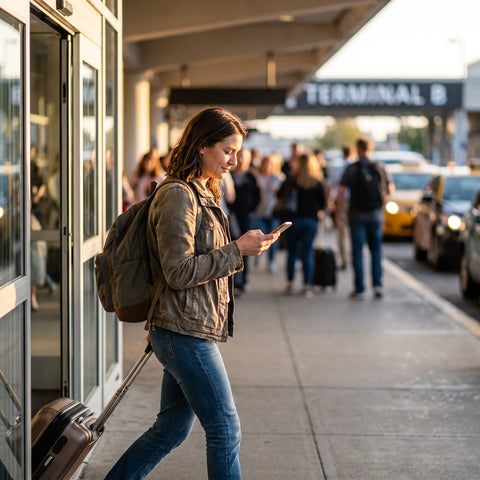
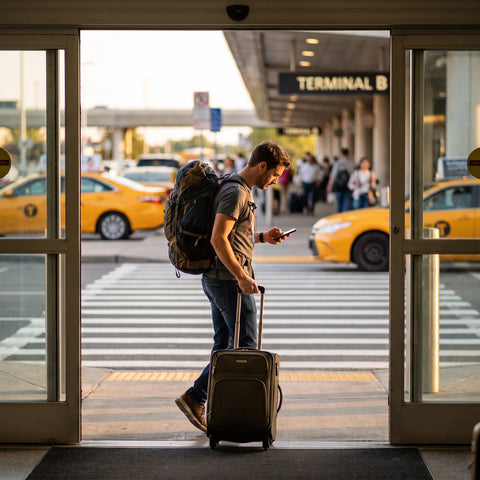
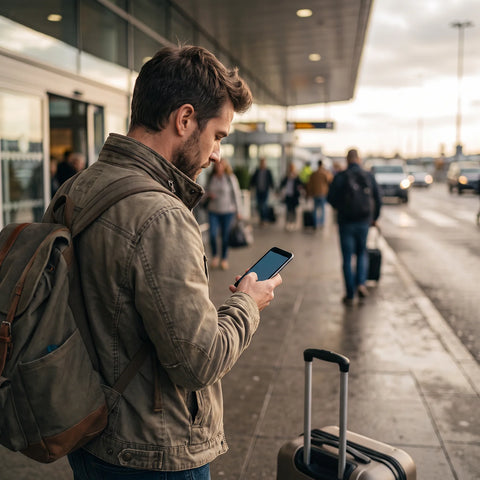
India is one of those destinations where having data from the first second changes the entire trip. When you leave the terminal, taxis will be offered everywhere — they will literally stop you as you walk towards the exit — and being able to open the Uber or Ola app with a fixed fare avoids the classic haggling and some of the scams that are already a tradition in the arrivals area. With an eSIM, you arrive connected and in control from minute one. You only need an eSIM-compatible phone, which is standard on models from recent years, although it’s advisable to check before buying anything.

The Indian SIM paperwork you save
Buying a prepaid SIM in India is a bit of an ordeal. They ask for your passport, visa, a passport-sized photo and sometimes a local address, you fill out a paper form or on a counter tablet, and the card can take hours — or even a whole day — to activate due to the verification process required by the Indian regulator. All of that, freshly landed, with jet lag and with the only real priority of getting to your hotel.
The eSIM skips that entire process. You buy it online, activate it in a minute, and you don't depend on finding an official store or whether an airport counter is open at your arrival time, which is not guaranteed if your flight lands in the early morning, which is common for many flights from Europe. It's the difference between starting your trip relaxed or losing your first morning to errands. To ensure your phone supports it, check how to install an eSIM step by step beforehand.
Traveler tip: in Delhi, always use taxi apps with a fixed price (Uber, Ola) instead of negotiating on the street. With the eSIM working from the airport, you'll see the fare and avoid surprises when you arrive at the hotel.
Coverage in Delhi and the airport
Delhi has solid mobile coverage. At the airport, in the Connaught Place area, on the metro (one of Asia's most modern, with air conditioning and English signage), or in bustling Chandni Chowk, you'll have plenty of 4G for Maps, translator, and social media. The Airtel and Jio networks cover the entire capital well.
Where the signal weakens, and almost no one tells you this, is in the narrowest alleys of Chandni Chowk and the old city, where tall, tightly packed buildings block the signal, and inside enclosures like the Red Fort or some temples with thick stone walls. Nothing serious: you walk twenty meters to a wider street and regain coverage. A practical detail that is worth knowing beforehand: public WiFi in India (airports, shopping centers, some cafes) usually requires an Indian mobile number for SMS registration, so without a local SIM, you won't always be able to connect to these free networks. That's why an eSIM with its own data gives you real autonomy to move around Delhi without depending on anyone or any external WiFi. If you are going to connect the subcontinent with other surrounding countries, keep in mind that you will need a different eSIM for each country, because Asian regional plans do not always include India.
GB for your getaway
Typical consumption in Delhi combines maps, taxi apps, translator, messaging, and social media. For a few days' getaway, most travelers are comfortable with between 3 and 6 GB. If you are going to share the connection with someone, make video calls, or upload many photos and videos to social media, upgrade your plan.
| Trip type | Duration | Approx. GB |
|---|---|---|
| Layover or short stop | 2-3 days | 3 GB |
| Delhi + Golden Triangle | 5-7 days | 6 GB |
| Long trip through India | 2 weeks or more | 10 GB or unlimited |
A money-saving trick that almost everyone forgets: download maps of Delhi and Agra in Google Maps from your hotel's WiFi the night before, and only use your mobile connection for what really matters outside, like confirming the exact location or real-time traffic. Another less obvious trick: disable automatic app updates and background photo backups before leaving the hotel, because in India it's easy for your phone to connect to low-quality open WiFi networks and then continue consuming data without you realizing it when you go out into the street.
From Delhi to Agra and the Golden Triangle
Almost no one goes only to Delhi. The capital is the gateway to the famous Golden Triangle with Agra (the Taj Mahal) and Jaipur, and many continue to Goa, Varanasi, or Rishikesh. Here, an important clarification for your data plan is needed, because it's the most repeated doubt travelers have before buying.
For mobile network purposes, India is a single country, so the eSIM you use in Delhi works exactly the same in Agra, Jaipur, or the rest of the country. You don't buy an eSIM per city, but for all of India. On road and train journeys, coverage varies in sections — there are rural areas between Delhi and Agra where 4G drops to 3G for a few minutes — but in tourist stops and cities, there is usually good signal. The only thing you adjust is how many GB and days you contract depending on how long your circuit is, with the same Indian eSIM. If your trip extends longer than expected, always check how to save data on your travel eSIM so that the plan lasts until the last day without being cut off just before returning.
How to activate it and avoid scares
Installing the eSIM takes about a minute and is best done with WiFi at home before flying. The usual sequence is: you buy the plan, receive the QR by email, scan it in your phone's settings, and activate data roaming for that line when you land in Delhi.
- Install the QR in your home country and leave data roaming off until you land, to avoid using up the plan prematurely.
- Upon arrival in Delhi, turn on data roaming for the eSIM and wait a few seconds for it to connect to the nearest airport tower.
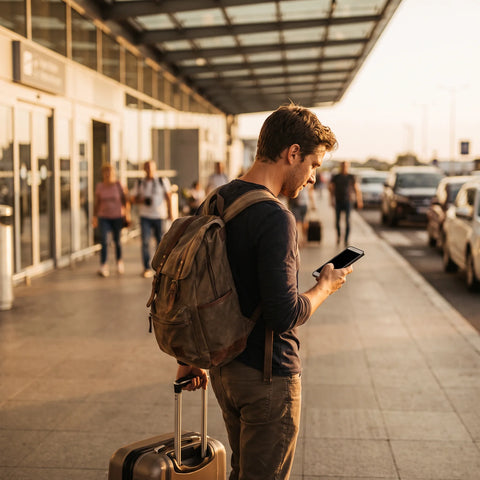
- Check that you have internet before leaving the terminal, to order a fixed-fare taxi from inside, not on the street surrounded by drivers.
- Keep your home country SIM without roaming to avoid an international roaming bill when you return home.
If this is your first eSIM, the detailed process is in how to install an eSIM. And if you're wondering whether to pay for your home provider's roaming, the eSIM vs. roaming comparison makes it clear why an eSIM is much more cost-effective in India: roaming outside the European Union significantly increases the cost per megabyte, so check the current price with your operator before relying on it.
Myths and what almost no one tells you
There are a few ideas circulating about India and eSIMs that should be debunked before traveling, as they cause unnecessary last-minute doubts.
Myth: "in India, you absolutely must have a local SIM or nothing works." False. A data eSIM works exactly like any local SIM for browsing, using Maps, or WhatsApp. The only difference is that a local SIM also gives you an Indian phone number, which most short-stay travelers don't need at all.
Myth: "if my phone says it's eSIM compatible in my home country, it will work with any eSIM from any provider." Not exactly: compatibility depends on the model and sometimes also on whether the phone comes factory unlocked or is tied to a specific carrier that blocks the feature. It's best to check before paying, not when you arrive at the airport.
What almost no one tells you: in Delhi, if your flight lands in the early morning (very common when arriving from Europe, with flights touching down between 1 and 5 AM), the airport is quiet, but outside, in the pickup area, the crowd of drivers can be intense even at those hours. Having your eSIM active before crossing the automatic exit doors allows you to confirm the exact pickup area for your Uber or Ola without having to ask or rely on airport WiFi, which sometimes requires registration with an Indian number.
Another less obvious detail: some Indian payment and banking apps (not those you'll use as a tourist, but those used by local businesses) rely on SMS verification with an Indian number, so don't expect to be able to register yourself for local services like food delivery apps without a physical Indian SIM. For what a traveler needs — Maps, taxi, messaging, translator, social media — the eSIM covers plenty; for integrating as a resident, it doesn't.
And when NOT to buy an extra eSIM: if you're only making a technical layover of a few hours at Delhi airport without leaving the international zone, you don't need to buy anything: the terminal's WiFi, though limited, is usually enough for a short layover. Save the expense for when you're actually going to step into the city.
Purchased eSIM vs Indian SIM: comparison
| Aspect | Travel eSIM | Local Indian SIM |
|---|---|---|
| Documentation | None, bought online | Passport, visa, photo, form |
| Activation time | Minutes, before or upon landing | Hours or up to a day for verification |
| Indian phone number | Not included | Included |
| Requires physical store | No | Yes, with limited hours |
| Geographical coverage | All of India with the same plan | All of India (depending on operator) |
Frequently asked questions
Do I need a visa or passport to activate an eSIM in India?
No. The local Indian SIM requires a passport, visa, photo, and sometimes hours of waiting to activate. The travel eSIM activates online without any paperwork: you buy the plan, scan the QR, and arrive in Delhi with internet ready, no queues or forms.
Does the eSIM work as soon as I leave Delhi airport?
Yes. As soon as you turn on data roaming for the eSIM at Indira Gandhi Airport, it connects to a signal in seconds. This allows you to order an Uber or Ola with a fixed fare from the terminal and avoid haggling with taxis outside.
Can I use WhatsApp and Maps normally in India?
Yes. India does not block WhatsApp, Google Maps, or common social media, so they work completely normally using a data eSIM. You don't need a VPN like in China: you just need a connection to move around, translate, and stay in touch.
How many GB do I need for a few days in Delhi?
For a two or three-day getaway with maps, taxi apps, a translator, and some social media, 3 GB is usually sufficient. If you add Agra and Jaipur to a week-long itinerary, estimate around 6 GB, and for longer trips, choose 10 GB or an unlimited plan.
Does the Delhi eSIM also work for Agra and Jaipur?
Yes. You don't buy an eSIM per city, but for all of India, and that covers Delhi, Agra, Jaipur, and the rest of the country with the same network. Just make sure you contract enough GB and days for your entire Golden Triangle tour.
Is there internet in India or is coverage poor outside cities?
In large cities and tourist spots, there's plenty of internet with 4G. Coverage is weaker in rural areas between long road trips and inside some buildings with thick walls, but as soon as you step onto an open street or reach the next town, the signal returns. It's not a country where you'll be left incommunicado.
Can I keep my Spanish SIM active while using the eSIM in India?
Yes, and it is recommended to avoid roaming charges. Keep your Spanish line with data roaming off and use the Indian eSIM as your primary data line during the trip; for emergency calls or SMS, your Spanish line remains registered on the network even if it does not consume data.
Conclusion
In Delhi, arriving with working data makes the difference between starting your trip with control or with stress. You save yourself the paperwork of an Indian SIM, order a fixed-fare taxi, and navigate with Maps right from the terminal. Have your eSIM for India ready before takeoff and dedicate your energy to what truly matters: the Taj Mahal, the street food of Chandni Chowk, and the wonderful chaos of the city. If your itinerary takes you to other continents after Delhi, also check out our eSIM guide for South Korea or, if your trip begins in Europe before flying to Asia, the eSIM for Europe covers the initial leg without changing data profiles.