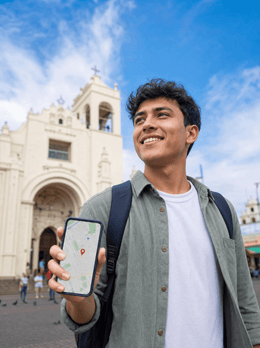
El Salvador is no longer just a transit country between Guatemala and Nicaragua: it boasts world-renowned surf beaches like El Tunco and El Zonte, the Ruta de las Flores (Flower Route) winding through coffee plantations and volcanoes, and a capital city that has transformed in just a few years. To navigate with a map, pay with your phone, or check the surf report before grabbing your board, you need data from day one. An eSIM for El Salvador connects you as soon as you land in San Salvador without incurring roaming charges from your Spanish carrier or wasting your first afternoon searching for a mobile store.
In summary: an eSIM for El Salvador is installed before you leave Spain and activates automatically upon landing in San Salvador, connecting you to Claro, Tigo, or Movistar networks without roaming or needing to swap out a physical SIM card. For a one or two-week trip, 5 to 10 GB is usually sufficient if you download offline maps of the coast and the Ruta de las Flores before you start moving.
What an eSIM is and how it works in El Salvador
An eSIM is a digital profile that replaces a physical card: it's downloaded via Wi-Fi before you fly, and your phone treats it like any other line, without a tray or a pin to remove with a paperclip. If you've never used one, you should first read what an eSIM is exactly before buying a plan, because while it's not much different from what you already know, it's good to know what to expect.
In El Salvador, it works the same as any other destination: you install the profile at home, calmly and with Wi-Fi, and upon landing at Comalapa Airport (SAL), you activate data roaming only on that line. Within seconds, your phone connects to the local network, and you have internet before even clearing immigration.
The only truly important thing to check before buying is that your phone supports eSIM and is unlocked. Most recent iPhones, Pixels, and mid-to-high-end Samsung phones have it as standard, but if you bought yours on installments with a carrier, check that it doesn't have a network lock before paying for the plan: this is the most common reason why someone can't activate their profile on the first day.

Coverage by operator: Claro, Tigo, Movistar, and Digicel
El Salvador is a small country, which works in your favor: mobile coverage is among the most consistent in Central America. The main operators are Claro, Tigo, and Movistar, along with Digicel in some areas, offering solid 4G LTE in San Salvador, Santa Ana, San Miguel, and the entire tourist coastal strip. The eSIM relies on these networks and automatically selects the one with the best signal at each point, so you don't choose an operator or make any manual adjustments.
On the surf coast—El Tunco, El Zonte, Sunzal—you'll have a stable signal in town, in hostels, and at most surf spots, although on some beaches further west, towards Mizata or Punta Mango, coverage becomes intermittent depending on the hillside. Along the Ruta de las Flores, the urban centers of Juayúa, Ataco, and Apaneca have good service, but between towns, on mountain curves, it's normal to lose some speed. In national parks and on the ascent to Santa Ana volcano or Cerro Verde, the signal may disappear in specific sections of the trail.
| Area | Coverage | Recommended use |
|---|---|---|
| San Salvador and airport | Excellent 4G | Everything, including video calls |
| Surf coast (El Tunco, El Zonte, Sunzal) | Good 4G in town | Maps, social media, surf reports |
| Ruta de las Flores (Juayúa, Ataco, Apaneca) | Good 4G in urban centers | Messaging and navigation |
| Santa Ana Volcano and Cerro Verde | Irregular on the trail | Download map before climbing |
| Suchitoto and northern area | Acceptable in town, weak on the road | Basic messaging |
eSIM vs. roaming and local physical SIM
Traveling from Spain, El Salvador is outside the European Union, so roaming with your usual plan is no longer free, and the price can skyrocket depending on your carrier and the plan you have. If you don't know exactly what you'll be charged, the smartest thing is to check directly with your carrier before you leave; amounts vary from one rate to another and from month to month, so any figure you read online may not apply to you. To understand why this happens, you can find the technical explanation in what data roaming is.
The other classic alternative is to buy a local physical SIM card as soon as you land. It works, but it comes with real friction: you have to find an open store, wait in line, register your data with your passport—in El Salvador, as in the rest of Central America, SIM registration with ID is mandatory—and lose the number you had during your trip, which makes it difficult for your bank or WhatsApp to recognize you. If you want to compare the pros and cons of each option in depth, you can find it in international chip vs. eSIM.
The eSIM solves both problems at once: activation in minutes without leaving your hotel, and your Spanish line remains active on your phone for banking and verification SMS, while data runs on the Salvadoran profile. You can see the full comparison, with its numbers and nuances, in eSIM vs. roaming.
Practical tip: with the eSIM already installed from home, you leave San Salvador airport with active data and can order a transfer or taxi without looking for Wi-Fi or queuing at any counter.

How many GB you need based on your itinerary
El Salvador is quick to traverse in terms of distances—you can cross almost the entire country in a day by car—but many travelers end up extending their stay along the coast. For one or two weeks with maps, messaging, social media, and uploading surf videos, between 5 and 10 GB is usually more than enough. If you work remotely, make long video calls, or are still in digital nomad mode, it's better to estimate on the higher side from the beginning rather than running out halfway through your trip.
A quick guide based on your travel profile:
- Short getaway (4-5 days): 3 GB covers the essentials: maps, WhatsApp, and social media without stress.
- One-week trip along the coast and the Ruta de las Flores: 5 GB provides enough for photos, daily navigation, and even some live streams from the beach.
- Two weeks or long stay with remote work: Increase to 10 GB or more if you plan to make video calls regularly.
Data consumption skyrockets more than people realize when uploading videos to social media from the beach with good coverage: it's easy to spend in one afternoon what you planned for three days. Downloading offline maps of San Salvador, the coast, and the Ruta de las Flores beforehand saves a significant portion of daily consumption, especially on road sections between towns where the signal fluctuates. If you want to make the most of every GB, you can find specific tips on how to save data while traveling.
Security and connectivity for worry-free travel
The perception of safety in El Salvador has changed significantly in recent years, and the country is receiving increasing tourism, particularly for surfing and nature. Nevertheless, it's advisable to gather information before departing: review the travel recommendations from the Ministry of Foreign Affairs and confirm the current entry requirements for Spanish citizens, as these may be updated.
Being connected from the first moment adds real peace of mind, not just convenience: you can share your real-time location with your travel companions or those at home, check timely alerts, and navigate with maps without relying on finding Wi-Fi at every stop. Some practical notes:
- Download offline maps for your routes before leaving the hotel; on the coast and in mountainous areas, they'll save you from more than one tight spot when the signal fails just at the turn you needed.
- Coordinate transfers and accommodation bookings via WhatsApp with your eSIM active: this is the channel most hostels and local surf guides use to confirm last-minute schedules.
- If you use public Wi-Fi in cafes or accommodations, consider an extra layer of privacy for your banking data; we explain this in detail in eSIM and VPN for private travel.
- If your route links El Salvador with another leg of your journey—for example, a layover in Europe before returning home—consider arranging that connection in advance as well: here's the plan for eSIM Europe.
With your connection sorted before you leave, the focus returns to where it should be: the waves and volcanoes, not whether you'll have coverage.
What almost no one tells you before traveling connected
There are a few details that aren't in generic guides and make a difference on the first day:
- El Salvador has used the US dollar as its official currency since 2001, and since 2021, Bitcoin also has legal tender status. This doesn't affect your connection, but it does matter for your payment and exchange apps: you don't need to mentally convert currency throughout your trip, a detail that surprises those coming from other countries in the region.
- A local physical SIM requires ID registration, which is common in Central America but many travelers don't expect: if you want to avoid queues and paperwork on the first day, this is exactly what an eSIM saves you completely.
- On public buses between San Salvador and the coast, the signal comes and goes depending on the section of the Pan-American Highway; if you're taking this journey, have your stop's map downloaded beforehand instead of relying on the signal lasting the entire trip.
- During the rainy season (May to October), heavy afternoon storms can degrade the signal for a few minutes in rural areas; this isn't an eSIM failure, but weather affecting the nearest tower, and it recovers on its own.
- Not everyone needs to buy data for El Salvador. If your trip is a two-day layover on the way to another destination and your hotel has decent Wi-Fi, it might be more worthwhile to wait and activate the eSIM only when the part of your trip begins where you'll truly be moving around independently.
How to activate your eSIM step-by-step
Activating an eSIM doesn't require any technical knowledge or prior experience. It's recommended to install the profile at home with Wi-Fi, before packing your bags, and leave data activation for when you land in San Salvador.
- Purchase the eSIM and receive the QR code instantly via email.
- At home with Wi-Fi, scan it from your phone's settings; if it's your first time, follow the step-by-step guide on how to install an eSIM.
- Configure the eSIM as your data line and leave your Spanish SIM active only for calls and SMS.
- Upon landing, activate data roaming only on the eSIM, not on your Spanish line.
- Check that your phone displays Claro, Tigo, or Movistar in the status bar, and you'll have internet.
If anything doesn't go right during installation, support is available in Spanish throughout your trip to resolve it without complicating your first day.
Frequently asked questions
Is it safe to travel to El Salvador from Spain?
The perception of safety has improved significantly in recent years, and tourism, especially for surfing and nature, continues to grow. Still, it's advisable to check the updated recommendations from the Ministry of Foreign Affairs before departing, travel with common sense, and stay connected to check for alerts or share your location in real-time if you're traveling alone.
What carriers does the eSIM use in El Salvador?
The eSIM relies on the local networks of Claro, Tigo, or Movistar, and in some areas also Digicel, automatically choosing the one with the best signal at each point. You don't have to select a carrier or configure anything manually: your phone connects automatically to the available network based on your location.
How many GB do I need for a week in El Salvador?
5 GB will comfortably cover a week with maps, messaging, social media, and some surf videos. If you work remotely or make long video calls, it's better to upgrade to 10 GB. Downloading offline maps of the coast and San Salvador significantly reduces consumption during trips along the Ruta de las Flores.
Can I keep my Spanish number with an active eSIM?
Yes. The eSIM functions as a second data line, so your Spanish SIM remains active on the same phone to receive bank SMS or important calls. Video calls and messages are made via WhatsApp or FaceTime using the eSIM's data, without incurring roaming charges from your home plan.
Do I need an eSIM if I'm only in El Salvador for a couple of days layover?
Not necessarily. If your stay is very short and you'll be at the hotel or airport with Wi-Fi most of the time, it might be more worthwhile to wait and activate the eSIM only when the part of your trip begins where you'll be moving around more independently, so you don't waste plan days without using them.
Does the eSIM work on Santa Ana volcano or in rural areas of the Ruta de las Flores?
In the urban centers along the route, coverage is good, but on mountain trail sections, like the ascent to Santa Ana volcano, the signal might disappear at specific points. Download an offline map of the route before climbing; it's the habit that will save you the most trouble in that type of terrain.
What if my phone doesn't support eSIM?
If your phone is not compatible or is locked by a carrier, you won't be able to install the digital profile and will have to resort to a local physical SIM, with the associated ID registration and number change. It's advisable to check this before purchasing the plan, not upon arrival at the airport.
Conclusion
El Salvador is best enjoyed when connected: real-time surf reports, maps of the Ruta de las Flores loaded before leaving the hotel, and transfers coordinated via WhatsApp without relying on random Wi-Fi. An eSIM gives you data from the moment you land in San Salvador, keeps your Spanish number intact for banking, and saves you from roaming charges whose price you never know until the bill arrives. Install it before you fly and land in the land of surf with internet from the very first minute, not from the first open store you find.