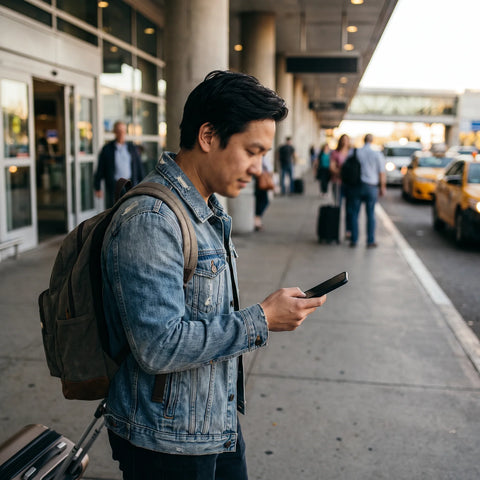
In short: an eSIM for Stockholm gives you 4G/5G data from Arlanda Airport without roaming or having to find a store. For a 3 to 5-day getaway, 3-5 GB is plenty, and since Sweden is in the EU, a European eSIM will also work. Activate it before you fly and land already connected.
If you're planning a trip to the Swedish capital, an eSIM for Stockholm will keep you connected as soon as you land at Arlanda, without having to find a store or change SIM cards. The city has excellent 4G/5G coverage, so the challenge here isn't the signal, but arriving with data and calculating the right amount of GB for a city break. We'll tell you how to do it and how it differs from a plan for all of Sweden.
Do I need an eSIM for Stockholm?
Yes, if you want to use maps, public transport, and translations without relying on WiFi. Sweden is part of the European Economic Area, so a European eSIM works in Stockholm with the same rates as in the rest of the EU. It gives you instant data, without queues and with Spanish-speaking support if something goes wrong.
If your Spanish plan includes roaming in the EU at no extra cost — which is common in most current plans due to European data roaming regulations — your operator already covers you in Stockholm and you don't need to buy anything. An eSIM makes sense in other cases: if your plan has little data allowance outside of Spain, if your plan does charge extra for roaming, or if you simply prefer to save your Spanish data for important things and not risk running out of it halfway through your trip. Purchasing it in advance prevents any surprises on your bill when you return. Moreover, Stockholm is a very digital city: public transport, many museums, and even small shops operate with apps or mobile payments, so being connected is not a luxury, it's practical.

Internet from Arlanda Airport
Most travelers arrive at Stockholm-Arlanda airport, about 40 km from the city center. The airport has free WiFi, but it's slow and requires registration, just when you need data the most: to book the Arlanda Express, order a taxi, or open the map to your hotel. With an already activated eSIM, you switch off airplane mode and have 4G as soon as you step into the terminal.
Practical tip: the Arlanda Express train reaches the city center in about 20 minutes. With data from minute one, you can buy the ticket on the app while walking through the terminal and avoid wasting time at machines or queues.
Here's what you gain by arriving connected to Arlanda:
- Book transport to the city center without looking for WiFi.
- Share your arrival with whoever is waiting for you.
- Have Google Maps active from the moment you leave the plane.
- Access your hotel reservation and online check-in.
All of this also applies if you fly to Bromma Airport, which is smaller and closer to the city center. The eSIM works the same at both.
Coverage in Stockholm's neighborhoods
Stockholm is built on 14 islands, and even so, mobile coverage is among the best in Europe. You'll have stable 4G and 5G throughout the city: in the old town of Gamla Stan, in the museums of Djurgården, in Södermalm, and in Östermalm. Swedish networks are highly developed, and the signal rarely drops, even on the subway.
Classic tourist spots (the Royal Palace, the Vasa Museum, the City Hall) have plenty of signal. The only reasonable precaution is that, if you take a boat trip through the archipelago, coverage may weaken offshore between islands, which is normal and no eSIM can solve. For the rest of the city, forget about it: you'll always be connected. If your trip continues north or into the Swedish wilderness, keep in mind that the archipelago and more rural areas lose coverage before the city center; there's no eSIM that will help there, so download offline maps in advance.

How many GB for a city break
A city break consumes less data than people think, because you sleep in a hotel (with WiFi) and use your phone mainly for maps, messaging, and photos. For a weekend or four days in Stockholm, 3 GB is usually plenty; for a week, 5 GB provides a comfortable margin.
| Duration | Recommended GB | Covered usage |
|---|---|---|
| Weekend | 3 GB | Maps, social media, messaging |
| 4-5 days | 5 GB | Previous + photos and some video |
| 1 long week | 5-8 GB | Intensive use without relying on WiFi |
The usual trick: rely on hotel WiFi to download offline maps and upload photos at night, and save your eSIM data for when you're out and about. This way, even 3 GB can stretch further. If you want to squeeze every GB, you'll find specific tips in our guide on how to save data with an eSIM while traveling, useful if you extend your trip or are on a very tight plan.
City or country: which eSIM to choose
There's an important nuance here. There are no exclusive "Stockholm only" plans: what you buy is a Sweden eSIM (or a European one) which, of course, works in the capital and throughout the country. The difference compared to looking for "Stockholm eSIM" is only in focus: the plan covers much more than your getaway needs, and that works in your favor.
Choose according to your itinerary. If you're only going to Stockholm and not leaving Sweden, a local plan is the direct option; if you prefer not to complicate things by searching for the exact country, a European eSIM covers Sweden just as well and serves as a wildcard for the rest of the continent. If you also jump to Gothenburg, Malmö, or cross into Norway or Finland on the same Nordic route, then it definitely pays to go straight for the European option instead of buying a new plan every time you cross a border.
Simple rule: for a single city or country trip, use an eSIM for that country. For a route through several nearby countries, use a regional eSIM. This way you won't overpay or run out of coverage when crossing a border.
How to activate your eSIM before flying
The best thing about eSIMs is that you can get them ready at home and land connected. The process takes 1 minute: you buy the plan, receive a QR code by email, scan it from your phone's settings, and choose when to activate it. Many plans start counting when connected to a Swedish network, so you can prepare it days in advance without spending data.
Before you go, confirm that your phone is eSIM compatible (most recent ones are) and have the QR code handy. You can find the complete step-by-step guide in how to install an eSIM. When you land at Arlanda, all you'll have to do is:
- Turn off airplane mode.
- Activate data roaming on the eSIM line (normal and necessary for travel eSIMs).
- Leave your Spanish SIM on "calls only" to avoid spending data on roaming.
And that's it: Swedish data from the moment you step off the plane, with your Spanish number intact for important calls.
Myths about eSIM in Stockholm (and what almost no one tells you)
"I'd better carry a physical spare SIM, just in case." This is the first idea that occurs to many people, and in Stockholm it fails just when you need it most: if your flight from Spain lands at Arlanda late in the evening, the airport operator counters are usually closed, and you're left without a plan B until the next day. With an eSIM, that problem doesn't exist because you don't depend on any store's opening hours; we compare it in more detail in physical chip vs. eSIM.
"The free WiFi at the hotel or a café is enough for me." It's enough for the basics, but in very touristy areas like Drottninggatan or the T-Centralen central station itself, open networks are an easy target for anyone who wants to snoop on your traffic: this is not exclusive to Stockholm, it happens in any European capital, but it's good to know. If you're going to do sensitive transactions (banking, work) from a public network, add an extra layer of security; in eSIM and VPN for traveling with privacy we explain how to combine it without complicating things.
"The more expensive the plan, the better the coverage." Not necessarily: in a city with such a developed network as Stockholm, price doesn't buy more signal, it buys more GB. You'll have 4G/5G everywhere with a small plan as much as with a large one; the only thing that changes is how much you can use without running out. Review the real difference between operator roaming and travel eSIM in eSIM vs. traditional roaming before deciding which one suits you.
What almost no one tells you: many museums and also Stockholm's public transport have their own app, and buying tickets within it is usually as good or better than at the physical machine on the platform, but the app takes a moment to validate the account the first time you open it with Swedish data. Register at the airport or on the train to the city center, not at the moment you get on the bus, so you don't get stuck in front of the turnstile with the bus waiting.
Frequently asked questions
Does a European eSIM work in Stockholm?
Yes. Sweden belongs to the European Economic Area, so a European eSIM works in Stockholm and throughout the country with the same rate as in the rest of the EU. You can also choose a specific Sweden eSIM if your trip is limited to this destination.
Do I have internet as soon as I land at Arlanda?
Yes, if you activate the eSIM before flying. When you arrive at Arlanda, you just turn off airplane mode and you'll already have 4G, without having to use the slow airport WiFi. This way, you can book the Arlanda Express or a taxi to the city center right from the terminal, without queues or registrations.
How many GB do I need for a weekend in Stockholm?
For a weekend, about 3 GB is plenty if you use the hotel's WiFi at night for downloads and photos. If you're staying four or five days or use a lot of video, increase to 5 GB to have some leeway and not depend on WiFi during the day.
Is there good mobile coverage throughout the city?
Excellent. Stockholm has very stable 4G and 5G throughout all neighborhoods, including the subway and tourist areas like Gamla Stan or Djurgården. The only signal that might falter is on boat trips offshore through the archipelago, which is normal between islands.
Can I use the same eSIM if I travel to Norway or Finland afterwards?
It depends on the plan. A local plan only covers Sweden, but a European eSIM also works in Norway, Finland, and neighboring countries without changing cards. If your route covers several countries, choose a broader regional plan to avoid having to activate a new one at each border.
Can I share my eSIM data with another device in Stockholm?
Yes, hotspot or tethering works just like with any SIM: you activate it from your phone's settings and share your Swedish data with a tablet, laptop, or the phone of whoever is traveling with you. Keep in mind that sharing connections consumes GB faster, so if you're going to use the hotspot often, upgrade your plan.
What do I do if I run out of GB halfway through my trip?
You can buy another data plan from your phone at any time, without waiting to return to Spain or looking for a physical store. If you usually run very low, it's better to calculate on the high side from the beginning: buying an extra GB is cheaper than running out of data in Gamla Stan on a Saturday afternoon.
Conclusion
Stockholm is an ultra-connected city, so here the eSIM is not about "finding a signal," but about arriving with data and not paying roaming fees. With 3-5 GB, your getaway is covered, and with a Sweden eSIM activated at home, you land at Arlanda connected from the first minute. Prepare your eSIM before you fly and dedicate yourself to enjoying Gamla Stan, not to looking for WiFi.