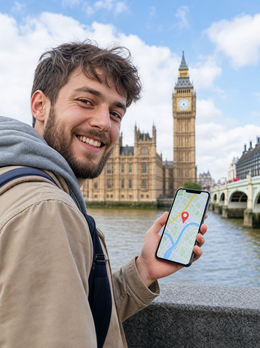

In short: an eSIM for Ireland and the United Kingdom gives you data on both islands with a single plan, because they are distinct territories for roaming purposes since Brexit. It connects automatically to the local operator in each area, without changing cards or contracting separate roaming, and with a fixed price from before leaving home.
Ireland and the United Kingdom are often traveled together: a flight to Dublin, a ferry to Wales, or a hop to London and Edinburgh. The problem is that, after Brexit, the United Kingdom is no longer part of the EU, and roaming has become expensive again. An eSIM for Ireland and the United Kingdom solves the two islands with a single plan, without having to worry about which operator you'll get at each invisible border.
Why a joint Ireland + UK plan is convenient
Because they are two different countries with two different regulatory situations: Ireland is in the EU, and the United Kingdom is not. A joint plan covers both with data in Dublin, Belfast, London, or Edinburgh without you having to buy two eSIMs or worry about which network to use at any given moment. It's the most convenient option for a trip that combines Ireland and the United Kingdom, which is very common because direct flights to Dublin are often cheaper than to other European capitals, and from there it's easy to jump to London in just over an hour.
The eSIM automatically connects to the local operator in each area. When crossing from the Republic of Ireland to Northern Ireland (which is the UK for all intents and purposes) or flying to Great Britain, data continues to work without you lifting a finger. A single QR, a single price, zero management on the go. And if at some point you decide that your trip will only stay in Ireland or only cross to a third country, you can always compare it to the generic eSIM for Ireland option, which is the reference plan if you ultimately don't set foot on British soil.

Brexit and roaming in the United Kingdom
Since Brexit, the United Kingdom is no longer covered by the EU's "roam like at home" regulations. This means that a large part of Spanish operators have reintroduced charges for using data in British territory, and the cost skyrockets if you don't check your tariff conditions beforehand. Northern Ireland counts as the UK for roaming purposes, even though it shares an island with Dublin and there is no visible physical border when crossing by car or bus from the Republic.
This is where a travel eSIM clearly wins out over waiting to see what your operator charges you: you pay a fixed price for the GB you contract and forget about surprises on your bill when you return. It's helpful to first understand what data roaming is exactly to know what you are replacing, and if you are in doubt between sticking with your usual operator or switching to a local eSIM, we have a complete comparison of eSIM vs. roaming.
Practical advice: Check your Spanish operator's roaming conditions for the United Kingdom before you leave. Many no longer include the UK in their European flat rate, and a weekend in London could end up costing you much more in data than you expected.
What if I only go to Ireland, without crossing to the UK?
Then you don't need the joint plan: you'll have more than enough coverage and probably pay for a country you won't visit. Ireland is EU territory, so if your itinerary stays in Dublin, Cork, or the west coast without jumping to Belfast or Great Britain, the specific eSIM for Ireland plan is the most suitable option. The joint Ireland + UK plan makes sense when the trip truly combines the two islands, not as a generic substitute for "eSIM for Ireland."
Real coverage in Ireland
Ireland has a modern network. Dublin, Cork, and Galway have plenty of 4G, with 5G expanding in urban areas, so moving around the city, using maps, or making video calls won't cause you problems. In the countryside, things change: in the Ring of Kerry, Connemara, or the Cliffs of Moher, there are stretches with very weak signals or directly no coverage for several minutes of driving, typical of areas with irregular terrain and low population density. If you're road tripping through those routes, download an offline map before leaving the hotel, because relying on the signal to return "in the next town" could leave you stranded just when you need to turn.
A detail that surprises those who don't know it: in Northern Ireland, even if you are geographically on the same island, your mobile will start looking for British operators as soon as it detects the network, not Irish ones. It's instantaneous and doesn't require you to do anything, but if you check the coverage bar, you'll notice the operator's name change as soon as you enter Newry or Derry from the south.
Real coverage in the United Kingdom
The United Kingdom has one of the best coverages in Europe. London, Manchester, Birmingham, Edinburgh, and Glasgow enjoy powerful 4G and 5G, with hardly any dead zones within urban centers. In the London Underground, however, mobile coverage is still partial: on a good part of the deep lines (Central, Piccadilly, Northern), you still don't have data between stations, so download the journey map or save directions before going downstairs.
In the Scottish Highlands, northern Wales, or the most rural English countryside, the signal drops quite a bit, but main roads (A9, A82) and towns with more than a handful of houses usually have enough data for the basics. If your route goes up to Loch Ness or the Isle of Skye, expect long stretches without coverage between valleys: it's a mountainous area with very few people, not a network failure.
Operators in each country
The plan relies on the leading networks in each country to maximize the signal, and you don't have to choose or configure anything: the eSIM connects to the best available operator at each point and switches automatically when crossing from one country to another.
| Country | Main operators | Roaming situation from Spain |
|---|---|---|
| Ireland | Vodafone, Three, Eir | EU: "roam like at home" depending on your tariff |
| United Kingdom (includes Northern Ireland) | EE, O2, Vodafone UK, Three UK | Outside the EU since Brexit: check your tariff before leaving |
This automatic management is precisely what avoids the hassle of having to understand the different roaming rules on each side of the invisible border between the two Irelands.
How many GB you need and how to activate it
Calculate the GB based on the days you'll be away and your actual usage, not on what you "just in case" feel like contracting. As a general guideline:
- Weekend in Dublin + London: for maps, social media, and some light streaming, a smaller plan from the catalog is usually sufficient.
- One week between both countries: if you're going to make video calls with some frequency or do intensive browsing, move up to the next tier of GB.
- Two weeks or more with daily video and video calls: a renewable plan or a larger volume plan is better so you don't run out halfway through your trip.
If you want to stretch the data you purchase, we have a guide with practical tips on how to save eSIM data while traveling that works just as well in Dublin as in London: disable automatic app updates, lower default streaming quality, and be wary of public Wi-Fi in certain establishments.
Installation is done at home with Wi-Fi and takes about a minute: you buy the plan, scan the QR in Settings → Mobile Data → Add eSIM, leave your usual SIM active for calls and messages, and activate the eSIM data upon landing. If this is your first time with this technology, the guide on how to install an eSIM will walk you through it step by step without assuming any prior knowledge.
Myths and what almost no one tells you
"If I have European roaming included, I'm covered for the whole trip." This is partially false, and it's the most expensive mistake. Your European tariff covers you in Ireland (EU), but as soon as you cross into Northern Ireland or fly to London, that coverage no longer applies unless your operator has expressly extended it to the UK, which not all do since Brexit. Check your operator's app before you leave, don't assume.
"With an eSIM, I no longer need Wi-Fi anywhere." Not entirely true. There are specific places where the Wi-Fi at your accommodation or a museum is still a better option: inside buildings with very thick walls (typical in castles and Gothic cathedrals in the UK), the mobile signal suffers just like in any other country, eSIM or not. And when you do use Wi-Fi in a pub or hostel, it's advisable to have your connection protected; we explain this in the guide on VPN and privacy while traveling.
"For a short day trip to Belfast, you don't need to change your plan." True, and that's precisely the beauty of the joint plan: you don't need to "change" anything, the eSIM already includes the UK and switches automatically. What you should do is check beforehand that you have enough GB for that extra day, because if you calculated the plan only for Dublin, you might run short.
When this joint eSIM is NOT convenient for you: if your trip is exclusively a weekend in Dublin with no intention of crossing into the UK, buying the joint plan means paying for coverage you won't use; the specific plan for Ireland would be better for you. And if you're going to the UK but your Spanish operator does have a good roaming agreement for the UK within your tariff, check the actual price before spending on an additional eSIM: sometimes the tariff you already pay covers you more than enough for a short getaway.
A detail almost no one mentions: if your mobile already uses an eSIM for your regular Spanish line (increasingly common), you can have both profiles active at the same time without conflict, as long as the device supports dual active eSIMs or switching between profiles. Before buying, check in your mobile settings how many eSIM profiles it supports simultaneously, as not all models are the same.
Frequently asked questions
Can a single eSIM be used for both Ireland and the United Kingdom at the same time?
Yes, that's precisely the purpose of this joint plan: it covers both countries with a single eSIM profile that automatically switches between the local operators in each area, without you having to buy two different plans.
Does Northern Ireland count as the United Kingdom or as Ireland?
As the United Kingdom for mobile network and roaming purposes, even though it shares an island with the Republic of Ireland. That's why a joint Ireland + UK plan is so practical: it covers Belfast (UK) and Dublin (EU) without you having to worry about where the border actually is.
Will I be charged extra roaming in the United Kingdom with this eSIM?
No. With the eSIM, you pay a fixed price for the contracted GBs, including usage in the United Kingdom. This is its advantage over your Spanish operator's roaming, which often applies additional charges for using data in British territory after Brexit.
Does data continue to work when crossing between the Republic of Ireland and the United Kingdom?
Yes. The eSIM automatically switches to the local operator when crossing countries, whether by land (border with Northern Ireland) or by plane to Great Britain. You don't need to reinstall anything or buy a second plan.
Is there an eSIM only for Ireland, without the United Kingdom?
Yes. If your trip does not include the United Kingdom, the specific eSIM for Ireland plan will be more suitable for you than the combined one, because you won't be paying for coverage in a country you won't visit.
Is it for calls or just for data?
It's a data plan. For calls, you use WhatsApp, FaceTime, or internet calls, which work perfectly with the eSIM's connection. This is what most travelers use and is usually much more economical than conventional roaming calls.
Can I buy it if my phone already has another eSIM installed?
Yes, as long as your model supports multiple eSIM profiles, which is common in iPhones and recent Android phones. You can have several saved and activate only the one for this trip. Check beforehand if your device is compatible with eSIM technology and how many simultaneous profiles it supports.
Conclusion
Combining Ireland and the United Kingdom is a classic travel plan, but Brexit has put a price on British roaming again, and many Spanish tariffs no longer cover it for free. With a single plan, you get data in Dublin, Belfast, London, and Edinburgh, a fixed price from before you leave, and activation in one minute without touching your usual SIM. Land with internet, no roaming, and no stress: prepare your eSIM for Ireland and the United Kingdom before you fly and travel between the two islands without checking your bill when you return home.