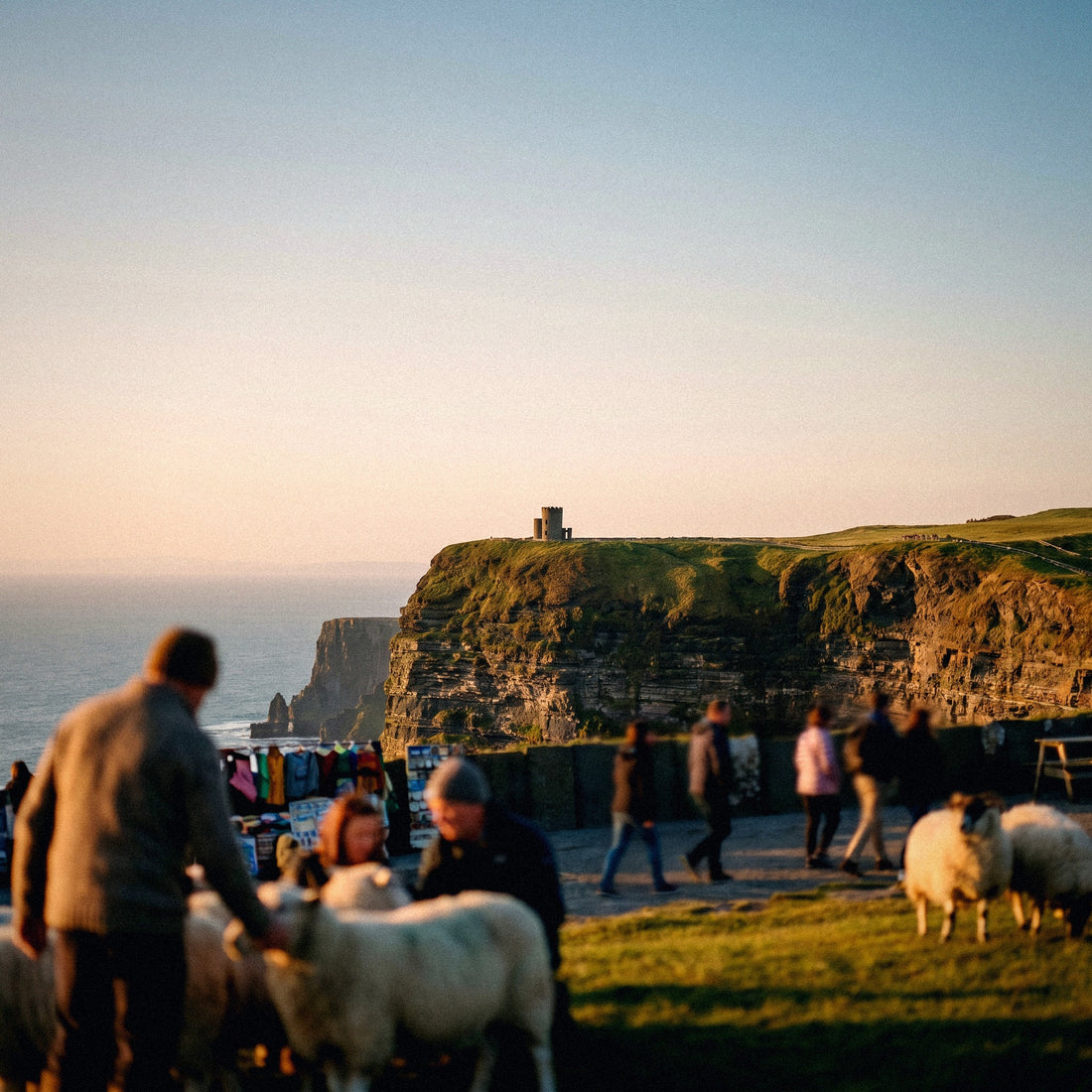
If you've made it this far, it's because the trip is already booked and the only thing left is to decide how many GB to buy for Ireland. I'll tell you with numbers and without beating around the bush, because Ireland is one of the destinations where the least data is used, and because there's a detail about the north of the island that almost no one checks before leaving and that has caused more than one person a nasty surprise on their bill.
The short answer, without beating around the bush
For a 10-day normal trip to Ireland, most people will find 3 GB to be plenty; if you live on Instagram and upload videos daily, aim for 5 GB. With downloaded maps and backups only over Wi-Fi, many people finish their entire trip using less than 2 GB.
That's the answer. The rest of this article is to help you understand where that number comes from and to adjust it to your specific case, because someone driving the Ring of Kerry with a downloaded map won't use the same amount of data as someone who uploads three stories per stop.
Ireland has a very favorable combination: it's a small country, there's a lot of driving but few stops, Wi-Fi is available in almost all accommodations, English is spoken (so you won't be burning data with a camera translator like in Japan or Morocco), and a good part of the west has spotty coverage, meaning there are hours of the day when you simply can't use data even if you wanted to. All of this pushes consumption down.
What does significantly increase the number is one very specific thing: photos. Ireland is a landscape destination; you'll be snapping away like crazy, and if you have automatic cloud backup activated with mobile data, two hundred photos of cliffs can turn into nearly 800 MB in a single day. That's the enemy, not WhatsApp.
If you want the general criteria for any destination, I've laid it out in the guide on how much data you need for travel. Here, I'll focus specifically on Ireland.
Honest warning: if you live in the EU, you're already covered
I'll start with something that goes against my own commercial interest, because I'd rather you trust me next time: Ireland is in the European Union. If your line is Spanish, Portuguese, French, German, or from any EU or EEA country, your plan works there with your national data allowance, without extra charges and without buying anything. It's the famous "roam like at home." So if you go to Dublin for ten days with a normal Spanish plan, you don't need to buy data from me. Period.
That said, there are three real situations where it's worth checking twice, and all of them relate to the fine print of your contract:
- Fair use policy. Cheap and prepaid plans often limit the GB you can use for roaming to considerably less than your national allowance. If you have 100 GB at home, don't assume you have 100 GB in Ireland.
- Exceeding the limit. The surcharge within the EU is regulated and low (around €1 per GB plus VAT), so it's not ruinous, but it's no longer free.
- You're crossing to the North. That's another story, and I'll cover it in the next section.
| Where your line is from | Do you need to buy data? | Reason |
|---|---|---|
| Spain / EU / EEA, standard plan | No, with exceptions | Your national allowance works the same in Ireland |
| Spain / EU, cheap prepaid | Maybe | Fair use limit significantly lower than allowance |
| United Kingdom | Yes, almost always | Outside EU regulations since Brexit |
| Mexico, Argentina, Colombia, Chile… | Yes | Roaming packages from 5 to 20 USD per day |
| Any origin + visit to Northern Ireland | Yes, check plan coverage | Northern Ireland is the United Kingdom |
For the Latin American traveler, the calculation changes completely: paying by the day is very expensive compared to paying by the gigabyte. Ten days at 10 USD daily is 100 USD for data you'll barely use. If you're coming from outside Europe, a full comparison of options is available at internet in Ireland.
The northern trap: the Giant's Causeway is not in the EU
This is the most useful warning in the entire article, and I'm surprised how little it's mentioned. The Giant's Causeway, Belfast, Derry, and the entire Causeway Coast are in Northern Ireland, which is the United Kingdom. And the United Kingdom, since Brexit, is no longer covered by European roaming. Your Spanish plan might stop working as it did, or it might continue to work because your operator voluntarily maintains it, which is not the same as by law.
What makes this dangerous is that the border is invisible. There's no control, no barrier, no sign to warn you. You're driving from Sligo to Donegal, or from Dundalk to Belfast, and your phone switches networks without telling you anything beyond a name change in the status bar that no one checks. Even worse: in border counties (Donegal, Louth, Monaghan, Cavan), your phone might latch onto a northern antenna even if you're physically in the Republic, simply because that signal is stronger.
If your route includes the Giant's Causeway, don't just buy "data for Ireland": check that the plan also covers the United Kingdom, or get a Europe plan that explicitly includes it.
What to do, in order of sensibility:
- Check if your plan covers Ireland and Northern Ireland before buying. This information should be written down, not assumed.
- In border areas, set network selection to manual and choose an Irish operator (Vodafone IE, Three IE, or Eir).
- Download maps for the North before crossing, using your accommodation's Wi-Fi.
This is the only point of the trip where you could genuinely get a shock, and it can be solved with two minutes of checking. In the eSIM for Ireland guide, I detail what territorial coverage to look for before paying.
What each app on your phone actually consumes
Here's the core of the calculation. These are average consumption figures, measured in real use, not anyone's promises. I'm rounding up to give you a margin:
| Activity | Approximate Consumption | On a travel day |
|---|---|---|
| Google Maps navigating online | 5-10 MB per hour | 40-80 MB |
| Google Maps with downloaded map | 1-2 MB per hour | 10-20 MB |
| WhatsApp (text, audio, some photos) | 5-10 MB per hour of use | 20-40 MB |
| Video call via WhatsApp | 300-700 MB per hour | 50-150 MB (10-15 min) |
| Instagram or TikTok, scrolling | 600-900 MB per hour | 200-400 MB |
| Uploading a 15-second story | 3-6 MB each | 15-40 MB |
| Automatic photo backup to cloud | 3-5 MB per photo | 400-900 MB if active |
| One minute of 4K video uploaded to cloud | 300-400 MB | The silent killer |
| Spotify at normal quality | 70-100 MB per hour | 150-250 MB in the car |
| YouTube at 480p | 250-350 MB per hour | Avoid with data |
| Netflix on mobile, standard quality | 300 MB - 1 GB per hour | Download via Wi-Fi |
| Browsing, email, booking a restaurant | 20-50 MB per hour | 50-100 MB |
| Checking the weather forecast | 1-2 MB per check | 10-25 MB (and in Ireland, you'll check it a lot) |
Notice the leap: there's a hundredfold difference between navigating with a downloaded map and watching video. That's why the question isn't "how much will I use my phone," but "what will I do with it?" Two people on the same trip can use 1 GB or 15 GB depending on how their phone is configured. If you want the expanded breakdown by application, I have it in the mobile data usage statistics by activity.
Why Ireland uses less data than you think
Some destinations inflate data consumption, others reduce it. Ireland clearly falls into the second group, and it's useful to know why so you don't overbuy:
- Wi-Fi everywhere. Practically all Irish hotels and B&Bs include it, as do many pubs and cafes. In Dublin, it's rare to sit somewhere without Wi-Fi. Be aware that in small western towns, bandwidth can be limited: it's fine for WhatsApp and downloading maps, but not for backing up 8 GB.
- English is spoken. It might seem trivial, but in Japan, Morocco, or Korea, people spend hundreds of megabytes on translator apps, pointing their camera at signs. Here, you won't open it once.
- No VPN needed. There's no censorship or blocking, so you save the extra consumption (between 5% and 15%) that an encrypted connection adds.
- Patchy coverage in the west works in your favor. In sections of Connemara, inland Donegal, and some secondary roads in Kerry, the signal disappears. You can't spend what you don't have.
- Lots of driving. And driving, with downloaded music, is dead time in terms of data usage.
What does increase compared to other destinations are two things. One, the weather: in Ireland, the forecast changes every three hours, and you'll open the app ten times a day to decide whether to go to the cliffs now or after lunch. These are tiny amounts of data, but they illustrate the point. And two, landscape photos. Green, sheep, cliffs, castles with fog: you'll shoot three times more than on a city trip, and that's where the real consumption lies.
The advice in this section is as simple as it is decisive: turn off automatic cloud uploads using mobile data, and you'll have solved 70% of the problem before you even take off.
The important table: GB per profile and duration
Find your profile, cross-reference it with the number of days you'll be staying, and you'll have your number. These calculations assume you're sleeping in places with Wi-Fi (which is normal in Ireland) and have your maps downloaded:
| Profile | 5 days | 10 days | 15 days | 30 days |
|---|---|---|---|---|
| Map and WhatsApp tourist | 1 GB | 2 GB | 3 GB | 5 GB |
| Photos and social media | 3 GB | 5 GB | 8 GB | 15 GB |
| Family sharing connection | 5 GB | 8 GB | 12 GB | 20 GB |
| Digital nomad or remote work | 8 GB | 15 GB | 20 GB | 40 GB or unlimited |
How to interpret each profile, so you don't pick the wrong row:
- Maps and WhatsApp: You navigate, send photos via WhatsApp, look for places to eat, check the weather. No video. About 150 MB per day.
- Photos and social media: The above, plus daily stories, scrolling through Instagram, and some video calls. Between 400 and 550 MB per day.
- Family: Two active phones plus a child watching cartoons in the back seat. Video in the car dominates: 700-900 MB per day.
- Remote work: Video calls, screen sharing, uploading files, and tethering to a laptop. From 1 to 1.5 GB per day.
If you're torn between two rows, choose the lower one only if you plan to share your connection with a laptop. In any other case, the row above will likely be more than enough.
And yes, I am aware that I'm recommending small packages here. I'd rather you buy 3 GB and come back next time than buy 20 GB and feel cheated when you get home with 17 GB unused.
The road trip: Kerry, Moher and the Wild Atlantic Way, day by day
Since a typical trip to Ireland is a road trip, I'll break down a real day: leaving Killarney, doing the entire Ring of Kerry, stopping at viewpoints, and ending up having dinner at a pub. Nine hours away from accommodation.
| Time of day | What you do | Data |
|---|---|---|
| Before leaving (with Wi-Fi) | Download map, music, and forecast | 0 MB from your plan |
| Morning driving | Downloaded map + traffic | 15 MB |
| Viewpoint stops | Photos, 2 stories, checking weather | 60 MB |
| Lunch | WhatsApp family, looking for place, reviews | 70 MB |
| Afternoon in the car | Music streaming (2 hours) | 160 MB |
| No-coverage areas | Nothing, no signal | 0 MB |
| Pub at night | Instagram 20 min, short video call | 230 MB |
| Total for the day | ≈ 535 MB |
That half-gigabyte is a genuinely active day. If you have music downloaded instead of streaming, you're down to 375 MB. If you also skip Instagram, you're at 150 MB. Multiply by your number of days, and you'll have your refined figure.
A couple of nuances specific to this itinerary. At the Cliffs of Moher and throughout most of the Ring of Kerry, the signal is good, so don't count on running out of data due to lack of coverage. Where it does drop out is on secondary roads in inland Kerry, in Connemara, and in northern Donegal. And at the Giant's Causeway, remember, you're in a different jurisdiction.
Download the map of the entire island in one go: Ireland is small, it fits in a few hundred megabytes, and it solves the problem for your whole trip.
How to check your data usage before leaving home
Everything above is averages. Your exact number is already on your phone, free, and takes two minutes to check. It's the most honest method I know because it doesn't depend on you believing me:
- On iPhone: Settings → Mobile Data. Scroll down to the app list and check the total for the period. Important: this counter doesn't reset automatically, so note the "Last Reset" date. Reset it and let it run for a week.
- On Android: Settings → Network & internet → SIM → App data usage. Here you'll find the full monthly cycle and the breakdown by app.
- Do the math: Divide the previous month's consumption by 30 to get your daily average.
The key adjustment: at home, you spend most of the day on Wi-Fi (office, couch, gym). When traveling, you don't. Multiply your daily average by two for a much more realistic estimate.
An example with numbers. If your phone shows 6 GB per month, your average is 200 MB per day. Multiplied by two, that's 400 MB per travel day. For 10 days in Ireland, that's 4 GB, but since you'll be sleeping with Wi-Fi every night and will have downloaded maps, 3 GB will be more than enough. See how it fits with the table above.
And also check which app is taking your data at home. If 60% is TikTok, be honest with yourself: you'll still be you in Ireland. People don't change habits when crossing a border, so buy for the traveler you are, not the one you'd like to be.
How to make your data last in Ireland
With these settings, made just once before you leave, a small package will last you the whole trip. They are ordered by real impact, from greatest to least:
- Backup only over Wi-Fi. Google Photos, iCloud, OneDrive, and Dropbox. This is by far the biggest saving setting, and in a scenic destination like this, it can be several gigabytes.
- Downloaded maps. In Google Maps, your profile → Offline maps → Select your own map. Frame the entire island, including the north if you're going up there. Do this with your home Wi-Fi.
- Downloaded music and series. Spotify, Netflix, and YouTube Premium allow downloads. There are many hours of driving along the Wild Atlantic Way.
- Autoplay disabled on Instagram, TikTok, X, and Facebook. This is where your megabytes disappear without you realizing it.
- WhatsApp automatic download set to manual for photos and videos. Family groups are a bottomless pit.
- System data saver mode, activated. On Android, it's in Network & internet; on iPhone, under Cellular Data Options.
- Video in standard quality, never high quality with data. The difference on a mobile screen is minimal; in consumption, it's three to five times more.
A very Irish trick: take advantage of long stops. When you sit down to eat or have a drink in a pub, connect to their Wi-Fi and let the morning's photos upload. By the end of the trip, you'll have moved almost all the weight without touching your plan. It's the difference between needing 3 GB or needing 10.
I have the complete list of settings, with screenshots and details for each system, in the guide on tips for saving data while traveling.
What if I run out of data halfway through the trip?
It's fine. And this is important to understand, because it's why I recommend buying low: running out can be fixed in two minutes; having too much can't be fixed at all. The data you don't use isn't refunded or carried over to your next destination.
When your package runs out, you simply stop having data. You're not charged extra, nothing unexpected activates, there's no hidden bill. Your phone still works with Wi-Fi, and you recharge from the hotel, pub, or airport's own Wi-Fi. The recharge applies to the same line, without changing anything on your phone.
What to do if you find yourself in a bind:
- See how much you have left and how many days are remaining. Divide and you'll have your daily budget.
- Activate data saver and stop cloud uploads if you haven't already.
- If that's still not enough, recharge. It's usually cheaper than a large package bought upfront that you'll never fully use.
The opposite error is more expensive and more common than it seems: buying 20 GB "just in case" for ten days in Ireland and returning home with 17 GB wasted. It's throwing money away out of fear, and that fear can be cured with the table in section six.
If it's your first time with this system and you want to understand how the installation works, how it coexists with your usual line, and which phones are compatible, I explain it step-by-step in what an eSIM is.
Frequently Asked Questions
The questions I get asked repeatedly about this destination, answered briefly so you don't have to read the whole article again.
How many GB do I need for 7 days in Ireland?
2 GB is fine for a normal week-long trip. If you upload daily stories or share your connection with someone, aim for 3 or 4 GB. Assuming you sleep with Wi-Fi and have maps downloaded, typical consumption is around 150-300 MB per day.
Does my Spanish plan work in Ireland?
Yes, Ireland is in the European Union and your national plan works there at no extra cost. Just check two things: your plan's fair usage limit, which for prepaid and cheap plans is usually much lower than your home allowance, and if you'll be crossing into Northern Ireland.
Is the Giant's Causeway included in an Ireland plan?
Not necessarily: the Giant's Causeway is in Northern Ireland, which is the UK. Since Brexit, it's not covered by European roaming. If your route goes north, make sure your plan explicitly includes the UK, or get a European plan that covers it.
Will I notice when I cross the border to the north?
No, and that's precisely the problem: there's no border control or visible warning. Your phone changes networks on its own and you'll only see it if you check the operator name in the status bar. In border counties, it can even connect to a northern antenna while you're in the Republic.
Is there good Wi-Fi in Ireland?
Yes, very good and widely available. Hotels, B&Bs, cafes, and many pubs offer it, and in Dublin it's almost universal. In small western towns, bandwidth is limited: it's enough for messaging and downloading a map, but not for uploading large videos to the cloud.
Is there coverage on the Ring of Kerry and at the Cliffs of Moher?
Yes, in the main tourist spots, the signal is good. Where it does drop is on secondary roads in inland Kerry, Connemara, and northern Donegal. That's why a downloaded map is not optional on a road trip through the west.
How much data does Google Maps use on a road trip in Ireland?
Very little: between 5 and 10 MB per hour online, and barely 1 or 2 MB per hour with the map downloaded. A full day driving the Ring of Kerry uses about 15-70 MB. Maps is never what empties your plan; it's photos and video.
What if I run out of data halfway through the trip?
You recharge from any Wi-Fi in two minutes and continue. There are no surprise charges: when the package runs out, you simply stop having mobile data. That's why it's better to buy a conservative amount and extend if necessary, instead of paying for gigabytes you'll never use.
Conclusion
To summarize what really matters: for ten days in Ireland, 3 GB. For a week, 2 GB. If you're constantly taking photos and on social media, 5 GB. And if you're teleworking from a cottage in Kerry, then yes, 15 GB. It's a cheap data destination because there's Wi-Fi everywhere, English is spoken, and much of the west leaves you without a signal even if you wanted to use it.
Just do three things before getting on the plane: turn off automatic photo uploads with mobile data, download a map of the entire island using your home Wi-Fi, and check if your route goes up to Northern Ireland. With that sorted, the package you buy will be more than enough.
And I repeat this because your trust matters more to me than a sale: if you have a Spanish line or from any EU country, your plan already covers Ireland. Only buy data if you're coming from outside Europe, if your fair use policy is insufficient, or if you're going to cross to the north. In any of those cases, here's the package you need, with no surprises on the bill: eSIM for Ireland, choose your gigabytes and have your phone working as soon as you land in Dublin.