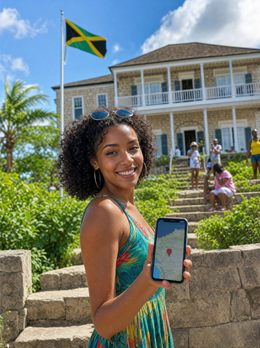
In short: a Jamaica eSIM gives you mobile internet as soon as you land in Montego Bay or Kingston, without queuing at Flow or Digicel and without expensive roaming charges. Coverage is solid on the tourist coast and in cities, and weaker in the mountainous interior; the number of GB you need depends on whether you stay at the resort or drive around the island.
Jamaica is about beaches, reggae, and mountain roads, and for almost all those plans, you'll want mobile data: maps to Negril, uploading photos of Dunn's River, or ordering a taxi in Montego Bay. With a Jamaica eSIM, you have internet as soon as you land, without looking for a Flow SIM card or paying regular roaming prices. Here's a breakdown of actual coverage, how many GB to bring, and why an eSIM saves you from waiting in line at the operator's counter.
Does an eSIM work in Jamaica?
Yes. An eSIM works in Jamaica by connecting via network agreements with local operators, so you have internet as soon as you land, without needing a store or paperwork. You only need a compatible phone and to have installed it before leaving your home country, with the QR code already scanned.
The advantage over a local SIM card is clear: buying a prepaid SIM in Jamaica means going to a Flow or Digicel store, sometimes at the airport with inflated prices for tourists, and topping up credit in Jamaican dollars. With an eSIM, you skip all that. You buy the plan online from home, receive the QR code instantly, and in a minute, you have data ready to activate upon arrival. Plus, you keep your home number in dual SIM, so WhatsApp and bank SMS still reach you while the eSIM handles data. For a Caribbean destination, this convenience is noticeable from the first taxi. If you've never quite understood why traditional roaming skyrockets your bill outside the EU, we explain it in detail in what is data roaming.

Coverage: coast, resorts, and mountains
Mobile coverage in Jamaica is good on the tourist coast and in cities, and weaker in the mountainous interior. The northern strip—Montego Bay, Ocho Ríos, Negril—and the capital, Kingston, have stable 4G/LTE, more than enough for maps, messaging, and streaming.
Large all-inclusive resorts usually offer their own Wi-Fi, but as soon as you go out to explore the coast, swim in waterfalls, or drive the road, your mobile data takes over. In areas like Negril or around Dunn's River Falls, you'll have signal in main areas and access points, while in the Blue Mountains, deep jungle, or secondary roads inland, coverage drops to 3G or disappears at times. This is to be expected on a mountainous island. The eSIM relies on the best available network at each point, so you don't depend on a single operator.
A nuance that almost no one mentions: all-inclusive resort Wi-Fi doesn't cover the entire property equally. In large complexes like Sandals or Half Moon, the signal weakens in areas further from the main building—beach ends, gardens, some isolated bungalows—and that's where your mobile data comes in to rescue a video call or a map. If Jamaica is a stop on a broader Caribbean or Latin American route, the eSIM guide for Colombia, including Medellín, Bogotá, and Cartagena, will also be useful.
Tip: Download maps for the route to Negril or the waterfalls before leaving the resort. In mountain sections, the signal plays hide-and-seek, and you'll appreciate having the offline route.
Local operators: Flow and Digicel
The Jamaican mobile market is shared between two operators: Flow (Flow Jamaica) and Digicel, which support the 4G network your eSIM connects to. Both cover the tourist coast well; inland, coverage depends more on the topography than on the operator.
Buying a prepaid Flow or Digicel SIM as a tourist is possible, but inconvenient: queues at the airport or in city shops, registration, cash balance, and a new number that no one in your contacts uses. A travel eSIM uses the infrastructure of these same operators without requiring you to register with any of them. You don't change numbers, you don't handle Jamaican dollars to top up, and you don't waste time on your first day. For several years, Jamaica has required any local SIM to be registered with an ID, an extra step that the eSIM completely saves you from because you never register a new line in your name. If you want to see the full comparison with figures, you can find it in international SIM vs. eSIM and eSIM vs. roaming.
Data on arrival in Montego Bay and Kingston
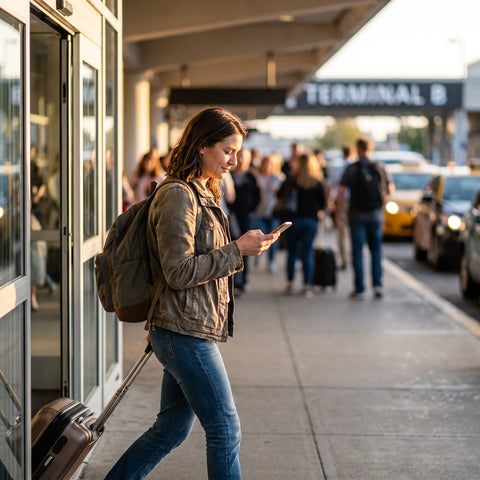
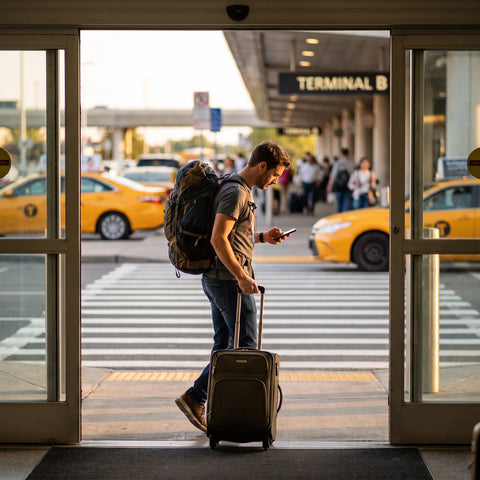
Upon landing at Sangster Airport in Montego Bay (MBJ) or Norman Manley in Kingston (KIN), your eSIM automatically connects to the local network, and you have internet before even collecting your luggage. You only need to activate the eSIM's roaming data; you don't need the airport Wi-Fi.
Montego Bay is the gateway for most tourists: from there, many continue on to Negril or Ocho Ríos, and having active data allows you to confirm transport, notify your hotel, or order a taxi without relying on a crowded public network. Kingston, the capital, is more urban and has dense coverage. In both cases, the trick is the same: install the eSIM at home with Wi-Fi and activate it upon arrival. You land with data ready and avoid the operator's counter with airport prices. It's the difference between starting your trip relaxed or starting it by wrestling with connectivity.
How many GB you need for your trip
It depends on your style. In Jamaica, many travelers stay in resorts with Wi-Fi, which reduces mobile data consumption; others tour the island and rely on maps all day. These references will help you choose the right plan.
- Basic use (1-2 GB/week): resort with Wi-Fi, occasional maps, and WhatsApp. Typical consumption for someone who rarely leaves the hotel.
- Medium use (3-5 GB/week): daily excursions, maps, social media, and music. The most common profile for someone exploring the island.
- Intensive use (7-10 GB or more): sharing internet with a laptop, uploading beach videos, and constant navigation on the go.
If you're staying at an all-inclusive, you'll use less mobile data than you think. Still, it's better to have a small buffer so you don't run out of internet in the middle of the road to Negril. To stretch your GBs without running out mid-route, you'll find specific tips in how to save data with your eSIM on your trip.
Indicative prices by day
eSIM plans for Jamaica are organized by GB and validity days. These amounts are indicative to help you plan your trip; the final price depends on the plan you choose.
| Duration | Suggested Data | Traveler Profile |
|---|---|---|
| 3-5 days | 1-2 GB | Short getaway or cruise with a stop |
| 7 days | 3-5 GB | Resort week with excursions |
| 10 days | 6-8 GB | North coast and Negril route |
| 15 days | 10 GB or more | Long stay or beach nomad |
Compared to roaming outside the EU, where the cost per megabyte can skyrocket without warning, an eSIM for your entire stay in Jamaica is usually more cost-effective than just a couple of days of traditional roaming. The longer the trip, the greater the difference in favor of the eSIM; always check the current price of your plan before buying.
Installation and practical tips
Installing the eSIM takes a minute and should be done at home, with Wi-Fi, before flying. The process is practically the same on iPhone and Android; only the menu names differ.
- Purchase your plan and receive the QR code by email instantly.
- iPhone: Settings → Mobile Data → Add eSIM. Android: Settings → Connections → SIM Manager → Add eSIM.
- Scan the QR and label the line as "Jamaica."
- Upon landing, activate the eSIM's data roaming and deactivate it on your home line.
A couple of notes for Jamaica: download mountain routes before heading out, use the resort's Wi-Fi for heavy downloads, and save mobile data for what really matters outside the hotel. With that done, connectivity won't give you trouble anywhere on the island.
Myths and what almost no one tells you
There are preconceived notions about traveling with mobile data to Jamaica that should be dispelled before you leave, and a couple of details you only learn by being on the island or reading the fine print of your phone.
Myth: "With resort Wi-Fi, I don't need data." In a small all-inclusive, this might be true. In large complexes, the Wi-Fi network gets saturated at dinner time or during pool events, and the speed drops just when you need it most to upload a photo. Having an active eSIM as a backup prevents the endless "loading" message.
Myth: "My Spanish plan's roaming works outside the EU." Jamaica is not part of the European free roaming zone, so if you activate roaming on your Spanish line without checking, the cost per megabyte can shoot up at a price that has nothing to do with what you pay in France or Portugal. Check your operator's conditions before leaving, or simply deactivate it and let the eSIM do the work.
What almost no one tells you: In Jamaica, you won't find VTC apps like Uber that are common in other tourist destinations. Much of the transportation is coordinated by phone or WhatsApp directly with the hotel, the usual resort taxi driver, or the driver recommended by the reception. Having active data from the airport is not a whim: it's what allows you to text the hotel to confirm your transfer before leaving the terminal.
Another overlooked detail: if you're going to use public Wi-Fi in Montego Bay or Kingston cafes, avoid online banking or paying with a card without protection. With your own mobile data, that risk is significantly lower, and if you frequently use open networks, take a look at eSIM, VPN, and privacy while traveling to secure your connection without complications.
And a honesty that must be said: if your plan is a five-night all-inclusive without hardly leaving the resort, without excursions or the need for maps, it's possible that the hotel Wi-Fi and a couple of GB of buffer will actually be enough. There's no need to buy more data than you'll use; it's better to have a plan tailored to your actual route than an oversized one you won't use.
Frequently asked questions
Does the eSIM work in the resorts of Negril and Ocho Rios?
Yes. The eSIM connects to the network of local operators, which cover the tourist strip of the north coast well, including Negril and Ocho Ríos. Many resorts add their own Wi-Fi, so you'll have double connectivity. On excursions outside the hotel, the eSIM is what keeps you connected.
Is an eSIM better or should I buy a Flow SIM at the airport?
For most travelers, an eSIM is more convenient. Buying a Flow or Digicel SIM at the airport usually means queuing, registration, and inflated prices for tourists. You buy the eSIM online from home, activate it with a QR code in a minute, and keep your home number on dual SIM.
Will I have coverage in the Blue Mountains?
In the Blue Mountains and other mountainous inland areas, coverage is spotty and can disappear in sections, which is normal in jungle and at high altitudes. In access points and villages, there's usually a signal. Download route maps before heading up and you'll regain data when you descend to more populated areas.
Can I use WhatsApp with my usual number?
Yes. WhatsApp is linked to your number, not the SIM that provides data. With the eSIM providing data and your home line on dual SIM, you can keep WhatsApp, calls, and bank SMS working normally, without changing your account settings.
How many days of validity should I choose?
Choose a plan that covers your entire stay with some buffer. If you're going for a week, choose one for at least 9 or 10 days so you're not cutting it close. Topping up or extending on the fly is possible, but it's more convenient to leave your home country with validity already secured for the entire trip.
Can I activate the eSIM before arriving in Jamaica?
Yes, and it's recommended. Install the profile at home, with Wi-Fi, a few days before flying, but don't activate data roaming until you land: this way you avoid consuming validity or data while still in your home country. As soon as the plane touches down in Montego Bay or Kingston, activate it and you're good to go.
What happens if I run out of GBs halfway through my trip?
You can buy an additional plan or extend data without moving from where you are, as long as you have Wi-Fi or some connection to complete the purchase. That's why it's a good idea to be generous when calculating GBs, especially if your route includes days outside the resort exploring the north coast.
Conclusion
With a Jamaica eSIM, you forget about queuing at Flow, Jamaican dollar balances, and the surprise of roaming charges upon your return. You land in Montego Bay or Kingston with data, keep your number, and adjust your GBs between resort and island exploration. Install your eSIM before you fly and arrive in Jamaica already connected, with Spanish support in case any questions arise along the way. And if your itinerary continues after the island, for example with a layover or connection in the United States, we also have an eSIM for the United States ready to activate as soon as you change destinations.