
In short: lots of people search for "wifi Kyrgyzstan" before traveling, but public wifi is scarce outside hotels and cafes in Bishkek. The most practical option is an eSIM: you install it before your flight, it activates automatically when you land, and gives you 4G in cities, on Issyk-Kul, and in trekking base villages — no physical card, no expensive roaming.
Kyrgyzstan has become the dream destination for anyone seeking spectacular mountains, yurts, and the Silk Road without the crowds. But it's a remote country, and having internet isn't as straightforward as in Europe. With a eSIM for Kyrgyzstan you get connected as soon as you land in Bishkek, without hunting for a store or wrestling with roaming. Here's the lowdown on coverage, local operators, how many GB to bring, and how to activate it in a minute.
Does an eSIM work in Kyrgyzstan?
Yes. If your phone is eSIM-compatible, it works in Kyrgyzstan by connecting to local networks. You install the profile with a QR code before leaving home, and when you arrive in Bishkek, you activate the data. It's the most convenient way to have internet in a country where arriving with a SIM already set up saves you language hassles and paperwork.
The advantage is huge in a destination like this: Russian and Kyrgyz dominate signage, and the last thing you want after a long flight is to hunt for a phone store. With an eSIM you get everything sorted before you leave and land connected. You just need a phone that supports eSIM profiles, which is standard on recent models. If you're unsure what this type of digital line is, here's an explanation of what a virtual eSIM is and how to check if your model supports it.

Where is Kyrgyzstan and what to expect from the connection
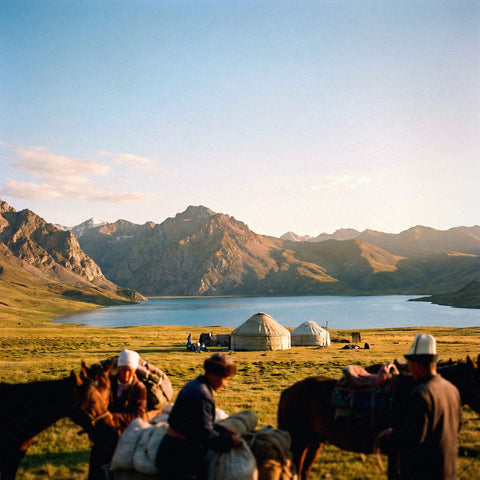
Kyrgyzstan is a mountainous country in Central Asia, between Kazakhstan and China. Its capital is Bishkek, the currency is the Kyrgyz som, and over 90% of its territory is mountains, dominated by the Tian Shan ranges. It's a destination for nature, trekking, and yurt camps.
For your phone, this means two things. First: it's very far from any cheap roaming zone, so your local plan would switch to expensive international rates (here's an explanation of what data roaming is and why it skyrockets in such distant destinations). Second: the connection is very good in cities and towns, but in the high mountains — which is exactly the best part of the country — coverage is patchy due to the terrain, not the provider. It pays to be prepared. Kyrgyzstan is part of the Central Asia region, so if you're combining it with Kazakhstan or Uzbekistan on the same trip, check the coverage of each plan carefully before buying, because not all eSIMs cover multiple countries at once.
Coverage and local operators
Kyrgyzstan's main operators are Beeline, MegaCom and O! (Nur Telecom), which share the country's 4G network. A travel eSIM taps into these local networks to give you connectivity without having to pick an operator yourself.
In Bishkek, Osh, Karakol and tourist towns the 4G coverage is solid and fast. It usually holds up on main roads. Signal starts to drop when you head into high valleys, mountain passes and remote yurt camps — expected given the terrain. For most of your trip — cities, transfers and base towns for routes — you'll have data without issues.
Traveler tip: download offline maps of Kyrgyzstan (Maps.me works great here) and the coordinates of your accommodations before heading into the mountains. Between valleys you can go hours without signal even if you have data.
With PuraSIM, Kyrgyzstan is part of a catalog of more than 200 destinations with 24/7 support by email and WhatsApp, an extra that's appreciated in a country where English is scarce outside the capital.

Internet in the mountains and Lake Issyk-Kul
The best of Kyrgyzstan is in nature, and there connectivity has its nuances. Lake Issyk-Kul, one of the main attractions, has good coverage on the more developed north shore and in towns like Cholpon-Ata. On the south shore and in the valleys leading up into the mountains, signal drops.
For trekking routes in Ala-Kul, Song-Kul or Jyrgalan, assume you'll be out of reach for a good part of the day and plan accordingly:
- Notify before you go up: send your itinerary to someone you trust while you still have signal.
- Download routes and offline maps of the full trek.
- Use guesthouse WiFi to sync photos and messages when you come down.
- Bring a power bank: your phone drains fast searching for signal in areas without coverage.
With those habits, the eSIM gives you connection where it matters — cities, airport, towns — and frees you from relying on a local SIM that's hard to manage without the language.
How many GB you need based on your route
Usage depends on your travel style. In Kyrgyzstan you'll spend a fair amount of time offline in the mountains, so you might use less than you think, but it's good to have a buffer in case you rely on maps and messaging daily.
| Travel profile | Duration | Recommended GB |
|---|---|---|
| City break (Bishkek and surroundings) | 4-5 days | 2-3 GB |
| Classic route with Issyk-Kul | 1 week | 3-5 GB |
| Long trekking and multiple regions | 2 weeks | 5-10 GB |
| Digital nomad or remote work | long stay | 10 GB or refillable |
If you run low, you can top up the same eSIM without installing anything new. And if you want to stretch your GB to the max on stretches without WiFi, these tips to save data with your travel eSIM come in handy for trekking.
How to activate your eSIM in one minute
You can get everything ready before you board your flight. In four steps:
- Buy your eSIM for Kyrgyzstan and receive the QR code by email instantly.
- With WiFi, scan the QR from your mobile data settings to install the profile.
- Label the eSIM (for example, "Kyrgyzstan") so you don't confuse it with your home line.
- When you land in Bishkek, select it as your data line and enable roaming for that profile.
The installation is done before you travel; the actual activation happens on arrival, in one minute. If this is your first eSIM, this step-by-step guide on how to install an eSIM walks you through it with screenshots.
Myths and what almost nobody tells you about Wi-Fi in Kyrgyzstan
Before you go, you probably assume a couple of things about connectivity in Kyrgyzstan that aren't exactly true on the ground.
Myth: "there's free Wi-Fi everywhere in Bishkek." Yes, there's Wi-Fi in many cafés and restaurants in the capital, but a good chunk of them ask for a Kyrgyz phone number to send you the access code by SMS. Without a local line, that "free" Wi-Fi is pretty useless. With your own mobile data, you skip that hassle and connect straight away, without depending on the waiter to help you set it up.
Myth: "I'll get by on airplane mode and hostel Wi-Fi on the trekking routes." Many guesthouses and camps in the CBT system (community-based tourism, very common in Kyrgyzstan) run on generators and only provide electricity —and Wi-Fi, if any— for a few hours in the evening. Don't count on a constant connection for work or video calls; save it for the essentials.
What almost nobody tells you: banking apps get jumpy. It's common for Revolut, N26, or your bank to ask for extra verification, or even block a payment outright, when they detect a connection from Central Asia, even if it's completely yours. Notify your bank before you leave, and if you plan to use online banking or sensitive work tools over public networks, consider using a VPN with your travel eSIM to avoid blocks and protect your data.
What almost nobody tells you: the Too-Ashuu pass and mountain tunnels are dead zones. If you travel by road between Bishkek and the south —toward Osh or around Lake Issyk-Kul on the inland route— there are tunnel sections and high mountain stretches where no carrier has coverage, not just yours. This isn't a fault of the eSIM; it's the terrain. Download whatever you need for the journey beforehand, including music or an offline episode for the trip.
Myth: "I need a regional eSIM for all of Central Asia." If your trip is just Kyrgyzstan, a country-specific eSIM usually works out cheaper than a regional one designed for multiple destinations. The regional plan only makes sense if you'll actually cross into Kazakhstan or Uzbekistan on the same route, and even then it's worth checking exactly which countries it covers before you pay.
eSIM vs. roaming and local SIM
In such a remote destination, the alternatives to eSIM aren't worth it. Roaming from your local plan in Kyrgyzstan is billed as international, and the cost quickly adds up: just one day of using maps and messaging can make the bill a real shock when you get back. A local SIM is cheap, yes, but it requires registering with your passport, understanding Russian or Kyrgyz in the shop, and wasting trip time. If you're torn between that physical option and an eSIM, this comparison of international chip vs. eSIM clears things up before you decide.
eSIM combines the best of both: a fixed price like a local SIM, but bought online from home, with no registration and no language barriers. If you want the breakdown of why roaming gets expensive outside Europe, check out our comparison of eSIM vs. roaming. You arrive connected and without surprises, which is exactly what you need in a remote country.
Frequently asked questions
Is it safe to travel to Kyrgyzstan and does having a connection help?
Kyrgyzstan is considered a safe destination for tourism, with hospitable people, though the mountain roads require caution. Having active data is a big help: you can check maps, contact guides, and share your itinerary. An eSIM gives you that connection from the moment you arrive, without depending on finding a local SIM.
Is there coverage in the mountains and at Lake Issyk-Kul?
On the northern shore of Issyk-Kul and in resort towns, there's good 4G coverage. In high valleys, mountain passes, and yurt camps, signal is spotty or nonexistent due to the terrain. Download offline maps before you head up and use accommodation Wi-Fi to sync when you come down.
What's the capital and what currency is used?
The capital of Kyrgyzstan is Bishkek, and the official currency is the Kyrgyz som. Many tourist businesses also accept US dollars or euros in cash, but it's a good idea to carry soms for daily expenses. With mobile data you can check the current exchange rate and avoid being overcharged when you pay.
Do I need to register to use the eSIM?
No. The travel eSIM is bought online with no passport registration, unlike the Kyrgyz local SIM which requires you to show ID at the store. You receive the QR by email, install it before you leave, and activate it on arrival. It's the fastest route with no language barriers.
Can I use the same eSIM in Kazakhstan or Uzbekistan?
It depends on the plan. A Kyrgyzstan-specific eSIM only covers this country. If your route includes other Central Asian destinations, consider a regional plan that covers multiple countries or combine eSIMs. Always check coverage before you buy so you don't run out of data at a border crossing.
Is there free Wi-Fi in Kyrgyzstan, or do I need to constantly search for coverage?
There's free Wi-Fi in many cafés, hotels, and restaurants in Bishkek and Osh, but it often fails in the rest of the country, and some places ask for a Kyrgyz phone number to activate it via SMS. If you're looking for "Kyrgyzstan Wi-Fi" thinking you can rely on public networks, better not count on it outside the big cities: an eSIM with your own data is much more reliable for the whole trip.
Which eSIM should I choose if my route continues to Kazakhstan or Uzbekistan?
If your trip stays in Kyrgyzstan, a country-specific eSIM suits you best, usually at a lower price. If you'll cross borders within Central Asia, you need a plan that expressly covers those countries or buy a different eSIM for each one; always check coverage before you pay so you don't run out of data mid-route.
Conclusion
Kyrgyzstan is a destination of immense mountains and genuine hospitality, but its remoteness means having internet depends on being well prepared. An eSIM connects you from the moment you land in Bishkek, with a fixed price, no registration, and no language barriers. If the mountain bug bites you and you keep exploring destinations at similar altitudes, take a look at our guide to eSIM for Peru and Machu Picchu: it shares that same challenge of spotty coverage in remote areas. Get your eSIM ready before you fly and focus on the yurts, the lakes, and the peaks.