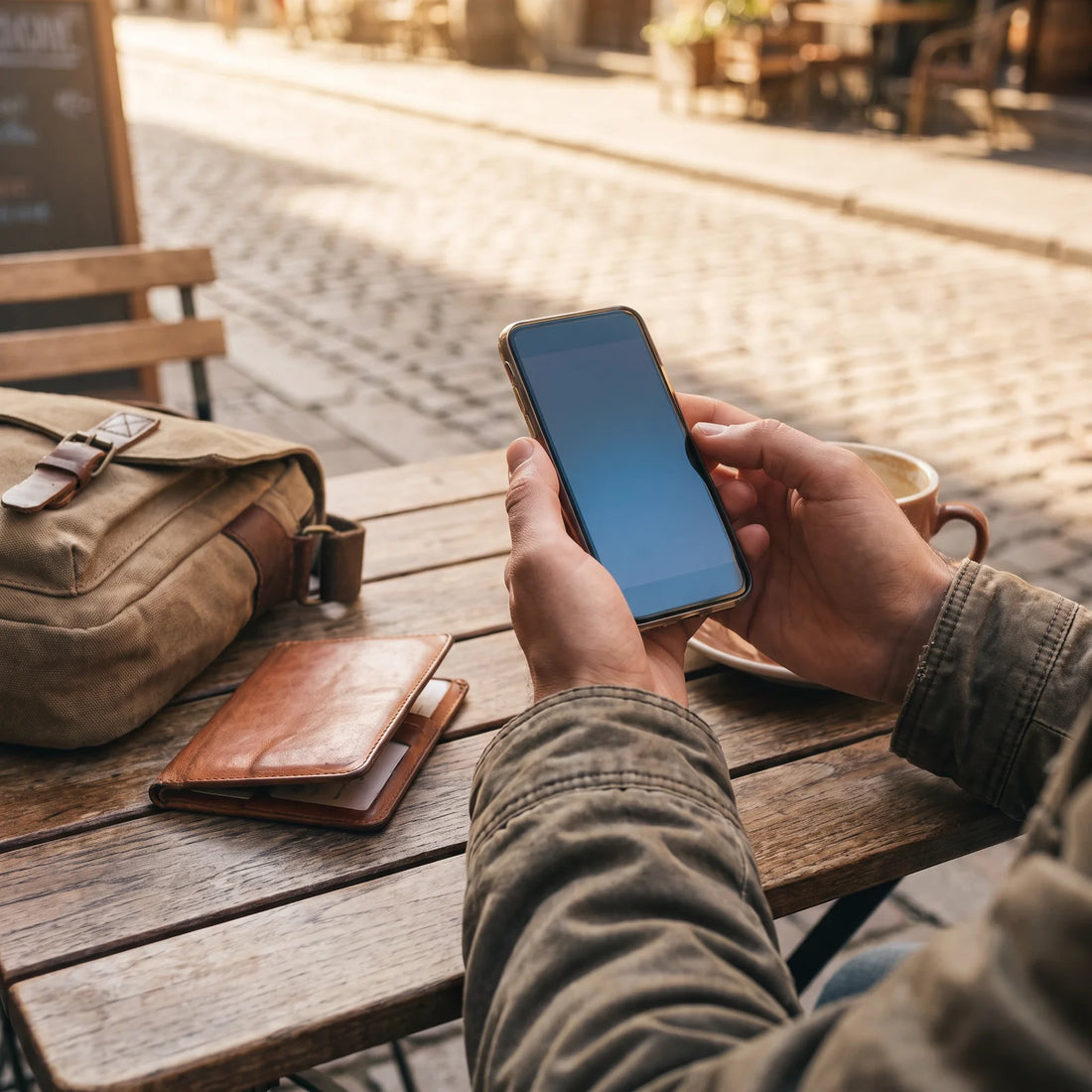
What is an eSIM and why are so many people searching for "apk"?
An eSIM is a digital SIM card that is already integrated into the phone: it is not downloaded like an app or installed from an APK file. The confusion is reasonable, but it is activated from the phone's settings, without app stores or external installers.
It's a reasonable misunderstanding. When something is "digital" and not a physical item that arrives by mail, the natural reaction is to look for the corresponding app, just as one would look for a banking or airline app. But an eSIM is not a program that runs on the phone: it is an operator profile, a set of data that tells the phone's internal chip which network to connect to and with what data plan. This chip, called eUICC, is already soldered inside compatible phones from the factory. Installing an eSIM is more like setting up a new email account than installing a game: you add data, not an executable.
So, if you came here looking for an APK file for your eSIM, the good news is that you're saving yourself a step. There's nothing to download or install from outside the phone's system. What you do need is to understand where the profile comes from and how to add it, which is exactly what we'll cover next.
Do you need to download an app or an APK to use an eSIM?
No. The eSIM is activated from the native settings of iOS or Android (the "Mobile Data" or "Mobile Network" section), not from an installed application. Any file that presents itself as "APK to install your eSIM" is not part of the actual process and should be viewed with suspicion.
This is worth emphasizing because non-official app stores and some search results circulate files that claim to be "eSIM installers." An APK file is, by definition, an Android installation package: it serves to put a new app into the system, not to configure a network profile. No serious operator, neither PuraSIM nor any other, distributes the eSIM as an APK, because technically it wouldn't make sense: the phone's operating system already has the function to read and save eSIM profiles built-in.
If something asks you to install a file outside the official app store to "activate" an eSIM, it is not a legitimate step in the process: activation always occurs within the phone's own settings.
The only thing you might have, optionally, is an operator app to check how much data you have left or to manage your account. This app is a convenience add-on, not a requirement: the eSIM works the same without it. The confusion between "I need an app to manage my plan" and "I need an app for the eSIM to exist" is the root of most searches for "eSIM apk."
How to install an eSIM step-by-step?
The actual process, without external apps, has three possible forms depending on what the provider gives you: scanning a QR code, tapping a direct installation link, or manually entering an activation code. All three options live within the operating system settings, not in a separate application.- QR code scan: open your phone's camera (or directly the "Add eSIM" settings, depending on the model) and point it at the QR code provided by the vendor. The system recognizes it as an eSIM profile and asks if you want to install it.
- One-tap installation: some providers send a link that, when opened from the same phone you're going to use, triggers the installation automatically without needing to scan anything.
- Manual code: if you can't scan the QR (for example, because you received it on another device), there is an option to type an alphanumeric code directly into the settings.
A point almost no one explains: installing the eSIM profile and starting to consume data are two distinct moments. You can install the profile calmly, even weeks before your trip, connected to your home Wi-Fi, and that step doesn't use up data from the plan or activate the day counter. The plan only starts running when the phone connects to the destination network for the first time and you activate the data. Since the window to install the eSIM is 180 days from purchase, it makes sense to get it ready well in advance of your trip and activate it only upon landing, so you don't lose even a single day of the plan prematurely.
Real example: activating data before landing
Imagine you have a flight to Buenos Aires next week. Before leaving home, connected to Wi-Fi, you buy a data plan for Argentina, receive the QR code by email, and scan it from your phone's settings. The system shows you the new profile as "eSIM Argentina" alongside your usual line. At that moment, the profile is saved, but it's not yet transmitting data.
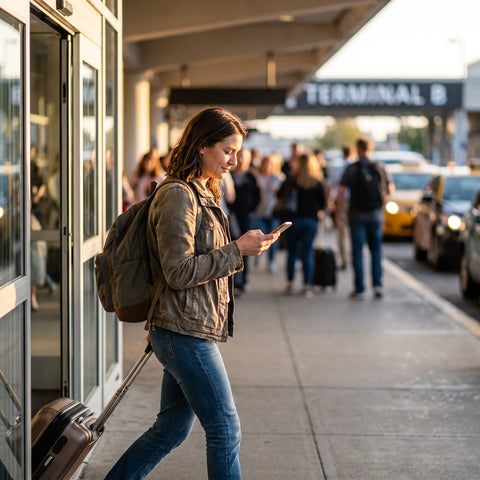
During the flight, your phone continues to use the physical line for calls and messages if you configured it that way. Upon landing, you go into the settings, activate the data line of the eSIM, and deactivate roaming for your usual line to avoid charges. In less than a minute, your phone is already connected to a local network, without having to find an operator counter at the airport or borrow SIM cards. The map, the taxi's GPS, and WhatsApp to let people know you arrived safely all work from the moment you step into the terminal.
That is, in essence, the difference between looking for "an app that gives me internet on my phone" and understanding that the solution already lives within the phone's operating system: there's nothing to install at the airport, no queues, no reliance on public Wi-Fi at the terminal to sort it out.
eSIM vs physical SIM: differences you should know
eSIM and physical SIM accomplish the same thing (connecting the phone to a mobile network) but in different ways. Neither is an application: both are network profiles, one stored on an interchangeable physical chip and the other stored on a chip soldered inside the phone.
| Aspect | eSIM | Physical SIM |
|---|---|---|
| How it's obtained | Digital profile sent by email (QR or code), no physical delivery | Plastic card that needs to be picked up or received by postal mail |
| Installation | From the phone settings, without opening the casing | Tray is ejected with a tool or clip and the card is inserted |
| Phone change | Profile is reinstalled or transferred depending on the provider | Physical card is removed and moved to the new device |
| Risk of physical loss | Does not exist: no card to drop or lose | Yes: the card or tray can be lost |
| Multiple lines at once | Can coexist with your usual line on the same phone (depending on the model) | Requires a phone with a dual physical tray or swapping cards |
| Activation time upon arrival at destination | Approximately 1 minute once installed | Depends on finding a point of sale and stock availability |
If you want to delve deeper into each point of this comparison, there is a guide dedicated exclusively to eSIM vs. physical SIM with more detail on each use case.
Which phones are eSIM compatible?
Not all phones come with the eUICC chip necessary to use eSIM, and that's another reason why some people assume that something additional needs to be installed: they think that software could "add" the function to a phone that doesn't have it. This is not the case. Compatibility depends on the phone's hardware, not on any application.
In general, mid-range and high-end models launched in recent years by the most common brands in Mexico, Colombia, Argentina, Chile, Peru, and the United States usually include this feature, although it varies depending on the exact model and, in some cases, the country where the device was purchased (certain regional versions come blocked by the manufacturer). Before buying a data plan, it's a good idea to check the phone's settings to see if there is an option to "Add eSIM" or "Add mobile plan": if it appears, the device is compatible. There is a more detailed review of models and brands in the guide on eSIM compatible phones.
If your phone doesn't have that option, then it is a case where eSIM is simply not viable on that device, no matter what app or file you try to install: it's a factory limitation, not something that software can fix.
Is an eSIM secure? Can it get viruses like a pirated APK?
An eSIM installed from the correct provider is not an executable file, so it cannot "get viruses" in the way an APK downloaded from an unofficial site can. The real risk is not with the eSIM itself, but where you purchase the QR code that activates it.
Security issues that do exist around eSIMs usually arise when someone buys the activation code from a site that mimics a real provider, or when they respond to an email or message asking to "reinstall" the eSIM by clicking on a suspicious link. In this case, the risk is not technical but a scam: paying for a product that never arrives, or giving personal data to a fake site. Therefore, it is always advisable to buy from the provider's official website and check that the QR code arrives via the channel indicated by the purchase itself (usually immediate email after payment).
More details about common failures and how to resolve them, beyond security issues, can be found in the guide on common problems with eSIM.
Common mistakes when searching for "eSIM APK"
Searching for an APK file for an eSIM often leads to results that do not come from real operators. Recognizing warning signs avoids wasting time and, more importantly, avoids providing payment data to the wrong site.
| Warning sign | What to do instead |
|---|---|
| A site offers to download an .apk file to "install your eSIM" | Close the page: an eSIM is never installed from a downloaded file |
| An app promises to automatically "convert" your physical SIM to an eSIM | Be suspicious: this change depends on the operator and system settings, not an external app |
| They ask you to install something before showing you the plan price | Find the official provider's website and check the plan directly there |
| The QR code comes from a sender that doesn't match the purchase | Verify the original confirmation email and contact through official channels before scanning |
If you prefer to start with the complete process explained from scratch, without shortcuts, the step-by-step installation guide covers exactly what to expect on each screen, and the general introduction in what is an eSIM addresses common conceptual doubts.
How to choose a data plan for your next trip
Once it's clear that no app or APK is needed, the real decision is choosing the right plan for your destination and trip duration. Three simple questions organize the choice: where are you going, how many days do you need coverage, and how much do you normally use your phone (just messaging and maps, or also streaming and video calls).
For short trips with moderate use (maps, messaging, normal social media), a small gigabyte package is usually sufficient. For long trips or for those who work from their phone while traveling, it's wise to calculate a larger margin or check if the destination has a higher capacity plan. If the itinerary crosses several countries, it's worth comparing a per-country plan against a regional one that covers the entire route without having to install a new profile at each border.
PuraSIM covers over 200 destinations, with 24/7 support in all languages via email and WhatsApp to answer questions during the purchase or activation process. You can review available plans by destination directly in the international eSIM collection. And if the trip combines different countries consecutively, it's also worth reviewing how this model compares to traditional roaming from your usual operator in the eSIM vs. roaming guide, to make a decision with clear numbers and not just out of habit.
Frequently Asked Questions
Do I need to install an app to use an eSIM?
No. The eSIM is activated from the phone's native settings (iOS or Android). An operator app, if it exists, is just an optional add-on to check your data usage, not a requirement for the eSIM to function.
What is an APK file and why don't I need it for an eSIM?
An APK is an application installation package for Android. It's used to install programs, not network profiles. The eSIM is added from the system settings, so no APK is part of the legitimate activation process.
Can I install the eSIM before traveling?
Yes. You can install the profile with Wi-Fi days or weeks before your trip without activating data consumption. You have 180 days from purchase to install it, and the plan only starts running when you activate data at your destination.
If the device doesn't have the necessary chip, the "Add eSIM" option simply won't appear in the settings. In that case, eSIM is not viable on that phone, no matter what app or file you try to use, because it's a hardware limitation.
Does the eSIM work without an internet connection for installation?
To install the profile, an internet connection (usually Wi-Fi) is needed long enough to scan the QR and download the profile data. Once installed, the phone can use it to connect to mobile data without relying on another network.
Can I have both an eSIM and a physical SIM at the same time?
In many models, yes, and it's common to use the physical SIM for your usual line and the eSIM for travel data, or vice versa, depending on what you need active at any given time.
Do eSIM plans expire if I don't use them?
The window to install and activate the eSIM from purchase is 180 days. After that period without activation, it's advisable to check the plan's current terms before assuming it's still available.
In summary
If you came here looking for an APK for your eSIM, the short answer is that such a file doesn't exist because it's not needed: the eSIM is activated from the phone's own settings, without external downloads or installers of any kind. All you need is a compatible phone, a QR (or activation) code from the correct provider, and a Wi-Fi connection for the time it takes to install it, ideally before you leave for your trip to take advantage of the 180-day window.
The next natural step is, first, to confirm that your phone is compatible and, then, to choose your destination. For the former, the step-by-step installation guide in the previous sections walks you through each screen of the actual process. For the latter, you can review the available plans by country in the international eSIM collection linked above and get the profile ready before your flight date approaches.