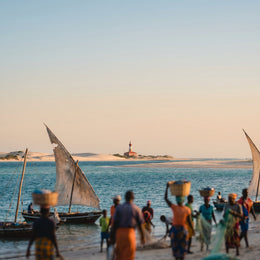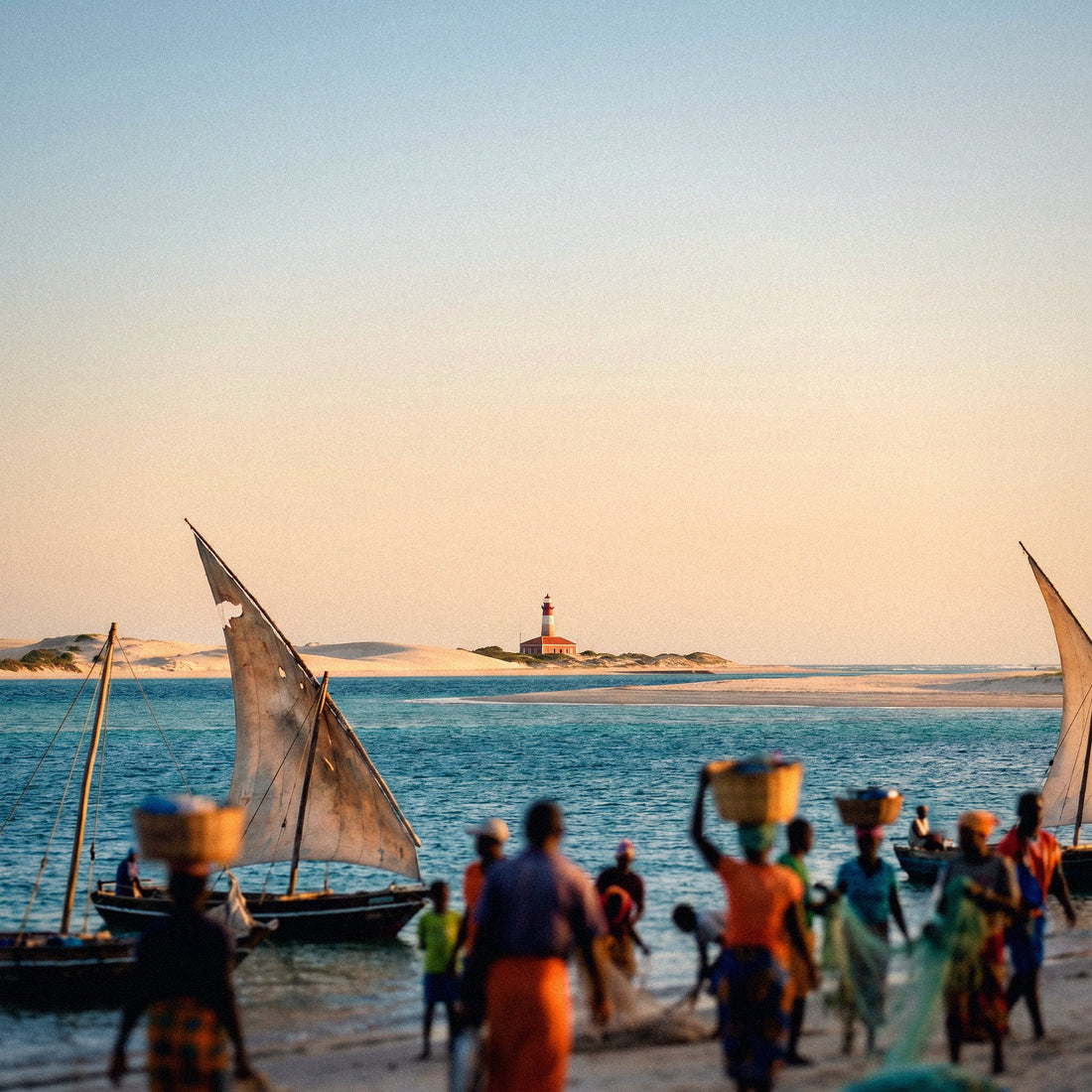

In short: the Mozambique eSIM provides you with mobile data as soon as you land in Maputo, without queues to register a physical SIM with your passport or the fear of roaming charges. It's installed before you fly, activated upon arrival, and connects you to the best available network between city, coast, and safari. In remote inland areas, coverage remains inconsistent, so always combine it with downloaded maps.
Mozambique is a country that takes days, not hours, to explore: white sand beaches in Tofo and Vilanculos, the Bazaruto Archipelago, Mozambique Island with its Portuguese historic center declared a World Heritage Site, and safaris in Gorongosa that leave you without signal for entire stretches. Traveling with an active Mozambique eSIM solves a very specific problem: arriving at Maputo airport, activating data, and having Google Maps, WhatsApp, and the lodge's email working even before you collect your luggage.
What it is and why it's useful in Mozambique
An eSIM is a digital SIM card that lives inside the mobile phone itself: there's no plastic to insert or tray to open with a clip. You buy the plan, receive a QR code by email, scan it, and the profile is installed. That's it. The difference from buying a physical SIM in Mozambique is that in this African country, like in most of the southern continent, registering a local card requires presenting your passport at an operator's store, filling out a form, and sometimes waiting for it to activate. With an eSIM, you skip that entire process even before boarding the plane.
The other reason, more practical than it seems: Mozambique is huge and spread out. The distance between Maputo, in the far south, and Pemba, in the north, is over 2,000 kilometers in a straight line, so many itineraries combine internal flights with road trips where your mobile is your only way to confirm a transfer, report a delay, or find the correct turn-off to a lodge that isn't well signposted.

Operators and coverage by region
Mozambique has three main operators: Vodacom, Movitel, and Tmcel. Vodacom and Movitel compete for the country's widest network, with reasonably solid 4G in Maputo, Beira, Nampula, and Pemba, and decent coverage in coastal tourist enclaves like Tofo, Vilanculos, and Inhambane. A travel eSIM automatically connects to the local network with the best signal in each area, without you having to manually select an operator or worry about which one has better coverage where you are.
Where the signal fails, as in almost all of Southern Africa, is in the rural interior and within large nature reserves. If you go on safari to Gorongosa National Park, assume there will be stretches of hours without coverage between the camp and the sighting areas: it's protected and dispersed terrain, not a fault of your operator. The same applies to secondary roads in the north, where the asphalt ends and cell towers are scarce.
| Region | Typical Coverage | What to Expect |
|---|---|---|
| Maputo and Matola | Good and stable 4G | Sufficient for video calls and occasional remote work |
| South Coast (Tofo, Vilanculos, Inhambane) | 4G in urban centers, weaker on remote beaches | Good for booking diving and sharing photos; upload heavy videos with WiFi |
| Beira, Nampula, Pemba | Reasonable 4G in the center | Good base if combining city and north coast |
| Bazaruto Archipelago | Acceptable at lodges, weak on smaller islands | Download routes and reservations before boarding the dhow |
| Inland and Reserves (Gorongosa and similar) | Irregular or non-existent | Offline map is mandatory, not optional |
How many GB you need according to your itinerary
Actual consumption varies greatly depending on the type of trip, so it doesn't make sense to buy "the big plan" just in case without thinking it through. A photo safari uses little data during the day — the camera doesn't use data — and only relies on a connection at night when you upload photos from the lodge. A diving trip in Tofo with 4K reef videos, on the other hand, can consume gigabytes without you even realizing it.
- Beach getaway, one week: 3-5 GB is usually enough for maps, messaging, and social media without stress.
- Combined coast + safari trip, two weeks: Estimate between 5 and 8 GB if you alternate between city, beach, and a park.
- Remote work or frequent video calls: Better to go for 15 GB or more, and keep in mind that lodge WiFi is often slow and unstable, so the eSIM will end up being your primary connection more often than you imagine.
A nuance that almost no one considers: offline maps, even if you downloaded them via WiFi before leaving, still use data to update your real-time position and traffic. It's not much, but on a multi-week trip, it adds up. And if you're traveling in a group sharing a single mobile hotspot, multiply the estimated consumption by the number of people connecting, because running out of data halfway to Vilanculos is not ideal.
To avoid going in blind, here are specific tips to save data while traveling that work just as well in Mozambique as in any other destination with inconsistent coverage.

eSIM vs. Physical SIM and Roaming
You have three options for data in Mozambique: activate your Spanish operator's data roaming, buy a physical SIM upon arrival, or install an eSIM before flying. Roaming in East Africa is among the most expensive with typical European rates: the cost per megabyte skyrockets outside the European Union, and on a two-week trip, this can turn into a significant bill if not closely monitored. If you want a detailed comparison, we have a complete analysis of eSIM versus roaming.
A local physical SIM is cheaper in the long run, but it requires arriving, finding an operator's store, waiting in line, showing your passport, and waiting for activation, all while tired from the flight. If your trip lasts weeks or you're staying for a long period, that local SIM might be worth it. If you're just passing through, the eSIM wins on convenience: you set it up from your couch at home. And if you've never used one, it's worth understanding first what an virtual eSIM is exactly and how it differs from a traditional SIM.
How to activate it step by step
The process is short and is done entirely before leaving home:
- Check that your mobile supports eSIM (iPhone XS onwards and most Android phones from recent years).
- Purchase the Mozambique eSIM plan and receive the QR code instantly via email.
- Scan it from your phone's settings with WiFi connected, and do not delete the profile even if it takes time to activate.
- Upon landing in Maputo, or at the airport corresponding to your route, activate the eSIM data and start browsing.
If this is your first time installing one, follow this guide on how to install an eSIM step by step. Having everything configured before boarding is what makes the difference: this way you don't depend on finding WiFi in the arrivals terminal or your flight landing late at three in the morning.
When NOT to buy an eSIM
Let's be honest, because sometimes you don't need to buy data. If your layover in Maputo is only a few hours and you won't leave the airport, the free terminal WiFi is usually sufficient for essentials; don't spend on a plan you won't use. If you're going to live in the country for several months for work or studies, a local physical SIM with a monthly plan will be more cost-effective than buying successive travel plans: the eSIM is designed for stays of days or a few weeks, not for residency.
And if your itinerary in Mozambique is linked with other Indian Ocean countries, consider the entire trip before buying individual plans: you might want to also review coverage in nearby destinations like Comoros to avoid duplicating purchases if your itinerary hops from island to island.
Myths and what almost no one tells you
There are preconceived notions about staying connected in Mozambique that should be dispelled before you leave:
- "If I have an eSIM, I don't need an offline map." False. In Gorongosa, on inland roads, or even on some remote beaches near Vilanculos, the signal disappears without warning. The downloaded map is your safety net, the eSIM is your usual connection.
- "Hotel or lodge WiFi is always better than mobile data." In Mozambique, it's usually the opposite: many accommodations, especially the more isolated and charming ones, rely on a slow satellite link shared among all guests. An eSIM with good local coverage is usually faster than the lodge WiFi for uploading a photo or making a short video call.
- "The more coverage the operator announces, the better it will be in practice." Published coverage is national, but within the same region there are dead zones due to terrain or dense vegetation. On Mozambique Island, for example, the historic center with narrow stone streets may have worse signal than the new part of the city, so don't rely solely on the generic coverage map.
- "It doesn't matter if you install the eSIM upon arrival or before leaving." Technically, you can do it at the airport, but you need stable WiFi to download the profile, and small terminals in inland Africa don't always guarantee it. Install it at home, calmly, and activate it only upon landing.
- "Data I don't use in Mozambique is saved for the next country." It depends on the specific plan you buy, so always check the validity and geographical scope before assuming that any leftover GB automatically travels with you to South Africa or Tanzania.
A security note often overlooked: if you're going to connect to open WiFi networks in Maputo cafes or common areas of a hostel, using a VPN along with your eSIM adds an extra layer of privacy for banking or work, something especially recommended on shared networks you don't control.
Another detail that makes a difference and almost no one mentions: Mozambique has a rainy season between November and March, and during these months some sections of roads in the center and north of the country are cut off or become seriously complicated, especially towards rural areas. Having active data allows you to follow local weather forecasts, notify your diving or safari operator in advance if there are changes to your plan, and consult alternative routes on the fly instead of relying on what someone on the road tells you. If your trip falls within these dates, still download an offline map of your base area: even if you lose signal in a specific section, the GPS will still guide you without data.
Frequently Asked Questions
Do I have internet as soon as I land in Maputo?
Yes, as long as you've installed the eSIM before flying. Upon landing, you just need to activate the eSIM data from your phone's settings and within seconds you'll connect to the local network, without looking for WiFi in the terminal or making any on-the-spot purchases.
Does the eSIM work on the islands of the Bazaruto Archipelago?
In the tourist areas and lodges of Bazaruto and Vilanculos, 4G coverage is usually reasonable. On smaller or more remote islands, the signal can weaken considerably, so download maps and confirm your reservations before boarding the dhow.
Can I share the eSIM connection with another device?
Yes. You can activate your mobile hotspot and share data with a tablet or laptop, which is useful if you need to work for a while from the beach or the lodge without relying on the accommodation's WiFi.
Do I need a different eSIM for each country if my itinerary includes several destinations?
You can use a specific eSIM for Mozambique or consider a plan that covers several countries if your itinerary jumps from one to another in a short time. Always check which exact countries each plan covers before buying, as not all include the same list.
Does the eSIM consume a lot of battery in areas with poor coverage?
In areas with a weak signal, the mobile works harder searching for a network, and that does consume a bit more battery than usual. A simple trick is to activate airplane mode in sections where you know there will be no coverage, such as inside Gorongosa, and reactivate data when you return to an area with antennas.
Is an eSIM or an international physical chip better for Mozambique?
It depends on your mobile and how much you value convenience. If your device supports eSIM, you avoid queues and passport procedures; if you prefer a physical chip or your mobile isn't compatible, here's the comparison between an international chip and an eSIM to help you decide wisely.
What happens if my flight arrives at dawn and there's no one at the operator's counter?
With an eSIM, that's no longer a problem: you don't depend on any counter or store hours. The profile is already installed before you leave home, so you just need to activate the data the moment the plane lands, no matter the time.
Conclusion
From the stone streets of Mozambique Island to the Gorongosa safaris, passing through diving in Tofo and the dhow boats of Bazaruto, this is a country that is much more enjoyable when you don't have to rely on finding WiFi to know where to go. A Mozambique eSIM gives you data from the moment you land in Maputo, frees you from expensive East African roaming, and lets you control every gigabyte you spend. Install it before you fly, adjust the GB to whether your route is more coastal or inland, and always keep an offline map for sections without coverage: that combination is what really works on the ground.