In short: an eSIM Nicaragua gives you local internet as soon as you land, without roaming or having to look for a physical SIM at the airport. For a typical trip through Managua, Granada, León, and San Juan del Sur, 4-6 GB for a week is usually enough; if you're going to work remotely or make video calls daily, upgrade your plan.
Nicaragua is not a destination with Wi-Fi on every corner. Outside of hotels and some cafes in Granada or San Juan del Sur, connection relies almost entirely on the mobile network, so arriving without data means arriving blind: no map to leave Managua airport, no way to confirm hostel reservations, no way to notify whoever is waiting for you. That's why more and more travelers solve this before boarding the plane with an eSIM, instead of risking it with airport Wi-Fi or looking for a physical SIM card store upon landing.
In this guide, we review the real coverage you can expect in Managua, Granada, León, and the Pacific beaches like San Juan del Sur, how many GB a normal one- or two-week trip needs, how to activate the eSIM simply, and what mistakes people unknowingly make. With PuraSim, you land with internet, without roaming, and without surprises on your bill when you return home.
Why an eSIM is convenient for traveling to Nicaragua
Roaming from your home operator in Nicaragua is usually expensive and, above all, unpredictable: daily rates, low data limits, or reduced speed without warning. There's no need to memorize exact figures because they change according to the operator and each person's contract; what you can take for granted is that the cost skyrockets as soon as you leave the European Union or your usual coverage area. Before traveling, it's best to check with your operator what exact rate would apply in Nicaragua, because in many cases, it's not even included in standard roaming packages.
The eSIM completely changes the approach:
- Home operator roaming: depends on your contract, often without clear notice of how much you'll pay, and often with reduced speed compared to the local network.
- PuraSim eSIM for Nicaragua: you buy the data plan before you leave, you know exactly what you've contracted, and you connect to the local network as soon as you land, without depending on hotel Wi-Fi.
One advantage that many people aren't clear about: the eSIM goes into an independent virtual slot from your physical SIM, so you can keep your usual number active for calls and SMS while using the eSIM only for data. You don't have to choose between being reachable and having internet.
For a country like Nicaragua, where public Wi-Fi is scarce outside tourist areas, having your own data stops being a convenience and becomes what allows you to move freely: ordering a taxi, finding the restaurant you were looking for in Granada, or solving an unforeseen event without depending on the accommodation having a good signal.
Data coverage in Nicaragua: what to expect by area
Coverage in Nicaragua is not uniform, and it's worth knowing before planning your route. Generally, the further you get from the Managua-Granada-León corridor, the more the signal depends on the topography and how isolated the town or beach in question is.
Managua
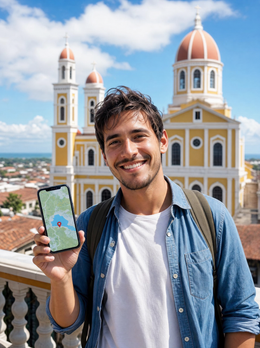
As the capital and main communication hub of the country, Managua has the most consistent coverage: 4G in most of the city, sufficient for navigation, social media, and video calls without constant interruptions. It's also where you land, so it's the first place you'll notice the difference between arriving with an activated eSIM and having to look for Wi-Fi at the airport.
Granada and León
These two colonial cities, the most visited after the capital, have good 4G coverage in the historic center and most neighborhoods. This is where you'll spend the most time walking among churches, markets, and viewpoints, so stable data is especially helpful for getting around without getting lost in the cobblestone streets.
San Juan del Sur and the Pacific
On the Pacific beaches, such as San Juan del Sur, the signal is acceptable in the town and on nearby beaches, although not always at the level of large cities. The further you go into less crowded beaches or remote surf areas, the more likely it is that coverage will drop to 3G or become intermittent.
Rural areas, volcanoes, and the Caribbean islands
In the rural interior, on hiking trails by volcanoes like Concepción or Maderas (Ometepe Island) and, especially, in the Nicaraguan Caribbean (Corn Islands, Bluefields), coverage can be limited or nonexistent in specific sections. This is not an eSIM failure: it is the reality of the local infrastructure, and it affects any operator, local or foreign, equally.
- Major cities (Managua, Granada, León): Stable 4G, sufficient for light streaming, browsing, and video calls.
- Pacific Coast and tourist towns: Acceptable signal in the urban core, more erratic as you move away.
- Rural areas, volcanoes, and Caribbean islands: Limited or intermittent coverage; expect sections without signal.
PuraSim relies on local roaming agreements with the networks that have the most available infrastructure in Nicaragua, so the eSIM automatically searches for the best available signal in each area. This cannot make coverage appear where there is none, but it can make the most of what exists.

How many GB do you need to travel to Nicaragua?
This is the question we get asked most often before a trip to Nicaragua, and the short answer is: for a week with normal usage, 4-6 GB is usually sufficient. The long answer depends on what you do with your phone every day.
| Type of usage | What it includes | Approximate daily consumption |
|---|---|---|
| Basic | Occasional maps, messaging, quick lookups | 300-500 MB/day |
| Moderate | Social media, photos, almost continuous GPS navigation | 800 MB-1.5 GB/day |
| Intensive | Remote work, video calls, streaming | 2-4 GB/day |
With this reference, for a week in Nicaragua with moderate use (which is the most common profile: Google Maps active almost all day, WhatsApp, Instagram, and some itinerary inquiries), a 4-6 GB plan covers the trip without issues. If you know you'll be working remotely or making daily video calls, upgrade directly to the next plan: it's cheaper to prevent than to run out of data halfway through the trip.
And if you still run short, it's okay: PuraSim plans allow you to top up data directly from the app whenever you need it, so you don't suddenly lose coverage or have to buy a new eSIM from scratch. You can see the current data and duration options available in the eSIM plans for Nicaragua.
How to activate your eSIM for Nicaragua step-by-step
Activating a PuraSim eSIM does not require going to any store or waiting for a mail delivery. The entire process is done from your mobile phone and takes a few minutes:
- Purchase your plan for Nicaragua on purasim.com. You will receive an email with the activation QR code.
- Install the eSIM: on iPhone, go to Settings → Cellular → Add Data Plan; on Android, Settings → Connections → SIM Manager (the exact menu varies slightly by manufacturer).
- Scan the QR code you received, or enter the activation data manually if your device requests it.
- Select the PuraSim eSIM as the default data line, so your phone doesn't try to use your usual SIM for browsing.
- Activate data roaming specifically for the PuraSim eSIM line; without this step, even if installed, it will not connect to the local network.
You can install the eSIM days before your trip and have it ready to activate as soon as it detects a network in Nicaragua, or activate it manually on the day you land. The important thing is not to leave it until the last minute at the airport, when public Wi-Fi is usually slow and there are queues everywhere.
Before purchasing, check that your phone is compatible with eSIM. As a general reference: most iPhones from XS, Samsung Galaxy from S20, and Google Pixel from 3 are compatible, but it's advisable to confirm on your own device from Settings → General → About, where the "eSIM" or "Add eSIM" option should appear if it is compatible.

eSIM vs. physical SIM vs. roaming: what's best for you in Nicaragua
When you arrive in Managua, you basically have three options for data. Here's a comparison of what really matters for a trip:
| Option | When it's ready | Keeps your number | Risk of running out of data upon arrival |
|---|---|---|---|
| PuraSim eSIM | Before leaving home | Yes, in parallel | Low: you activate it wherever you want before the trip |
| Local physical SIM | Only upon arrival, searching for a store | No, it replaces it | High: depends on store hours and airport queues |
| Home operator roaming | Immediate, but without cost control | Yes | Low, but with risk of a high bill |
If you also have a layover or are continuing your trip after Nicaragua, this also applies: you can prepare another eSIM in advance for your next destination, for example, if you continue your route to the United States or have a layover in Spain before returning, without having to manage physical SIMs at each airport.
Common mistakes (and what almost no one tells you)
There are a few recurring mistakes in this destination that are easy to avoid if you know about them beforehand:
- Buying an eSIM at Managua airport using public Wi-Fi. It's slow, sometimes unstable, and not the best time to download a QR code calmly. Buy it and install it days in advance from home.
- Not activating eSIM data roaming. This is the step most people forget: the eSIM is installed but, if roaming for that specific line is not activated, it won't browse. Check it just before landing.
- Assuming that "all of Nicaragua has the same coverage." It's not true. What works perfectly in Granada might fail in Ometepe or a secluded Pacific beach. Download offline maps for less urban areas as a backup plan.
- Leaving shared hotspot activated all day. If you're with other people and share data among several devices, consumption skyrockets much faster than it seems. Activate it only when you really need it.
- Not checking phone compatibility before buying. Confirming that your model supports eSIM takes thirty seconds on the phone itself and avoids the disappointment of finding out too late.
- Relying on accommodation Wi-Fi for everything. In tourist areas, it usually works well, but it's common for it to become saturated in the evenings with several guests connected at once. Having your own data frees you from that dependence.
Local connectivity tips for Nicaragua
Beyond choosing the right plan, there are tricks that make a difference during your trip:
- Download offline maps of Nicaragua (or at least Managua, Granada, León, and the Pacific area) before you leave. Google Maps and Maps.me allow it and will save you in any section with a weak signal.
- Use airplane mode on long road trips when you don't need data at that moment; it saves battery, which is appreciated in a country with constant heat.
- Prioritize WhatsApp and similar apps for calls instead of traditional calls: they consume much less data and help you avoid international call charges if you still have a voice line active.
- Share connection wisely. A hotspot is convenient for a group, but it depletes the data plan faster than it seems.
- Carry a power bank. With GPS and data active all day, the battery drains faster, especially when exploring Granada or León on foot.
With these habits and a well-sized data plan, you can enjoy your trip without worrying about whether you'll have a signal for the next step of your journey.
Frequently asked questions
When should I activate the eSIM for Nicaragua?
You can install it on your phone before leaving home. Most PuraSim eSIMs for Nicaragua can be set up days in advance and automatically activate upon arrival at your destination, or manually when you decide to start using it.
Is my phone compatible with the eSIM for Nicaragua?
Most smartphones manufactured from 2018-2019 onwards are compatible: iPhone XS and later, Samsung Galaxy S20 and later, Google Pixel 3 and later, among others. Check in Settings → General → About; if your device lists the "eSIM" option, you're all set.
Can I keep my usual phone number while using the eSIM in Nicaragua?
Yes. The eSIM occupies a virtual slot independent of your physical SIM, so you can keep your usual line active for calls and SMS while the PuraSim eSIM manages mobile data in Nicaragua.
What happens if I run out of data in Nicaragua?
You won't suddenly lose coverage. You can purchase a data top-up directly from the PuraSim app or client panel; it applies within minutes and you don't need to change your plan or install a new eSIM.
Is there good coverage in San Juan del Sur and the Pacific beaches?
Yes, the signal is acceptable in the town and on the nearest beaches. In less crowded beaches or more remote surf areas, coverage may be more sporadic, so it's a good idea to download an offline map of the area just in case.
Does the eSIM work in rural areas, volcanoes, or the Nicaraguan Caribbean islands?
The eSIM uses the same network infrastructure as any local line, so in remote areas such as the rural interior, volcano routes, or the Caribbean (Corn Islands, Bluefields), coverage may be limited or non-existent in some sections, just like with any operator. Downloading offline maps before these excursions is the best way to not rely on the signal.
Is an eSIM better than buying a physical SIM when arriving in Managua?
For most travelers, yes: the eSIM is purchased and installed before leaving home, without having to find an open store or queue at the airport, and without losing your usual number. A physical SIM might make sense if you're staying for a long time and prefer a full local line, but for a one- or two-week trip, the eSIM is faster and more convenient.
Activate your eSIM before you leave and arrive connected from the very first moment, without roaming and without bill shock.
See eSIM plans for Nicaragua →To better understand how all this works, we have guides on eSIM vs. traditional roaming, on what data roaming is, and a step-by-step guide on how to install an eSIM. If you continue your route through Latin America, also check out the eSIM guide for Colombia.