What is an eSIM and what is a VPN? (and why they are so often confused)
An eSIM is a virtual chip that provides your cell phone with mobile data signal in the country you are in, just like a physical SIM would. A VPN is an application that encrypts your internet connection and can simulate that you are browsing from another country. They solve different problems: one connects you, the other protects you.
If you arrived at this article looking for "esim nordvpn," you are most likely mixing two legitimate searches into a single phrase. On the one hand, NordVPN is a name that most people associate with internet security and privacy. On the other hand, "eSIM" is the word that began to appear in traveler forums as an alternative to roaming. It is normal to wonder if they are the same thing, if one includes the other, or if you need to contract both separately.
The short answer is that they are not interchangeable. A VPN needs you to already have an internet connection to function: it encrypts the traffic that passes through that connection and can change your apparent location. An eSIM is what creates that connection from scratch, connecting you to a local or international cellular network so that you have data even if there is no Wi-Fi nearby. If you want to understand the complete technical functioning, we have a more in-depth explanation in what an eSIM is.
What is NordVPN's eSIM?
NordVPN, in its main product, is a VPN application: it changes your IP address and encrypts your existing connection, but it is not itself a SIM card or an eSIM profile that provides a cellular signal to your phone. If your cell phone does not have active data, opening NordVPN will not solve it, because the VPN needs a network to travel through.
VPN brands frequently change their catalogs, and some have launched sister connectivity products under names other than the main app. As these catalogs are updated frequently and this article cannot give you a number or feature that we cannot verify with a date, the most honest thing is for you to check directly on the app or NordVPN's official website what they offer today under their brand, instead of relying on a search result that may be outdated.
What we can explain to you with certainty, because it is the technical part that does not change, is how a data eSIM works regardless of what brand sells it, and how it relates (or not) to any VPN you already use. That is what the rest of this article covers.
Does NordVPN offer eSIM?
This is not information we can confirm with an exact date in this article, because the catalog of any VPN app can change from one month to the next and we do not sell or distribute NordVPN products. If that is your specific question, the correct source is the NordVPN app itself or its official website, not a third-party article.
What is constant, and what we need to explain to you well, is the structural difference between both types of products. A data eSIM—like the ones we offer for more than 200 destinations—you use to get a cell signal when you arrive in a new country: to call a taxi, open the map, receive a verification code by SMS. You use a VPN to browse with more privacy over the connection you already have, whether that connection is an eSIM, a physical SIM, or the hotel's Wi-Fi. Neither replaces the other because they do not solve the same problem.
Which eSIM includes a VPN?
The vast majority of data eSIMs, including ours, do not come with an integrated VPN: they give you megabytes or gigabytes to browse, and that's where their function ends. If you want to encrypt your traffic or change your virtual location, you install the VPN app you prefer on top of that connection, just as you would install it over your home's Wi-Fi.
This is not a problem; it's precisely how the two technologies are designed: in independent layers. The eSIM works at the cellular network level, the VPN works at the software level over any active network you have. You can use an eSIM without a VPN, a VPN without an eSIM (over Wi-Fi, for example), or both at the same time without them interfering with each other.
| What you need when traveling | VPN solves it | Data eSIM solves it |
|---|---|---|
| To have a signal to call a taxi when getting off the plane | No | Yes |
| To receive a bank verification SMS | No | Yes |
| To browse with another country's IP over hotel Wi-Fi | Yes | No |
| To encrypt traffic when using a public network | Yes | No (but your own cellular network is already more closed than open Wi-Fi) |
| To access your company's corporate VPN from abroad | Depends on the VPN your company uses | Provides the connection over which that VPN runs |
How much does NordVPN cost in Mexico?
We will not give you a figure that we cannot support with a verifiable source and date: prices of products we do not sell change due to promotions, subscription type, and country, and publishing an outdated number would be worse than not publishing it. The correct thing is for you to open the NordVPN app or official website and see the current price there.
What we can help you do well is the comparison. It is easy to fall into comparing the monthly price of a VPN with the price of a data eSIM for a one-week trip, as if they were competing for the same budget. They do not compete: one is a software subscription that you probably pay for all year whether you travel or not; the other is a one-time expense, only for the days you are outside your country, and only if you need data that your local plan does not cover.
A VPN protects what already travels through your internet connection. An eSIM is what creates that connection from scratch, via a cellular network, in the country where you are located.
A real trip where you need data and privacy
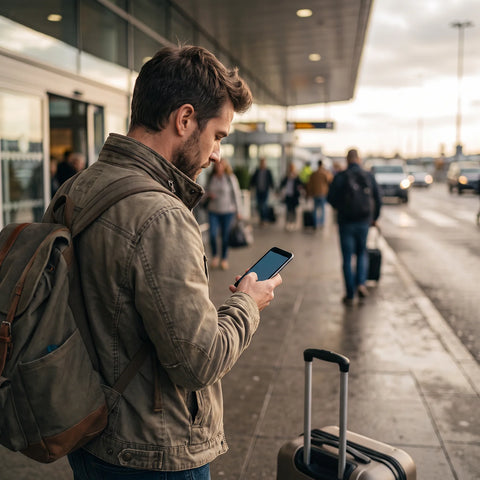
Imagine you're traveling from Bogotá to Mexico City for work, for three days. You land at nine at night, with no Wi-Fi available outside the plane, and you need to order a car to get to the hotel. That's where the eSIM comes in: if you installed it before leaving home (the profile downloads with Wi-Fi, no data needed), you just activate it upon landing and in seconds you have a signal to open the transportation app, see the map, and receive the driver's confirmation message.
Once at the hotel, you connect to your email to check some work files, and your company requires you to log in via a corporate VPN. That's where the second layer comes in: you open your office's VPN app over the same data connection you already have active through the eSIM, and you browse encrypted to the company's server. Neither tool replaced the other: the eSIM gave you the street, the VPN gave you the private hallway within that street.
If instead of buying an eSIM you had left your operator's roaming activated without checking the cost, it is likely that those three days of maps, messages, and files would have cost much more than a data plan purchased in advance. You can see that complete comparison in eSIM vs. roaming.
How to activate a data eSIM for your next trip
The process is shorter than it seems the first time. In order:
- Confirm your phone is compatible. Not all models support eSIM, especially if they are low-end or unlocked from certain regions. Check the list of eSIM-compatible phones before buying any plan.
- Purchase the plan before traveling. You have 180 days from purchase to activate it, so you can plan ahead without worrying about the flight date.
- Install the profile with Wi-Fi, at home. The QR code or installation link downloads with any connection, no need to wait until you are at the airport. The step-by-step instructions are in how to install an eSIM.
- Activate it when you land, or when you enter the destination country, depending on how your plan is configured.
- If you are going to use a VPN, open it after confirming that you already have a data signal, not before.
Common errors when combining eSIM and VPN
The most frequent error is not technical, it's about order. Many people install the eSIM, and before confirming that there is already a signal, they immediately open the VPN app because they want to "be protected from the first second." The problem is that the VPN needs data to connect to its own server, and if the phone is still finishing registering on the cellular network—which can take a few seconds after activating the profile—the VPN app will show a connection error. This error is from the VPN, not the eSIM, but because it appears right after activating the data plan, many people assume the eSIM failed and cancel it unnecessarily. If this happens to you, close the VPN, wait to see the active mobile data icon on the screen, and only then open it again.
Another common mistake is to leave two data eSIMs from different countries active at the same time, which confuses the phone about which one to use for browsing and can lead to you spending the wrong plan. And a third: using a dubious free VPN over a travel eSIM, which is exactly the opposite of what you're trying to achieve by traveling more carefully. Check out more similar cases in common eSIM problems.
Data eSIM vs VPN vs physical SIM
Placed side by side, the differences are clearer than in the abstract:
| Data eSIM | VPN | Physical SIM | |
|---|---|---|---|
| What it is | Virtual chip that connects to a cellular network | Software that encrypts your internet traffic | Physical chip that connects to a cellular network |
| Requires new hardware | No, if your phone supports it | No | Yes, the physical card |
| Provides data signal on its own | Yes | No, depends on another connection | Yes |
| Encrypts your browsing | Not on its own | Yes | Not on its own |
| Activated before traveling | Yes, with Wi-Fi | Yes, it's an app | No, must be purchased at destination |
If you want to delve deeper into the difference between eSIM and physical SIM, the complete comparison is in eSIM vs. physical SIM.
Frequently asked questions
What is NordVPN's eSIM?
NordVPN, in its main product, is a VPN application: it encrypts your connection and changes your apparent location, but it is not a SIM card or an eSIM profile that provides a cellular signal to your phone. To find out about its current product catalog, the correct source is its app or official website.
Does NordVPN offer eSIM?
We cannot confirm this with an exact date here, as we do not sell or distribute NordVPN products and their catalog may change. Please check directly on their app or official website.
Which eSIM has a VPN?
Most data eSIMs, including ours, do not come with an integrated VPN: they provide mobile data and nothing else. If you want to encrypt your traffic, you install the VPN app you prefer on top of that data connection.
How much does NordVPN cost in Mexico?
We do not publish prices for third-party products without a verifiable source and date, so we will not give you a figure that could be outdated. Check the current price directly on the NordVPN app or official website.
Do I need a VPN if I already have a data eSIM?
It's not mandatory. The eSIM provides the connection; the VPN is an additional layer of privacy that you can add if you're interested, for example, if you also usually connect to public Wi-Fi networks during the same trip.
Can I use two eSIMs at once on my phone?
Most modern phones allow you to save multiple eSIM profiles, but only one or two active for mobile data at the same time, depending on the model. To avoid confusion and spending data from the wrong plan, the simplest thing is to leave active only the profile for the country you are in.
Does the eSIM work without Wi-Fi?
Yes, once installed and activated, the eSIM provides mobile data on its own, without needing Wi-Fi. Wi-Fi is only necessary before the trip to download the profile.
What happens if my VPN doesn't connect as soon as I activate the eSIM?
This is a common error of order, not of the eSIM. Wait to see the active mobile data icon on the screen before opening the VPN app; if you open it while the phone is still registering on the cellular network, it will show a connection error that has nothing to do with the data plan.
Conclusion
If you arrived looking for "esim nordvpn," the concrete recommendation is to separate the two decisions. For your browsing privacy, check directly in the NordVPN app or on its official website which VPN product suits you and at what price, because that is not something we can confirm here precisely. To have a data signal as soon as you land at your next destination, that is our area: at PuraSIM we have data eSIMs for more than 200 destinations, with activation in approximately one minute and up to 180 days from purchase to activate it when you need it. If anything is unclear during the process, support is available 24/7 in all languages via email and WhatsApp.
The first practical step is to check which destination you have in mind and compare plans in the international eSIM collection. If it's your first time using an eSIM, it's advisable to first read the definitive guide to eSIM for travel, which covers everything from purchase to step-by-step activation.